

Article updated 28 December 2025
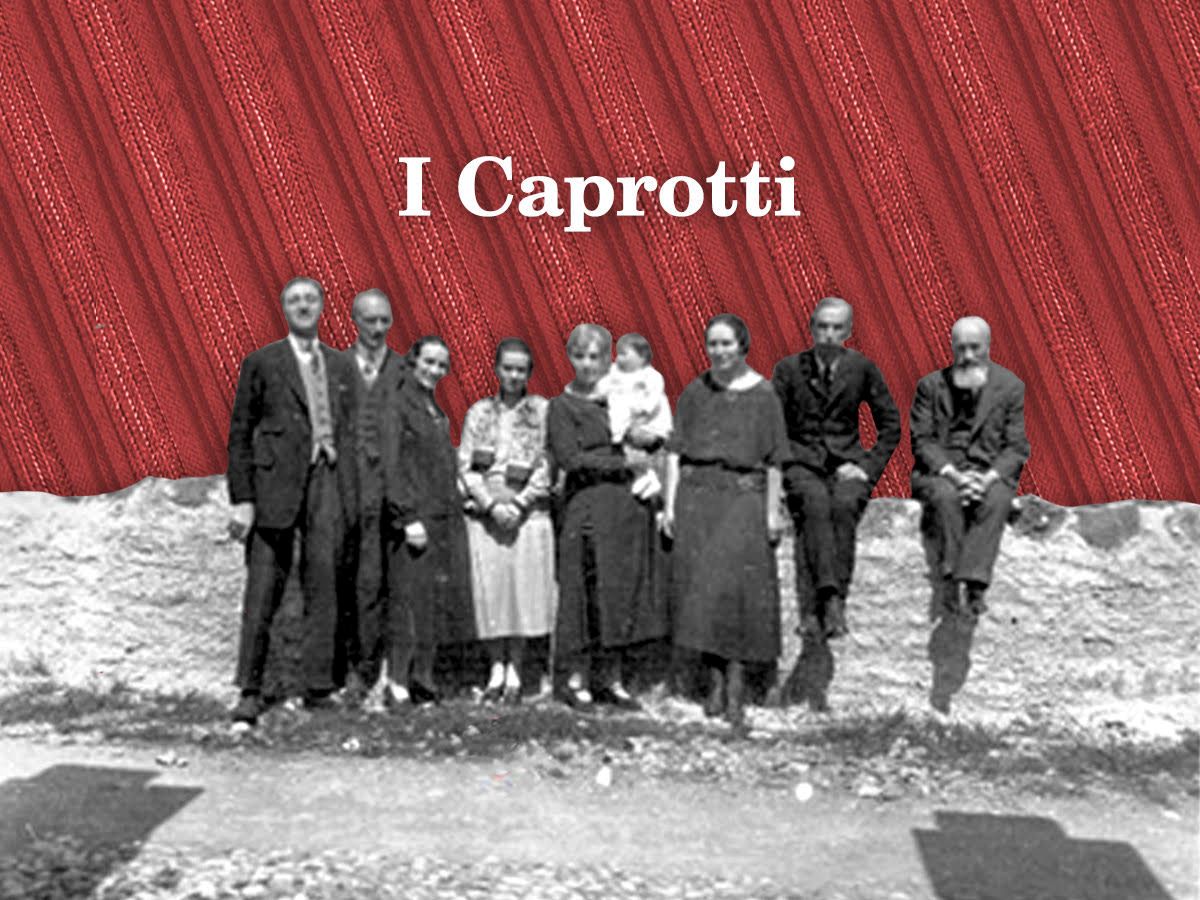
The photograph, possibly taken by my grandfather Giuseppe [Peppino] Caprotti, shows the family on the side of his mother Bettina. The second from the left is in fact her brother Guido Caprotti, the ‘jolly’ uncle Guido who had played an important role in supporting and encouraging Giuseppe [Peppino] during his studies at the textile school in Épinal (pp. 37 – 39 of Le Ossa dei Caprotti). Next to him may be Silvia, Giuseppe’s sister, his young wife, Marianne Maire [in Caprotti] , whom he had met in Épinal, his mother Bettina holding her niece Lina, an unidentified woman, and finally, seated on the little wall, his uncle Arnaldo, Bettina and Guido’s brother, and Bernardo, Bettina’s husband and Giuseppe’s father
The reorganisation of the Caprotti family archives, located in Albiate, was supervised by Dr. Eleonora Sàita and lasted three years, from 2007 to 2010.
It was also carried out thanks to the intervention of Professor Carlo Capra, Professor of History of the Age of Enlightenment at the Faculty of Literature and Philosophy at the University of Milan and member of the Società Storica Lombarda
Eleonora Sàita graduated in medieval history from the State University of Milan, where she also obtained her PhD.
A graduate of the School of Archivistics, Palaeography and Diplomatics of the State Archives in Milan, Eleonora Sàita worked for many years as an archivist in Lombardy and Liguria, reorganising various ancient, modern and contemporary archival fonds.
Foreword:
The Caprotti are recorded as inhabitants and owners of land in the Lambro area at the end of the 17th century, with Antonio del fu Giovanni Battista(1685).
Their activity in the field of textile manufacturing may have begun between the 18th and 19th centuries with Giovanni Caprotti, but it was his nephew Bernardo Caprotti who founded the company Bernardo Caprotti di Giuseppe around 1840, with which the expansion of the business really began.
History of the Caprotti family’s textile adventure
The Caprotti family lived in the Lambro area and were landowners as early as the end of the 17th century. We know this from a deed of sale of agricultural land in 1685. The purchase was made by ‘Antonio Caprotti’, son of Giovani Battista.
At the end of the 18th century, they started a textile manufacturing business and participated in the first European Industrial Revolution, thanks to Giovanni Caprotti and his son Giuseppe Caprotti.
1830
the Manifattura Caprotti was active under the direction of Giuseppe (1782?-1851), a merchant-entrepreneur, who inherited a dyeing workshop, albeit a very artisanal one, from his father, Giovanni (1737?-1809).
1840
Bernardo 1 (1804-1864), Giuseppe’s son, made a decisive change to the family business by founding the company Bernardo Caprotti di Giuseppe (a name that survived the founder until it was transformed into a joint-stock company in 1907), which had elementary machinery for the preparation of cotton yarn, and two warehouses, one in Ponte Albiate, where the main factory was located, and one in Saronno, active at least until 1855.
1845
The business, which consisted of hand and home weaving, had 608 looms, “the highest number among all the weaving mills in the part of Brianza included in the province of Milan”.

The Caprottis became textile entrepreneurs but remained landowners: the two activities were integrated.
At the end of the 19th century, 900 people in the area around Albiate drew their livelihood, totally or partially, from the cultivation of land belonging to the Caprotti family.
The textile company employed 487 labourers and factory workers. However, 73% of the wage bill was made up of pieceworkers (peasants who worked the land and also cotton yarns).
1866
Therewere 1,500 workers (p. 86 Romano, op.cit.), in Carate, Albiate, Giussano, Verano, Paina, Seveso and Cabiate.
1867- 1872
Bernardo’s sons, Giuseppe (1837-1895) and Carlo (1845-1926), undertook a large-scale mechanisation project of the company, creating a true industrial plant
1872 – 1873
In July, Giuseppe (Beppo) and Carlo (who had long since settled in Switzerland, in Zurich, where he had married Selina Hüber in September 1871), matured the decision to proceed with the separation of the paternal inheritance, which took concrete form in the liquidation of his younger brother’s interest in the company with a deed drawn up in Milan by the notary Girolamo Corridori on 21 January 1873.
At the basis of the separation were probably different views on work, but also the fact that Carlo had married a Protestant woman. Giuseppe (Beppo) did not turn up for the wedding and Carlo, with his Swiss relatives, “does not give up” (Giuseppe’s letter to Giuseppe, from Zurich, 10 September 1871). The two brothers, despite their separation, maintained cordial and respectful relations.
1873
Giuseppe continues with his policy of investment, starting the construction of a vast premises for use as a dyeing plant and continuing the purchase of mechanised looms and increasingly modern and efficient machinery.
1875
On 1 March Carlo Caprotti founded the Carlo Caprotti and Güttinger Companyin Scanzo (BG) with a partner for the mechanical manufacture of coloured cotton and mixed fabrics.
The company’s activities and the figure of Carlo who, on 20 January 1880, officially joined the Evangelical Community and in 1907 was the first president of the Bergamo Textile Industries Federation.
A detailed website of the exhibition Per filo e per segni. Innovation and creativity in the textile industry in Bergamo between the 19th and 21st centuries, held at the Bergamo Museum from 1 March to 7 September 2008, unfortunately no longer available.
There is also a Villa Caprotti in Bergamo.
1892
In May, Giuseppe, who had been suffering for some months from a serious cerebral illness that reduced him to a state of total unconsciousness from which he would not recover until his death, was interdicted by the court and was succeeded in running the company by his sons Bernardo 2 (1868-1928, who, on 15 June 1893, would marry cousin Bettina, daughter of his uncle Carlo (despite the strong disagreements between his father Giuseppe 2 and his uncle), Emilio (1871-1963) and, in a marginal position, Antonio 2 (1869-1899) and Giovanni 3 (1879-1921).
1906
Bernardo (my great-grandfather), in competition with his brother Emilio, co-participates in the establishment of the Società anonima Manifattura di Valle Camonica for the weaving of coloured cotton, with headquarters in Milan, Piazza Castello and factory in Ponte Barcotto in Valle Camonica.
The company had Vittorio Olcese as its major shareholder.
Things would go so badly that the company would be put into liquidation as early as October 1913.
1907
Things went better at Albiate and Bernardo and Emilio, despite the “profound contrast between the two Caprotti brothers” (Roberto Romano, op. cit.), in order to better support their ambitious projects, decided to set up the Cotonificio Caprotti joint-stock company, whose object was cotton spinning, dyeing, the manufacture of coloured fabrics and trade in related industries.
1907 was also the year of a strike (the Ponte Albiate ‘lockout’, Corriere della Sera, May 1907).
1912
The three main partners
1913
Objective market difficulties and disagreements
1923
After the war, the company, which had long existed only on paper, was officially liquidated and the Caprotti brothers went their separate ways.
Emilio, together with his son Alessandro, took over the Giussano factory, which he maintained through the Società Anonima Emilio Caprotti, whose purpose was cotton spinning and dyeing, fabric manufacturing and related industry and trade.
Following the difficulties of the first company, on 25 January 1930 he set up the limited partnership Emilio Caprotti e Figlio (Emilio Caprotti and Son) with the purpose of spinning and dyeing cotton, and anything else related to its manufacture and processing, destined to go bankrupt in 1933 after a long and heavy criminal case
Emilio was accused and then acquitted of fraudulent bankruptcy.
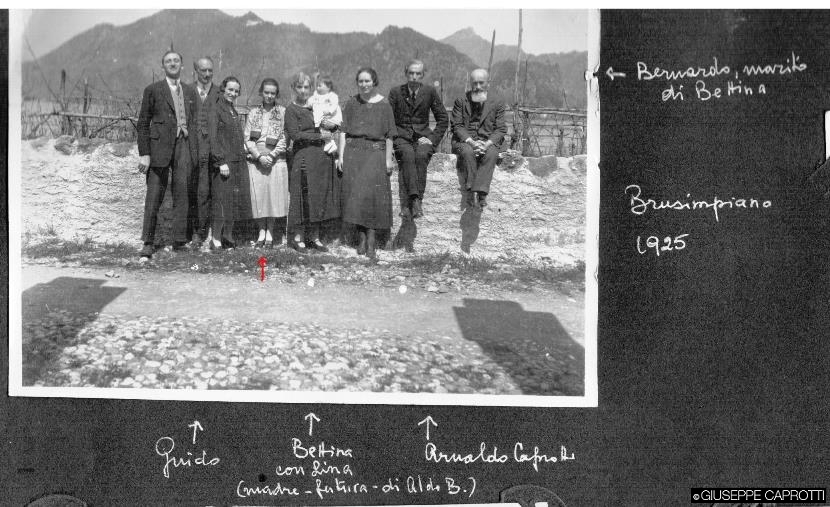
Above: the group photo, in Brusimpiano in 1925, from which the cover of this article is taken: Marianne Maire in Caprotti (my grandmother) is the one indicated with the red arrow. The photo was probably taken by Peppino Caprotti ( my grandfather, Giuseppe). On the right in the photo you can see Bernardo Caprotti (my great-grandfather, bald, with a beard).
Date unknown: Bernardo (my great-grandfather) transformed Giuseppe’s Bernardo Caprotti into Manifattura Caprotti, later passed on to his son Giuseppe (1899-1952).
The transition is not so simple: the two do not get along and my grandfather Giuseppe Caprotti, lives and works in Turin several years before returning to Albiate.
1947
My grandfather Peppino (Giuseppe), thanks to the help of his grandmother Marianne’s first cousin, Alfred Ellinger, obtains financing under the Marshall Plan that allows him to start building a new, ultra-modern textile plant that makes the Manifattura a state-of-the-art company.
1952
Giuseppe dies prematurely in the summer. Management of the company passes to his sons Bernardo, Guido and Claudio, to remain first exclusively with Guido, then with Bernardo alone.
1957
Thanks to the textile profits and grandfather Peppino’s financial investments, the Caprottis are able to participate in the foundation of Supermarkets Italiani, later Esselunga .
The three brothers, with the participation of their mother Marianne Maire in Caprotti, bought the majority of shares in Supermarkets Italiani in the early 1960s , when Nelson Rockefeller decided to retire from Italy.
1999
The Manifattura and is sold by Bernardo to the Albini brothers, owners of the cotton mill of the same name in Albino (BG), who acquire it as Manifattura di Albiate S.p.A. 1830 (the characteristic fabric of production will be denim).
2009
Due to a sharp drop in orders, the company management decides to close the Manifattura after more than 179 years of activity.
On this subject you can read Benetton: what there was to learn from the experience of Manifattura Caprotti (textile)
Eleonora Sàita and Giuseppe Caprotti
Sources and reference Bibliography:
- R. Romano, I Caprotti; l’avventura economica e umana di una dinastia industriale della Brianza, Milano,1980
- Albiate, Villa San Valerio, Caprotti historical archives, inventory (chronological extremes 1830- 1938) edited by E. Sàita, 2010
- Le Ossa dei Caprotti, Feltrinelli , Milan 2023
The Caprottis and the textiles of Manifattura Caprotti
The Caprottis: private aspects, from the Risorgimento to the Second World War
The Caprottis : the Historical Archive Inventory
The Caprotti : the archive documents.
The Caprotti family during the First World War and Fascism
The Caprottis: the three medals of my grandfather, Giuseppe Caprotti, known as Peppino
Caprotti, Quintavalle and Marelli: how and when the three families’ destinies crossed
Caprotti Brand Campaign 1957 – 1959
Crespi and Caprotti, when the two families’ destinies crossed.
The Caprotti family, innovation and tradition in an Italian factory: Albiate and Switzerland
The name ‘Esselunga’, the story of a small myth
The Esselunga brand: its beginnings and development up to 2003
More news about the family and company history can be found in the “Book” section of this site and on Instagram, Facebook, Youtube, LinkedIn and Twitter.
Below is a brief, non-exhaustive history of Manifattura Caprotti.
Thanks to Jan Miguel Battistoni who brought Prof. Capra to Albiate


