STRONGER
“The situation has changed a lot in the last four or five years,” Claudio Caprotti continued. “Because as we grow and become stronger, we are able to force suppliers not to fix their prices.”
“What’s the story with the Hanoi pineapple?”, I said, because a few weeks ago I had noticed a can of pineapple, packaged by the Vietnam National Agricultural Produce and Foodstuff Corporation, on sale for only 130 Lira. Which, thinking of the Paris peace talks, I had bought as a sign of goodwill towards the North Vietnamese government. I was very curious, however, not only about where the pineapple had been grown, but also how on earth a Hanoi-based company, split in two like shell valves, had managed to process and ship the product at such a low price.
‘The pineapple was grown in Cambodia and Laos, packed in Hanoi, taken out by a Russian ship which then transferred its cargo to a British ship, docked in Italy. The Ministry of Agriculture informed us of its presence in Italy and we negotiated an agreement whereby the Italian government exchanged Italian radios, phonographs and televisions for their pineapple cargo!’
So the healing process of trade had been able to ease not only the tensions that had arisen from the war between the governments of Hanoi, Cambodia and Laos, but also between Russia and England, and had eventually led to an American being able to buy a can of pineapple for 23 cents in Italy!
“Thank God for international trade,” I said, because I am a Quaker by birthright. “Go to hell with the war!”
“It’s true,” Claudio Caprotti said, smiling.
“And how is it now possible to buy salt in the supermarket?” I said because I was also curious to know how supermarkets had managed to break the salt monopoly, providing salt that for years could only be bought in Tabacchi, or tobacco shops.
“This was due to a decision of the Italian Ministry of Industry and Trade,” Dr Caprotti replied.
“The Secretary of Commerce?” I said.
“Yes,” he said. “We had filed a lawsuit arguing that supermarkets should be allowed to sell any food product. Six months ago the Italian Supreme Court ruled in our favour against the Secretary of Commerce. So we were not only able to get salt for ourselves, but also for our competitors.”
“Your competitors are…?” I asked.
“Personally, I find Standa relatively limited,” Dr Caprotti replied.
“I personally find Standa relatively limited both in the variety of its products and in its service,” I stated.
‘Good,’ he moved his head in assent. “Standa started out as a department store and then, seeing the progress we were making in food, decided to open its own food department.”
“Proving,” I said, “that imitation is not necessarily emulation.”
SENSE OF CURIOSITY
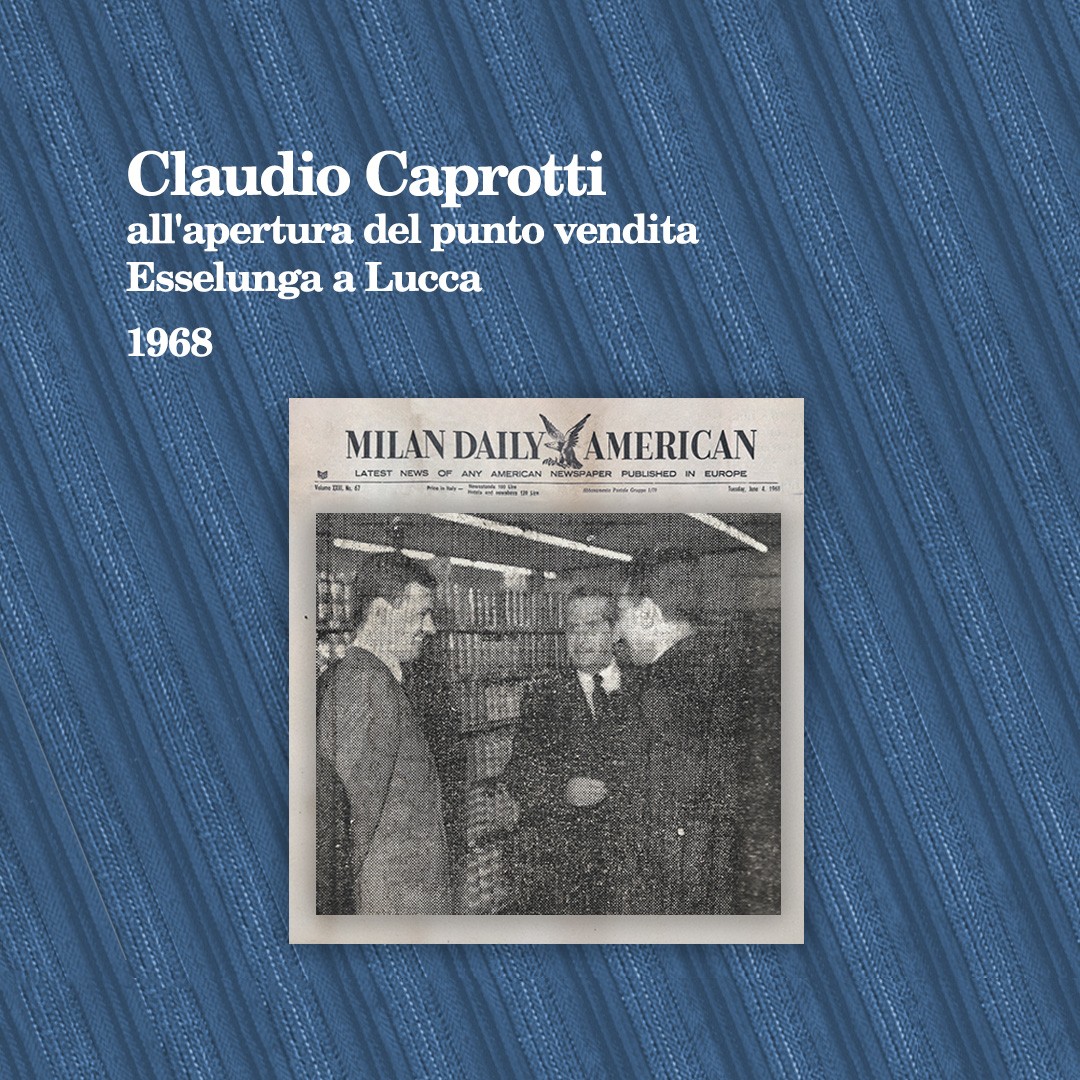
Claudio Caprotti gave his quick boyish smile, which somehow reminded me of John Kennedy.
So, if you Americans are endowed with our usual sense of curiosity, by all means take a break from seeing the Uffizi in Florence, Leonardo da Vinci’s Last Supper in Milan, the September Holy Face procession in Lucca and the Duomo in Pistoia, and pay a visit to the supermarkets in those cities. There, if you’re hungry for American food (and who isn’t, sometimes) you can buy a charcoal grill for $6.50, a bag of hamburger buns, an Italian-style coffee pot, which will bring back fragrant memories of Italy on your return to the US and be a real topic of conversation, a 300-gram bag of coffee (more than half a pound) for 51 cents, some barbecue sauce, ice cream and watermelon, and settle in for a real American picnic. DIY style!
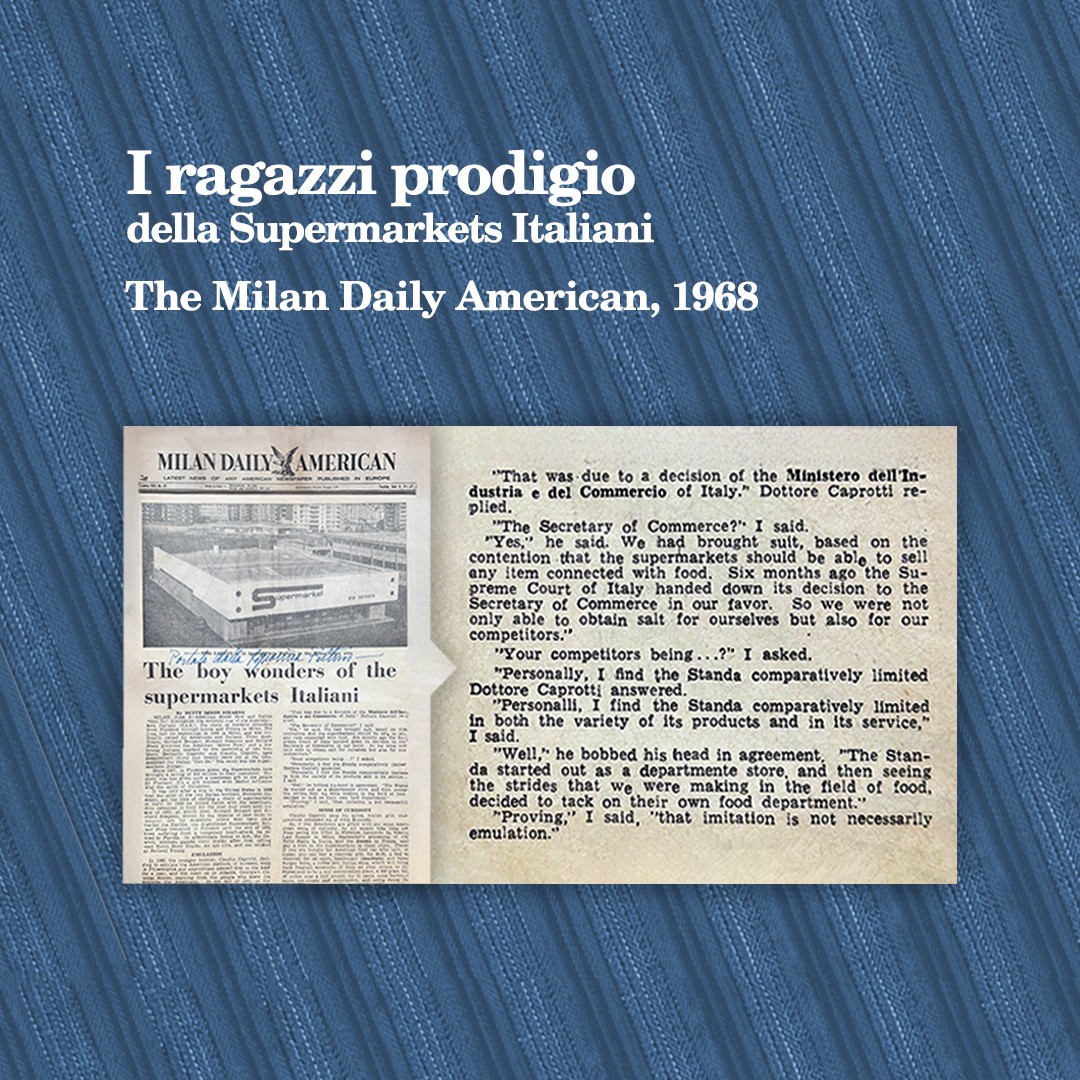
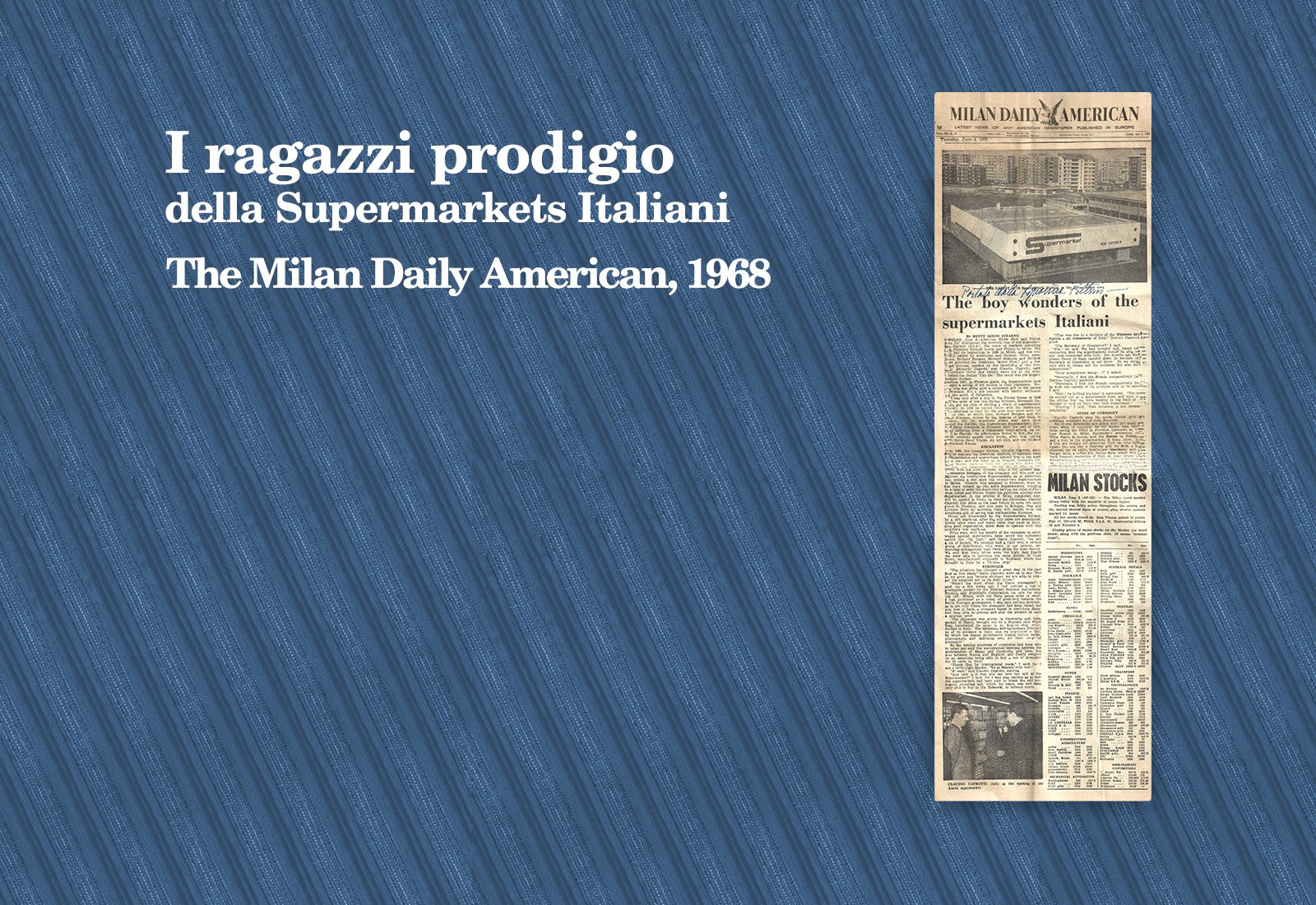
The boy wonders of the Italian supermarkets
By BETTY DIXON STEARNS, Milan Daily American, June 4, 1968
American Know How and Italian “Can Do” distinguish the meteoric rise of the Supermarkets Italiani (S.p.A.), the chain of markets extending from Florence through Lucca and Pistoia to Milan. The firm had its beginnings in 1958 in Milan, and was originally owned by Americans and Italians. Three Americans, Richard Bogaart, Richard Simpson and Rolland Hood provided the American ‘Know How’, and a few young Italians, sparked by the leadership of two brothers, Bernardo Caprotti and Claudio Caprotti, aged respectively thirty and twenty years old at the time, supplied the Italian ‘Can Do’. The result was the Supermarkets Italiani.
Since 1961, in Florence alone, the Supermarkets have brought a saving of $10 million to their customers. Nobody else has given such a consistent gift to the people of Florence. It’s a gift touched with Medici brilliance and the spirit of Columbus.
It was only after a trip to the United States in 1955 that the older of the two Italian brothers, Bernardo Caprotti, got the idea of starting a chain of supermarkets in Italy. In 1958 he joined forces with the Americans, who remained in Italy for the next four years until the end of 1961, at which time, Richard Bogaart and Richard Simpson, Driven by the impulse of new fields to conquer, left for Argentina where they have since started the DACSA, the Argentinian Supermarkets. Rolland Hood remained in Florence until the end of 1962, when suffering from a temporary heart-attack, he retired to Florida. In affectionate honour to him, the Caprotti brothers named their trucks after him, calling them Robin Hood Trucks. An apt title, and one relished by Rolland Young.
EMULATION
In 1960, the younger brother, Claudio Caprotti, deciding to emulate the American methods of business, went to Philadelphia and apprenticed himself first to the A&P for a year, and the went on to Atlanta Georgia’s Colonial Stores, learning from the people who knew the Americans’ business. In the sall of 1961, at the age of twenty-three, he returned to Milan and joined forces with his older brother, who is the present Managing Director of the company and who now supervives the twenty-one Supermarkets, as of yesterday, and within a few days the twenty-two Supermarkets in Milan. Claudio was assigned to Florence, were he has since opened up two more Supermarkets, bringing to a total of seven the stores that service the cities of Florence, Lucca and Pistoia. Under his guidance, another new Supermarket, in the process of being completed now, will be opened in Prato, in time for Christmas. Claudio Caprotti also plans in the near future to open two more stores in Florence, and also ones in Bologna, Pisa and Livorno. Soon all northern Italy will benefit from the consistent gift of saving that distinguishes Florence.
Prices wars, with the benefit of the consumer in mind, waged against distributors, have saved the customers untold lire. “In Italy,” said Carlo Caprotti, “we sell a lot of Scotch. We recently had a fight with a certain group of distributors. who were, in our opinion, demanding outrageously high fixed prices for their Scotch. We said that their proces were too high. And finally we were able to purchase the same Scotch in Cape Town, originally manufactured in Scotland, which was brought to Italy by a Chinese ship.
STRONGER
“The situation has changed a great deal in the past four or five years,” Carlo Caprotti went on to say. “For as we grow and become stronger, we are able to compel the suppliers not to fix their prices.
“What’s the story about the Hanoi pineapple?”, I said, for a few weeks ago, I had noticed a can of pineapple, packed by the Vietnam National Agricultural Produce and Foodstuff Corporation, on sale for only 130 lire. Which, with the Paris peace talks in mind, I had purchased as a token of good-will towards the North Vietnam government. I was very curious, however, as to not only where the pineapple had been raised, but also how in heck, a company based in shell-torn Hanoi had been able to process and ship the product at such a minimal price.
“The pineapple was grown in Cambodia and Laos, packed in Hanoi, brought out by a Russian ship which then transferred its cargo to an English ship, which docked in Italy. The Ministry of Agriculture informed us of its presence in Italy, and we negotiated a deal, by which the Italian government traded Italian radios, phonographs and television sets, for their cargo of pineapple!”
So the healing process of commerce had been able to relax not only the war-strained tensions beetween the governments of Hanoi and Cambodia and Laos, bit also between Russia and England and finally resulted in an American being able to buy a can of pineapple for 23 cents in Italy!”
“Thank God for international trade,” I said, for I am a birth-right Quaker.“Go to hell with war!”
“It’s true,” said Claudio Caprotti, smiling.
“And how is that you can now buy salt at the Supermarket?”, I said for I was also curious as to how the supermarkets had been able to break the salt monopoly, providing salt, which for years one had only been able to buy at the Tabacchi, or tobacco stores.
“That was due to a decision of the Ministry of Industry and Trade of Italy,” Dottore Caprotti replied.
“The Secretary of Commerce?” I said.
“Yes” he said. “We had brought suit, based on the contention that the supermarkets should be able to sell any item connected with food. Six months ago the Supreme Court of Italy handed down its decision to the Secretary of Commerce in our favour. So we were not only able to obtain salt for ourselves but also for our competitors.”
“Your competitors being…? I asked.
“Personally, I find the Standa comparatively limited,’ Dottore Caprotti answered.
“Personally, I find the Standa comparatively limited in both the variety of its products and its service,’ I said.
“Well” he bobbed his head in agreement. “The Standa started out as a department store, and then seeing the strides that we were making in the field of food, decided to tack on their own food department’.
“Proving”, I said, “that imitation is not necessarily emulation”.
SENSE OF CURIOSITY
Claudio Caprotti gave his quick boysh grin, which somehow reminded me of John Kennedy.
So, if you Americans are gifted with our usual sense of curiosity, by all means take time off from seeing the Uffizi in Florence, Leonardo da Vinci’s Last Supper in Milan, September’s procession of the Volto Santo in Lucca, and the Duomo in Pistoia, and pay a visit to the Supermarkets in those cities. There, if you are hungry for American food (as who isn’t, at times) you can buy a charcoal grill for $6.50, a bag of charcoal for 48 cents, hamburger(mince) and hamburger buns, a coffee pot, Italian style, which will bring back fragrant memories of Italy on your return to the States and to be a real conversation piece, a 300 gram bag of coffee over a half pound for 51 cents, some barbecue sauce, ice-cream and watermelon, and settle down for a real American picnic. Do-it-yourself style!