Drafted in 2022, updated on 17 July 2025
Milan, 16 August 2022: above the much-maligned palm trees in front of the Duomo well symbolise the current climate extremes in Lombardy.
Climate. The summer will last up to six months. Milan will be as hot as Texas
Gianluca Schinaia Friday, 12 August 2022
Scientists agree on the prediction of shorter and milder winters, increased heat waves, floods and extreme events. With major consequences for agriculture and health
This year, summer arrived in May. The month that normally crowns spring was the fifth hottest ever at European level and the second hottest May at national level after 2003. And if we focus on northern and central Italy, May 2022 was the hottest ever (about two degrees above average). Therefore, without bothering about June temperatures or the heat waves caused by the African anticyclones in July, the prediction of a Chinese study, edited by climate experts, does not seem like science fiction: by 2100, throughout the northern hemisphere, summer will last six months and winter less than sixty days.
The prediction, clearly, affects us closely. Not only because we live in the northern hemisphere, but above all because in Italy the temperature is rising more than twice the world average: since 1880, the increase has been 2.4 degrees against a world average of almost 1 degree.
The title of the Chinese study on the seasons of the future frames both the consequence and the cause: ‘ Changing Lengths of the Four Seasons by Global Warming’. “Summers are getting longer and warmer, while winters are shorter and warmer due to global warming,” summarises Yuping Guan, lead author of the study, published on the AGU(Advancing Earth and Space Science) website. This is again the point to make: this is how things will be, but if effective climate mitigation policies are not implemented, this seasonal variation could become even more intense.
In case any of the climate sceptics and deniers start to raise doubts, the same scientific report reminds us that until the 1950s in the northern hemisphere the four seasons followed each other in a predictable and fairly uniform pattern. The researchers used daily climate data from 1952 to 2011 to measure changes in the duration and onset of the four seasons in the Northern Hemisphere. They found that, on average, summer increased from 78 to 95 days over these sixty years, while winter shrank from 76 to 73 days. Spring and autumn have also shrunk from 124 to 115 days and from 87 to 82 days respectively. These seem minor variations, yet they have a huge impact and lead to incontrovertible results that we Italians have somehow realised: spring and summer start earlier, while autumn and winter start later.
And it is no coincidence that in the shadow of the Belpaese this trend is becoming increasingly evident: the most significant seasonal changes in the hemisphere have been recorded in the Mediterranean region (as well as in the Tibetan plateau). “Never as in recent months has an almost endless series of events, unfortunately also tragic, made it clear to everyone that we have entered the new normal of the age of climate change,” explains Andrea Barbabella, coordinator of Italy for Climate at the Foundation for Sustainable Development. In reality, the change is deeper, structural, and the study cited focuses on a particularly important aspect, that of the seasons, which are not a calendar convention but a characteristic of a specific climate area, to which we and our food production models have adapted”.
What are the effects of a prolonged summer? First of all, more frequent extreme weather events : heat waves, fires, floods. On the other hand, warmer and shorter winters create instability, cold spells and winter storms, which, according to the researchers, are the explanation for rare weather phenomena such as the recent snowstorms in Texas and Israel.
It is also clear that this seasonal change has far-reaching impacts on agriculture and human health. Already we can see how plants are born and flower at different times than in the past and that birds are changing their migratory patterns: it is also happening because the traditional food sources of birds and animals in general are threatened, as are their habitats.
It is easy to imagine the effects on agriculture, which we are already experiencing in part with the severe drought that has hit northern Italy and the Po River in particular. “In our hemisphere,” Barbabella continues, “the summer has certainly lengthened, but it has also changed, and this is already heavily impacting the food production sector in particular. For example by changing the timing of production, sending the same fruit to ripen at the same time in different regions, when previously these productions could be differentiated even in terms of timing’. And more intense and prolonged heat throughout the year means more pollen that causes allergies, the growth of mosquitoes, which often carry diseases, and heat-related illnesses.
A six-month long summer means a different life than the one we know. We should not fear it, but adapt and in the meantime curb a further acceleration of the greenhouse effect that could trigger heavier climate dynamics.
There is the present, where we can already predict what the climate will be like in large cities around the world by 2050: according to another scientific study in 2019, in thirty years’ time the climate of Milan will be like the current climate of Austin (Texas), that of Rome will be like the current climate of Izmir (Turkey), then the climate of London will be similar to Barcelona, that of Moscow to Sofia, and that of Stockholm to Budapest. In general, about 80 per cent of the world’s 520 major metropolises will tend to take on the climate of large cities a thousand kilometres to the south.
This is what will happen, as some effects of global warming are now unstoppable. “Another important aspect that the Seasons Study highlights is that of the irreversibility of the ongoing change. At a recent press conference of theWorld Meteorological Organisation, the message was loud and clear: heat waves are more frequent and will become even more so in the coming years, the negative climate trend will continue until at least 2060 even if we are successful with mitigation measures,’ Barbabella concludes. But what if the international community, the global economy and all those who can act to curb the issue do not make a positive impact in the near future? In the last few days, another study signed by over 11,000 scientists from 153 different countries (250 Italians are also included) has been published analysing the effects of climate change. The analysis points out that a further worsening of global warming will condemn humanity to ‘untold suffering’, if nothing is done to curb emissions of carbon dioxide and other greenhouse gases.
We must not dramatise the problem of global warming, but take action to curb it. We have sufficient resources and technology to act now. We only need to want to and frame the issue as central to our survival. On the other hand, a very recent poll shows that Italians are among the most concerned at European level about the damage caused by climate change: a reminder for the parties running in the next political elections. And the national symptoms of this epochal challenge, from the Marmolada to the Po drought, are now evident to all. These include the prediction of a six-month-long summer: action must be taken as soon as possible so that the mildest season does not become the most threatening.
- In France they call it dérèglement climatique, in Italy the term used is climate extremes. And, last year, it caused €2 billion in damage to Italian agriculture.
- Worldwide, the damage caused by climate extremes has been quantified by insurers (not only to agriculture) at 175 billion.
- Forty years of extreme climate – in Italy – have cost us 72.5 billion. The calculation was made by the European Environment Agency, for 20,735 events between 1980 and 2019.
16 July 2025
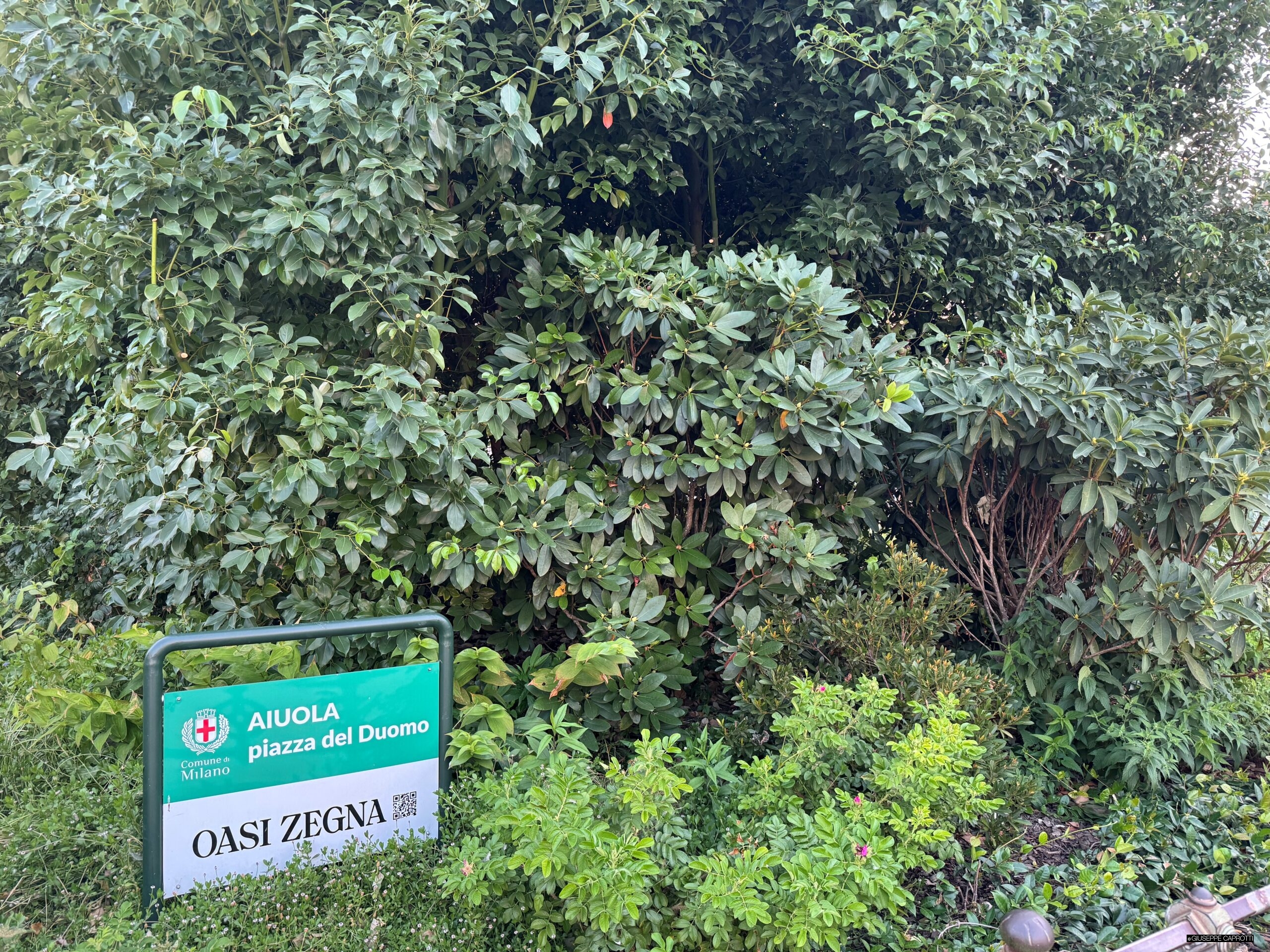
Yesterday evening, I passed by Piazza Duomo and took the photo below, from which you can deduce that no competent body in Milan understands anything about green: the rhododendrons of the Zegna oasis are fine in the mountains, not in a red-hot city like ours, where today it was 35°
Like in Austin, Texas.
The ‘discord’ palms were totally appropriate for the climate and location.
P.S.: one of the consequences of this situation is a longer and more devastating fire season.