

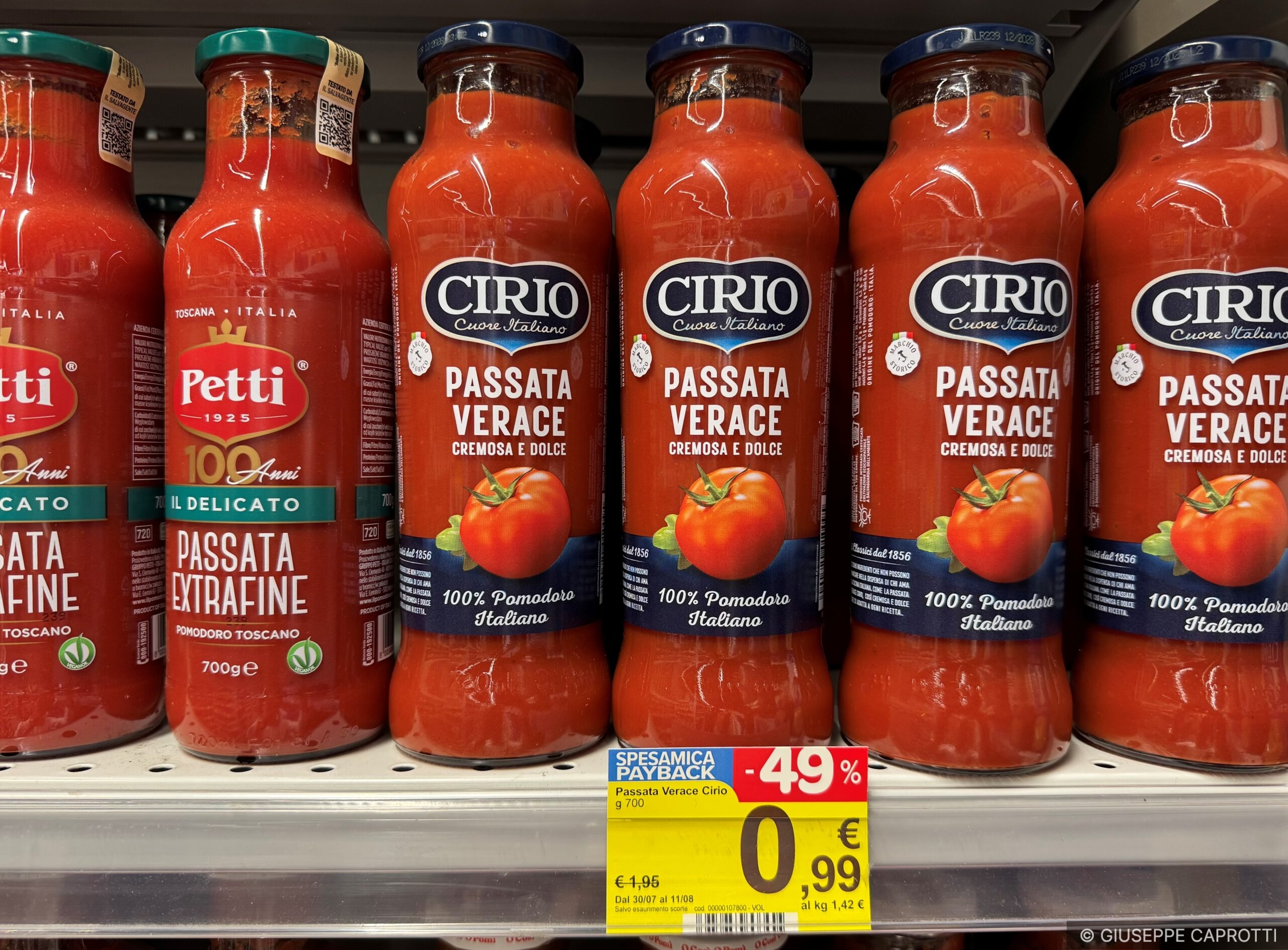
“Illegal labour practices distort prices”, Published on 21 July, updated on 8 August 2026. Photo taken at Carrefour, Milan
The Amendolara massacre, in which Waseem Khan (aged 29), Amin Fazal Khogjani (aged 28), Safi Iayjad (aged 27) and Ullah Ismaappena (aged 19) were burnt alive by the Mafia took place on 1 June 2026; it is now a distant memory in the media, on social media and, consequently, in the minds of Italians.
However, the social and economic situation it highlighted is still very much present: the informal economy employs more than 3 million workers, concentrated in agriculture, services and commerce.
The laws against illegal labour recruitment, passed in 2016, have remained unenforced.
Those whoexploit labour, pay starvation wages or circumvent safety regulations and fundamental rights gain an illegitimate economic advantage over those who operate in compliance with the rules.
This applies to industry, to international trade and, above all, to agriculture.
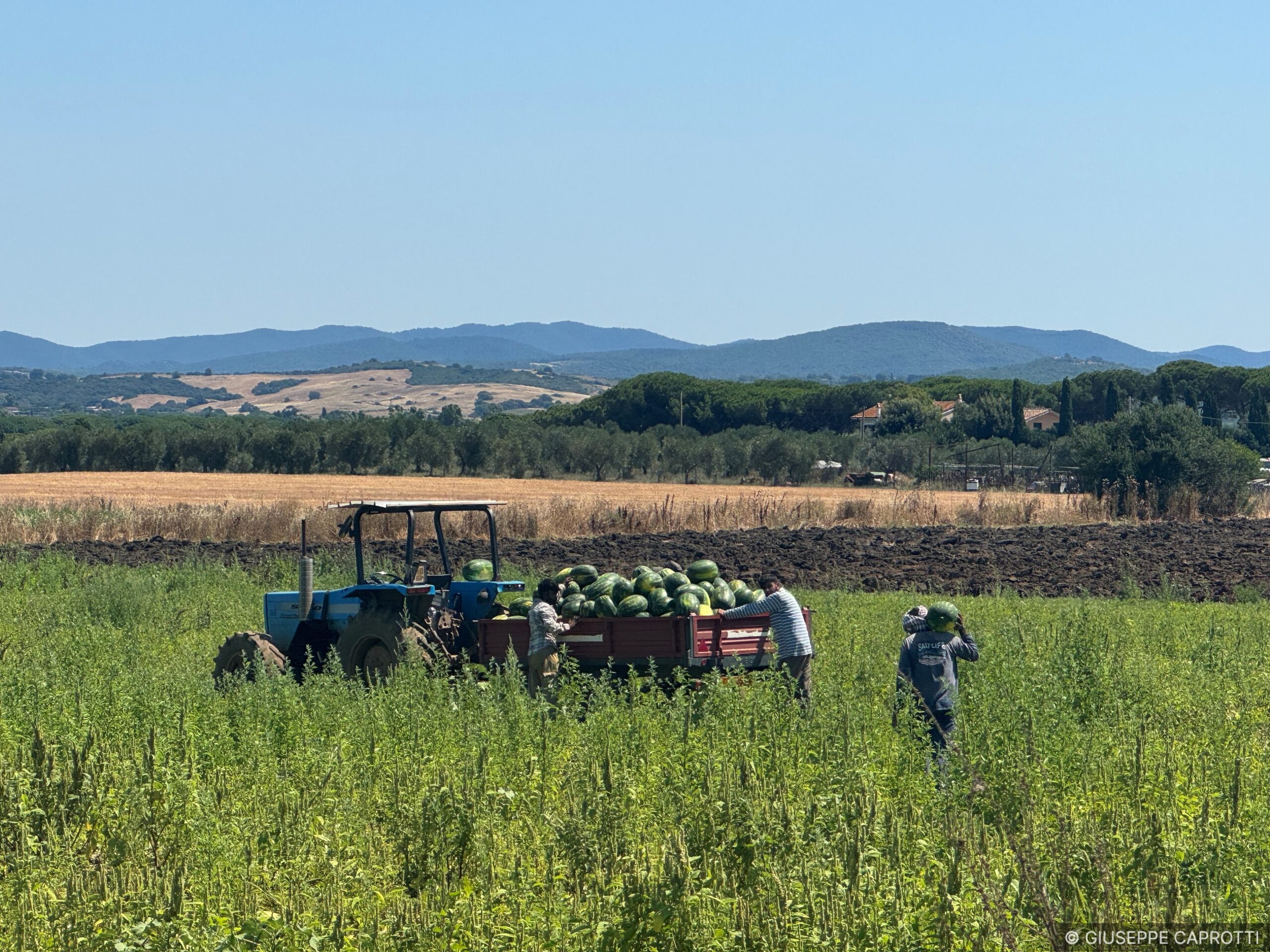
Below: farm labourers harvesting watermelons in Tuscany (2026).
This is a distortion of competition that distorts the market and penalises law-abiding businesses.
It is no coincidence that, at the very same time as Italy is once again questioning the practice of ‘caporalato’, the Trump administration has announced new tariffs (Trump’s new tariffs: 12.5% against those who exploit workers) against dozens of countries – including Europe on the blacklist – accused of failing to effectively combat forced labour in their supply chains.
“The failure of our most important trading partners to address the issue of importing goods produced using forced labour is unacceptable. This creates a situation in which American workers are forced to compete globally on an uneven playing field,” said Trade RepresentativeJamieson Greer.
Setting aside political assessments of Washington’s decisions, the principle highlighted by the US administration deserves attention: forced labour is not merely an ethical or social issue. It is also a distortion of competition.
Europe has responded to Trump by pointing out that, in 2024, it adopted one of the world’s most advanced regulations against the placing on the market of products made using forced labour. This was an important decision. However, the credibility of regulations is measured by how they are enforced.
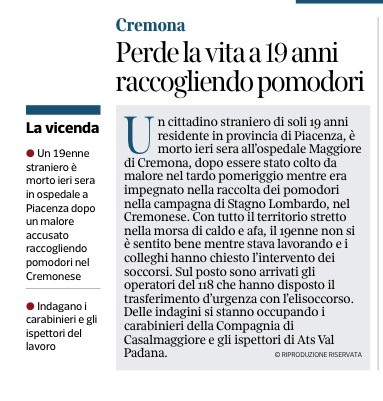
Below: an article from *Corriere della Sera* dated 3 August 2026 about a farm labourer who died whilst picking tomatoes
The Italian paradox
And this is where the Italian paradox emerges. For years, the sector has been investing in quality, environmental sustainability, traceability and the international reputation of ‘Made in Italy’.
Yet there is a contradiction that cannot be ignored. If part of the sector’s competitiveness continues to be built on the suppression of labour costs, the market receives a distorted signal.
The final price no longer reflects the true cost of production, and competition ceases to reward innovation, organisation and efficiency. In other words, the ‘caporalato’ system produces false prices: pricesthat shift part of the company’s costs onto the most vulnerable workers and which ultimately penalise precisely those companies that play by the rules.
No environmental certification, no technological innovation, no marketing strategy can compensate for a supply chain that tolerates pockets of slave labour.
Perhaps this is the message we should take on board ten years after the law on illegal labour recruitment was passed and in the face of yet another tragedy. Forced labour is not merely a violation of human rights: it is a factor that distorts the market, diminishes the value of production and undermines the credibility of the entire agri-food system.
This is why the fight against illegal labour recruitment should not be regarded as a niche battle reserved for magistrates, trade unions or associations. It should be seen as an economic and industrial priority.
Because a product obtained through exploitation is not merely unjust. It is also a symbol of distorted competition that harms everyone: workers, legitimate businesses, the entire supply chain. Including consumers.
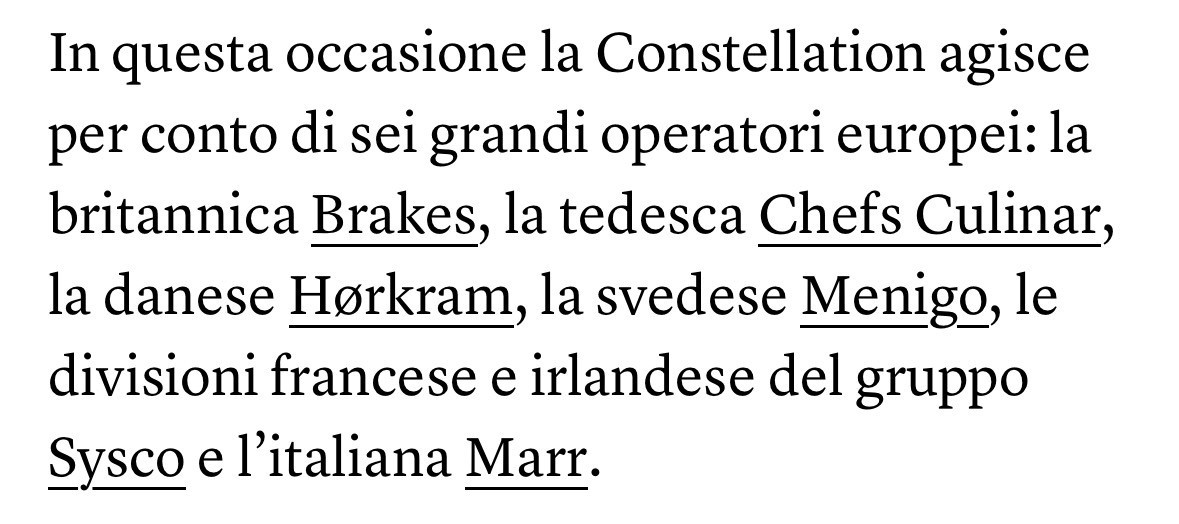
This has been confirmed by this investigation by Fabrizio Ciconte (Internazionale) into the purchasing practices of the Constellation Group, in which the distributor Marr is involved (title: ‘The true cost of a tin of tomatoes is not what you see on the shelf’).
His observations remind us how the fight against unfair practices – selling below cost – throughout the supply chain (agriculture – production – trade) has stalled.
Because double-reduction auctions are still legal: they’re banned in Italy, but all you have to do is organise them in another European country and that’s it (instead of arguing with the EU, we should be trying to get it on our side).
And another investigation by *La Stampa* highlights how “a national network of illegal labour recruitment moves migrants throughout Italy”. The commission of inquiry: the same workers are moved from one region to another for harvest work in the fields
In a nutshell, La Stampa has established that:
1) the exploitation network is nationwide;
2) there are no inspections (each year, they cover less than 4 per cent of farms).
3) accommodation for workers was supposed to be built under the National Recovery and Resilience Plan (PNRR), but very little has been done (25.9 million has been allocated out of the 200 planned).
4) There is undeclared work, but the majority of workers are in a grey area: only a minimal proportion (around one-fifth) of wages and social security contributions are officially paid. *La Stampa*, from which you will find some excerpts below, calls this the ‘formal invisibility of the daily-rate scam’. This is a facade of legality.
I’m very sorry to have to admit it, but Donald Trump, at least as far as we’re concerned in this case, is right: the ‘Italian system’ only works with the underground economy.
Regardless of the American president, the government can continue to turn a blind eye to the problem or try to ‘take the bull by the horns’.
How?
As well as measures to combat organised crime, it could start tackling the issue of wages and consumer incentives: with wages and prices distorted by the Mafia, we won’t get very far.
Of course, ‘the story continues’: Illegal labour in the Caserta area: exploited undocumented farm labourers, caught between pesticides and extreme heat


