[vc_column_textPublished 5 March 2022, updated 1 May 2025
he was also the founder and member of the Bolshevik National Party, the Bolshevik National Front and the Eurasia Party. Emblematic is the slogan he coined: ‘Russia is everything, the rest is nothing! “..
The term ‘Eurasia’ sounds familiar because it is found in Orwell’s ‘1984’.
And here it becomes more disturbing because of the suggestion it evokes. Eurasia, in fact, according to the Orwellian account in the novel 1984, is one of the three continental superpowers born after the hypothetical atomic war of the 1950s invented by George Orwell. The form of government hypothesised by the great British writer is neo-Bolshevism, born from the ashes of the Communist Party of the Soviet Union.
For Dugin, therefore, this dystopian novel is not a warning: it is a model to aspire to. As an old Soviet philosopher, Dugin is anti-capitalist, anti-liberal, anti-democracy, pro-dictatorship. For Dugin it is Stalin rather than Lenin, the great ideological hero.
Like Putin, Dugin also believes that the dissolution of the Soviet Union was a disaster. Dugin in his writings proposes the re-establishment of the Soviet-era empire by force. In 2008, when Putin inv aded Georgia in the same manner as he invaded Ukraine, Dugin urged him to attack Ukraine…
Lenin, Ukraine and the spectre of Orwell
A speech by the historian of communism on the conflict
03 MARCH 2022
In his war speech on 21 February, Vladimir Putin made a statement that left historians stunned. He said that ‘contemporary Ukraine was completely and entirely created by Russia, to be precise by Communist and Bolshevik Russia. This process began almost immediately after the 1917 revolution, and Lenin and his comrades acted very unfairly with Russia, grabbing and wresting from it a part of its historical territories’ (1).
By contextualising the birth ofUkraine in this way, Putin ‘forgets’ that it was a historical reality in its own right for more than 1,200 years, when Rus, the first Slavic state, was created in that vast territory stretching from the Baltic Sea to the Black Sea, bordered by the Dnepr and Dnestr, with Kiev as its capital – when St Petersburg and Moscow did not even exist.
Ukraine was forcibly re-annexed into the Tsarist empire only at the end of the 18th century and saw the emergence in the mid-19th century, as throughout Europe in 1848 and its ‘peoples’ spring’, of a powerful nationalist movement centred on its language, its literature and the memory of the great Cossack revolts against all forms of oppression.
Well, by evoking 1917, ‘professor’ Putin ‘forgets’ that in 1917 there were two revolutions: the democratic one in February and the one in October that allowed Lenin, on 7 November, to create the first totalitarian regime in History.
The abdication of Nicholas II on 15 March had caused the collapse of the Tsarist empire, known then as ‘the prison of the peoples’. Ethnic Russians accounted for just 44 per cent of its population.
All other national identities were emancipated: Poles, Finns, Estonians, Latvians, Lithuanians, Bessarabians (Bessarabia coincides with present-day Moldavia and Transnithria), Georgians, Armenians, Azerbaijanis.
As for the Ukrainians, on 17 March they created a Rada, an assembly, chaired by Mykhailo Hruchevski, which proclaimed its independence from the central government on 23 March. Shortly afterwards, an autonomous government headed by Volodymyr Vynnychenko was created.
Since Lenin had created the Council of People’s Commissars on 8 November, the Rada proclaimed the People’s Republic of Ukraine on 3 December. Lenin reacted with anger and brutality. He knew that if Ukraine broke away from his power, it would lose the granary of Europe and a strong coal and metallurgical industry. But, more than anything else, as a true radical Marxist, Lenin knew that the power of Ukrainian national sentiment would explode the principle of class warfare that marked his every action.
Thus on 5 December he announced: ‘Today we are witnessing a national movement in Ukraine and we say: we unreservedly support the total and unconditional freedom of the Ukrainian people. (…) However, we extend a fraternal hand to the Ukrainian workers and tell them: ‘With you we will fight against your and our bourgeoisie'”. It was already Orwell!
On 16 December, the Rada reacted with a manifesto and gave land to the peasants, fixed the working day at eight hours and proclaimed a general political amnesty. Lenin counter-attacked in the pages of Pravda on 18 December with a ‘Manifesto to the Ukrainian People’ accompanied by an ultimatum.
After recalling, for the sake of appearances, the right of all nations ‘to secede from Russia’, he attacked head-on with a fantastic ‘politicking’: ‘We accuse the Ukrainian Rada of carrying on, concealed under patriotic phrases, a double-dealing bourgeois policy which has long been expressed in the refusal to recognise the soviets and their power in Ukraine. (…) This double game, which prevents us from recognising the Rada as the plenipotentiary representative of the exploited working masses of the Republic of Ukraine, has led it in recent times to take measures that, in fact, eliminate any possibility of an understanding”.
The conclusion was without appeal: ‘In the event that no satisfactory answer to our questions is received within 48 hours, the Council of People’s Commissars will consider the Rada of Ukraine to be in a state of declared war against the power of the Soviets in Russia and Ukraine’.
The Sovnarkom (Council of People’s Commissars of the Soviet Union) intrusively interfered in the internal affairs of Ukraine and accused the Rada of being responsible for the war it declared! Here was a prototype of lies, disinformation and threats that would have had a fine totalitarian offspring.
In the absence of any response, Lenin had a Soviet Republic of Ukraine proclaimed in Kharkov on 25 December, which he instantly recognised.
Then some (Soviet) units. took over Kiev on 8 February 1918.
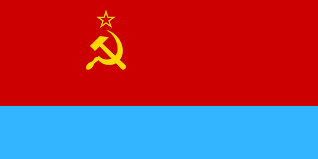
Below: flag of the Ukrainian Soviet Socialist Republic at the time of the USSR.
And so, less than six weeks after taking power, the Bolshevik leader had declared his first war on a nation whose right to independence he officially recognised.
Orwell again! Despite this, Ukraine in November participated in the first organised elections in Russia with universal male and female suffrage that led to the formation of the Constituent Assembly, which had been called for more than half a century by democrats and revolutionaries alike.
The Constituent Assembly, which met in St. Petersburg on 18 February 1918, was forcibly dispersed the next day on Lenin’s direct orders. In reaction to this, the Rada on 22 December proclaimed the definitive independence of Ukraine and on 29 April Hruchevski was elected president of the People’s Republic of Ukraine.
From that moment on, and until 1991, the Soviet power did not stop fighting the national aspirations of the Ukrainians with mass terror, trying, with iron and fire, to force them to submit to the USSR:
in 1920, during the Red Army’s offensive on Warsaw;
in 1932-1933 on the occasion of a genocidal famine organised by Stalin against the peasants : about 4 million people starved to death in the famine known as the Holodomor (2);
in 1937-1938 with the Great Terror led by Khrushchev;
in 1939-1941 with the annexation of western Ukraine when Stalin and Hitler destroyed the Polish state;
in 1944 and 1956 with the extermination of all anti-Soviet nationalist partisans at the hands of the KGB (3).
That KGB of which Vladimir Putin remained a loyal lieutenant-colonel.
That same Vladimir Putin in the pages of Le Figaro of 7 May 2005 declared that it was indispensable ‘to affirm the principles of tolerance and respect of peoples towards each other, to inculcate the idea that the unity of human beings is indispensable to come to terms with common difficulties and threats. To create, after all, an atmosphere of understanding around the idea that peoples have the same rights, whether or not they are more or less numerically important, including the right to decide the way forward for their development.
Let him therefore put into practice the principles he has proclaimed!
Translation by Anna Bissanti
© Le Figaro/Lena,Leading European Newspaper Alliance
The author, a historian of communism, is honorary director of the Centre national de la recherche scientifique in Paris.
Conclusion: no matter how one feels about communism, historically Putin’s theses do not stand up.
Ukrainians have their national characteristics and Russians theirs.
The events of the exterminated Ukrainian peasants (kulaks) remind me of the Armenian genocide perpetrated by the Turks. And the Russians would like history to repeat itself (read about it Ukraine : towards a second genocide. Wanted by Putin).
Remember this when you speak of Ukrainian ‘neutrality’, or use expressions like ‘neither with Putin nor with NATO’: the Ukrainians, they fight for their freedom, a word that, in the EU, we too often take for granted.
The principle of self-determination of peoples, son of the French Revolution (4) must, in my opinion, be defended to the bitter end.
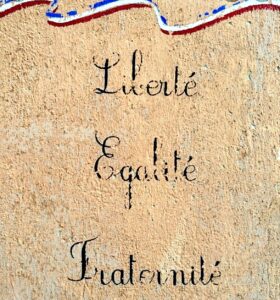
Below : Liberté, Egalité, Fraternité (photographed in a village in the South of France)
(2) the peasants called kulaks were considered ‘enemies of the people’ by Stalin because they were ‘well-to-do’. To qualify as a kulako it was enough to be ‘a farm worker, the possession of farm machinery a little more perfected than the simple plough, two horses and four cows’ (‘the city of man, the twentieth century between conflicts and transformations’ Fossati, Luppi, Zanette pg. 145).
But the extermination of the Ukrainian Kulaks is now also studied at university: The book adopted by Sciences Po . ‘De Versailles à Berlin, 1918- 1945’ by Pierre Milza, narrates the Holodomor famine and the numerous uprisings of the Ukrainians against the Russians, Tsarists and Soviets, including the story of the legendary Ukrainian anarchist leader Nestor Ivanovic Machno..
(3) secret political police of the USSR, active from 1954 to 1991. 1991 was also the year of Ukraine’s independence. In 1995 the KGB was replaced by the FSB.
(4) ironically adopted, more than a century later, by Lenin, as Courtois mentioned.
Read also: The neutralists’ farm. For George Orwell, pacifists were totalitarianism’s best allies.
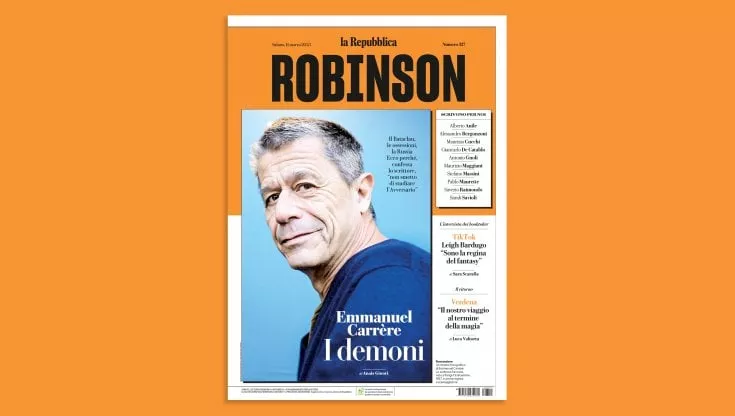
Below : Emmanuel Carrère – son of Helene Carrère d’Encausse – on Robinson expressed some opinions on the evolution of Putin’s Russia, where he was at the outbreak of the ‘special operation’:
“What happened in 2008, with Russia eating up twenty per cent of Georgian territory, was the model for what is happening today. Back then no one lifted a finger, everyone looked elsewhere. If we had done something, perhaps we would not be in this situation today. In any case, the Georgians fear that they are first on Putin’s list’…
“Saak’ashvili (former president of Georgia) was showered with American money, he welcomed Bush to Tbilisi, even naming one of the capital’s grand boulevards after him. But this is not enough to explain that eighty per cent of Georgians only dream of being European, of getting as far away from Russia as possible. The CIA is not behind it. And this is something that seems to escape Putin completely’.
And the problems, in Georgia, continue, even in 2024 (or you can read about it here) and in 2025.