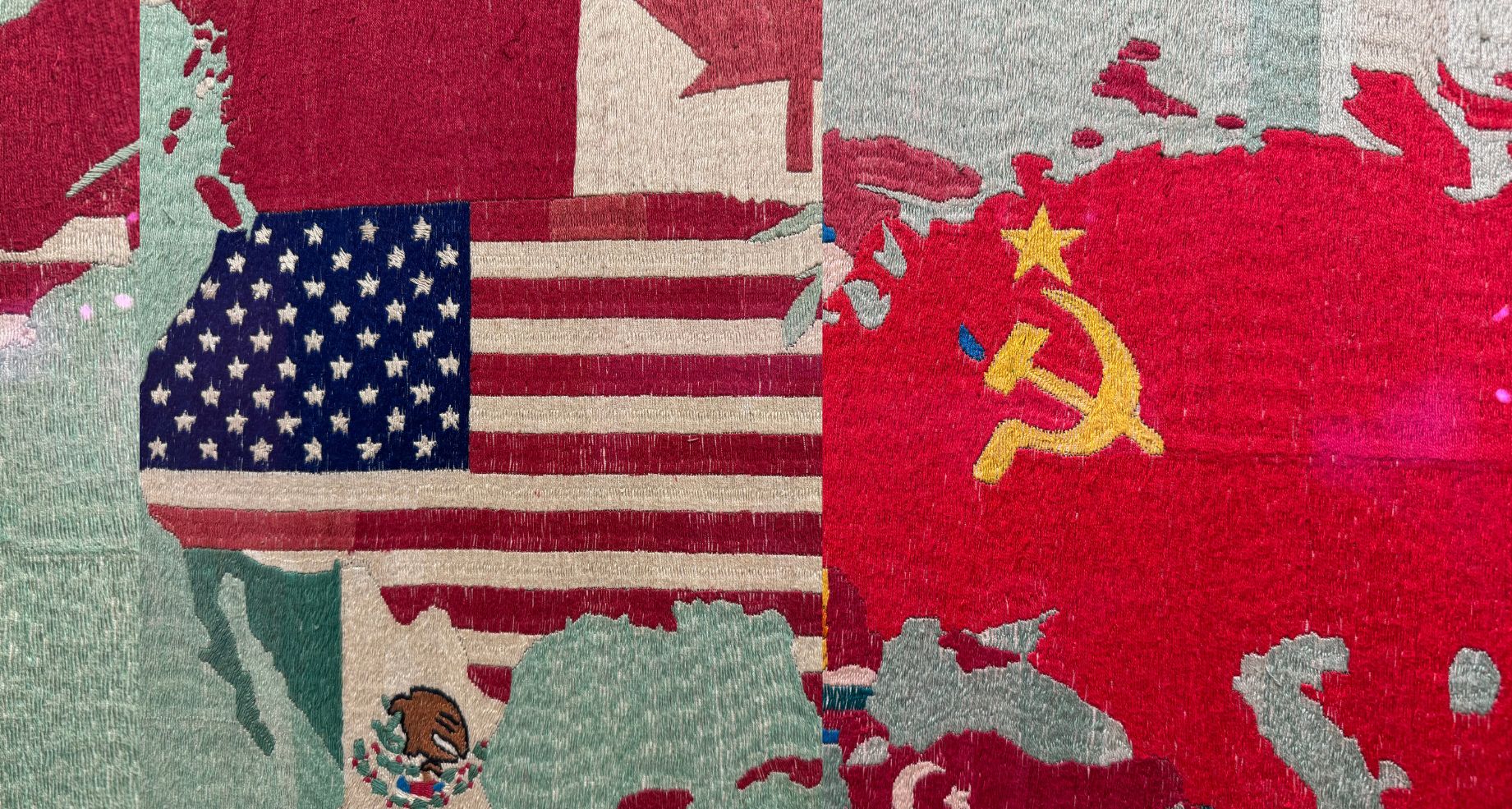
Compiled 3 November 2022, updated 6 January 2026
Foreword: the origins of the two imperialisms are studied in history books, at university .
1. The origins of American imperialism :
James Monroe was President of the United States from 1817 to 1825.
History courses study the Monroe doctrine , which can be summarised in the motto ‘America to Americans’.
With this phrase, American imperialism began.
The Monroe Doctrine refers to an ideological message by James Monroe contained in the State of the Union address delivered before Congress on 2 December 1823, which expresses the idea of the supremacy of the United States on the American continent.
Monroe stated in that speech that the United States would not tolerate any meddling in American affairs. Moreover, for Monroe, Latin America’s independence processes could not be managed by any European power. Especially by Spain.
This doctrine materialised mainly in the “banana wars”
The reasons behind these conflicts were diverse, mainly economic. The term Banana Wars originated from the correlation between these military interventions and the protection of US commercial interests in these regions. In particular, the US United Fruit Company had strong economic interests at stake in the production of bananas, tobacco, cane sugar and various other products from the areas of the Caribbean, Central America and the northern part of South America. The United States also had political interests, in particular, it was determined to keep the Panama Canal in its sphere of influence as a vital point of maritime traffic, both commercial and military.
They took place in Central America and the Caribbean between 1898 and 1934.
The casus belli was the protection of US political and economic interests in Central America and the Caribbean.
The Marines were mainly used in these wars.
The war with Spain in Cuba in 1898 ended Spanish influence on the South American continent in favour of the United States.
The Banana Wars gave rise to the name Banana Republic.
It is obvious that American imperialism is not limited to these wars. It has gone much further, up to the present day, often with tragic endings, remember Vietnam, Afghanistan or the countries of the former Yugoslavia. Here we have only hinted at its origins.
Very interesting in this regard is an extract by Massimo Gaggi in Corriere della Sera about the ‘arrest’ of Nicolas Maduro: ” …In the case of Venezuela there is more: a return to the Monroe doctrine enunciated by that president in 1823. Inessence the ‘backyard’ theory : the assertion of US supremacy over the entire American continent. Corollary: any intervention by foreign powers in Latin America should be considered a hostile act against Washington. Only then, James Monroe was thinking mainly of European attempts (particularly Spain) to suppress the independence processes underway south of the United States, whereas today the threat comes mainly from the growing Chinese influence throughout the sub-continent.
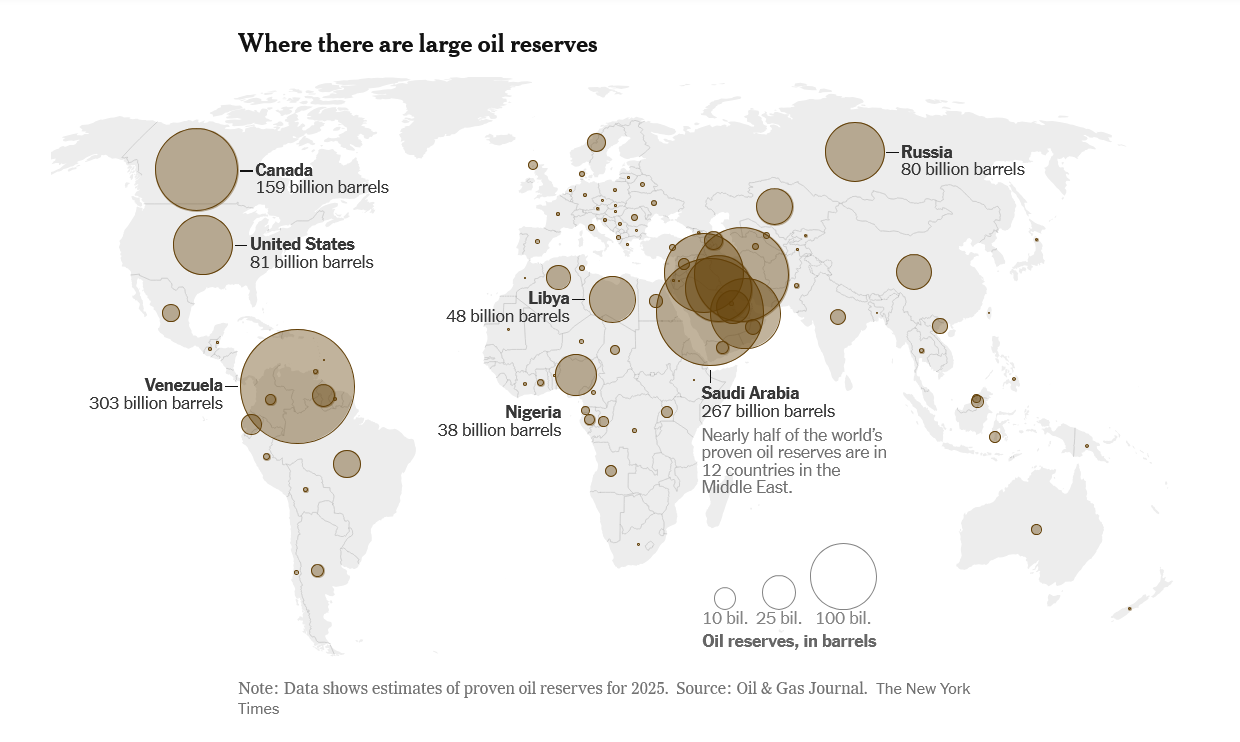
Maduro’s Venezuela had long been in the crosshairs of Trump, but also of his Foreign Minister Marco Rubio, especially since Russia and China had greatly increased their interventions in support of the regime of the country with the largest proven oil reserves in the world.
Once in business mainly with American big oil companies, Venezuela had long since become a major supplier of crude oil to the US’s adversary countries: China, Russia and Iran, as well as Cuba. An intolerable situation, in Trump’s eyes. In this sense, the accusation made by the spokesmen of the regime of the now deposed Maduro is not totally unfounded: the control of the country’s energy resources as the real cause of the US intervention. Trump himself has repeatedly spoken of his desire to bring the Venezuelan economy back into the sphere of the North American capitalist system…’.
Gaggi points out how ‘drugs’ is a pretext, even to by-pass the authorisation of the US Congress.
This is the seventh US attack against sovereign states (Somalia, Syria, Iraq, Yemen, Iran, Nigeria, Venezuela) in Trump’s second term but let’s not forget that the US intervened a bit everywhere (Panama, Libya, Iraq, etc.) well before the advent of Donald Trump.
In this regard, the film ‘Vice- the man in the shadows’ about Dick Cheney, the very powerful US vice-president, and the war in Iraq is enlightening.
2 The Origins of Russian Imperialism:
there is a strong correlation between tsarist imperialism, the Soviet Union and today’s Russia.
After the war in Afghanistan, lost by the USSR, Russia became involved in multiple conflicts in Europe or on the borders of the former USSR, such as:
Transnistria 1990- 1991
Chechnya 1999 and 2009
Georgia 2008
Nagorno Karabakh 1991- 1994 and 2020
Syria 2015
Ukraine 2022
This list does not include certain situations such as that of Belarus, a de facto state controlled by Russia, which stationed its soldiers there. And the situation has been confirmed to February 2023 : Putin wants to ‘engulf’ Belarus by 2030: secret document reveals Russian plan.
TheUSSR also participated in or subsidised various conflicts in Africa and the Middle East: in Syria but also in Mozambique, Angola and Ogaden (between Ethiopia and Somalia).
It trained African cadres for decades at Moscow’s Patrice Lumumba University, renamed the ‘Russian University of Friendship of Peoples’.
Today, Putin’s Russia, which continues the imperialist policy of the USSR, has a strong presence in Africa, for example throughout the Sahel where it intends to supplant the French presence, using Wagner mercenaries and subsidising local regimes.
And where it controls the flow of migrants to Europe.
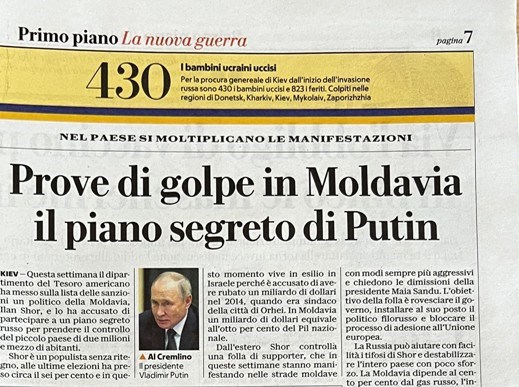
Returning toEurope, rumours of attempts to control Moldova, already strong in 2022 (the headline below is from last October), continued in 2023 – Putin revoked the decree on Moldova’s sovereignty – and continued in 2025.
Conclusion :
In Africa, the Wagner ghost army ( which officially did not exist…) linked to Putin, numbered 50,000 military personnel had installed itself all over Africa.
Putin admitted for the first time on Tuesday (20 June 2023) – after years of Kremlin denials – that Wagner had been ‘fully funded’ by the state, with Rbs 86 billion ($1 billion) in payments made from May 2022 to May 2023 and a further Rbs 110 billion in insurance payments…(Source : Financial Times 27 June 2023).
Putin is now moving to incorporate the group into the official army after Prigozhin’s failed march on Moscow on Saturday (24 June).
In Europe, Hungary and Slovakia have long been in Russia’s orbit while Putin has recently – 2025 – worked to install a puppet government in Romania.
The Cold War did not end with the dissolution of the USSR in 1991 and it is just a question of which side you want to be on: in the USA there is a democracy (definitely in the balance, with Trump)…. while on the other side there is a totalitarian state.
In between there is a democratic but too divided Europe, as was also noted in the statements on Venezuela: Macron disapproved while Meloni declared the US action ‘legitimate’.
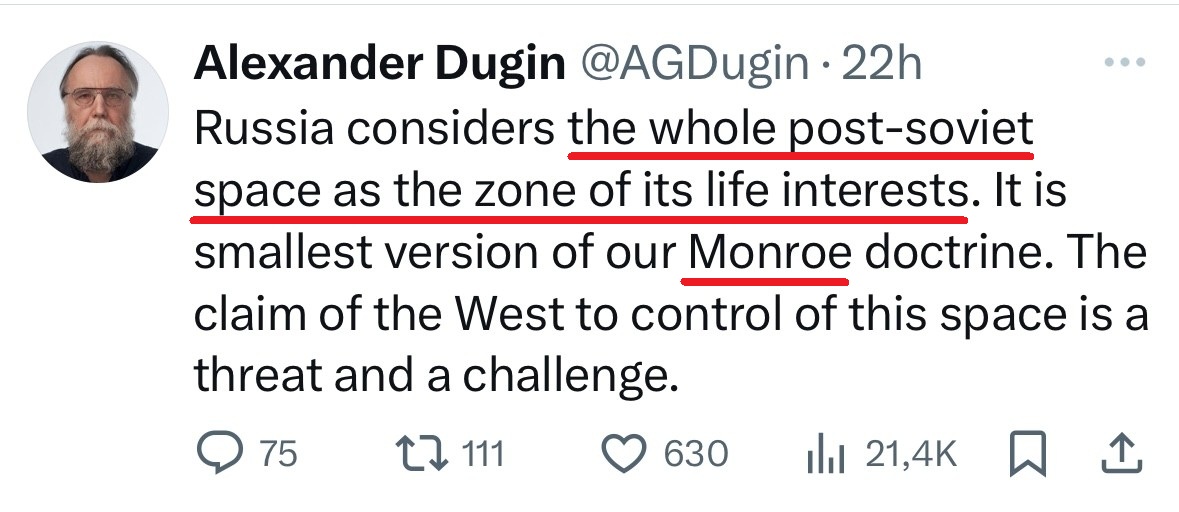
Below: Alexander Dugin, the philosopher who inspires Putin, confirms – in August 2025 – what has already been written: ‘Russia considers the entire post-Soviet zone as its living space. It is a smaller version of the Monroe Doctrine. The West’s claim that it wants to control that space is a threat and a challenge’.
I would like to remind you that in the ‘living space’ of post-Soviet Russia there are probably also – in addition to the former Soviet republics such as Ukraine, the Baltic States and Belarus – the Warsaw Pact adherents, such as Poland, Czechoslovakia, East Germany, Hungary, Romania, Bulgaria and Albania.
N.B. on Venezuela: Putin did not comment but according to Le Monde: ” Russia was taken by surprise. “Maduro has beenPutin ‘s main partner in Latin America,” said Peter Rough, director of the Centre for Europe and Eurasia at the Hudson Institute.
The Venezuelan president’s presence at the grand celebrations in Moscow on 9 May 2025, marking the 80th anniversary of the ‘Soviet victory’ in World War II, had been welcomed by the Kremlin’s master. “Eliminating him is clearly a blow to Putin.
It shows that his air defences, installed around the Venezuelan capital, and his political agreements – Moscow and Caracas recently signed a ten-year strategic partnership agreement – are useless in the face of American power,” he said. Rough.
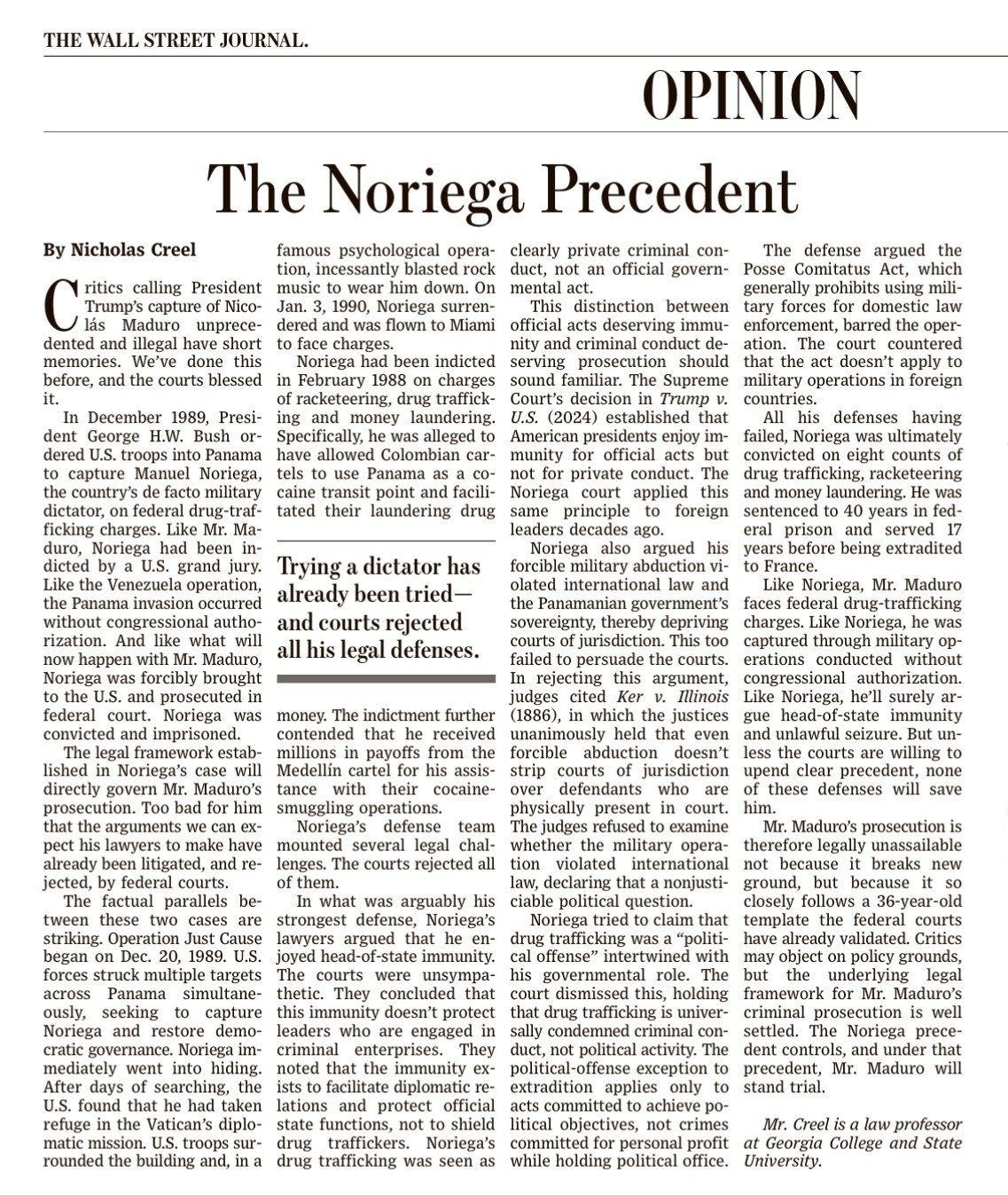
Russia’s Russia Today television said the operation is reminiscent of the US attack on Panama in 1989, as confirmed by The Wall Street Journal on 5 January 2026, recalling how Panamanian dictator Noriega spent 17 years in US prisons.
Also according to Le Monde, by intervening in Venezuela, Washington is hitting one of Moscow’s sensitive spots: its oil revenues. The US is aiming to revive oil facilities that are no longer in operation, seeming to jettison the joint venture agreement renewed for fifteen years in November 2025 between Venezuela’s public company Petroleos and a subsidiary of the Russian company Roszarubezhneft.
This capture of Venezuelan oil wealth, and the foreseeable drop in prices due to a more abundant supply, could make the Russian economy, already plagued by its war of attrition in Ukraine and international sanctions, suffer severely. “Russia, Venezuela and Iran are key players in the energy market. These countries account for a third of the world’s liquid hydrocarbon reserves and 15 per cent of world production,” Igor Setchin, the head of Russia’s Rosneft oil group, told the St Petersburg Economic Forum in June 2025…
Below : Venezuela’s oil reserves are the largest in the world (The New York Times 4 January 2025).