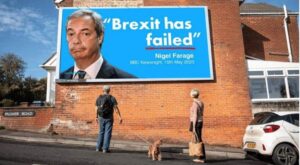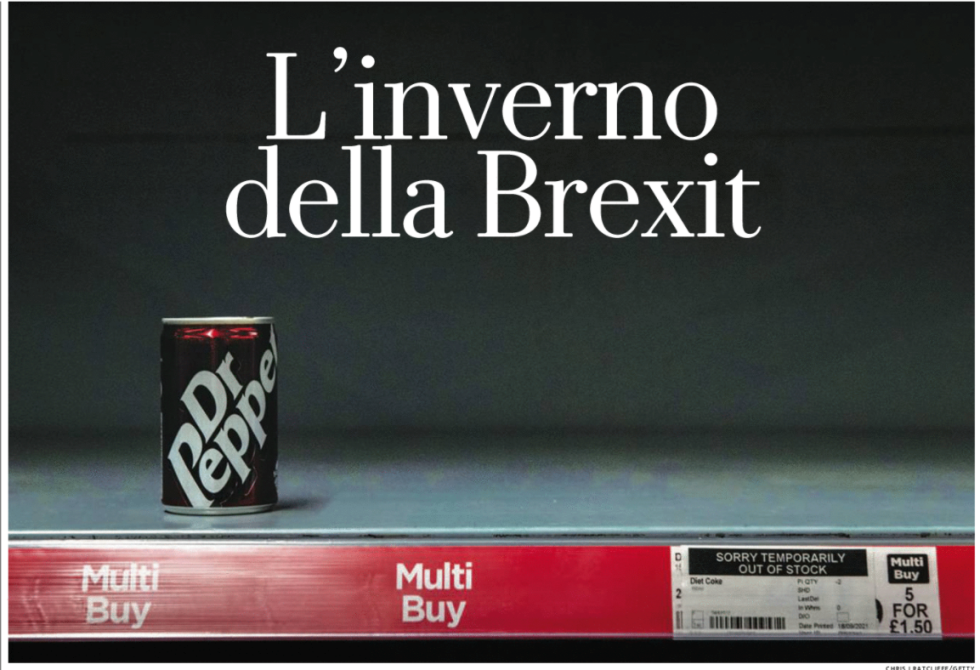
Compiled 6 May, updated 23 December 2024. I have adapted the title above from the image taken from Repubblica. The source article is called: The bitter lessons of Brexit
Tackling the UK’s challenges requires more than the performative policies of populist leaders The Brexit would surely have gone wrong, because it was based on false premises.
Populism is a powerful form of democratic politics. Unfortunately, it is also destructive, as it weakens institutions, damages debate and makes politics worse. It can threaten liberal democracy itself. The Brexit saga is an object lesson in the dangers: it has damaged what was long thought to be the most stable democracies in the world. The recent book, What Went Wrong With Brexit: And What We Can Do About It, by my colleague Peter Foster, lays out the story superbly. It shows how a classic populist alliance of zealots and opportunists mixed simplistic analyses with heated rhetoric and outright lies to undermine the UK’s most important economic relationship and threaten its internal stability. Fortunately, there is an opportunity to learn from this experience and begin to put things right. In fact, the Brexit was bound to go wrong, because it was based on false premises. Countries cannot be fully sovereign in trade, because it involves at least one counterpart. Therefore, single market rules were created because the alternative was multiple different regulatory regimes and thus more expensive (and smaller) trade. An institution also had to decide whether countries complied with the agreed rules. This was the indispensable role of the European Court of Justice. The creation of the single market, therefore, was an act of regulatory simplification . Leaving it would increase regulation for any company trying to sell in both the UK and the EU. Such business would necessarily be discouraged. So, in effect, it has been proven. As Foster shows, it is the smaller businesses that suffer most from these burdens. In the short term, existing businesses have benefited from sunk costs: capital, knowledge and relationships. The costs of creating these resources again are much higher than those of utilising what they already had. Let us therefore assume that a company is considering entering the EU market today. All things being equal, would it make sense to set up in the UK rather than in one of its 27 members? Obviously not. In time, then, the separation will increase. This also applies to personal relationships, education, work experience or work as a creative person, consultant or lawyer. In summary, this supposed liberation has greatly reduced the freedom of many millions of people on both sides. Whose freedom has been increased? That of British politicians. They can act more freely than they could when bound by EU rules. What have they done with this freedom? They lied (or, worse, failed to understand) what they had agreed on the Northern Ireland Protocol . They threatened to break international law . They even proposed to scrap thousands of pieces of legislation inherited from EU membership, regardless of the consequences. These people, in short, have destroyed the country’s reputation for common sense, moderation and decency. All this is the natural result of the classic populist mixture of paranoia, ignorance, xenophobia, intolerance towards the opposition and hostility towards binding institutions.
Yet all is not lost. For some good things have emerged, at least for now. The ruling party has peacefully rid itself of two terrible prime ministers, Boris Johnson and Liz Truss. Their successor, Rishi Sunak, is no fantasist. Neither is the opposition leader, Keir Starmer. This is cheering. Many surely now know that the challenges facing the country – inadequate infrastructure, slow innovation, low investment, poor business performance, huge regional inequality and high income inequality – have nothing to do with the UK’s membership of the EU. Moreover, opportunities for transformative global trade agreements have proved to be a ‘fatuous fire’. In Foster’s words, Brexit is ‘a colossal distraction’. It is a performative policy, full of noise and fury that means nothing meaningful. Other EU members at least have learned that.
I have argued that trying to rejoin the EU now would be a mistake. But it is possible to seek improvements in the UK’s relationship with the UK, particularly in the movement of people and workers and in regulatory standards, especially in the food and manufacturing sectors. There is no good reason to diverge from the latter. After all, would a specific UK regulation on artificial intelligence or a carbon-boundary adjustment mechanism make sense? More boldly, there is a strong case for rejoining the customs union and thus eliminating the difficulties now created by rules of origin. The UK must seek to mend its relationship with the EU. Its government must also act to improve its economic performance. If the next government fails to improve the economic trajectory, this populism could resurface in a worse form. Nothing less is at stake now.
martin.wolf@ft.com

The confirmation of what Martin Wolf said in January 2024 came a few months later, in May:
After Brexit, the slow erosion of British trade
UK trade in goods has fallen by 10% since 2019, while that of other G7 countries has grown by 5%
Brexit was not a one-off event, it is a never-ending process. Eight years after the referendum (23 June 2016), four years after the UK’s official exit from the European Union (EU), three years after the actual exit from the European single market (1 January 2021), new border controls have just come into effect.
On Tuesday 30 April, British customs began physically checking products of plant or animal origin entering the UK. These checks have existed in the opposite direction (from the UK to the EU) since January 2021, but the British authorities had so far postponed the start of their own checks five times, fearing to cause chaos at the border.
The new rules have caused an outcry from small businesses because they include a fee that companies have to pay: £29 (€34) per product category. If an exporter ships meat, dairy products and fish at the same time, this corresponds to three categories and therefore three payments. In total, the UK government estimates the cost to UK businesses at £330 million per year. Considering an economy like the UK’s, this is a small cost, but one that the UK authorities calculate should add 0.2% to food inflation over three years.
‘Loss of dynamism’
The Brexit was a rare experiment from an economic point of view: here is a country that chose to erect barriers with its main trading partner, which accounts for almost half of its trade. The agreement signed with the EU avoids duty drawback, but imposes heavy declarations (import and export forms, health certificates, etc.).
Two and a half years later, the results are a slow erosion of British trade…
- This is also borne out by these figures: since the UK’s exit from the European Union, finalised in 2020, sales of UK brands have plummeted by around €7 billion, with the fashion sector bearing the brunt, with revenues slipping by 60 per cent. Italy lost exports to the UK in the sector, amounting to €600 million.
- The agricultural sector is not faring any better: 8,000 companies have closed since 2019: the situation has worsened further since Brexit and the subsequent transition to new agricultural and trade policies. These challenges have been exacerbated by the impact of the Covid-19 pandemic, price pressures and climate change. The Conservative government has not replaced EU subsidies with other funds and has opened up imports from Commonwealth countries such as Australia and New Zealand.
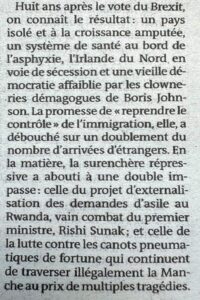
- Also interesting is the view of Le Monde (1 July 2024): ‘eight years after Bexit, we know the result: an isolated country, with growth “amputated”, a health system asphyxiated, Northern Ireland wanting secession… the promise to regain control over immigration ended up with a doubling of the number of incoming foreigners…’. In fact, Brexit today is rejected by 55% of Britons
- Read also : UK : cost of living hits families
Further confirmation comes from this: London’s shrinking stock market where we read: ‘It has been a particularly bad year for the London Stock Exchange. A total of 88 companies cancelled or moved their main listings from the market, with only 18 taking their place.
This is the largest net outflow of companies since the financial crisis…. But there are also deep issues. Thinning liquidity makes it difficult to compete with the deep US capital markets and fast-growing economy [and this is a European problem, there is also of the internally divided EU] but…
“The state of the London stock market reflects a deeper malaise in the UK business environment that needs to be resolved. In recent years, political turmoil has hampered listing, investment and expansion in Britain. The large majority of the new Labour government offers a stable platform on which to build. And the UK has many comparative advantages, from financial services to life sciences, that can attract listings and investment opportunities.
Unfortunately, the government has already erred in putting companies and wealth creators on the back foot with heavy taxes in its autumn budget. It must now act quickly to regain business confidence. In the new year, investors will want to see progress on Labour’s lauded planning reforms, infrastructure projects and broader growth strategy. Only by developing a compelling business case for Britain can the government give London’s stock market more than a fleeting chance of recovery.”