Well, after the war he had the task of selecting, on behalf of the Rockefellers, reliable Italian entrepreneurs of sure anti-communist faith to be partners in the food ‘colonisation’ that was to be the fuel of the Italian economic boom.
James Angleton, a decorated officer of the American army, was none other than the father of James Jesus Angleton, the right-hand man of General Donovan, founder of the OSS from which the CIA was later to be born: Angleton Jr. was to be the head of the CIA station in Italy, until he became the head of American world counter-espionage and the number two of the CIA for over 29 years, one of the most powerful men in the world to whom we owe the birth of the Italian Secret Services by Prefect Federico Umberto D’amato, who was Angleton’s protégé for years.
This should not really come as much of a surprise: first of all, in its early days, the CIA selected its agents from among the richest white and Protestant families, so that they would not be easy to buy and were of safe American family faith.
Nor should the close relations between the CIA and large American multinationals be surprising: Allen Dulles, the CIA’s most powerful director, was the brother of the big boss of the American United Fruit Company, whose brother’s CIA even went so far as to carry out a coup d’état to further whose interests in Guatemala.
Angleton left the CIA at the end of the 1970s, and a film by Robert De Niro, The Good Shepherd, was even dedicated to him, while Bernardo Caprotti with extraordinary entrepreneurial ability took over the majority of shares from the Rockefellers and became the king of Italian supermarkets.
Francesco Martelli
Superintendent of the Archives of the City of Milan
Lecturer in Archival Studies at the University of Milan
“Supermarket competition was the subject of a clash between the USA and the USSR”?
Supermarkets were invented by the Americans, the Soviet Union at the time had no idea what a supermarket was.
Besides its corporate and social role, it was also a very politicised entity. In fact, Rockefeller thought it was “it’s hard to be a Communist with a full belly.”
But the Coop supermarkets were born six years after Esselunga, when the Americans were already about to leave Italy, which they finally did in 1965.
From the following text – taken from ‘La cooperazione di consumo in Italia’, Il Mulino, 2004– it is perfectly clear that when the cooperatives decided to launch into the supermarket business they lacked the distinctive trait that had made Esselunga so successful in its early days: management.
The American managers of Esselunga were called Richard Boogart, Dick Simpson, Roland Hood, Wayne Broehl and Duane Horney. I talked about them extensively in my book, Le Ossa dei Caprotti.
And the cooperatives, which launched themselves – without capital and suggestions from the USSR – into the supermarket business risked bankruptcy.
On the approach to historical facts you can also read: ‘Le Ossa dei Caprotti’ : the difference between journalistic reporting and history.
The first concrete realisation was in 1957 the opening by the Cooperativo di consumo del popolo in Bologna of a shop without clerks: the first self-service shop of the Italian movement, which would be followed by many others.
The second milestone was the inauguration of the first supercoops, i.e. the first large supermarkets of the cooperative movement, in 1963: the Coop 1 in Reggio Emilia (over 2,000 m2 of sales area organised on two floors connected by escalators) and the supermarkets in Empoli, Sassuolo (of 800 m2) and Bologna.
Despite these courageous attempts, modernisation proceeded very slowly…. traditional shops remained the backbone of consumer cooperation throughout the 1960s and it was only in the following decade that sales outlets larger than 200 m2 and especially those with over 400 m2 became an important percentage of the sales network and above all of turnover.
There were several reasons for this slowness. Firstly, the fact that, despite the choices of a few particularly far-sighted managers, the consumer movement as a whole took a long time to embrace a strategy focused on innovation. Let us remember that the 1st Congress of the ANCC in 1958 if on the one hand it indicated the objective of a renewal of traditional distribution equipment and its replacement by rational and modern installations, on the other hand it stressed that such investments did not automatically imply the introduction of self-service (53)
In reality, it was only towards the middle of the 1960s, starting with the Cortina conference of …
What are the benchmarks against which we can measure our efficiency? Certainly not the retailers, who are also in dire straits, forced to survive by a variety of expedients. The most valid term of comparison is the large retailers with whom we compete for a leading position in the market (53).
- The first self-service shop of the Italian movement, in “La Cooperazione italiana”, 17 July 1957. For Emilia-Romagna we remember Vignola in the province of Modena, Lugo and Massalombarda in the province of Ravenna and P. Catellani, Uno spaccio attrezzato a self service inaugurato, Salla coperativa di consumo di Vignola, ivi, 9 October 1957. C. Folli, Sistema self service comincia a penetrar nel ravennate, ivi, 23 October 1957.
- Ancc, Relazione introductiva, I Congresso, 1958.
Page 351
1964 that the adoption of modern sales techniques became the objective of the entire movement (54). This choice was then confirmed in 1965 on the occasion of the IIIInd Congress of the AICC, which indicated as a pillar of the reorganisation of consumer co-operation and, we would add, of overcoming the crisis that had gripped it for many years, precisely the transformation of the sales network with the use of the most advanced techniques: innovation thus became the strategy of the entire movement. As Mario Cesari, president of the Aicc and one of the main advocates of change, very lucidly observed in 1964:
- The first concrete foundations were laid in Cortina d’Ampezzo, on the occasion of the national convention on retail policy that took place on 18 and 19 June 1964. On this occasion, the modernisation of the sales network was linked to the location of the new outlets.
- M. Cesari, Report, National Conference on Commercial Policy, 18 and 19 June 1964…, cit.
page 352
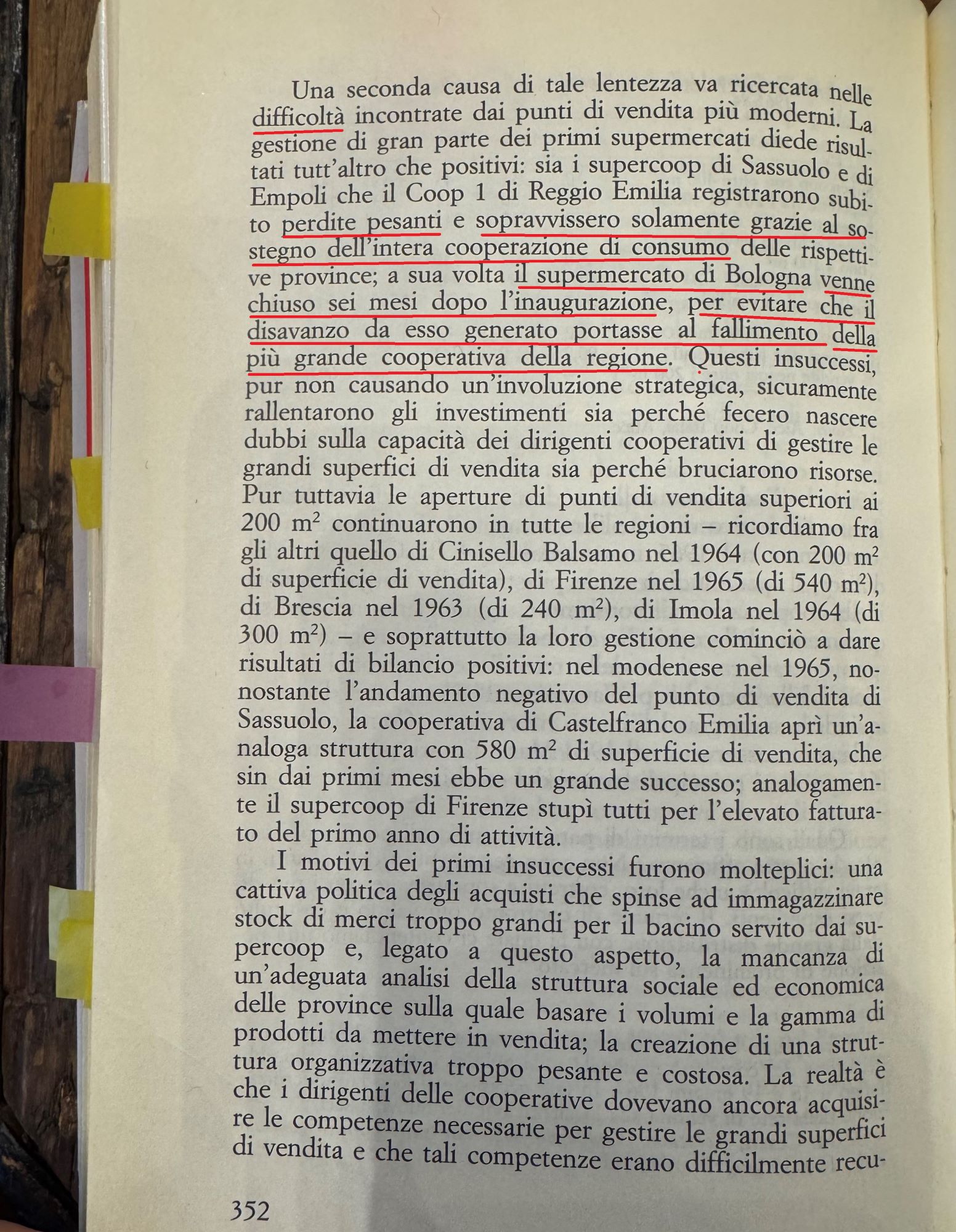
A second cause of this slowness is to be found in the difficulties encountered by the more modern sales outlets. The management of most of the first supermarkets gave results that were anything but positive: both the supercoops in Sassuolo and Empoli and Coop 1 in Reggio Emilia immediately recorded heavy losses and survived only thanks to the support of the entire consumer cooperation of their respective provinces; in turn, the supermarket in Bologna was closed six months after its inauguration, to prevent the deficit it generated from leading to the bankruptcy of the largest cooperative in the region. These failures, while not causing a strategic setback, certainly slowed down investment both because they raised doubts about the ability of cooperative managers to manage large sales areas and because they burnt resources.
Nonetheless, the opening of sales outlets larger than 200 m2 continued in all regions – we recall, among others, that of Cinisello Balsamo in 1964 (with 200 m2 of sales area), of Florence in 1965 (of 540 m2), of Brescia in 1963 (of 240 m2), of Imola in 1964 (of 300 m2) – and above all their management began to show positive results: in the Modena area in 1965, despite the negative performance of the outlet in Sassuolo, the Castelfranco Emilia cooperative opened a similar structure with 580 m2 of sales area, which was a great success from the very first months; similarly, the supercoop in Florence amazed everyone with its high turnover in its first year of operation.
The reasons for the early failures were many: a bad purchasing policy that led to stocks of goods that were too large for the catchment area served by the supercoop and, linked to this, the lack of an adequate analysis of the social and economic structure of the provinces on which to base the volumes and range of products to be put on sale; the creation of an organisational structure that was too heavy and costly. The reality was that the managers of the cooperatives had yet to acquire the necessary skills to manage large sales areas and that these skills were difficult to recu =
perable on the market: both Coop 1 in Reggio Emilia and the supermarket in Sassuolo hired managers who had trained in the major private chains (read Standa), without achieving positive results. It is no coincidence that Supermarkets Italiani [Esselunga] was managed in its early years by an entirely American management with several decades of experience in the sector behind it. All that remained was to learn from the mistakes made and to let a new lever of cooperative management mature.
The decision to rationalise the movement in order to improve its efficiency also posed the problem of the cooperative clubs and bars, which had always been part of the consumer movement and had often been run jointly with the cooperatives. The separation of bars and shops in many provinces had been adopted independently during the 1960s. However, the Ancc congress of 1970 definitively sanctioned this separation, in order on the one hand to safeguard the economic viability of the shops, but on the other hand also to leave as much room as was right for the recreational and cultural function of the clubs.
The co-operative club must be able to grasp and arouse the various cultural and recreational interests for the use of the leisure time of workers, women and young people I… it must be an important point of democratic associative life linked to the social and cultural problems and interests of the community in which it operates […] This line requires in the first place that the management of co-operative clubs be made autonomous, and therefore detached from the management of consumer co-operatives (56).
This decision in some marginal respects highlighted even more how the Movement had decided to focus on specialisation in a single sector: that of commercial distribution and in particular on large sales outlets.
- Ance, Introductory Report, IV Congress, 1970, pp. 38-39.
Below: page taken from “La cooperazione di consumo in Italia”, Il Mulino, 2004. the preface of the book is by Aldo Soldi and Vincenzo Tassinari.