A post by Paolo Caruso that complements what has already been written on the subject, with a final comment from me.
THE YELLOW OF PASTA
Dried pasta is one of the Italian foods that is particularly appreciated and known all over the world.
But how to choose, empirically, a good quality pasta?
Often, on the supermarket shelf, we are confronted with different shades of pasta colour, ranging from an ivory white to a luminescent yellow.
Dry pasta is obtained from the mixing and subsequent extrusion, drawing and drying of durum wheat semolina and water. The phase that most determines the colouring of pasta is drying.
Drying is a fundamental phase in the pasta production process, necessary to bring the moisture content to below 12.5% as required by law.
The pasta drying process has undergone considerable transformations over the course of time; with modern plants, very high temperatures are reached, ranging between 90 and 135°C, which reduce the drying time to 2-3 hours.
High-temperature drying has become widespread because it entails higher productivity and lower costs.
A pasta dried at high temperatures behaves very well during cooking, but the high temperatures reached during drying cause the unavailability of the amino acid called lysine, which is very important for our organism, which cannot produce it on its own. At high temperatures, when lysine comes into contact with sugars, it is blocked and made unavailable in the Amadori compound.
A measure of the thermal damage suffered by the dough is given by the quantification of furosine, a non-natural molecule, which is formed during the drying phase by the Maillard reaction. The presence and quantity of furosine provide an indication of the quality of the dough (Giannetti et al., 2021).
Linear correlations have also been found between yellow point and furosine content (Salvadeo et al., 2008).
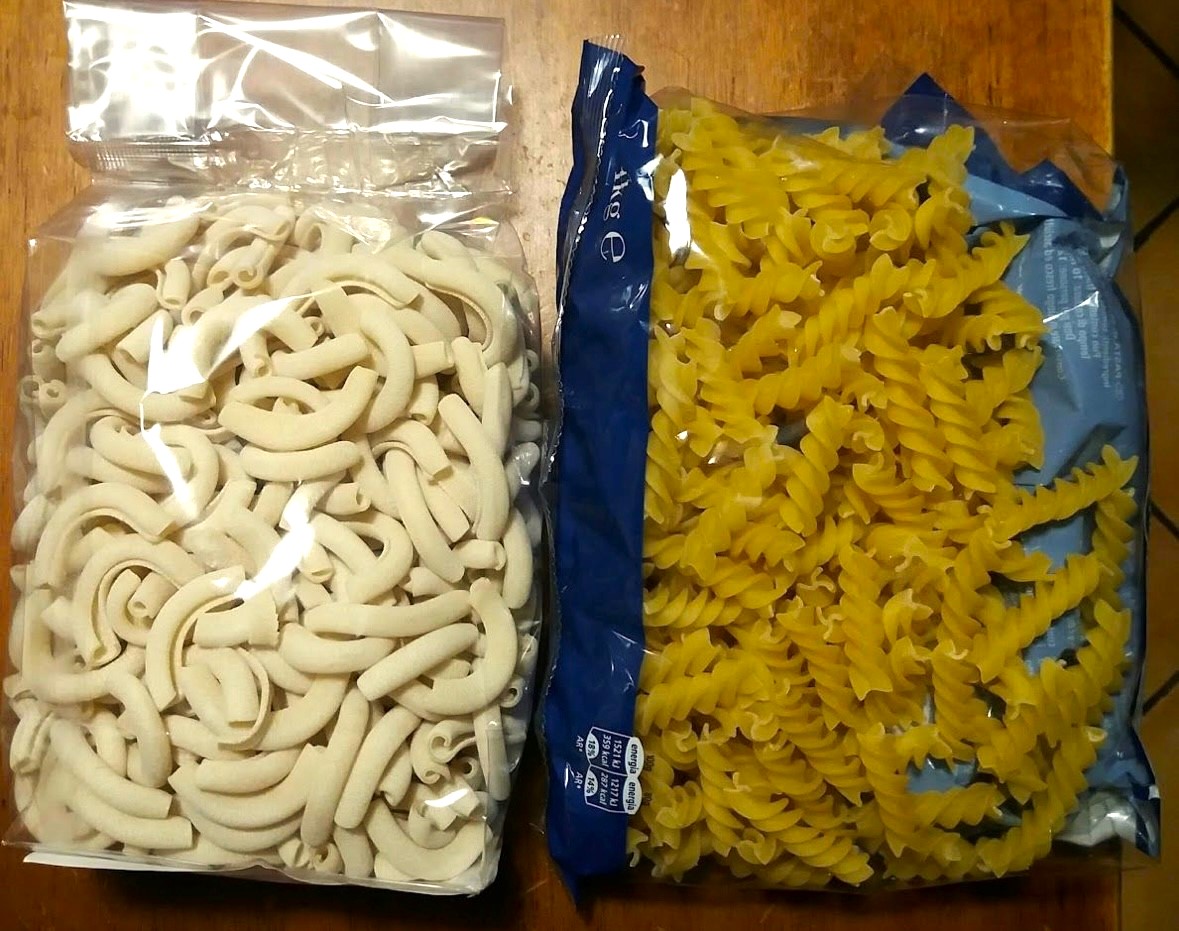
The higher the amount of furosine found in the laboratory, the higher the temperatures used for drying, the yellower the colour of the dough and the lower the organoleptic quality.
Obviously, the indication on the label of the amount of furosine formed is not a compulsory parameter and the large pasta producers are careful not to do so.
However, empirically, by choosing a light-coloured #pasta, like the one in the picture, we can with a good margin of certainty know that it has been dried at low temperatures for a long time.
So we are wary of pasta that is too ‘yellow’.
Lysine supports the formation of antibodies, hormones (such as growth hormone) and enzymes; it is also necessary for the development and fixation of calcium in the bones.
Furosine is an indicator of the effects of heat treatments undergone by food.