Over the past ten years, the volume of spirit in maturing casks has risen from less than 400 million litres to 1.4 billion litres – the equivalent of 389 million cases and, at current consumption levels, roughly three years’ worth of demand.
This situation has forced many distilleries tocut productionby more than a third.
If all thewhiskycurrently ageing in Scottish warehouses were to be bottled, it would fill around12 billion70-centilitrebottles. A huge quantity, even for the country that has madeScotchone of its most recognisable products worldwide. The problem is that, whilst stocks are rising, Western consumers are drinking less.
This is the new ‘whisky loch’ –the oversupplythat is overwhelming independent distilleries.
To understand how we got to this point, we need to go back to around 2010, when the sector ramped up productionin anticipation offuturegrowth.
The Covid pandemic initially seemed to vindicate that decision, as with people confined to their homes and with more disposable income, many consumers began experimenting with cocktails and new spirits.
However, this growing demand for the product never really took hold; indeed, shortly afterwards, inflation and the cost-of-living crisisreduced people’s spending power, leading them todrink lessor opt for cheaper brands.
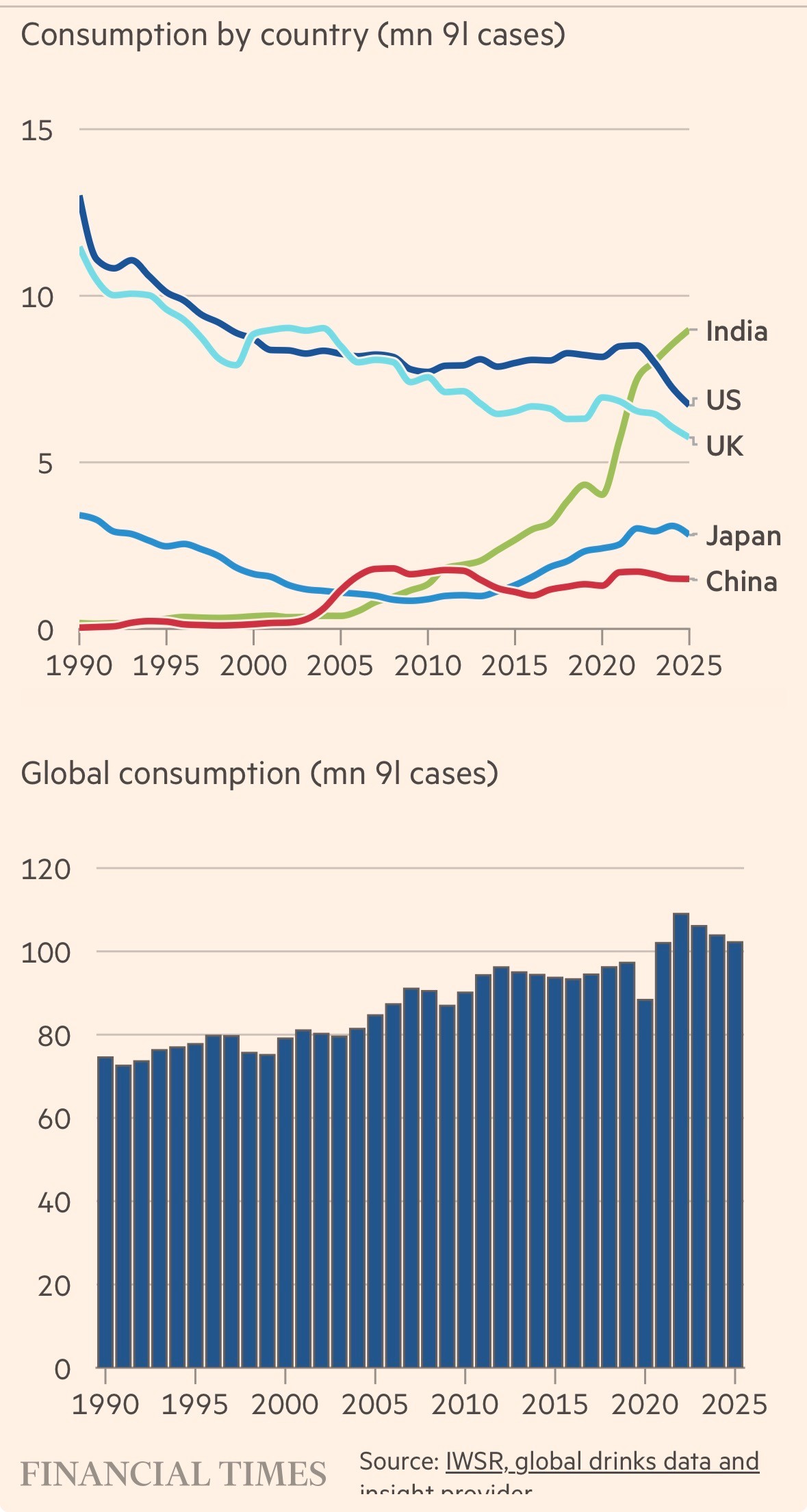
In the United States, the most lucrative market for Scotch (accounting for 18 per cent of the value of Scotch whisky exports), per capita alcohol consumptionis now 11 per cent lower than in 2019.
This is also partly due tothe tariffs imposed by Trumpfrom April 2025 (although these were abolished in July 2026).
Greater health consciousnesscertainly plays a role,though it appears to be less of a factor than inflation and the cost of whisky:
according to IWSR data. Twenty per cent of Americans who said they were drinking less stated they could not afford it, according to YouGov. “We’ve returned to levels [of abstinence] not seen since the mid-1940s,” says Nadine Sarwat, an analyst at Bernstein.
Although young people have also been singled out as responsible for the sector’s problems, analysts dispute the notion that Generation Z does not drink. The decline in consumption, they argue, is due to the fact that young people have been hardest hit by the cost-of-living crisis and the Covid-related lockdowns.
The latest survey by market research firm IWSR, conducted amongst 32,000 people across the 15 largest alcohol markets, found that 74 per cent of young adults in Generation Z said they had drunk alcohol in the last six months, compared with 66 per cent three years ago, thus matching the alcohol consumption rate of the total adult population, which stands at 76 per cent.
“Overall, the narrative that Generation Z drinks less is not a primary explanation for the decline in volumes,” says Laurence Whyatt, an analyst at Barclays. Whisky producers are seeking to attract younger consumers through product innovations and a growing demand for ‘ready-to-drink’ mixed alcoholic drinks in cans.
Diageo has launched fruitier and sweeter versions of its flagship Scotch whisky, Johnnie Walker, designed for a younger female audience. Ideal for cocktails, these more affordable bottles aim to challenge Scotch whisky’s reputation as a drink reserved for connoisseurs and older consumers. The brand has also partnered with celebrities such as pop star Sabrina Carpenter in a bid to broaden its audience.
Whisky tourism is no longer working, whilst hopes are pinned on a deal with India: the country is already theworld’s largest whisky marketby volume and could overtake the United States by value as well. Anewtradeagreementwith the UK has halved tariffs on Scotch from 150 per cent to 75 per cent and is set to reduce them gradually to 40 per cent by 2036.
Today, Scotch whisky accounts for just 3 per cent of the Indian market.
“India is making great strides: it has a young and ambitious population, with more favourable credit conditions and therefore greater disposable income,” says Nishant Sharma, who moved to Scotland from India twenty years ago. His independent company, Rutland Square Spirits, sells Scottish-made gin and rum inspired by his Indian heritage, and plans to expand into the whisky sector as well.
Below: consumption by country and consumption in cases of whisky (note the decline following the Covid pandemic; bear in mind that the global market also includes low-priced whisky, e.g. Indian whisky).