

First published: 27 May 2021, updated on 31 August 2026
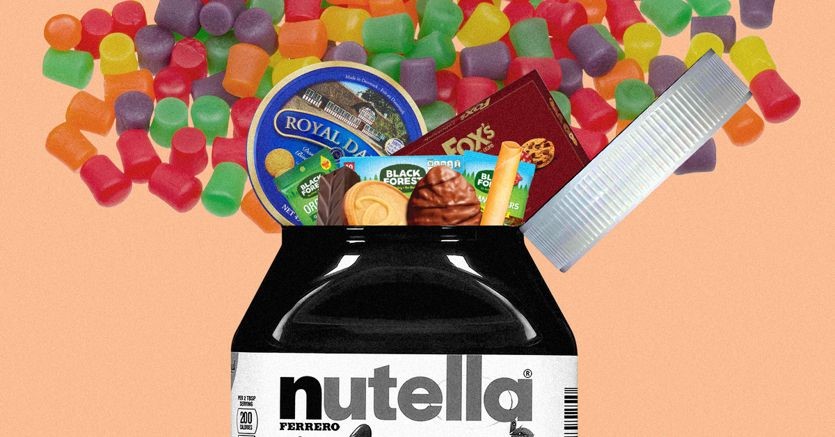
Illustration by Laura Cattaneo/Il Sole 24 Ore
It’s not just Nutella: with a mega-merger, Giovanni Ferrero creates a new group in Belgium
The Italian entrepreneur has set up a parallel structure in Brussels to the company he inherited from his father. Acquisitions of Delacre, Kelsen and Ferrara Candyover the past five years
Report
by Angelo Mincuzzi (Il Sole 24 Ore, 4 February 2021)
A ‘parallel’ Ferrero has emerged in Belgium over the last five years, far from the spotlight. It has no financial links whatsoever with the traditional Ferrero – the one behind Nutella and TicTacs – other than the fact that the shareholder is still the same man, Giovanni Ferrero, born in 1964, son of Michele, who has been at the ‘sole’ helm of the family empire since 2011 following the tragic death of his elder brother Pietro.
The “parallel” Ferrero is called CTH Invest and is based at 187 Chaussée de la Hulpe, a six-storey building housing offices and professional firms, nestled in a green area in Watermael-Boitsfort, a small municipality south-east of Brussels. It was founded by Giovanni Ferrero in July 2016 and, since then, the entrepreneur has injected €1.6 billion into its coffers through various capital increases intended to finance acquisitions.
Growth has been rapid. In five years, CTH Invest has acquired Delacre biscuits in Belgium, Kelsen butter shortbread in Denmark, Fox’s tea biscuits in Great Britain, Ferrara Candy’s gummy sweets along with some of Nestlé’s operations in the United States and, finally, an industrial ice-cream manufacturer in Spain. And now, a mega-merger points to further acquisitions in the coming months.
The mega-holding company is born
On 31 December 2020, in Brussels, CTH Invest merged with and absorbed Cdm International Holding, which was also wholly owned by Giovanni Ferrero. At the time of the transaction, CTH Invest had a share capital of over €1.6 billion and net assets of €2.8 billion. Cdm International Holding, meanwhile, had a share capital of 763 million and wholly controlled the Luxembourg-based Teseo Capital Sicav-Sif, an investment company which, in 2019, managed assets worth almost 1.9 billion euros on behalf of the Ferrero family.
The new CTH Invest now controls, directly and indirectly, assets totalling nearly five billion euros, spread across various countries. The merger proposal clearly states that the transaction ‘will facilitate access to external financing or make it easier to secure guarantees in the context of financing operations, whether for the refinancing of existing investments or the financing of new acquisitions’.
The two Ferreros
The more time passes, the clearer Giovanni Ferrero’s strategy becomes. He is the 32nd richest man in the world with a net worth of $27.4 billion according to Forbes, and 38th in the rankings with a fortune of $33.5 billion according to Bloomberg. And it is a strategy that is advancing rapidly along two parallel paths, each complementing the other.
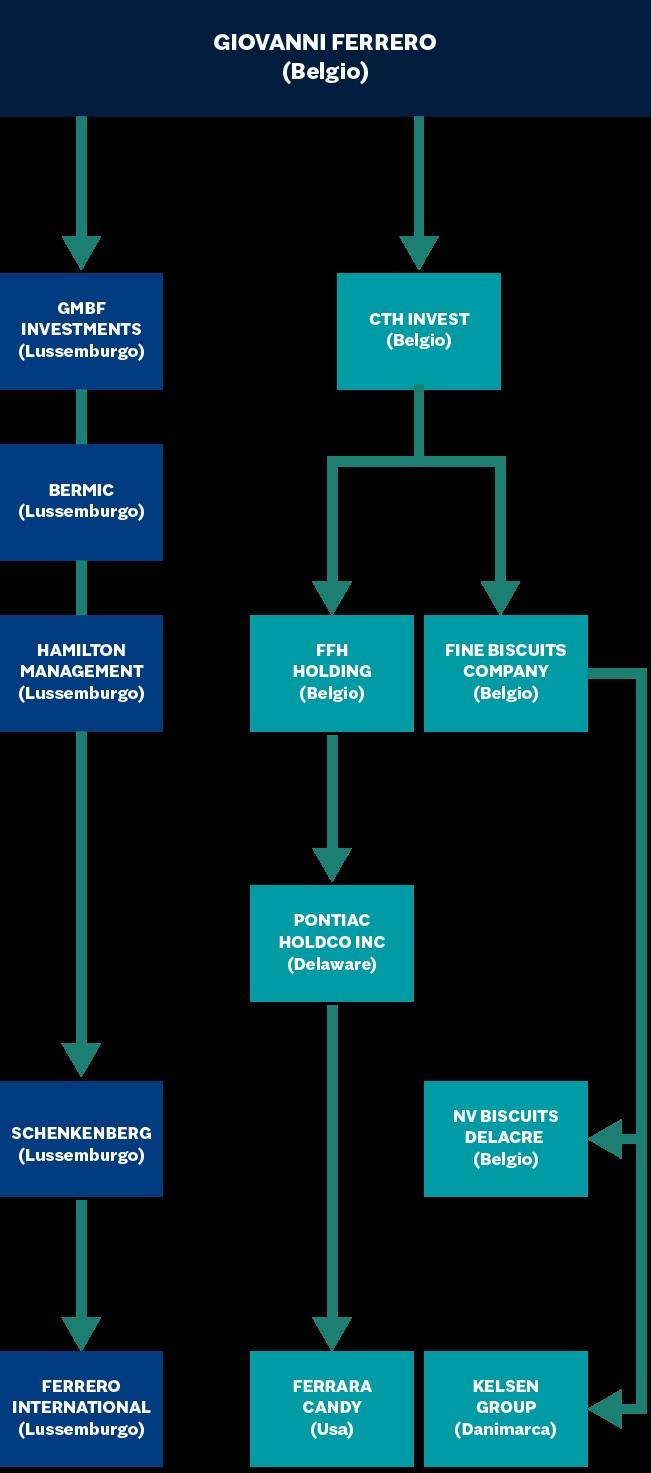
THE PARALLEL FERRERO ENTITIES
The holding companies in Belgium and Luxembourg through which Giovanni Ferrero controls the confectionery group
The two Ferrero entities operate in parallel with the aim of doubling, within a few years, the firepower of the companies headed by Giovanni Ferrero, currently the world’s third-largest confectionery group after Mars (famous for M&M’s) and Mondelez (which produces Toblerone).
As for the traditional Ferrero – the one inherited from his father Michele – Giovanni Ferrero controls 75 per cent of the shares (20.1 per cent of which are held in bare ownership) through Schenkenberg,a Luxembourg-based holding company whose existence was revealed by an investigation by ‘Fiume di denaro’ on 24.
Schenkenberg controls 100 per cent of Ferrero International, a holding company comprising 104 consolidated subsidiaries worldwide and 31 production plants. Ferrero International’s 2020 statutory financial statements closed with a profit (including dividends from the previous year) of €464.3 million, compared with €928.5 million in 2019. Also in 2019 (the 2020 figures will be available shortly), the group’s consolidated turnover had reached €11.4 billion.
Ferrero International is the first pillar of Giovanni Ferrero’s empire. It was founded in Alba in the 1940s thanks to the skill of Giovanni’s grandparents and developed under his father, Michele Ferrero, becoming a leading force in the production of chocolate confectionery. The multinational is headquartered in Luxembourg, and Giovanni Ferrero is its executive chairman, having served for several years as co-CEO alongside his brother Pietro, who died of a heart attack in South Africa in 2011. Ferrero retained the role of CEO until 1 September 2017, when he handed over the reins to Lapo Civiletti, the group’s first chief executive not to be a member of the family.
The Schenkenberg-Ferrero Group has grown mainly through internal expansion within a highly profitable segment – such as chocolate products – following the strategy of the patriarch Michele Ferrero, who prioritised internal innovation and had foregone major acquisitions so as not to compromise the quality of the group’s products.
But Nutella, Kinder and Ferrero Rocher are seasonal products. They sell best in winter. And although the Ferrero Group’s financial results have been growing steadily for years and reflect a history of undoubted entrepreneurial success, seasonality objectively represents a risk. A risk that is largely manageable, but a risk nonetheless.
The choice of Belgium
So, between 2016 and 2017 (when Civiletti took over the operational leadership of the Luxembourg-based group), Giovanni Ferrero devised a second strand: the ‘parallel’ Ferrero. And he began his acquisition drive in sectors other than chocolate, albeit with lower profit margins than those of the traditional Ferrero brands. And it is perhaps to prevent the substantial profits of the traditional Ferrero from being eroded that Giovanni Ferrero incorporated Delacre biscuits, Kelsen, Fox’s and Ferrara Candy’s chewy sweets into his private group.
The ‘parallel’ Ferrero developed in Belgium, where Giovanni Ferrero has lived since he was a teenager. During the ‘Years of Lead’, when many Italian industrialists feared kidnappings by the Mafia or the Red Brigades, Michele Ferrero decided to move his family to Belgium. Here, the Ferreros chose a villa in Rhode-Saint-Genèse – a town in Flanders between Brussels and Waterloo – as their base, and their sons Pietro and Giovanni attended a boarding school in the Belgian capital.
In 1958, Ferrero opened its first overseas sales office in Belgium, to allow visitors to the Brussels Expo at Heysel to sample Mon Chéri, the chocolate-covered cherry in liqueur. And in 1965, he launched Nutella here, followed by TicTac sweets in 1970. Brussels served as a springboard for Ferrero’s international growth, even though the headquarters were later established in Luxembourg.
Giovanni Ferrero, after studying at university abroad and gaining some international experience within the group, decided to stay in Brussels, which is just 200 kilometres from Luxembourg. And he has remained there ever since. In fact, since 2016, he has centralised all the companies he has founded since then in the building on Chaussée de la Hulpe: from CTH Invest to the numerous property companies that manage the entrepreneur’s personal assets.
The ‘American’ holding company
At the helm of the ‘parallel’ Ferrero is, therefore, CTH Invest. It is the parent holding company and controls four firms. The first is also the most important. It is called FFH Holding; it was incorporated in October 2017 and controls Pontiac Holdco Inc., a Delaware (USA) company through which the acquisitions of Ferrara Candy and the confectionery division of Nestlé USA were carried out.
Based in Oakbrook Terrace, Illinois, Ferrara Candy is the third-largest manufacturer of non-chocolate confectionery in the United States. Its best-known brands are Brachs, Trolli and Black Forest Organics fruit-flavoured organic gummy sweets. Ferrara was formed in 2012 through the merger of Farley’s & Sathers Candy Company and Ferrara Pan Candy Co. FFH acquired the company in October 2017 from the L Catteron fund, investing approximately 476 million euros. Ferrara generates annual turnover of around one billion dollars (850 million euros).
In 2019, FFH held financial assets worth €2.85 billion and ended the year with a loss of €240,000. In 2019 alone, Ferrero increased the company’s capital by €1.3 billion, bringing it to €2.28 billion.
CTH Invest’s portfolio also includes the Danish company Kelsen, famous for its Royal Dansk-branded butter biscuits, which was acquired in July 2019 for approximately 300 million dollars. In 2019, Kelsen Denmark posted a profit of 54.5 million euros, whilst Kelsen US (another subsidiary of CTH Invest) ended the year with a profit of 1.5 million.
Delacre biscuits
The latest subsidiary of the Belgian holding company is Biscuits Delacre, acquired in 2016 for around 191 million euros. The Belgian biscuit manufacturer is regarded as ‘the sleeping beauty’ amongst the acquired companies. In 2019, it made a loss of 25.5 million euros and requires some investment to be revitalised. Delacre’s accounts have been reflected in CTH Invest’s financial statements, which closed 2019 with a loss of 21.9 million euros; when added to the 12 million lost in previous financial years, this brought the company’s total losses to 34 million.
In short, for the time being, this ‘parallel’ Ferrero is not posting the record profits seen by the Luxembourg-based Ferrero (apart from 2020, the year of the Covid-19 pandemic), partly due to the lower profitability of the biscuit business compared to chocolate. But Giovanni Ferrero has all the firepower needed to get the company back on track.
The new sub-holding company
Further evidence of the importance the Belgian holding company holds for the Italian entrepreneur is the fact that CTH Invest’s activities never seem to stop. On 10 April 2020, CTH Invest created a new sub-holding company, the Fine Biscuits Company, to which it transferred its stakes in Delacre and Kelsen a month later via a capital increase of €514 million. The transaction provided an insight into the current valuation of the two companies. 100 per cent of Delacre was valued at €219.5 million, whilst 100 per cent of Kelsen was valued at €294.4 million.
On 24 December 2020, the share capital of Fine Biscuits Company was further increased by €3.7 million through the transfer of a new company, The Fine Lab, which specialises in laboratory activities related to the biscuit, chocolate and confectionery sectors, as well as research and development in these fields. The company was capitalised with €3.7 million.
The Ferrero treasure trove
To understand the significance of the merger carried out on the last day of 2020, however, we must look back at Cdm International Holding, the company that was taken over by CTH Invest. Cdm was relocated to Belgium on 30 June 2020 and was managed by Paola Rossi Ferrero, Antonio Fassinotti and Christian Chéruy. It originated in Luxembourg, where it had moved in 2016 from the British Virgin Islands, the country where it was originally founded. In Luxembourg, also in 2016, it was capitalised at 885 million euros.
The company holds a 100 per cent stake in Teseo Capital Sicav-Sif, the fund (also established in 2016) that invests the substantial dividends received by Giovanni Ferrero from the Schenkenberg holding company (which owns Ferrero International). In 2019 (the latest financial statements available), Teseo Capital reported a total net asset value of over 1.8 billion euros and is divided into three sub-funds: Capital Preservation (with a NAV of 1.13 billion), Long-term Growth (645 million) and Strategic Opportunities (97 million).
Following the merger of CTH Invest with Cdm International Holding, these assets are now managed by the Belgian super-holding company headed by Paola Rossi Ferrero.
In short, Giovanni Ferrero – an atypical entrepreneur on the global stage due to his creative sensibility, which has led him to write several novels – appears to have a very clear strategy in mind. Whilst in the traditional Ferrero (in which he holds a 75 per cent stake, with the rest of the family owning the remaining 25 per cent), he continues to follow in the footsteps of his father Michele, keeping the company firmly focused on chocolate products, in the ‘parallel’ Ferrero he pursues his own direction with greater freedom, broadening the scope of investments into sectors new to the group, such as shortbread biscuits and gummy sweets.
This strategy aims for healthy diversification but also for very rapid growth. And the merger, which went through on New Year’s Eve 2020, will most likely result in an acceleration of the entrepreneurial vision of this entrepreneur-intellectual.
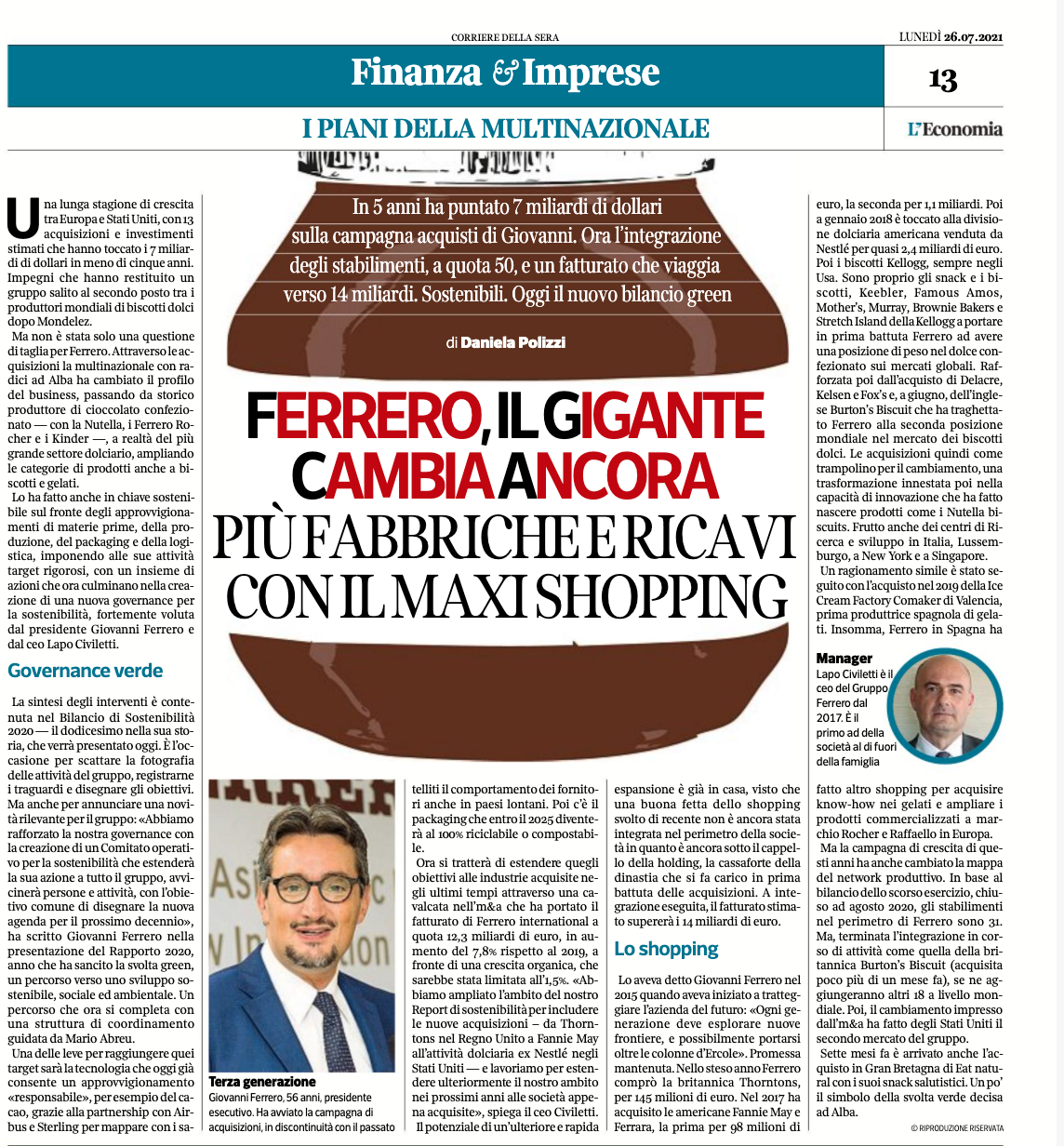
Above is an article from Corriere Economia, dated 26 July 2021, which explains Giovanni Ferrero’s strategy, in which he speaks of a ‘green balance sheet’.
Over time, we hope that Ferrero’sprogramme will include all his workers – both direct and indirect (*) – worldwide.
Anyone thinking of Ferrero, apart from hazelnuts, also considers cocoa, palm oil, etc. And they immediately think of what Nestlé is doing to abolish child labour in the cocoa sector.
The Swiss multinational has ‘taken the bull by the horns’ and has decided to allocate $1.4 billion to farmers over eight years to put an end to child labour.
Ferrero is certainly not short of money (as can be seen above and in FerreroInternational’s results : profits of 677 million).
But to draw up aplanof this kind, whichwould affect millions of children, and above all to implement it, would takeyears.
Read more on this: Ferrero has published its 13th sustainability report, in which, for example, it reports significant progress in the working practices of 134,000 farmers in Ghana and the Ivory Coast.
It is difficult, really, to understand what is happening in those distant lands.
Ferrero is also facing criticism here in Italy (Ferrero: the hazelnut policy in Piedmont is unsustainable for farmers and fails to promote Italian produce). And it is perhaps here that it should provide the first concrete answers. Ferrero has in fact stated that it would become ‘sustainable’ by 2023 with regard to hazelnuts
(*) including its suppliers, who are stakeholders defined by the Treccani dictionary as: ‘All parties, whether individuals or organisations, actively involved in an economic initiative (project, company), whose interests are negatively or positively affected by the outcome of the initiative’s implementation or progress, and whose actions or reactions in turn influence the stages or completion of a project or the fate of an organisation”.Below: the chain of custody.
Generic paternalism is no longer enough.
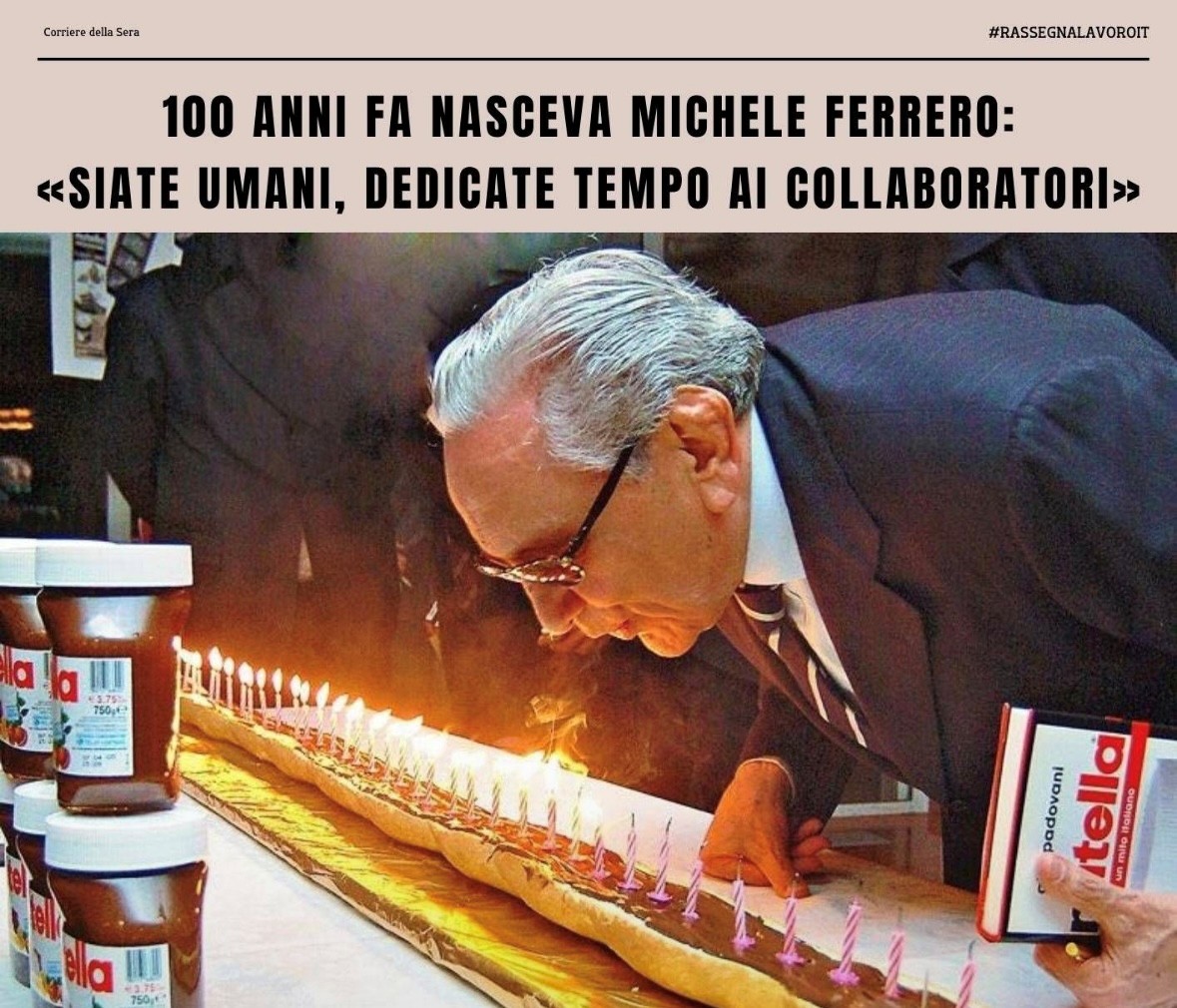
For an update, read:
Salmonella: Ferrero knew about the contamination since 15 December
Barilla and Ferrero’s Nutella among the 100 iconic grocery brands in the US
Nestlé: 1 billion Swiss francs for greener coffee and to improve workers’ conditions.
Giovanni Ferrero richer than Mark Zuckerberg. Nutella ‘worth’ more than Facebook.
Mondelez invests $600 million to source sustainable cocoa.
Unsustainable cocoa: inadequate legislation and poor traceability.
Giorgio Santambrogio: Ferrero, Barilla and Fage (yoghurt) are making a profit
Ferrero acquires Wells, the US ice-cream giant
Ferrero: rising turnover and profits in Italy
Hazelnuts: legal action to protect Lake Vico from the monocultures of Ferrero’s suppliers .
As at 31 August 2022, Ferrero International S.A., the parent company of the Ferrero Group, reported consolidated turnover of €14 billion, an increase of 10.4 per cent: Ferrero International’s scope does NOT include €2 billion from the Belgian company CTH (the parallel structure mentioned above).
Nutella: 70 per cent is sugar and palm oil, 13 per cent hazelnuts.
Ferrero tops the reputation rankings
Ferrero acquires German snack brand Nutrisun
Ferrero refinances with $1 billion
Ferrero: salmonella outbreak in Belgium halts Kinder production once again
Ferrero: €2,400bonus for employees.
Ferrero: certified raw material supply chains
Ferrero abandons hazelnut production in Australia: a loss of 70 million
Ferrero makes its debut in the frozen breakfast market with Nutella croissants
Ferrero: vegan Nutella on the way
Ferrero: €10 billion in dividends received over twenty years
France: among the best-selling Italian products in 2023, only Ferrero’s Nutella
Nutella loses court case against Nocciolata Rigoni
The Ferrero Group hits the 17 billion turnover milestone.
Unethical packaging for the vast majority of snacks, biscuits and chocolate. In the dock: Ferrero.
Ferrero launches Nutella ice cream
Ferrero, the other branch of the family, and the 100 million in profits in the safe in Luxembourg
Barilla, Ferrero and Loacker are making a major push into the ice cream market with a variety of formats and containers (read this article on ice cream too).
From Nutella ice cream to Kinderini, Ferrero’s turnover rises to 18.4 billion
Ferrero is investing in Canada to expand its plant in Ontario (April 2025)
Ferrero continues its acquisitions: it expands into France with CPK and Carambar (2025)
Hazelnuts: Ferrero’s environmental dilemma, from Turkey to Tuscia (2026).
Ferrero (with CTH) heading towards €25 billion in turnover (2026)
Ferrero International: profits of €1.2 billion.
Ferrero sets its sights on Estathé (2026)
Ferrero acquires Purely Elisabeth (directly, not through CTH, during the summer of 2026).
Below: the latest figures as at 31 August 2026. It’s a shame that *Il Corriere* got the headline wrong: 3F (Ferrero International CTH) has a turnover of €27.4 billion, not €25 billion.

Conclusion:
1)One might perhaps expect more from a market leader – not only regarding workers’ rights (in distant countries such as Indonesia or the Ivory Coast) and pollution in Italy, but also on raw materials and food labelling.
Read more on this: Barilla and Ferrero: act like leaders on raw materials and food labelling.And indeed: “We cost less than the packet of chocolates we make – it’s a disgrace”: the protest by contract workers outside Ferrero in October 2024.
2) Obviously, the fact that Ferrero has remained in Russia and is featured in ‘regime’ propaganda films to show just how beautiful and well-stocked Russian supermarkets are does not reflect well on the group.
Canada’s a plus, Russia’s a minus (although, to be fair, most companies have stayed there).
3) The latest acquisitions (Kellogg’s and Carambar – sweets and chocolate) are bold, if not reckless, because the sweet snacks market in the United States is slowing down sharply (-6.1 per cent).
There are many reasons for this: inflation, the impact of Covid-19, the use of anti-obesity drugs (GLP-1, with volume losses in some categories of up to -2.9 per cent), healthier snacks and fast-foodoffers (e.g. McDonald’s $5 promotion).
Finally , demographic factors may not have been taken into account : the population of the West is ageing at lightning speed, even though, very often, a true leader can afford to go against the grain.
The acquisition of Purely Elisabeth, on the other hand, is interesting .


