

[vc_column_textContrary to what one might think Amazon has copied – in its model – Alibaba. And not vice versa:
- Alibaba started as a marketplace: has no warehouses, it is the suppliers who deliver directly to customers.
Alibaba acts as an intermediary – and charges fees.
Under marketplace Wikipedia speaks, quite rightly, of intermediation.
- Amazon, on the contrary, has always been a direct e-commerce distributor.
And then, later, it added the marketplace , (in the US it came into being in 2000, six years after the birth of Bezos’ company).
This was also the case in Italy, where Amazon arrived in 2010 and added the marketplace the following year.
Today this % is certainly much higher.
For technical explanations on marketplaces and suppliers you can read here .
The Americans, Germans and Chinese are dominating a market that is now worth $6 trillion.
E-commerce has made the world ‘borderless’, even in food where Amazon, for example, also through Whole Foods, is bringing its products to Singapore.
Alibaba, not only invented this sales system (the marketplace) but is teaching Americans how to segment the care and beauty sector.
Perhaps we can find the answer by looking at a distant but far more advanced market than the Western online marketplaces: China.
In China, retail is now Online First. E-commerce accounts for more than 60% of total retail sales. A monstrous number if you think that in the United States, the share of e-commerce does not reach 20%.
In China, all retail passes through Online, but not from the web pages of companies, but from marketplaces: in particular JD.com, and Alibaba’s two platforms Taobao (a cross between Ebay and Amazon) and Tmall (as we shall see, an evolved and premium version of Amazon).
The commercial battle won by marketplaces
The answer to the first question, whether platforms such as Amazon will gain the upper hand over the sites of brands or retailers, can be found in the evolution of keyword research on the web. In China, people who want to buy a consumer product do not search on Baidu (the equivalent of Google) but on Taobao and Tmall. It is like searching directly on Ebay or Amazon and no longer on Google. And if you have any doubts that this is not Amazon’s strategy, try its Lens_Ai function: by framing any object with your camera, Amazon will find it and propose it to you!
The battle is won by the marketplaces. The real question is the second one: will Amazon’s model continue to be somewhat antagonistic, through its aggressive use of price leverage, to brand valorisation efforts?
Is it possible that beauty products, especially luxury ones, will continue to be described on Amazon as if they were a colander? Is it possible that the only competitive variable is price and that there is no space for collaboration and enhancement between the American marketplace and luxury brands?
Again, the answer lies in China.
…
in 2008, Alibaba launched Tmall: a high-end platform where brands could be enhanced through sub-pages that are in fact fully customisable flagship stores, with vertical storytelling pages, in-depth videos and exclusive products and experiences. All features managed exclusively by the brand owner, who also determines the price.
The case of Tmall
The success of Tmall has been resounding, for all beauty companies it has become the first sales channel in China, and subsequently also fashion houses have opened up to it, precisely because they have found themselves in an environment that enhances rather than devalues the brand, with in addition complete control of the price variable.
…
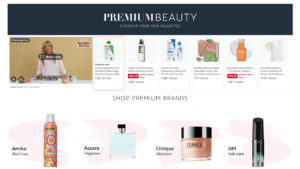
A few years ago in the United States, Amazon launched the Premium (sometimes called Luxury) Beauty Program, a programme that provides participating companies with two important advantages: price control and the almost total removal of third-party retailers, effectively giving the brand total control over brand positioning.
Successfully launched in the United States a few years ago, the big luxury beauty groups such as L’Oréal or Estée Lauder are not only no longer opposing Amazon, but are making a complete roll-out of their brands on the Amazon Premium Beauty Program, whose sales, according to Reuters, reached $15 billion last year in the United States alone, with an annual growth rate of 20%, far above the 5% average growth of online sales in the sector.
The programme was recently launched in the UK and I would expect it to be subsequently extended to continental Europe because it finally holds the key to unlocking the reticence of the big luxury groups.
…
From this point of view – of user experience – Amazon’s look and feel structure is still light years away from Tmall’s mini-sites.
The first steps are encouraging, and especially if it works in beauty, which is positioned somewhere between FMCG and luxury, this could really open the way for other categories such as fashion, accessories and design, which moreover at the moment due to the Chinese consumer crisis are looking for new ways to reach and recruit new consumers
Condividi questo articolo sui Social Network:


