[vc_column_textCompiled 21 September, updated 30 September 2025
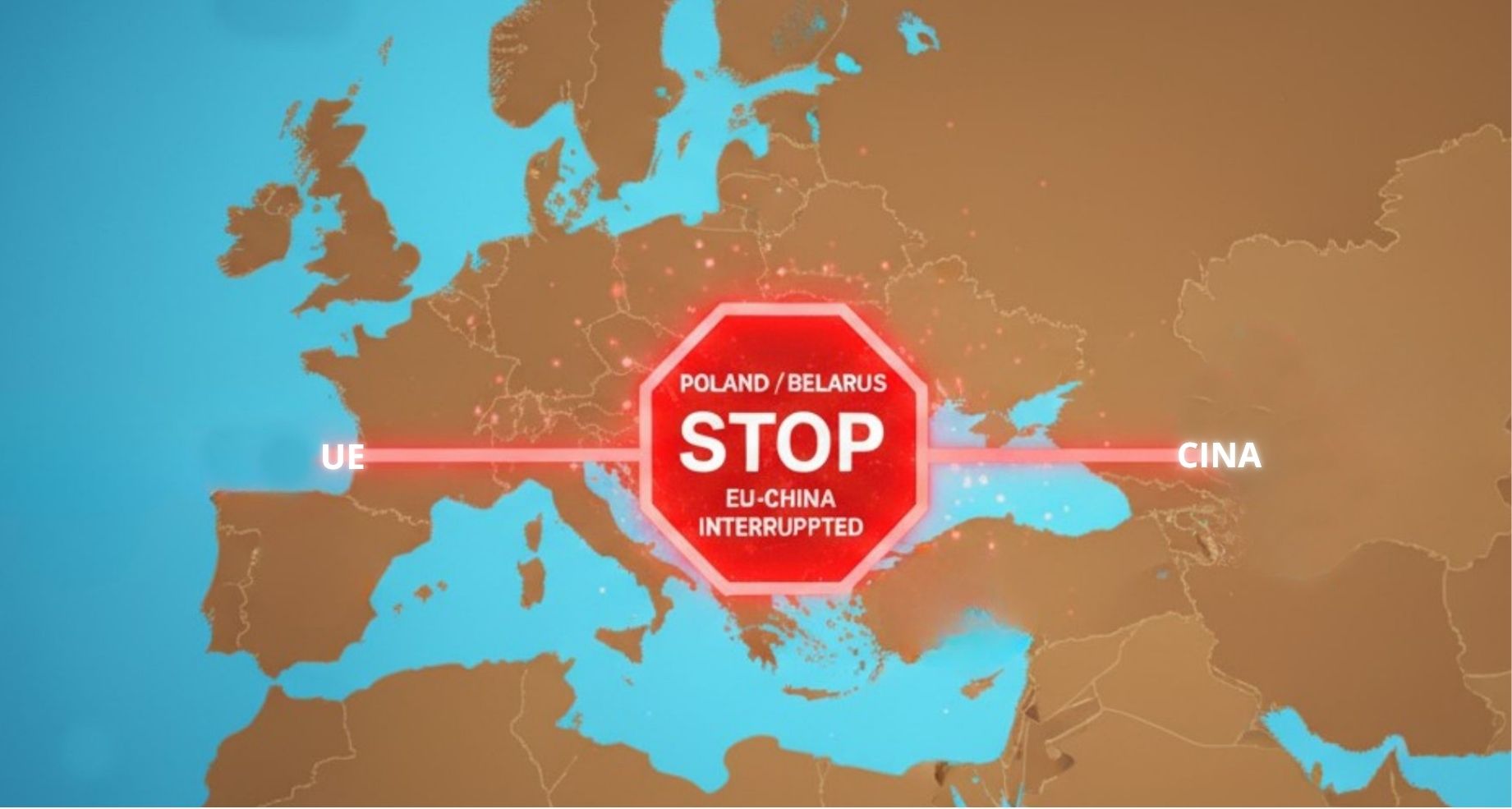
The European Commission is monitoring the possible economic impact caused by the closure of all crossing points between Poland and Belarus, which has effectively disrupted a traditional trade route between the EU and China. “We are certainly looking into this issue closely, but it is too early to go into further details,” Olof Gill, deputy spokesman for the Commission, said on Thursday, 18 September.
The response to Moscow and Minsk’s joint military exercises
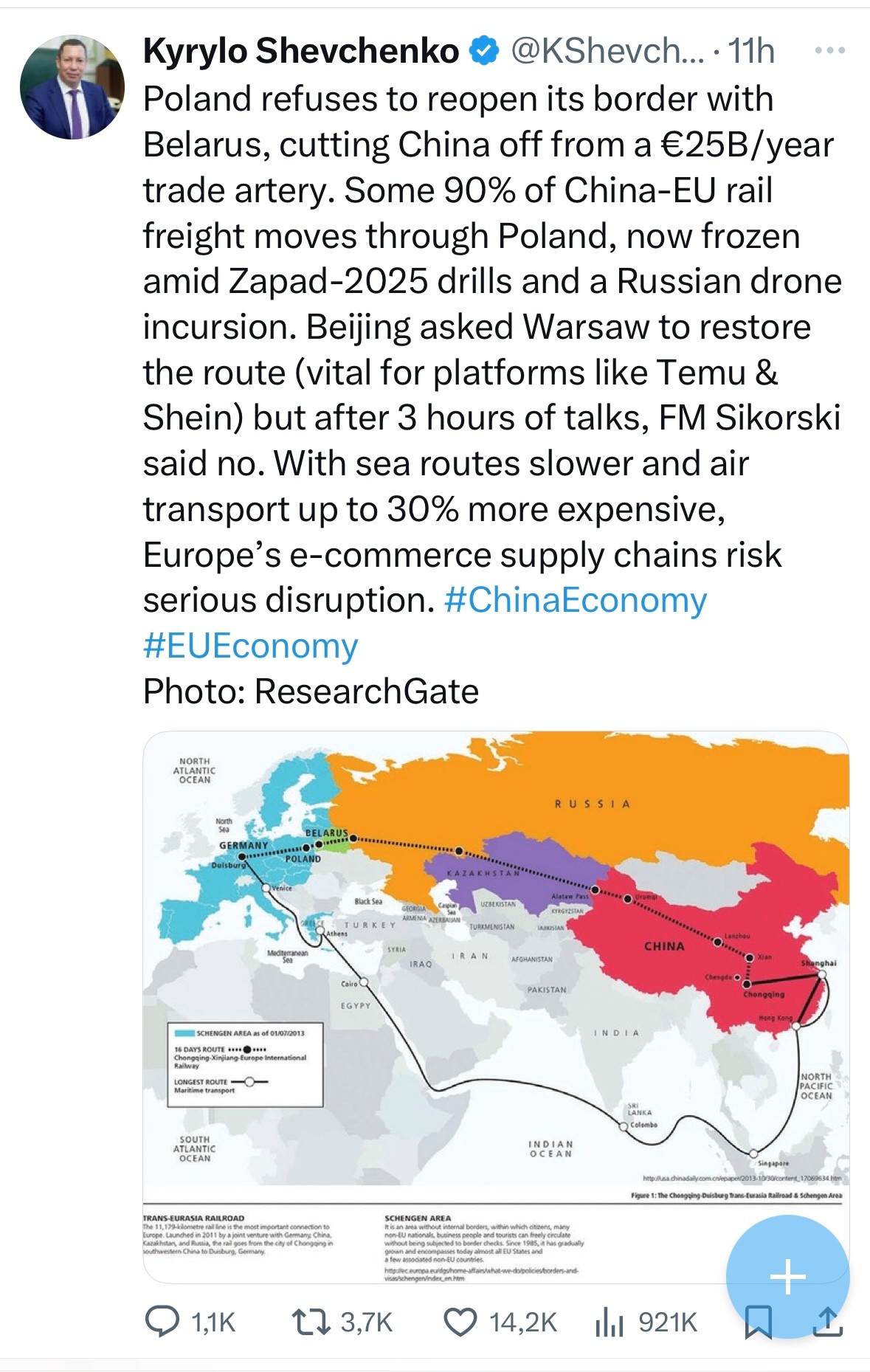
The Polish government decreed a total shutdown this week in response to large-scale military exercises conducted by Belarusian and Russian forces, known as Zapad-2025, near the border with Poland and Lithuania.
The joint exercises followed an unprecedented incursion of 19 Russian drones into Polish airspace, alarming Nato allies. Poland severely restricted road traffic with Belarus after accusing Minsk of launching an instrumentalised migration campaign in the summer of 2021. The event prompted Warsaw to install steel fences equipped with high-tech tools, deploy the army and create a forbidden buffer zone..
The closure of the rail link will affect 25 billion euro worth of goods travelling between the EU and China. The figure represents a tiny fraction of the 732 billion euro worth of goods traded between the two sides in 2024, mostly by sea..
And it does not matter that the figure is ‘tiny’ and that in the meantime the border between the two states has been reopened : there is a much bigger one behind this: the invasion of Chinese non-food products into Europe, through their marketplaces.
…In a joint declaration to be presented on Tuesday 16 September in Paris, during the Première Vision trade fair, which brings the industry together for three days, the main business federations of the European textile industry call on Brussels to be diligent in implementing its decisions to curb the rise of fast fashion in the European Union (EU).
The future of a “sector that employs 1.3 million people and represents 200,000 companies with a turnover of 170 billion euros” is at stake, says Mario Jorge Machado, president of Euratex, the European textile federation, and representative of the Portuguese industry.
In 2024, 12 million small parcels entered the EU every day, twice as many as in 2023 and three times as many as in 2022. And, according to European Trade Commissioner Maros Sefcovic, 96% of these parcels came from China, thanks to sales by Shein, Alibaba and Temu. This surge shows no signs of slowing down.
“Since the beginning of 2025, the number of small parcels imported into Europe has increased by 20% “, says Pierre-François Le Louët, co-president of the French Union of Fashion and Clothing Manufacturers (UFIMH), estimating that online sales platforms have intensified their activity following the measures taken by Washington against them, “sending to Europe what they used to send to the United States “. By decree, the US administration decided, as of 29 August, to abolish the exemption from customs duties previously enjoyed by small postal packages (consignments of goods with a value of $800 or less, or €686).
…urgent action is needed in Europe. “The questions have been asked and the problem identified for too long. We must therefore implement these measures quickly. Because the entire textile and clothing ecosystem in Europe is threatened. Ultra-fast fashion now represents 5% of the market,’ Le Louët complains.
The EU has already announced that it is considering several reforms to counter foreign platforms specialising in the direct import of clothing, footwear and everyday consumer goods at low prices. Brussels suggests bringing forward the end of duty exemptions on entry into the EU for parcels with a value of less than EUR 150.
In February, the Commission called on the Twenty-Seven to adopt without delay the customs union reform presented in 2023, which aims to strengthen the effectiveness of EU border controls. This text envisages, among other things, the end of exemption from customs duties for parcels of less than EUR 150. Brussels proposes to bring forward the initial timetable to 2026, instead of 2028. The EU executive also intends to use this legislative instrument to impose ‘processing fees’ to finance customs border controls . The amount, set at two euros in May 2025, is to be discussed with the member states and the European Parliament. “Two euros is ridiculous. We should tax each parcel at a rate of 20 euros,’ argue Le Louët and Machado.
The textile manufacturers also want their competitors to be subject to VAT. In their joint statement, they also point out that ‘VAT fraud, violations of intellectual property rights and misleading declarations are recurrent problems in the ultra-fast fashion sector, fuelling unfair competition within the single market and disadvantaging companies that respect the EU’s high social and environmental standards ‘. According to the president of Euratex, “this unfair competition must be stopped “.
The border issue between Poland and Belarus could be an opportunity to impose the regulation suggested by the EU, implement the customs union and deal with Beijing. Obviously it will not be easy given the opposition to any European construction progress by countries such as Hungary and Slovakia, for example.