

[vc_column_textDrafted 19 January, updated 22 January 2023
This is the summary, with some final considerations, of : Cooked ham: secrets for recognising quality ham. Prices from 8 to 60 €/kg
Valeria Balboni 19 December 2022 Labels & Products Comments
Cooked ham is the Italians’ favourite cured meat: in 2020 we consumed about 4 kilos of it per head, a quarter of all cured meats.
It is much loved by children, costs less than raw ham and is generally less fatty, therefore perceived as healthier.
At the time of purchase, one is spoilt for choice: there are many types and prices, for packaged cooked ham already sliced, range from 8 to 60 euros per kilo. Clearly, these are different products, but the differences are not always clear and, to understand them, one must first consider how it is produced.
Cooked ham is defined by law (*) as: “a charcuterie product obtained from the thigh of a pig, possibly cut, boned, defatted, with tendons and rind removed, using water, salt, including iodized salt, sodium nitrite, potassium nitrite, possibly in combination
Production comprises several stages: first of all, the pork legs are deboned and, if necessary, defatted.
In the subsequent ‘syringing’ phase, a brine consisting of water, salt, flavourings, sugars and preserving additives is injected into the meat through needles.
The leg is then ‘massaged’, i.e. moved with massage-like movements to make the penetration of the brine homogenous, and then placed inside a parallelepiped-shaped metal container (mould) which gives it its shape. Finally, the leg is cooked and removed from the mould to be wrapped and, in some cases, pasteurised to increase the shelf life.
The main ingredients are : pork leg (or pork meat), salt, flavourings and as additives sodium ascorbate as an antioxidant and sodium nitrite as a preservative.
In addition to these two additives, sugar (or the dextrose analogue) and sometimes glutamate, lactose and water are used in most products. More rarely, polyphosphates, used as stabilisers, carrageenan and milk proteins are used. Not all hams are the same, those of lesser value do not use the whole leg of pork, but assembled and aggregated leg parts.
The simple ‘cooked ham’ is less valuable and can be produced with aggregated leg parts
We asked the director of the Association of Meat and Cured Meat Industries(Assica) for his opinion. “Cooked ham ,” explains Davide Calderone, ” can only be prepared with the leg and not with other parts of the pig. This can be used as it is (after some minimal processing necessary to make it suitable for cooking), and in this case the main muscle strips are visible.
The alternative is to use muscles ‘cut out’ from the thighs which are processed by syringing for the insertion of ingredients. This is followed by massage and then the product is transferred into moulds to reconstruct a mass for cooking.”
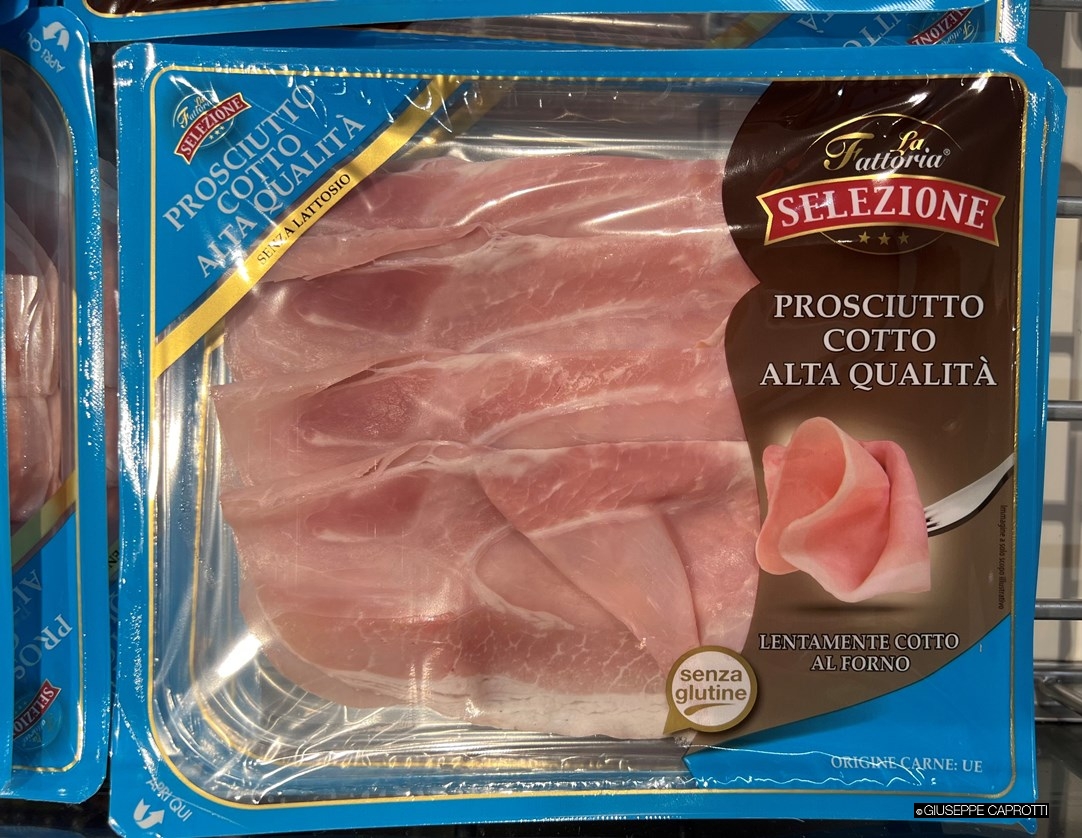
A first difference is therefore the use of leg as such or re-grouped leg parts. How can we distinguish between the two products? First of all, we have to read the label, which differentiates between ‘cookedham’ without further specifications, ‘choice cooked ham‘ and ‘high quality cooked ham‘.
These three categories are defined according to the moisture content of the defatted and dead-dried product (Uspd), a parameter related to the moisture content of the final product. In the cooked ham without further specification, the Uspd can reach a maximum of 82%, in the “selected cooked ham” it is up to 79.5%, while “high quality cooked ham” cannot exceed 76.5%.
Another important aspect is that in ” selected cooked ham” and ” high-quality ham” at least three of the four main muscles of the thigh must be “clearly identifiable”.
Simple ‘cooked ham’, on the other hand, is a less valuable sausage and can be made from aggregated leg parts (in which the muscle bands cannot be distinguished), has a higher moisture content and is presented with shinier slices, which stick together more easily.
The other thing to note is that high-quality cooked ham is subject to voluntary restrictions on the use of additives.
‘Water, ‘ explains Calderone, ‘is naturally contained in the meat and is generally around 70 per cent. The Uspd in the finished product is used as an index of quality because this apparently small difference is the result of factors such as the quality of the meat, the amount of water added with the brine, and the method used for massaging and cooking. This parameter takes into account the natural moisture content of the fresh leg, but can also vary depending on the processing the product undergoes, leading to a quality differentiation. The maximum amount of water that can be added for the technological process is set at 5%, when this is exceeded it must be declared on the label. In this case, the amount of meat in the finished product must also be specified.”
In “high quality” cooked ham, the muscle parts must be clearly distinguished
In order to distinguish one product from another, we have to see whether it is simply “cooked ham”, or “choice” or “high quality” and then see if more than 5% water has been added, remembering that the presence of water among the ingredients on the label suggests a manufacturing process whose result is a lower quality product. How many and which additives have been used must also be indicated on the label. Natural flavourings’ are extracted from raw materials of animal or vegetable origin, whereas when we find the word ‘flavourings’, it means they have been synthesised in a laboratory. The addition of the flavour enhancer glutamate or stabilisers such as carrageenan or polyphosphates suggests that the raw material is not of the highest quality…
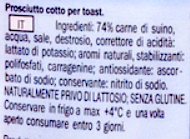
Pictured above is the label of a cooked ham sold for less than 8 €/kg.
Pork accounts for 74% and ingredients include water, dextrose, potassium lactate, polyphosphates and carrageenan.
Most of the trays we find in supermarkets contain ‘high quality cooked ham’ and prices range between 25-35 €/kg in most cases.
Cooked ham without further specifications is often indicated ‘for toast’ and sold in square packs or in slices at a price ranging between 10 and 15 €/kg. The products costing 50-60 €/kg are traditional products using special procedures, local meat and free-range pigs with animal welfare considerations. In these cases, companies focus on an aspect that cannot be discerned from the list of ingredients on the labels, i.e. the quality of the raw material, the farming methods and the characteristics of the pigs used.
Final considerations :
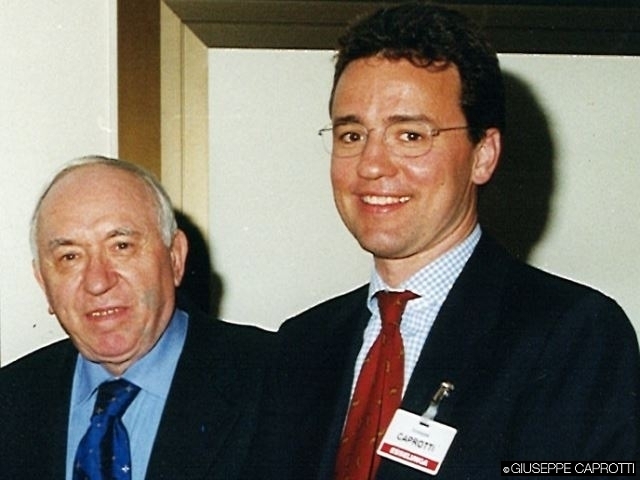
- the first lesson I was taught in the 1980s by Mr Luigi Guaitamacchi, head of meat, charcuterie, dairy and cheese purchasing at Esselunga, on the left in the photo above, was: ‘never eat toast’ (because ‘what’s inside – plain cooked ham is unhealthy’).
- the second lesson I take from this article is that you should always read product labels.This is nothing new, but it is worth repeating.
- the third is that the difference is made by the thighs, the processing, the water and the additives.
(*) Decree on Italian Salumeria of 21 September 2005 (revised in 2016). The decree specifies that: “Wine, including aromatised and liqueur wines, sugar, dextrose, fructose, lactose, maltodextrin (glucose syrup), milk protein, soya protein, native or physically or enzymatically modified starches, spices, food jellies, flavourings, as well as permitted additives may be used in the production of cooked ham.”
Below : ham for toast.


