Tuesday 11 February 2025
Giuseppe Caprotti arrives in Campania to present his book “Le Ossa dei Caprotti“, with two scheduled appointments that will allow the author to dialogue with exponents of the cultural and journalistic world. The first meeting will be held on Wednesday 12 February at 8 pm, at theHabita79 hotel in Pompei.
Giuseppe Caprotti will be the guest of Nicola Ruocco, founder and director of “Gli Incontri di Valore“, a literary salon in Pompeii, for a discussion on family memory, entrepreneurial ethics and the relationship between past and present in the business world.
The second meeting, on the other hand, will be held on Thursday, 13 February, at 6.30 p.m. at the Naples Tennis Club. It will be a multi-voice dialogue with Antonio Galdo, journalist and writer, and Roberto Napoletano, director of Il Mattino. An opportunity to delve into the story of a family and a country, amidst growth, crisis and transformation.
With “Le Ossa dei Caprotti“, published by Feltrinelli, for the first time Giuseppe Caprotti, who was dismissed from the company in 2004 after returning from the United States in 1989, exposes his truth after many years of silence.
The book talks about the protagonists of the first industrial revolution, the Caprotti family, who went from being farm owners to becoming merchant-entrepreneurs, with the production of fabrics spun in the homes of sharecroppers and labourers working on their land.
We are therefore talking about family successes, but it was only a century later that grandfather Giuseppe Caprotti, known as Peppino Caprotti, on the strength of American Marshall Plan funding and his skills, made the family fortune. That fortune will be used by the Caprotti brothers and their mother, who will use it to participate in the foundation of Supermarkets Italiani, today Esselunga, later acquiring the majority share. The author traces the history of the current company, which finds its starting point in the vision of the American magnate Nelson Rockefeller, who had a conservative but also political and social conception of business. In the post-war period, Rockefeller founded Ibec, a company that had ‘the objective of opening new business activities in developing countries’. James Hugh Angleton, father of one of the most legendary CIA agents will play an important role in Rockefeller’s Italian choices.
‘Le Ossa dei Caprotti‘ is not just the story of Esselunga. It is a portrait of more than three centuries of Italian history, with American ‘interference’. There is ‘everyone’, in a large extended family: from Giuseppe Caprotti, the first industrialist, to Peppino Caprotti, the author’s grandfather, the architect of the family’s economic and social rise in the post-war period, to Marco Brunelli, the trait d’union between Rockefeller and the Italian partners and the first president of Supermarkets Italiani. Guido Caprotti is the protagonist of this adventure: he and Brunelli, after starting Esselunga, later founded GS, one of the most important Italian chains.
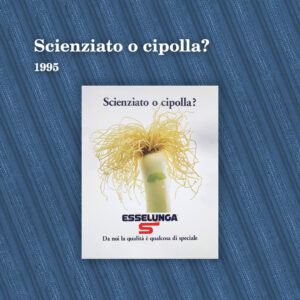
And of course there is Bernardo, who, with a series of trusted managers, will be the main character of the 1960s, 1970s and 1980s. Finally, we come to Bernardo’s children, Giuseppe and Violetta, protagonists of the great innovations of the 1990s and early 2000s. From superstores to organic and e-commerce, passing through Fidaty to historical advertisements such as ‘John Lemon‘, ‘Scientist or Onion‘, ‘Garlic and Oil‘ and ‘Sitting Leek‘.
Recurring and painful family feuds are also reconstructed in the book. Among these, the most dramatic is that of great-grandfather Bernardo Caprotti against his brother Emilio, when the Caprottis were cotton industrialists. Another conflict was that of Giuseppe’s father, Bernardo, with his brothers Guido and Claudio and his mother Marianne. And finally the conflict between Bernardo himself and his children Giuseppe and Violetta. Conflicts, these, never resolved, of which in fact the author speaks with regret.
Today, Giuseppe Caprotti, is president of the Guido Venosta Foundation. The Foundation was established on 27 June 2000 and honours the memory of Guido Venosta, promoting and contributing to the education of the public towards cultural ideals and solidarity.
Guido Venosta, the author’s grandfather, was one of the creators ofAirc, the Italian Association for Cancer Research, which he managed from 1966 to 1996. The Foundation operates along four guidelines: health protection, scientific research, promotion of culture and solidarity. After pain then, social commitment.
Below one of the Armando Testa advertisements cited in the article.