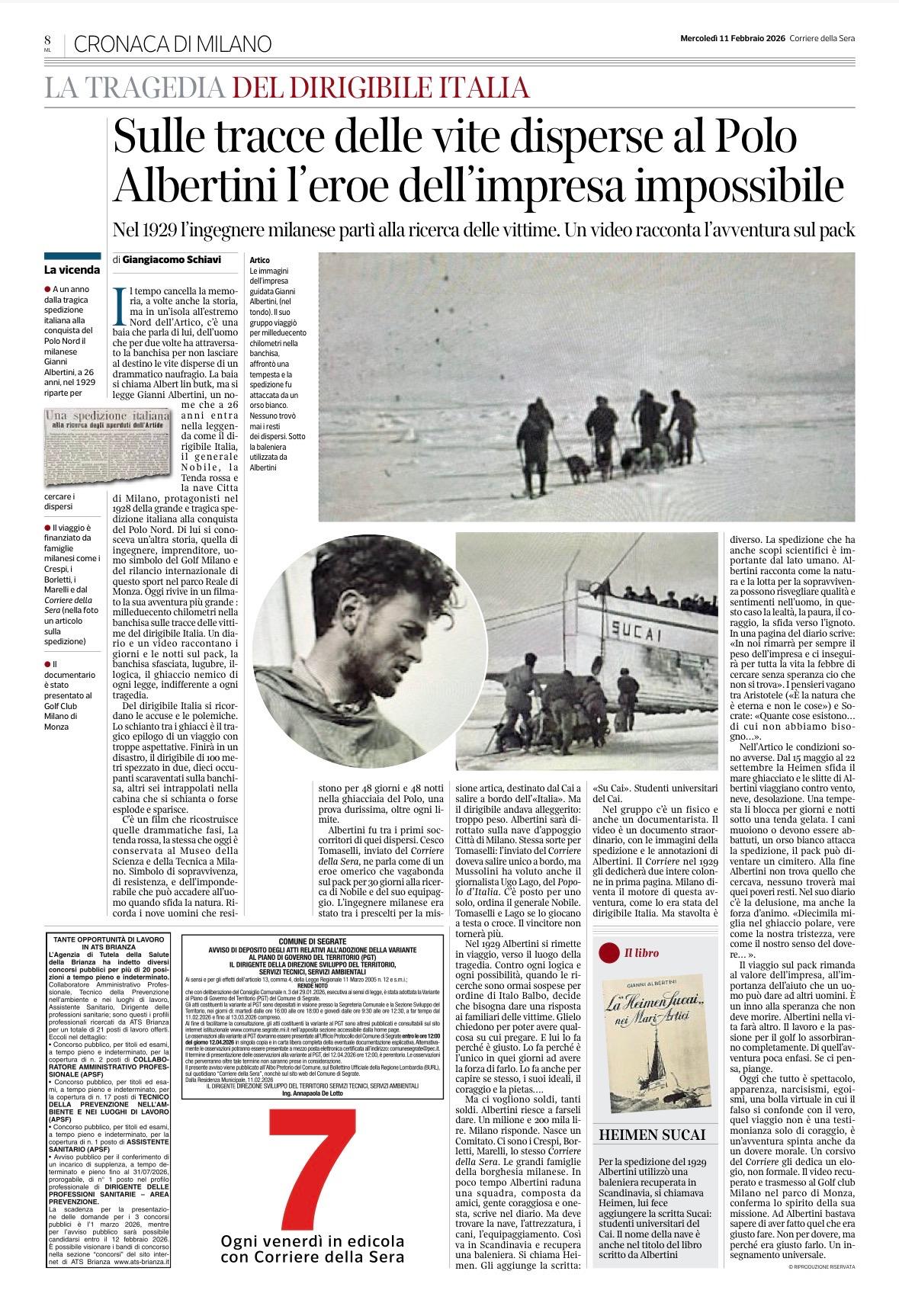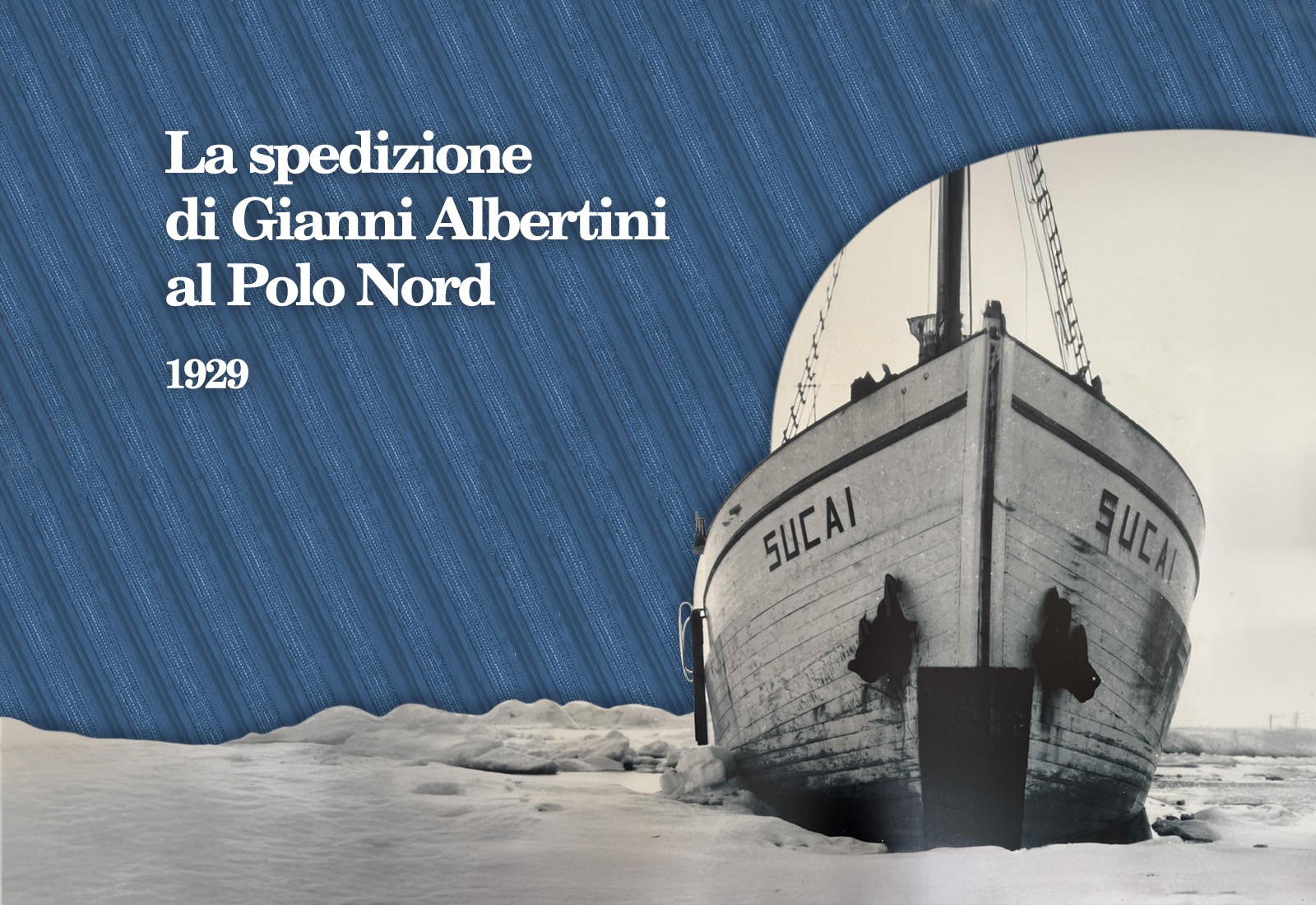
In 1929, Gianni Albertini, husband of my great-aunt Ida Quintavalle, set off across the Arctic pack in search of the missing crew of Nobile’s airship Italia: an almost impossible feat. The Corriere della Sera recounts the story:
Extract from il Corriere della Sera of 11 February 2026
… The airship Italia is remembered for its accusations and controversy. The crash into the ice is the tragic epilogue of a voyage with too many expectations. It ends in disaster, the 100-metre airship broken in two, ten occupants thrown onto the ice floe, six others trapped in the cabin that crashes or perhaps explodes and disappears.
There is a film that reconstructs those dramatic phases, The Red Tent, the same one that is now in the Museum of Science and Technology in Milan. A symbol of survival, of resistance, and of the imponderable that can happen to man when he challenges nature. It recalls the nine men who resisted for 48 days and 48 nights in the icebox at the Pole, a very hard test, beyond all limits.
Albertini was among the first rescuers of those missing. Cesco Tomaselli, correspondent of the Corriere della Sera, speaks of him as a Homeric hero wandering the pack for 30 days in search of Nobile and his crew. The Milanese engineer had been among those chosen for the Arctic mission, destined by Cai to board the ‘Italia’. But the airship had to be lightened: too much weight. Albertini was diverted to the support ship ‘Città di Milano’. The same fate befell Tomaselli: the Corriere correspondent was to be the only one on board, but Mussolini also wanted the journalist Ugo Lago, from the Popolo d’Italia. There is only room for one, ordered General Nobile. Tomaselli and Lago went head-to-head. The winner will never return.
In 1929, Albertini set off again, towards the scene of the tragedy. Against all logic and every possibility, when the search is now suspended by order of Italo Balbo, he decides that the families of the victims must be given an answer. They ask him in order to have something to pray about. And he does it because it is right. He does it because he is the only one in those days who has the strength to do so. He also does it to understand himself, his ideals, courage and pietas….
But it takes money, lots of money. Albertini manages to get it. One million two hundred thousand lire. Milan responded. A committee was born. There are the Crespi, Borletti, Marelli, the Corriere della Sera itself. The great families of the Milanese bourgeoisie. In a short time Albertini gathered a team, made up of friends, brave and honest people, he wrote in his diary. But he has to find the ship, the equipment, the dogs. So he goes to Scandinavia and retrieves a whaler. It is called Heimen. He adds the inscription: ‘Su Cai’. Cai university students.
In the group there is a physicist and also a documentary filmmaker. The video is an extraordinary document, with images of the expedition and Albertini’s annotations. The Corriere in 1929 will dedicate two entire columns to it on its front page. Milan became the driving force behind this adventure, as it had been for the airship Italia. But this time it is different. The expedition, which also has scientific purposes, is important from the human side. Albertini tells how nature and the struggle for survival can awaken qualities and feelings in man, in this case loyalty, fear, courage, the challenge to the unknown. On one page of the diary he writes: ‘In us the weight of the undertaking will remain forever and the fever of hopelessly searching for what cannot be found will chase us all our lives’. Thoughts wander between Aristotle (‘It is nature that is eternal and not things’) and Socrates: ‘How many things exist… that we do not need…’.
In the Arctic, conditions are adverse. From 15 May to 22 September, the Heimen defies the icy sea and Albertini’s sledges travel against wind, snow and desolation. A storm strands them for days and nights under a frozen tent. Dogs die or have to be put down, a white bear attacks the expedition, the pack can become a cemetery. In the end Albertini does not find what he was looking for, no one will ever find those poor remains. In his diary there is disappointment, but also fortitude. “Ten thousand miles in the polar ice, as true as our sadness, as true as our sense of duty… “.
The pack voyage refers to the value of the enterprise, to the importance of the help that one man can give to other men. It is a hymn to the hope that must not die. Albertini will do other things in life. His work and passion for golf will absorb him completely. Of that adventure little emphasis. If he thinks about it, he cries.
Today, when everything is spectacle, appearances, narcissism, selfishness, a virtual bubble in which the false is confused with the true, that journey is not just a testimony to courage, it is an adventure driven also by a moral duty. An italic in the Corriere dedicates a praise to him, not a formal one. The video recovered and broadcast at the Milan Golf Club in Monza Park confirms the spirit of his mission. It was enough for Albertini to know that he had done what was right. Not out of duty, but because it was right to do so. A universal lesson.
Gingiacomo Schiavi