[vc_column_textArticle compiled 29 November 2020, updated 3 December 2024.
This article from 2020 is still relevant as it tells the most fascinating story of Black Friday.
You will find data on the current situation (2024) at the bottom.
Amazon’s growth is increasingly overwhelming, also in its employment dimensions: 427,000 hires during the pandemic, in America alone.
That is the equivalent of the entire population of Dallas, notes the New York Times. Black Friday Cyber Monday will confirm the triumph of online commerce, an engine of American recovery. Actually, during the pandemic, the boundaries between Black Friday and Cyber Monday become increasingly mobile. Once upon a time – which now seems like prehistory to us – the distinction was very clear: on the day after Thanksgiving, ladies would scuffle in department stores tearing into each other’s clothing in the run-up to sales.
The following Monday, young ‘digital natives‘ would pounce on online specials, favouring computers and video games. But the only ‘traditional’ big retailers holding out in the US are those that have invested the most in digital commerce, see WalMart for example. The rate of digital innovation is what determines the life or death of companies, everyone in America understood this even before the coronavirus. Today this means that distinguishing between brick-and-mortar sales and Amazon sales no longer makes much sense.
We will do the maths on Tuesday to find out whether this long festive period has lived up to its promises of a buoyant consumer recovery and whether the sprint between now and Christmas will boost growth in the world’s richest economy.
A linguistic-historical notation: Black Friday, as you may know, is an expression that originated because traditionally large American retailers arrived on this date having covered all costs (wages and salaries, rent, supplier payments, interest on loans, and taxes).
Everything they sold from Black Friday onwards was pure profit, until 31 December, and thus brought their budgets into the black. Again, this is a time scale that will have to be verified in the light of the new relationship of forces, between online and traditional trade.
Finally, a note on logistics. Since the Second World War, a hidden force of the United States has been there. If Amazon was born in the US rather than in Europe, it is also due to the fact that Ups and FedEx gave the US market superior fluidity.
It isan ancient story, beginning with the Normandy landings in 1944, the invention of the container in 1956, later adopted by the Pentagon for troop supplies in Vietnam (1965-75). Civil economy and military-industrial complex have accompanied the development of the logistics industry, which only in the last decade China has managed to imitate to perfection. Mastering logistics is a strategic weapon on which the American economy can still rely.
Federico Rampini – Republic Santa Cruz, California, 27 November 2020

Thanks to Guido Barendson.
In 2024, Amazon anticipated discounts, as did retailers with sales, while ‘US retailers extend Black Friday deals to lure shoppers down‘… Sales of non-food units fell by 3% year-on-year in the week ended 16 November, according to data from Circana, which compiles data from retail outlets (Walmart, Amazon, Target and Macy’s ,for example).
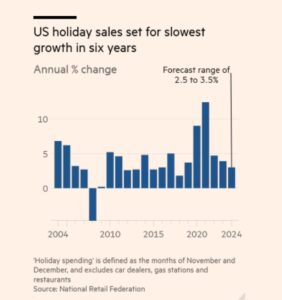
The National Retail Federation predicts that winter holiday sales will reach nearly $1 trillion in the US in November and December, a record $902 per person.
But the growth rate of spending is expected to be around 2.5-3.5%, the slowest since 2018.
Inflation weighs like a boulder.
Read also :
Black Friday : USA , the non-food crisis.E-commerce grows (9 per cent) and above all US consumers spend a record $10.8 billion on Black Friday, up 10.2 per cent from the previous year.(This masked markedly different trends in e-commerce and physical shops. While online retail sales increased 14.6 per cent year-on-year, in-store sales rose only 0.7 per cent, Mastercardsaid ).