Edited 31 October, updated 2 November 2024
Young people really don’t care about food made in Italy: spending data prove it
Young people aged between 18 and 35 care little whether the food they buy is Made in Italy or not. This is what the Coop Report, which highlights their food interests, tells us.
Young Italians care very little about Made in Italy. Excuse the immediacy, but the Coop Report 2024, which analyses consumption and lifestyles in the Boot, has recently come out, and the data is glaring: to the question “Do the following factors influence your food purchasing decisions?”, the answer “Made in Italy product” gets a paltry 12%. Who now tells Minister Urso, who last April instituted the ‘Made in Italy Day ‘ to celebrate ‘the excellence, creativity and ingenuity that distinguish Italian products in the world’?
Seasonal products, but cheap
It makes little difference to young people whether the food they buy was made in Italy or Papua New Guinea. But what are young people interested in at the table then? Let us first specify a couple of things. We are talking, in this case, about the 18-35 year olds who have already left the nest and who mainly highlight two appeals to the above question: ‘Seasonal product‘ (58%) and ‘Lowest price‘ (51%). Not exactly a contradiction, but certainly an interesting pair.
If on the one hand the seasonality of ingredients is at heart and therefore, we presume, a healthier and perhaps even more sustainable cuisine (and this interests Italians quite a lot – we will tell you about this in another article shortly), on the other hand the need to buy at the lowest possible price highlights some kind of economic and psychological discomfort. Yes, because although the Report underlines a certain recovery of the Italian economy, it also reveals that we consider our wages to always be insufficient, first and foremost with respect to the cost of living (and therefore also of food). But the unease is also psychological, we said, because the prevailing state when thinking about the future is disquiet.
Generational gaps
But let us return to our core business: the table. We talk about age and a comparison between generations is in order – and the Coop Report provides us with juicy data in this regard. The most interesting is the identification with food style: just under 40% of those under 35 feel represented by a cuisine made up of “only new identities“. Green light therefore to ethnic, organic, vegan or other specific food. The over-55s, on the other hand, remain more hung up on ‘traditionand territory‘ (30% of them), while the mixed ‘tradition and new identities’ interests 35% of this group.
The trend in our country in 2023 was: – 4.5% by volume for ‘Italian products’ (GS1 data, page 15 ) .
Conclusion:
1) the first to produce Italian sounding (fake) products are the Italians, the case of tomato is quite emblematic .
2) I am telling you this from someone who has used and ‘abused’ Italian flags for years: it is an outdated marketing, not very credible, given that we are major importers of raw materials (wheat, oil, rice, tomato, meat, milk).
3) there are those who now move differently: Mix Markt conquers Italy without ‘Made in Italy’ with over 70 shops.
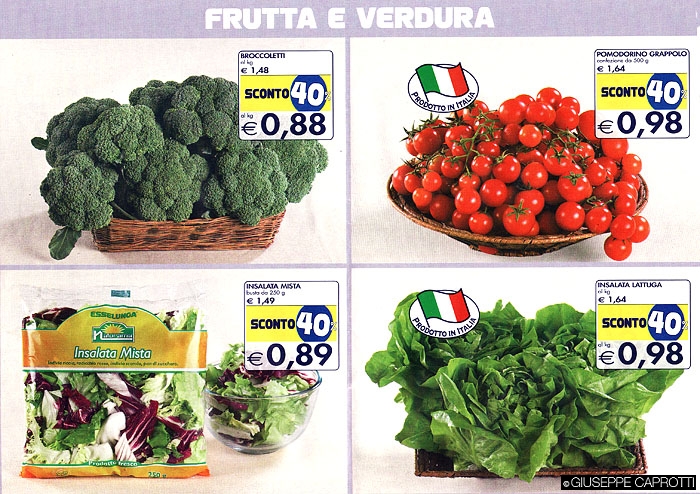
Under the old ‘Made in Italy’ flag on Esselunga fruit and vegetables, which we developed with Dr Claudio Arnoldi, some 20 years ago. We used it mainly on the products of the Esselunga Bio line that we launched back in 1999.