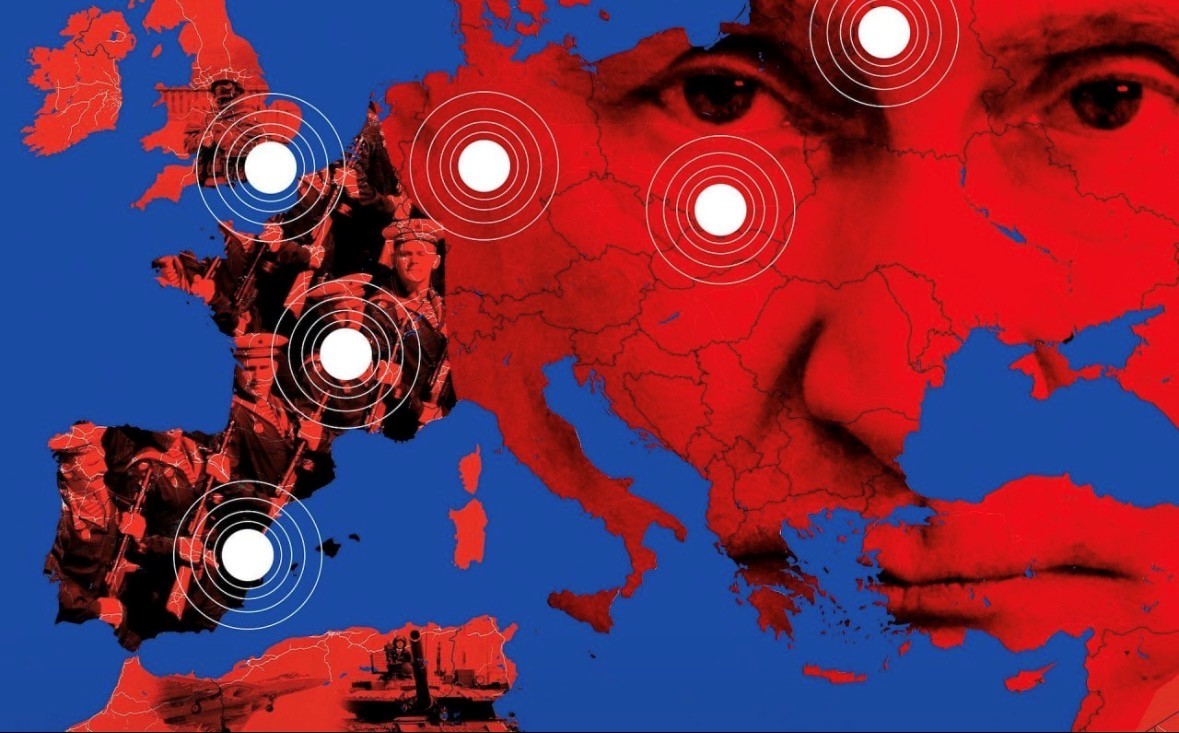
The context is that of a hybrid war, in which Russia attacks NATO countries or those in the former Soviet blocon a daily basis , as in the case of Moldova.
Putin is pushing hybrid threats to the brink of conflict with Europe
A cache of Russian weapons has just been discovered in Germany.
Against a backdrop of war, the Meloni government and the Vatican are promoting ‘pacifist dialogue’ with Putin
… Behind the master of ceremonies of this trial of the depraved, corrupt and anti-religious West will parade a gallery of Iranian ayatollahs, red-brown generals, geopolitical soothsayers, clerical-fascists of yesteryear and the 2.0 variety, reactionary cardinals, revolutionary pacifists and an assorted sovereignist menagerie of robes, skullcaps and laticlavi, all rejoicing at the funeral of the old world and the baptism of the new post-Enlightenment era. Just read the names and you’ll understand.
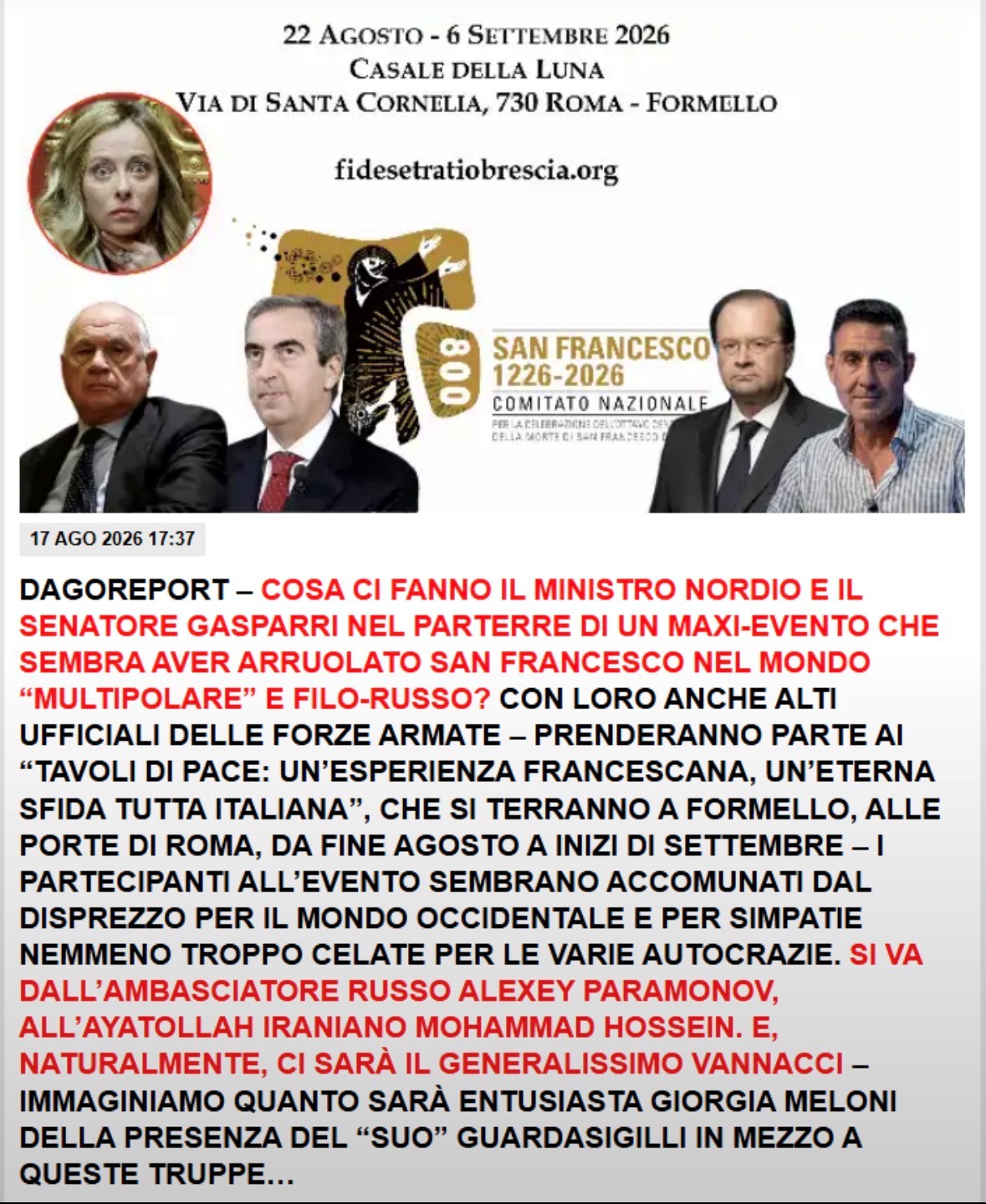
A partial spoiler for the laziest among you. Of course they’re there – how could they be missing? – Roberto Vannacci, Lucio Caracciolo, Michele Santoro, Marcello Foa and Simone Pillon.
But there are also Cardinal Angelo Bagnasco (who will be celebrating sixty years of priesthood on that occasion) and the Prefect Emeritus of the Holy Office, Cardinal Gerhard Ludwig Müller; Generals Maurizio Boni and Marco Bertolini; Public Prosecutor Nino Di Matteo, Coldiretti President Ettore Prandini and Family Day leader Massimo Gandolfini; MPs Paolo Inselvini (Fratelli d’Italia) and Maurizio Gasparri (Forza Italia); the former Italian Ambassador to Moscow, Giorgio Starace, and the current Ambassador to the Holy See, Francesco Di Nitto, as well as His Excellency Ayatollah Mohammad Hossein Mokhtari, Ambassador of the Islamic Republic of Iran to the Holy See, accompanied by Ali Asghar Soltanieh, a former negotiator for Tehran at the International Atomic Energy Agency in Vienna – two well-known experts in peace talks.
Amidst this splendid pacifist circus, the figure of Justice Minister Carlo Nordio stands out; he will be discussing the ‘anthropological-legal crisis of the West in the light of the trial of Jesus of Nazareth’ – no small matter.
It would be a grave mistake to treat these farcical displays of parallel diplomacy and these strategies of influence, blessed by Heaven and the cardinals, as a ridiculous and irrelevant spectacle. It is ridiculous, but it is highly relevant. Long before the start of the large-scale invasion of Ukraine, Russia – just like ‘America Maga’ – had infiltrated and often directly instigated religious and para-religious organisations, turning them into vehicles for anti-liberal propaganda centred on the corrosive effect of the rule of law.
The recognition of individual freedom on ethically sensitive issues and the constitutional limitation of state power are placed in the dock as the cause of the erosion of belonging and identity, the weakening of social cohesion, and the perversion of public ethics and the principle of authority.
The trade-off between the force of law and the law of force is then transferred from the realm of individual relations (such as on issues of sexual, family and reproductive ethics) to that of international relations, where it pits the fragility and disorder of free and cooperative relations between states (that is, something akin to the rule of international law) with the solidity and order of blocs built upon balances of power and justified solely by it.
The step from defending the so-called traditional family to defending the Russkij Mir is much shorter than one might think. The Italian right, including the so-called ‘pre-Vannacca’ wing, has long understood this; indeed, up until 2022, it openly flirted with Putin’s brand of religious traditionalism and largely accepted – if not justified – the occupation of the Donbas and the annexation of Crimea, railing against the ‘mad sanctions’ against Russia, which it claimed were the result of ‘blackmail from Brussels’ (Giorgia Meloni, 2018), and even hailing Putin as ‘one of the best statesmen in the world’ (Matteo Salvini, 2019).
So, are we returning to the past?