Drafted 31 October 2024, updated 2 March 2026
Chinese imports damage the ‘dignity’ of Italian tomatoes, says Mutti boss
Francesco Mutti urges protection for farmers affected by ‘unfair’ competition from China’s Xinjiang region.
Chinese imports damage the ‘dignity’ of Italian tomatoes, says Mutti chief.
The Italian tomato sauce tycoon has urged Brussels to protect farmers from “unfair” competition from cheap pasta produced in China’s Xinjiang region and restore the “dignity” of Italy’s staple red fruit. Francesco Mutti, CEO of the eponymous producer of ingredients including passata, pulp and canned tomatoes, said an EU ban or high tariffs on imports of Chinese products were necessary to safeguard Italian farmers. In 2021, the US banned tomato paste imports from Xinjiang citing concerns over forced labour, but Brussels did not follow suit.
“We should stop the import of tomato paste from China or add a 60 per cent tax on it so that its cost is not so different from that of Italian products,” Mutti told the Financial Times at the headquarters of his 125-year-old family business, which last year had a turnover of €665 million.
He warned that the Italian tomato industry risks being undermined by tomato paste produced by Chinese state-owned enterprises in Xinjiang, where the UN human rights commissioner has documented widespread rights violations against the local Uighur Muslim minority, including forced labour. Beijing denied the allegations. Francesco Mutti: ‘We must protect [our farmers] from unfair competition’ .
The fourth generation to run the company on the outskirts of Parma, Mutti criticised Brussels for forcing farmers to adhere to strict sustainability rules without protecting them from ‘environmental dumping’ from China. “We must teach our farmers how to grow better, but we must also protect them from unfair competition,” said Mutti, whose company uses only Italian tomatoes. “Otherwise the end result will not be to improve the environment, but to move our production abroad, where the environment is not protected.”
China is estimated to account for nearly 23% of global tomato production this year, up from about 18% in 2023, according to the World Processing Tomato Council.
Cheap imports are a sensitive issue in Italy, the world’s third largest producer of tomatoes after the US and China. Chinese tomato paste costs half as much as Italian products.
Last spring, Coldiretti, the influential Italian farmers’ association, sent a flotilla of small boats to protest against the unloading of tonnes of Chinese tomato paste in the port of Salerno. “Competition today is not fair because over 90 per cent of Chinese tomatoes are produced in the Xinjiang region and the labour costs are very, very low,” said Luigi Pio Scordamaglio, Coldiretti’s director of international affairs. “This is unacceptable from an ethical point of view, but also in terms of competition.”
The Chinese foreign ministry reiterated that the claims of forced labour in Xinjiang are “a lie” used by some countries, including the US, to undermine China and suppress the development of Chinese industries. “It is hoped that European individuals and institutions will recognise the harmful schemes behind the lie of so-called ‘forced labour’, refrain from tarnishing China’s image and not use this as a pretext to implement trade protectionist measures,” the ministry said.
Xinjiang’s large, export-oriented tomato industry has grown as part of Beijing’s economic development strategy for the restless western region. Major players in the industry include ChalkIS, a corporate affiliate of the sixth paramilitary Xinjiang Production and Construction Corps, and COFCO Tomato, a subsidiary of a large state-owned agribusiness conglomerate, according to the University of Nottingham Rights Lab and the companies’ websites.
COFCO says its 12 processing plants have the capacity to produce 300,000 tonnes of bulk tomato paste each year. About 13% of the bulk tomato paste produced in China is shipped to the EU, particularly Italy, where it is further processed – by dilution or blending with local tomato products – and repackaged, mainly for re-export, according to the Nottingham Rights Lab.
Italy’s strict food labelling laws prohibit the marketing of diluted Chinese tomato paste as passata, but the incentives to cheat can be tempting, given the price difference.
Coldiretti is lobbying for Europe to adopt stricter food labelling laws – requiring the identification of the origin of the main ingredients in processed foods – which it believes would allow consumers to make informed choices. Mutti also supports such rules, which are necessary ‘particularly for a product where the tomato is the most important element,’ he said. “The goal is to give tomatoes their dignity,” Mutti insisted, “to take a product that has often been considered a commodity and say, ‘no, tomatoes count!'”
Francesco Mutti , president of Centromarca (Confindustria) would be 100% right if:
1) Italy on food labelling had not made a lot of trouble. For an update on this you can read The NutrInform Battery, Italy’s answer to food labelling Nutri- score : a total political and operational failure (announced)
3) our country did not profusely exploit workers in the fields.
On Xinjiang read what happens in non-food with Shein.
On the exploitation of workers in Italy read
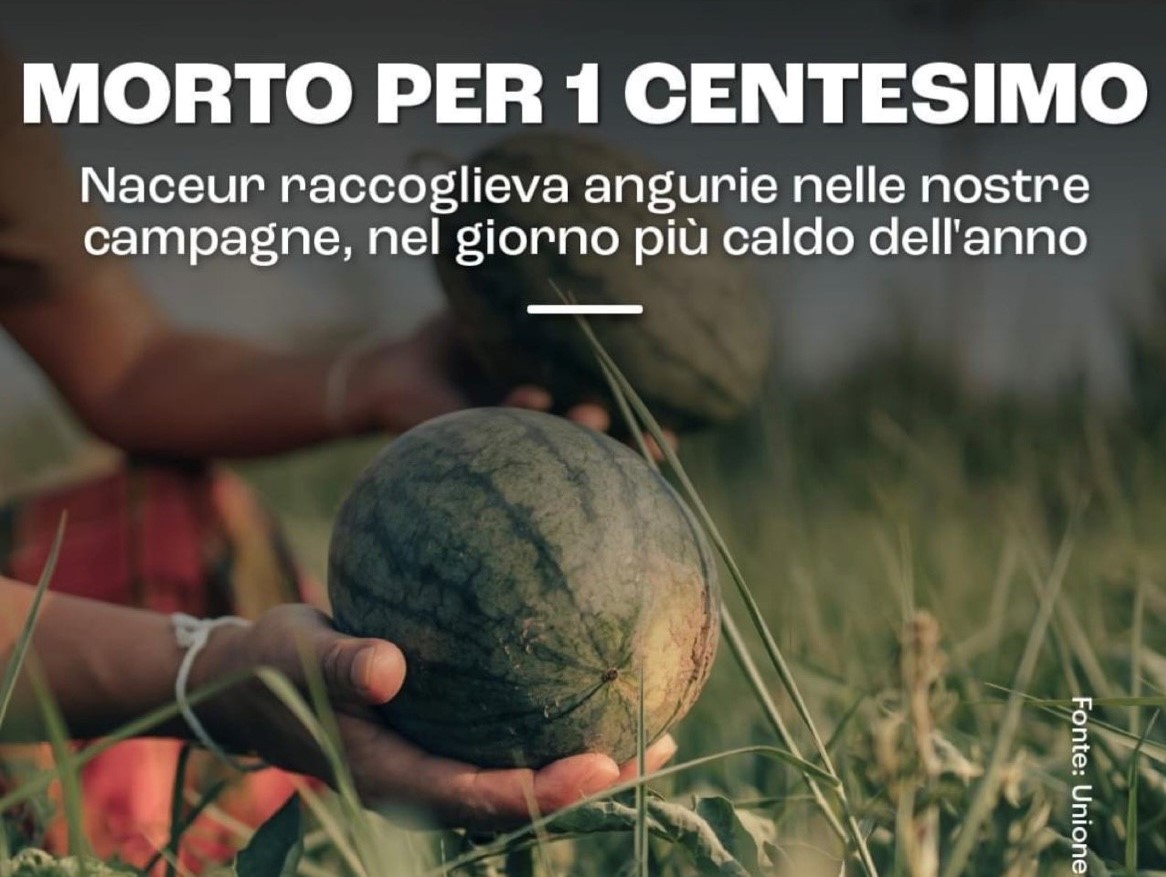
Naceur died on the hottest day of the summer while picking watermelons for 1 cent a kilo.
Caporalato in the Mantuan fields and greenhouses: 11 out of 14 companies are illegal
Veneto: corporalism and unfair practices in the large-scale retail trade
Corporalism in the Mantuan area: two Moldavians arrested and two Italians under investigation
The bitter side of citrus fruits: the exploitation of workers in the fields
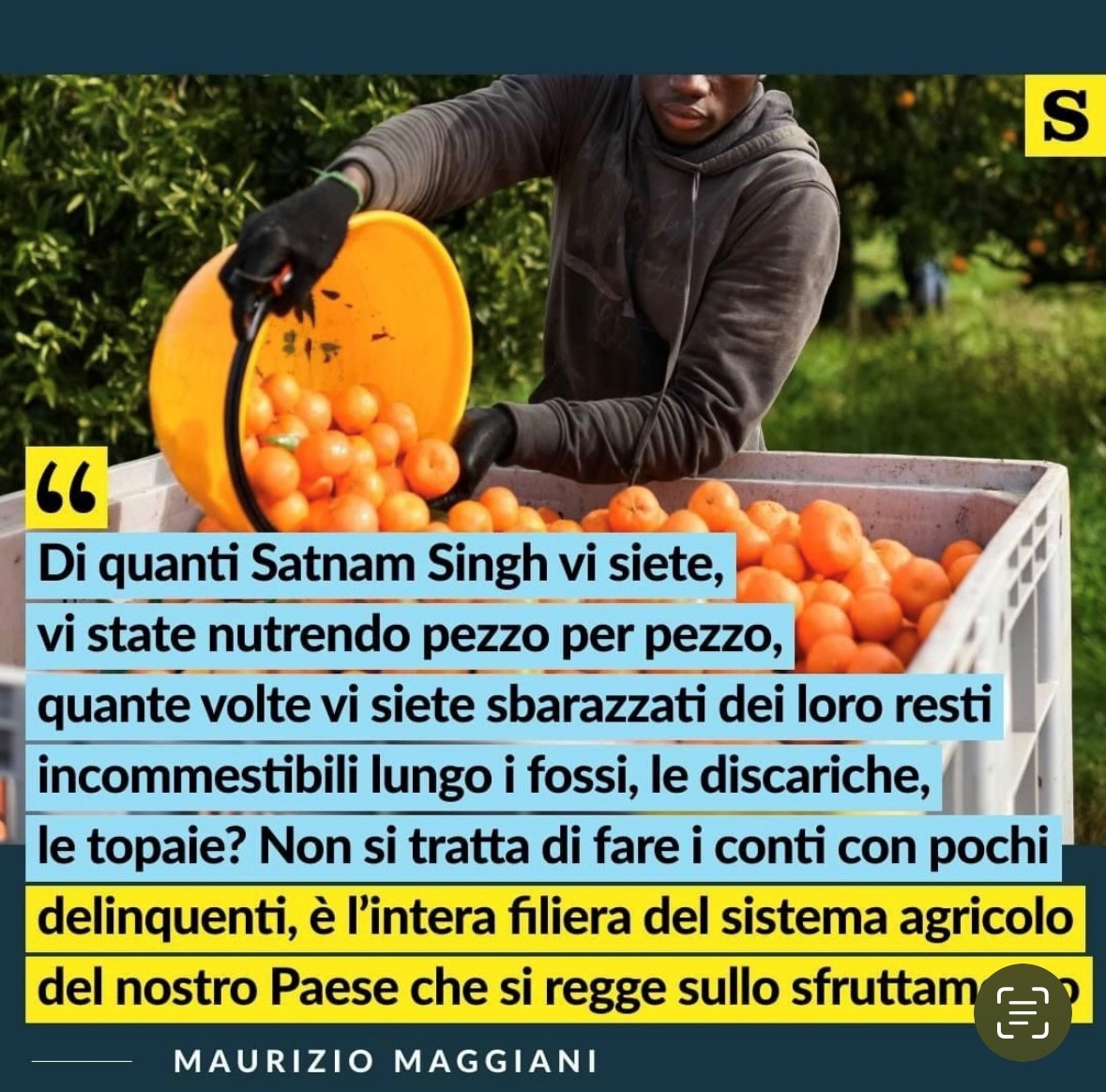
And if Maurizio Maggiani rails against these practices, you may think he is “exaggerating”.
But, unfortunately, reading the episodes in the news, we have to think again..
In fact, on 3 June 2025 , ‘a young Moroccan labourer was abandoned in front of the hospital with a leg lacerated by one of the farm vehicles used during the carrot harvest‘.
The worker had been ordered ‘to declare that he had fallen off a low wall’…The Fucino Plain is home to some 500 farms covering 160 square kilometres. According to the trade unions, at least 6,500 labourers, mostly Moroccan, work there. Many work 12-14 hours a day, even at night and on weekends. Grey’ contracts are widespread: part of the work is regular, the rest paid off the books. A., on the other hand, was employed completely off the books….
And in August 2025 Mario Sassi reports that: problems in agriculture, where they exist, remain, unfortunately, always the same. The Carabinieri conducted a series of labour checks on companies in the agricultural sector throughout Italy from 31 July to 11 August. They checked 888 companies, of which 468 were found to be irregular (52.70%). During the inspections, 3,601 work positions were verified, of which 729 were found to be irregular (20.24%); of these, 196 were attributable to the use of illegal labour (26.88% of the 729 irregular work positions); of the verified work positions, 1,557 involved non-EU workers, of which 79 were employed illegally, while 30 were found to be illegal. A total of 19 minors were found in the workplace, 9 of whom were working illegally. At the end of the checks, 113 business suspension orders were issued against 12.72% of the 888 companies inspected.
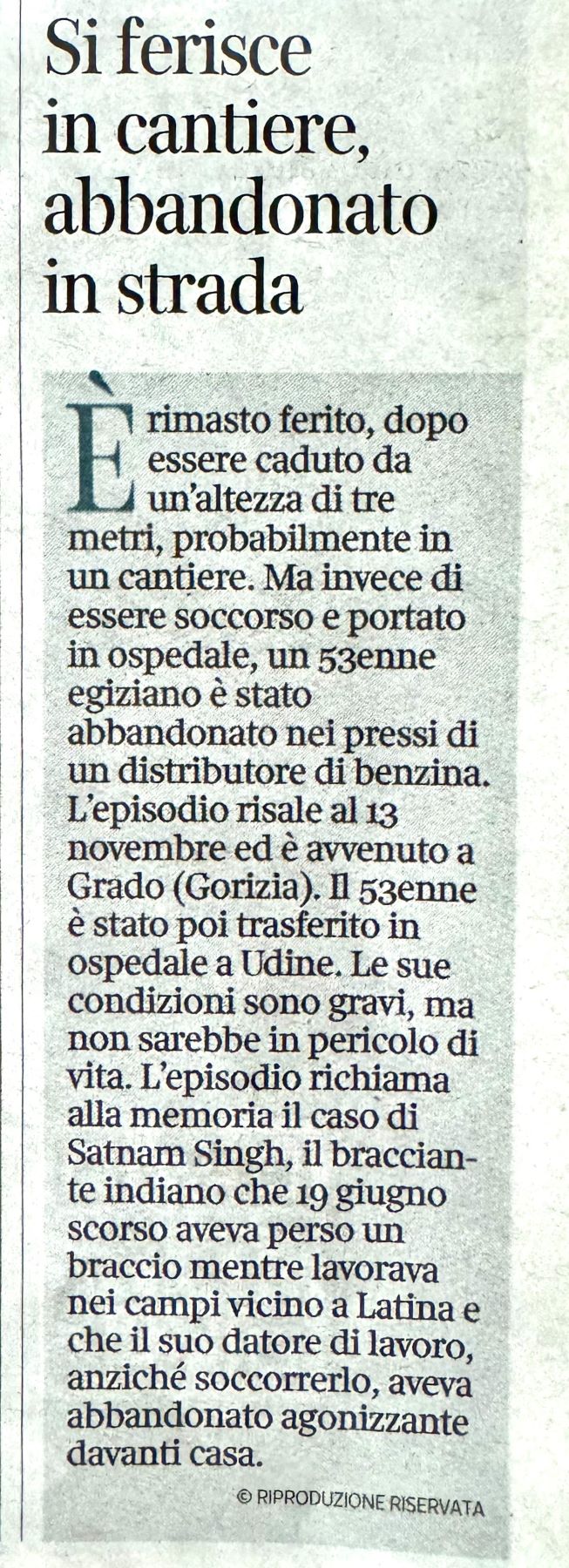
The short news item below, from the Corriere della Sera , on the injured worker abandoned in the street, is dated 17 November 2024 .
In Grado, Italy
Obviously this is one of the many obscure episodes, which will never be reported except by means of a blurb or a ‘trade magazine’, which few – if not related to the world of distribution and production – read.
P.S.: in 2026, nothing has changed: all workers in the black, company suspended, and labourer Mamadou, 38, died of hardship in his car-house).