Drafted 5 March 2022, updated 13 May 2025
Foreword: This article is mainly concerned with the impact on workers and the environment of Shein, not with the ongoing trade war between the US and China.
Shein is a Chinese fast fashion textile operator (” a retail clothing sector that makes low quality clothes at very low prices, but with the fast availability of new collections in the shop, continually re-stocked… The term was first used in the New York Times in 1989, when Zara opened the doors of its store in the Big Apple…’)
It has no shops, it only operates online, with e-commerce or pop-up (temporary) shops, like in Milan at the moment.
It is ahead of Amazon in 50 countries: in 2021 it was the most consulted site in the world (Le Monde).
The average cost of a dress on Shein would be €7.
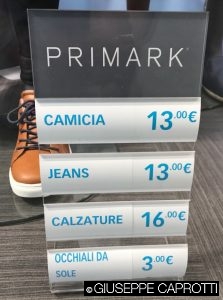
Only Primark would be able to counter this price level, Le Monde also reports.
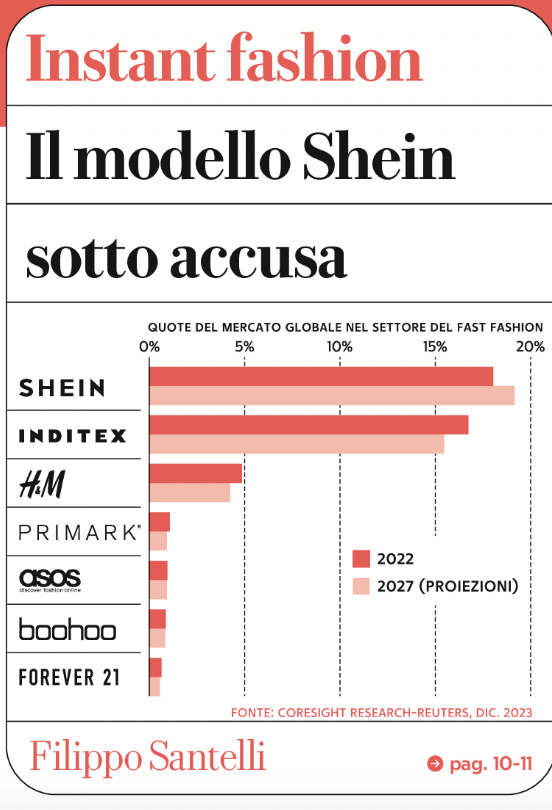
In France, Shein is the number one shopping destination for 15-24 year olds. And it has overtaken H&M which has a 5.7% share, rising to 6.7% of the market.
Since 2018, in the trade war with the US, it has benefited from the Chinese government’s rebate of customs duties on shipments from $800 upwards.
In the US it is the leader, as seen below(source: LSA).
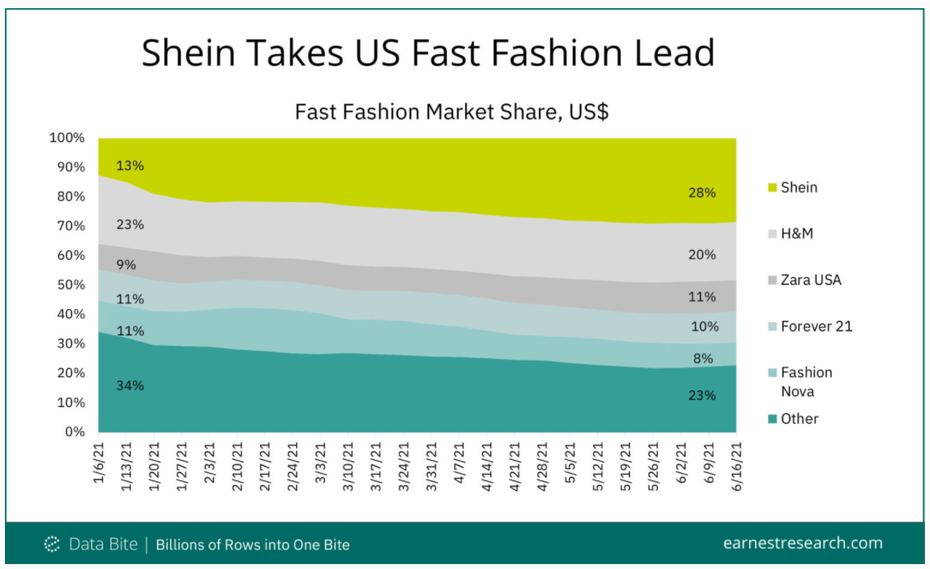
But Shein ‘s business model seems to lie in the indirect management of small factories that are ‘non-existent’ for the Chinese tax authorities. The workers in these factories would have no social security coverage and the working weeks would be 70 hours.
Shein would also use temporary agencies for its direct workers, with a very high staff turnover.
Obviously other European companies in the sector are certainly more ‘under the lens’ of their stakeholders (according to the Treccani, stakeholders are: ‘ all the subjects, individuals or organisations, actively involved in an economic initiative – project, company, whose interest is negatively or positively influenced by the result of the execution, or the course, of the initiative and whose action or reaction in turn influences the phases or the completion of a project or the destiny of an organisation’).
H&M abandoned the production of products made in China by the persecuted Uyghur minority (*)
The fashion companies involved would be :
- Abercrombie & Fitch,
- Adidas,
- Calvin Klein,
- Cerruti 1881,
- Fila,
- Gap,
- H&M,
- Jack & Jones,
- Lacoste,
- Nike,
- The North Face,
- Polo Ralph Lauren,
- Puma,
- Skechers,
- Tommy Hilfiger,
- Uniqlo,
- Victoria’s Secret,
- Zara,
- Zegna.
(*) Two million Chinese are Muslims .
According to Le Monde of 25 May 2022, between 900,000 and 1.8 million Uyghurs – in all – were imprisoned in Chinese camps, subjected to forced labour and ‘re-education’ sessions.
The detention rate – up to 12% of adults – exceeds those of Stalinism.
On the plight of Western companies in China read: Adidas in trouble in China over Uyghur issue and this later article, also on Adidas in China.
On Uyghurs read also the Post.
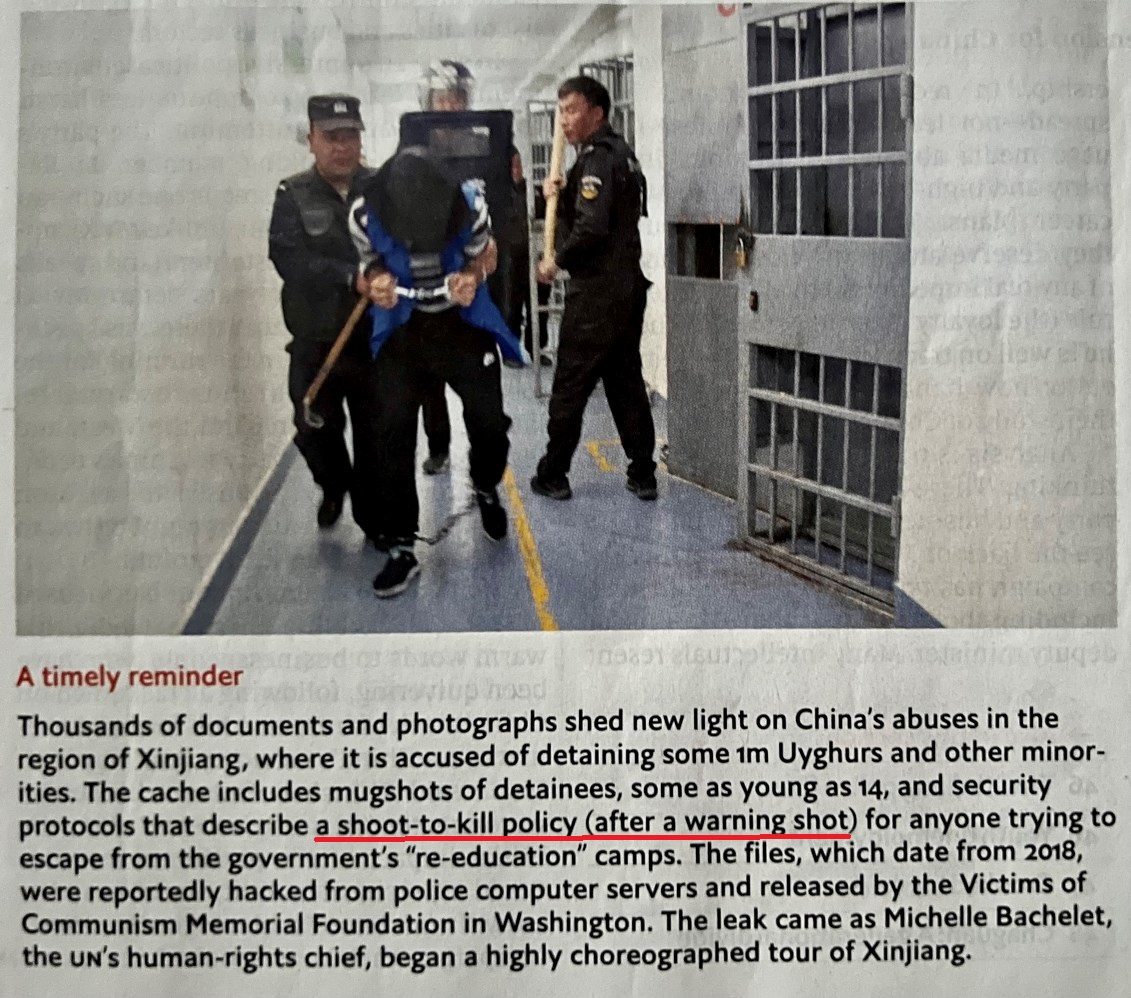
Below : The Economist pointed out the police’s ‘shoot to kill policy’ on those trying to escape from re-education camps in China. First they fire a shot in the air as a warning, then they can shoot at eye level and the UN has accused China of“crimes against humanity” (read : China : Uyghur minority used for forced labour in textiles).
In the camps there are even 14-year-old boys. And Chinese policemen persecute the exiled Uyghurs. Even those who keep their heads down find themselves the target of psychological torture.
On 28 January 2022, H&M announced that it will reduce its ecological footprint (= CO2 emissions) by 50%.
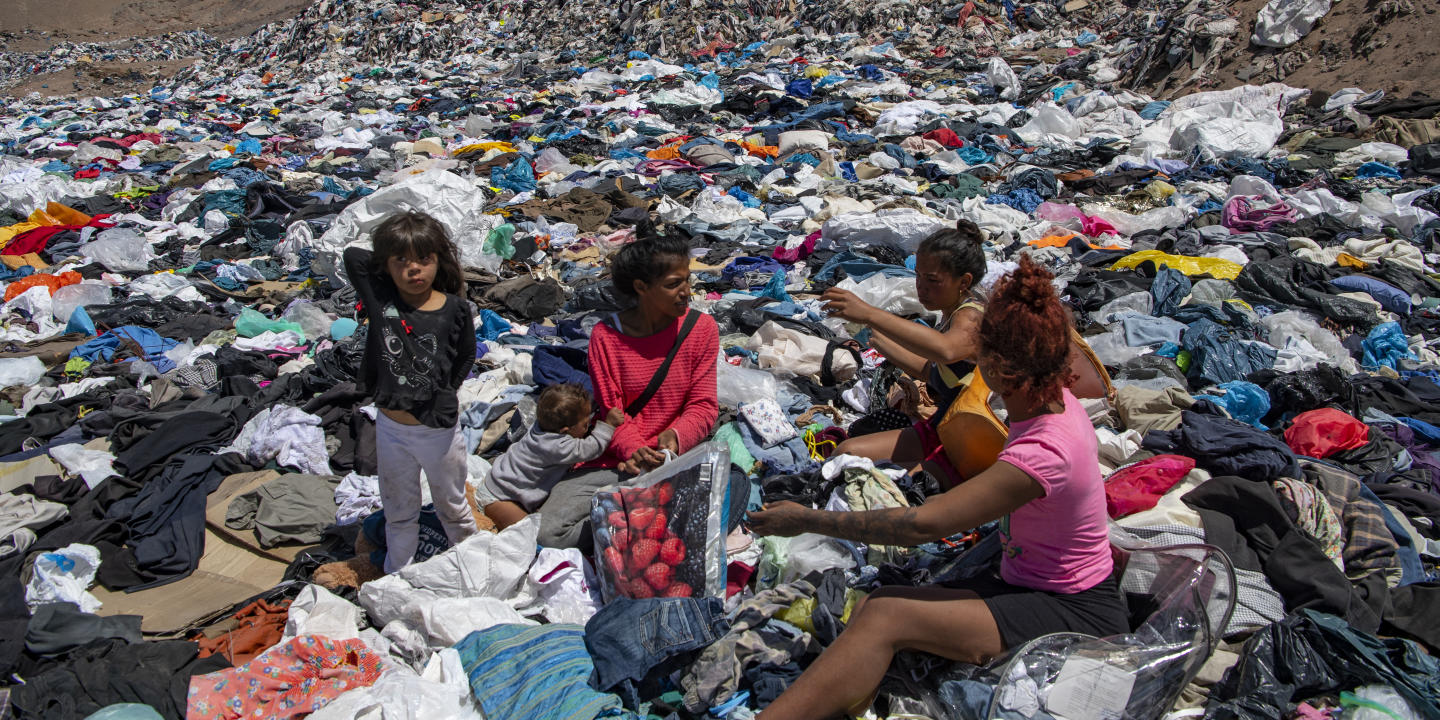
But the issue of sustainability in fashion is acute: on the one hand, people want lower and lower prices and growth in turnover, while on the other hand, shareholders and stakeholders would like ‘ethical, durable and sustainable’ companies.
This contradiction is highlighted by these facts :
- the textile industry is responsible for 10% of global CO2 emissions(third, behind energy and agri-food production)
- fast fashion textile production doubled from 2000 to 2015
- from 2 cycles per year (two collections) to 50.
- in contrast, the use per garment has fallen.
- the reuse market has only been multiplied by three, but the problem is that 32% of used clothing retailers use the proceeds to buy new clothes.
- 80% of clothes are not recycled
- the production of synthetic fibres takes up 1.35% of the world’s oil consumption (of Spain, for example)
- cotton uses 16% of the world’s pesticides
- one kg of clothes requires 3 kg of chemicals
- the textile industry withdraws and uses 4% of the world’s freshwater each year (one pair of jeans requires 7,500 litres of water)
- washing clothes throws microplastics equivalent to 50 billion plastic bottles into the oceans Source: Le Monde.
Recent research published by the Financial Times confirms that the fashion industry’s emissions are double what they should be.
And that recycling is practically non-existent (1%).
zara and H& M’s choice to go for the premium end is definitely brave and perhaps inevitable, given the prices of Primark and Shein.
Even if the context is difficult.
And I’m not just talking about discounting, due to the worsening political and economic context, but the fact that there are no laws to protect those who do better than others.
Or that sanction those who act reprehensibly.
The Fashion Pact, signed by more than 200 brands in 2019, works very slowly and only partially.
Sustainable fashion?
So much blah, blah
On the other hand, promising to ‘save the world’ – as many business leaders do – is pleasant and gives great satisfaction, while talking only about economic goals can be boring.
In this link an example to follow in fashion on demand.
Zara‘s latest signal is very important : from now on the return of garments bought on the net must be paid for.
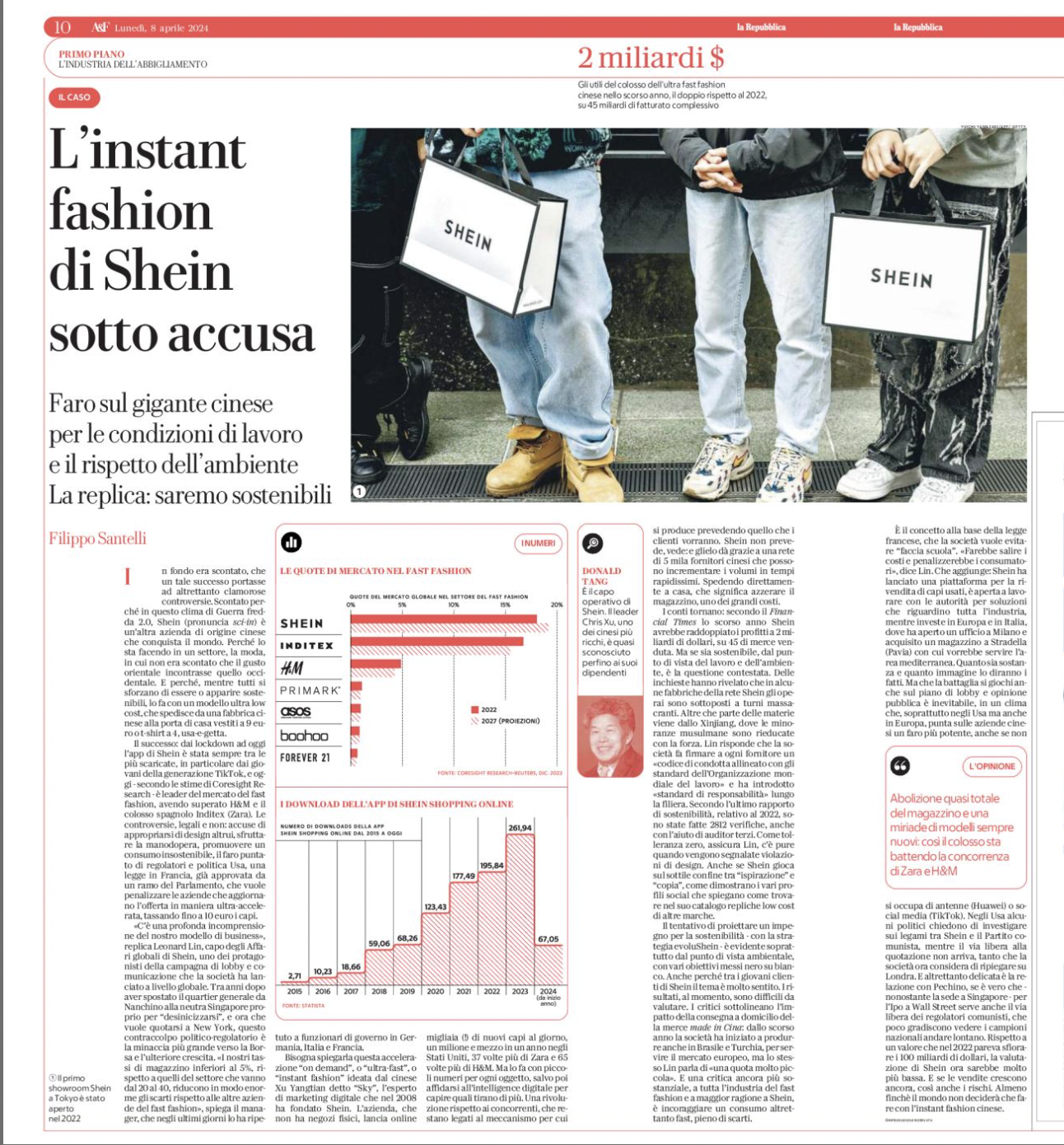
Below some data on Shein from Repubblica Affari Finanza updated to May 2022. On H&M read this update.
And, to finish, I recommend reading : Fast, Cheap, and Out of Control: Inside Shein’s Sudden Rise, where it becomes clear that little or nothing is known about the Chinese giant’s methods in reality (e.g. it is suspected that it uses forced labour of the Uighurs).
Shein’s pop-up shop in Milan was a huge success: Hundreds queuing up in Milan to get into Shein’s shop (open only 3 days)
P.S. : The ‘state of the art’ of fast fashion is reiterated by the Financial Times in December 2022: Fast Fashion : Textiles is the sector whose waste is growing more than any other sector.
but a positive sign comes from our French cousins, whose sales of garments and textiles in general are increasingly in crisis : France , new regulations for textiles and circular economy.
The fact is that Shein has become the largest – or second largest – textile fast fashion operator in the world: by 2022 Shein had reached €30 billion in revenues(Inditex, which, among many other brands owns Zara in 2022, had reached €32, 6 billion).
But by 2023 the Chinese fast fashion giant Shein would have overtaken H&M and by far Zara in terms of turnover: the Spanish group almost reached € 36 billion but Shein would have reached € 41, 7 billion, FT April 2024.
This figure seems exaggerated : Le Monde, 12 May 2025, speaks of 34 billion but the fact remains that Amazon has launched Amazon Haul to counter Shein. On Amazon Haul, a ‘discount’ platform, present in the US and UK, all its items will be sold for less than $20.
Shein produces in 3-5 days but how does it treat workers?
Shein plans to double its turnover between now and 2025.
On Shein’s devious marketing read this article.
The EU prepares to make the textile industry pay for its waste. The Commission proposal aims to reduce the environmental footprint of fast fashion brands (a laudable initiative whose effectiveness I have some doubts about, however).
Shein, the dark side of the fast fashion king: slave workers, toxic fabrics and pollution.
E-commerce: how Italy and Europe have ‘missed the boat’
The French Chamber gave the first green light to a bill that will introduce an environmental tax on garments produced by fast fashion companies and prohibit companies from advertising; it did so because, in 2022, 3.3 billion items of clothing were sold in France, 48 per inhabitant.
The French government rightly believes that fast fashion should be curbed. For while Shein is probably the largest textile operator in the world, it is also the most damaging, to workers and the environment.
White House: trade war against Chinese e-commerce giants Temu and Shein
Shein’s European entity records 68% sales growth in 2023
Below: an article from Affari e Finanza (Repubblica) of 8 April 2024