

When I entered Esselunga it was in the middle of what was called the ‘Years of Lead‘, because there was hardly a day without demonstrations, ‘proletarian expropriations’, protests and above all robberies. Even those of the notorious Vallanzasca gang in Milan.
These were years of strikes, continuous, hard ones, which my father Bernardo strongly and decisively opposed. In this way he saved the company from the union storm, even with big communication campaigns especially against the concept, still well rooted in Italy, of the right to work without, however, the duty and commitment that are linked to work. This was a great merit of his, and he should be fully credited, especially considering the situation in which he was operating.
In my book, “Le Ossa dei Caprotti”, Feltrinelli, 2003, I describe, in a concise way, this final phase: “In Tuscany I also lived through the last phase of the clash between Esselunga and the trade unions, during which about a thousand employees left the company. It was there that in 1986 a CGIL delegate had been sentenced, having fallen into a trap organised by the carabinieri with the loot of an attempted extortion against the company: ‘Either you give me 12 million lire or I’ll cause strikes’ was the message delivered. When I arrived in Florence, at the end of 1989, the situation was still very tense: one day I ended up in a strike where the employees of Coop and Superal, our competitors, tried to provoke me in front of the supermarket in via di Novoli, with the evident intention of involving me in a brawl. The signs read ESSELUNGA SS and the police look on without intervening. Another time, in viale Giannotti, a strike broke out with the employees leaving the tills open because ‘Giuseppe Caprotti’, the owner’s son, ‘came in’. I am somewhat familiar with these situations because I had experienced them a few years earlier in Milan, where some trade unionists were trying to blackmail the company and where I had been blocked and assaulted outside the offices in Limito. I had passed through the gates despite a picket line thick with red flags and the Radio Radicale programmes that had targeted me. As if we were in a film, in order to get in, an employee had jumped over the protective net of the internal car parks, without passing through the entrance. A racket had ensued: that day Bernardo gave a prize to all those who had managed to reach the workplace, including me. It was the era when executives and managers went to replace strikers on Saturdays’. (Caprotti, The Bones, p. 149)’.
Bernardo saved the company, but not the relationship with the majority of employees, because, unfortunately, tensions with the unions continued at least until the early 1990s.
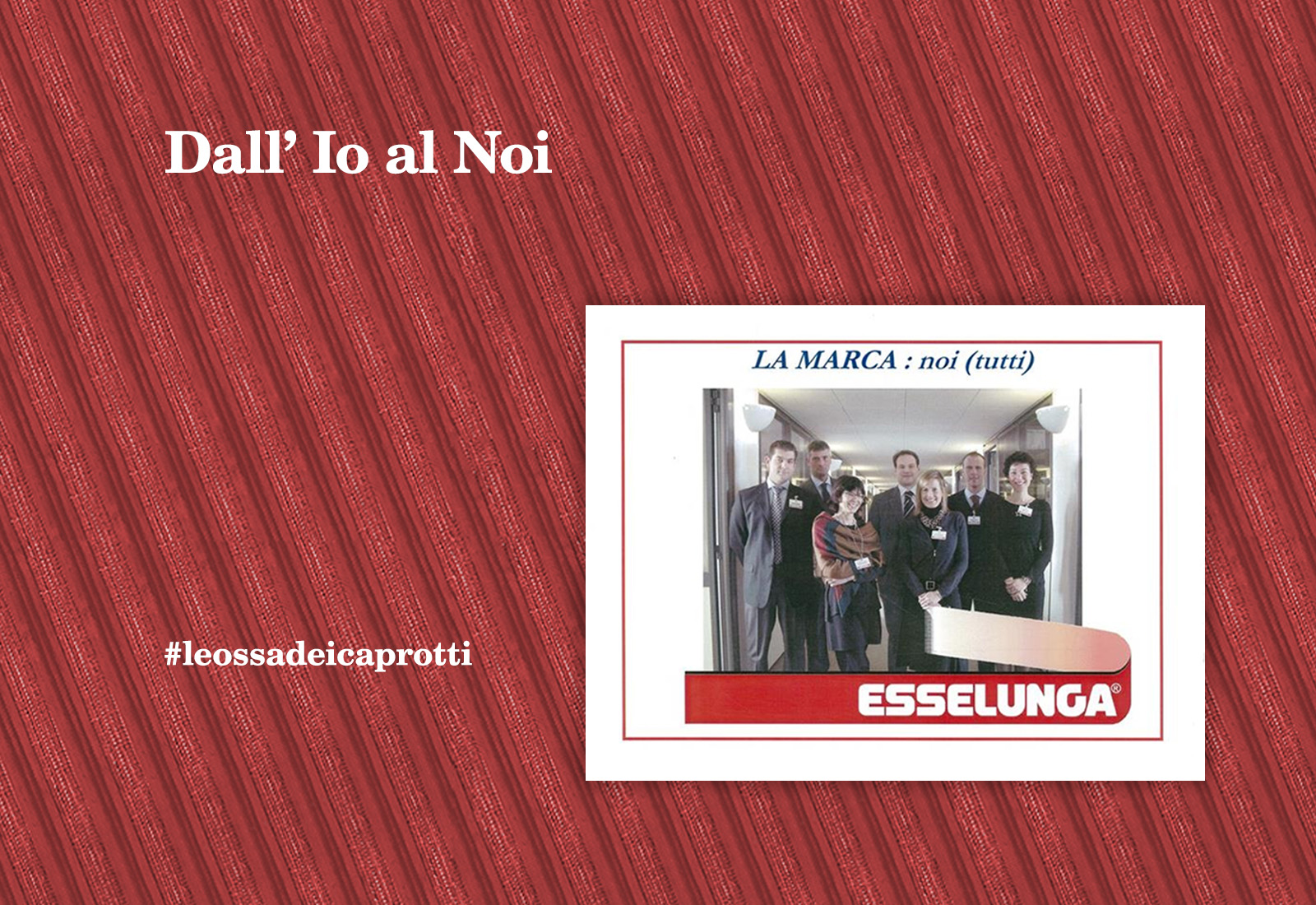
When I enter the company I try to lower the tension with the employees and apply what I learnt in the United States, moving ‘From I to We’: from decision-making power in a few hands to extended involvement in collaboration between colleagues and between departments, implemented in every possible way.
Think of the shop managers, who only received orders from above, had no power of choice over the products in their shops and did not even know the exact sales results. Since the early 1990s things have changed:
“The directors are involved in the choices we make in Milan: from 1992 onwards we start meeting all together – a fact that surprises them greatly – to inform them about the revolution taking place, we explain to them the logic behind the ‘non-food’ products and the new layout and management of the shelves. They are also encouraged to make requests and suggestions in person, directly to me. A representation of the managers is invited to planogram meetings, where it becomes easier to discuss together what is not working in the various product categories. They finally have direct access to the weekly sales data of their supermarkets, which until then had been kept confidential and only managed by the inspectors. The managers thus become protagonists in the management of the shop, being able to participate in the choices and touch the results of their efforts.” (CAPROTTI, The Bones, p. 148).
The ‘new course’ also touched the employees of shops and shops, for whom refresher courses and days were organised. Some cashiers, learning that they would be able to attend a course, even began to cry, as if they did not believe that someone was also interested in their category, one of those hitherto invisible within the company.
It was also in this spirit of joint work that, with the help of shop and head office staff, the little book ‘Values and Principles’ was born. Since 2002, it has been produced with each employee, summarising the guiding values that inspire the company and which everyone should know
“At the beginning of the 2000s, we involved all the staff, both at headquarters and in the shops, to help us define the company’s founding values and principles. A document was first drafted in 2002 and further improved in 2003. Human resources are defined as ‘the pillar’ on which our success is based and it is stated that teamwork ‘is the basis for achieving results’. This is why, for example, ‘Esselunga encourages its employees to work in groups in which everyone expresses their potential within shared objectives. The relationships between people are clear and based on the utmost mutual respect. There are several traitsin the document that anticipate those principles of fairness and sustainability that companies large and small must follow today, if they are not to be penalised harshly by investors, lenders and even customers. It says that Esselunga is committed to developing organic and ecologically sustainable products, including packaging; to building shops that are integrated in the local area and have a low environmental impact; to reject child, involuntary and forced labour; to reduce polluting emissions; to support social projects; and to contribute to the protection of the artistic heritage.
These were to be the guiding values that would end up in Esselunga’s first ‘Social Report’ in 2003.
These are not abstract principles but guidelines that determine our behaviour. In 2002, 3500 people were hired, 95 per cent on permanent contracts. The remuneration system adopted is at the highest level in the sector and support policies are implemented for the weakest, with 50-60 internships per year for the handicapped, aimed at recruitment. Also in 2002, 200,000 hours are dedicated to training, with an investment that represents 1.7 per cent of personnel costs and involves 6,000 employees. We then decided to establish rewards for all operational departments, when in the previous rigidly hierarchical organisation only supermarket managers were rewarded. The results we achieve, however, leave their mark. In 2003, the CIRM market research institute of Nicola Piepoli, a well-known pollster, pioneer and doyen of opinion and marketing research, conducted an internal survey based on 1,711 interviews, more than 10 per cent of the staff, which showed how much employees’ satisfaction with Esselunga as an employer had improved: in two years, from 2001 to 2003, the proportion of those declaring themselves ‘satisfied’ or ‘very satisfied’ rose from 49 per cent to 72.1 per cent”. (Caprotti, The Bones, pp. 199-200).
In a nutshell, if my father saved the company in the 1980s, I have tried to modernise its methods, taking it towards logics close to those of the well-known US chain Publix, where employees own the shares of the company in which they work. I did this by lowering turnover, which implies greater employee loyalty to the company. And the public and private messages I still receive today, more than 20 years after I left, indicate to me that I was on the right track.


