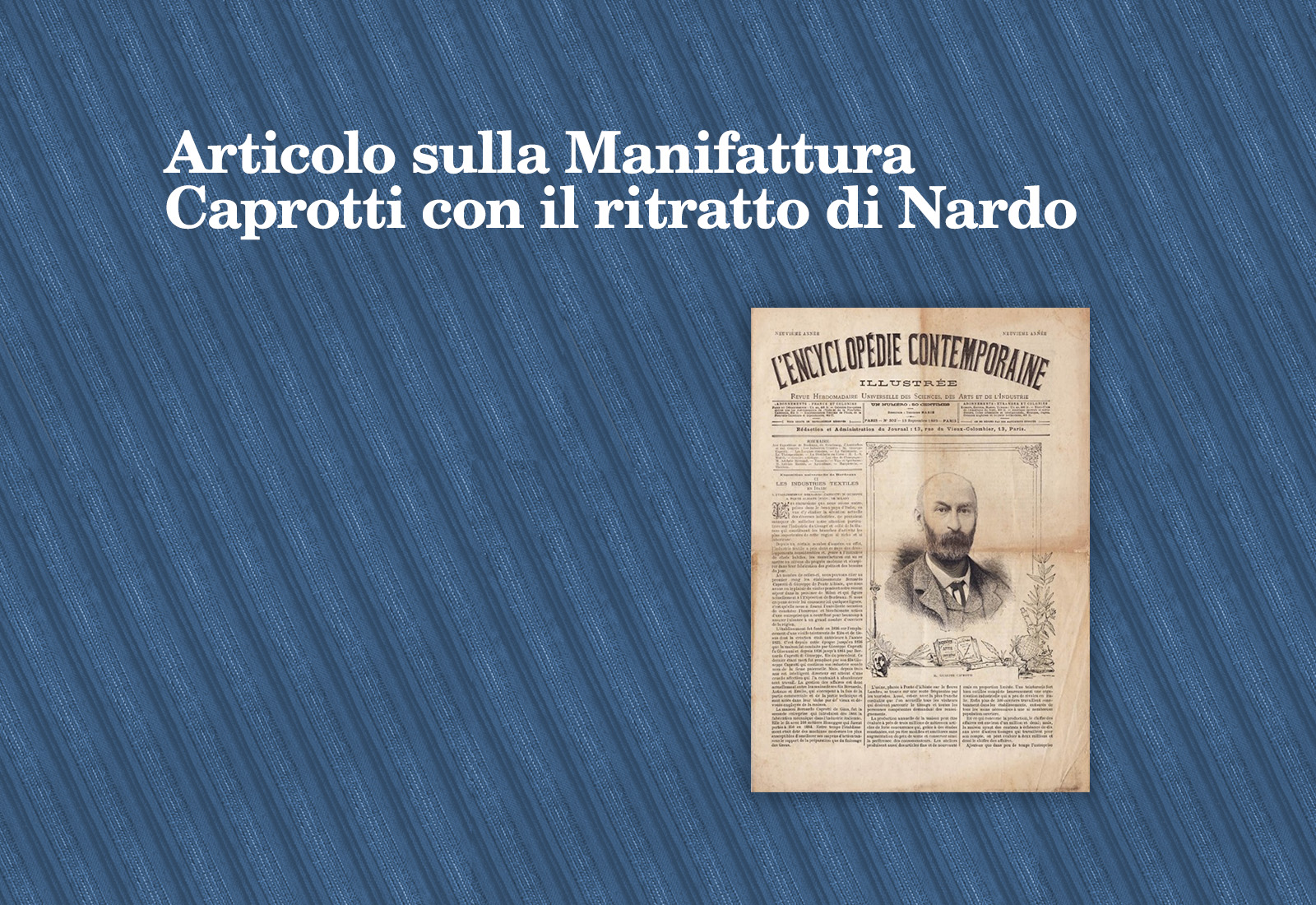
The article is part of a series written about the textile industry in Italy on the occasion of the Universal Exhibition in Bordeaux (1895), where Manifattura Caprotti was present with its own stand.
Valentin Dumesnil personally visited several textile companies in the rich and industrious region of Lombardy, where skilful entrepreneurs were able to bring their factories up to the level of modern progress, drawing inspiration in their production from the tastes and needs of today.
Foremost among these is undoubtedly the Bernardo Caprotti company owned by Giuseppe di Ponte Albiate, and the journalist immediately points out, having witnessed it for himself during one of his visits, the happy and beneficial influence it has in helping to ensure the well-being of a large number of workers in the region. It was the second company to introduce mechanical manufacturing into Italian industry, in 1866, and is still equipped with the most modern means of production. The factory is located along the course of the Lambro and along a road frequented by tourists: the owners, Giuseppe’s sons (whose photograph is published, writes the journalist, but it is actually his son Bernardo, my great-great-grandfather), show it around ‘with the most frank cordiality’ to all those who wish to learn about the weaving process and to all the experts who ask for explanations. The production figures – almost three million metres of fabric per year at highly competitive prices, always improved and updated without increasing consumer prices -, the dyeing department, one of the company’s strongest points, more than 500 workers permanently employed in the best working conditions and a turnover of around two and a half million make it an industrial organisation that, according to the journalist, has few rivals in Italy.
Despite their successes, the owners have decided to avoid any kind of intrusive or aggressive publicity, and to participate only in very few exhibitions, both Lombardy and international, thus being able to boast only a few distinctions of merit, albeit valuable ones: the silver medal at the Monza Provincial Exhibition in 1871, the gold medal at the Agricultural and Industrial Exhibition in Como in 1872, the silver medal at the National Exhibition in Milan in 1881 and finally the silver medal at the International Exhibition in Bordeaux that year. Caprotti would also be present at the Atlanta Exposition, then in preparation, thanks to the numerous exports of its products to the New World. There – the journalist is certain – it would certainly receive the definitive consecration that a company, which gave the greatest possible lustre to its country’s industry, had the right to expect.
Unfortunately, I was unable to find the medal table of the Atlanta Exhibition, which was held from 18 September to 31 December of that year. But I am reasonably sure that, given the premises, the manufactory certainly did itself credit.
Sources:
Villa San Valerio (MB), Villa San Valerio Archives, V. DUMESNIL, “L’établissement Bernardo Caprotti di Giuseppe à Ponte Albiate (Prov. De Milan), dans “L’Encyclopédie Contemporaine illustrée”, Paris, 15 September 1895″ [La ditta Bernardo Caprotti di Giuseppe a Ponte Albiate, provincia di Milano, in “L’encyclopédie contemporanea illustrata”, Paris, 15 September 1895].
Bibliography:
Bibliothèque Nationale de France, Catalogue collectif de France ‘Liste officielle des récompenses décernées par le jury international de la XIIIe exposition de Bordeaux en 1895’, Bordeaux, 1895.
Atlanta, United States 1895. Cotton States and International Exposition.
G. CAPROTTI, Le Ossa dei Caprotti. Una storia italiana, Milan, 2024/3.
ID., I Caprotti: aspetti privati, dal Risorgimento alla Seconda Guerra Mondiale, 08/11/2022.
ID., “Manifattura Caprotti: la sicurezza sul lavoro in un’impresa tessile“, 08/12/2024.