The tradition of national exhibitions was born with the industrial age, and became an ideal continuation of the trade fair, when technology and its wonders began to permeate and influence society and its way of working and thinking.
As with any trade fair, those who exhibit have, above all, the desire to know and be known; much more than for a trade fair, this desire is extended beyond the borders of one’s own country or region. The new techniques of the image, such as photography or the poster, and then magazines, illustrations, the great mass of collateral products (from maps to city guides, from postcards and tickets to souvenir medals to souvenirs of all kinds, garish and tasteless just like those of today), communications that have become faster allow for a maximum spectacularisation of the event; its grandiosity, born of the ambition of a city and, at the same time, of a nation move major funding and major urban redevelopment works, both recovering the existing and creating the new, thus allowing an ephemeral event – the small city of wonders was destroyed at the close of the event – to remain indelibly etched in memory and history.
In 1881, Milan, too, had its first National Exhibition. The city was coming out of a difficult decade, suffering from the immediate post-unification economic crisis and the fierce taxation policy wanted by the Italian government to even out the public debt. In order to restore confidence and courage to its activities, while at the same time strikingly affirming its role as the leader of modernity, development and renewal to which the city aspired so much in terms of town planning, industry and science, in 1880 a group of Milanese industrialists wanted to follow the French and British examples by organising a large exhibition of the best and most avant-garde products on offer at the time in the country’s young industry. With a thousand difficulties, the money was found and the event took place in the gardens of Via Palestro (today the Giardini Montanelli) from 3 May to 1 November, attracting crowds of visitors from all over Italy and beyond, and reaching truly successful figures. And among the industrialists taking part in the exhibition was Manifattura Caprotti.
In reality, the Caprotti family, as good, solid, shy Brians who care more about the substance and the transmission of their good name among their customers than about making a name for themselves in other ways, avoided on principle any kind of intrusive or aggressive publicity, something that was even veiledly reproached by Valentin Dumesnil, author of a flattering article on the Manifattura published in L’Encyclopédie Contemporaine illustrée of 15 September 1895 (DUMESNIL, L’établissement). Based on this precise choice, they participated in very few exhibitions, both national and international, although in almost every one of the few they won distinctions of merit:
| EVENT | LOCALITY | YEAR | DISTINCTION |
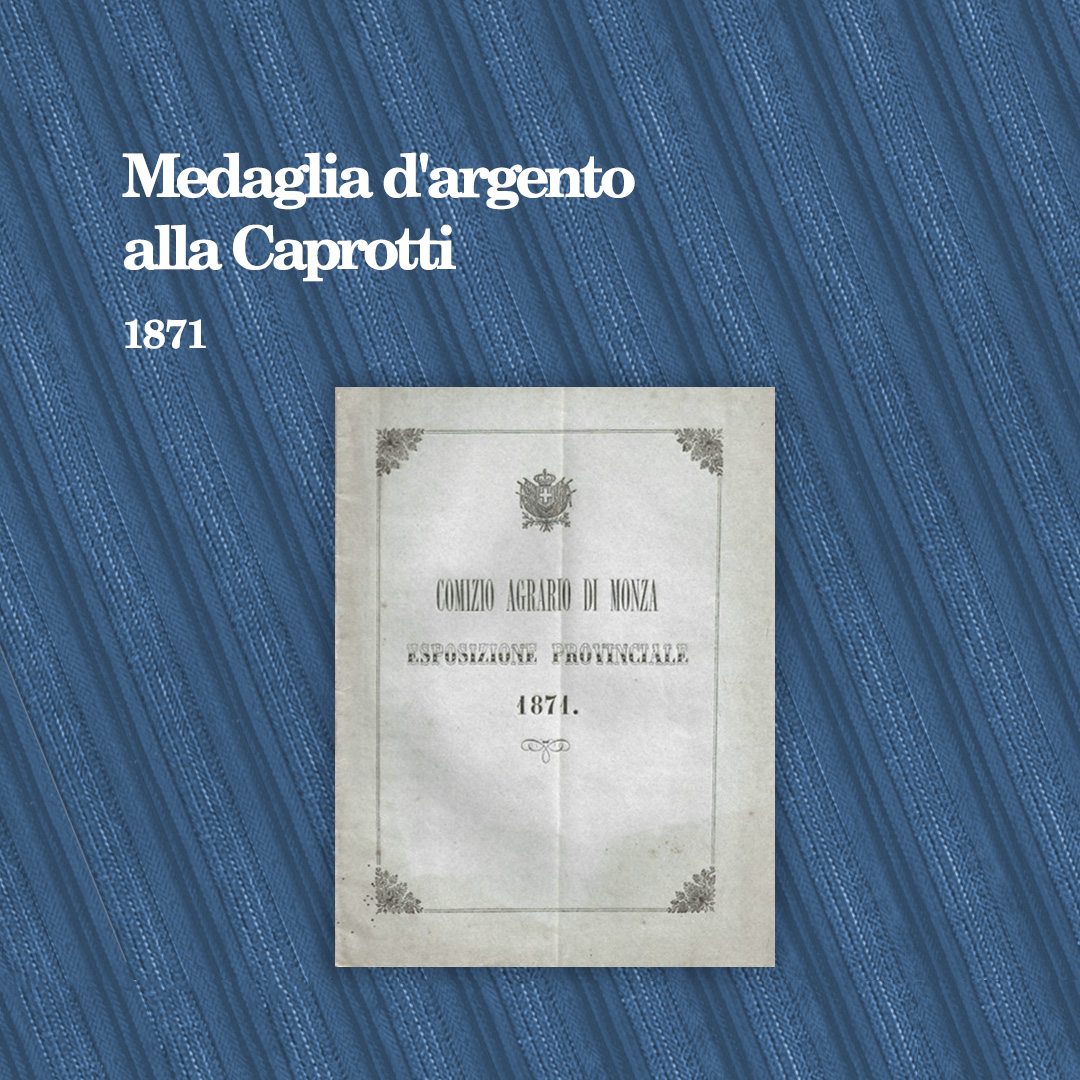
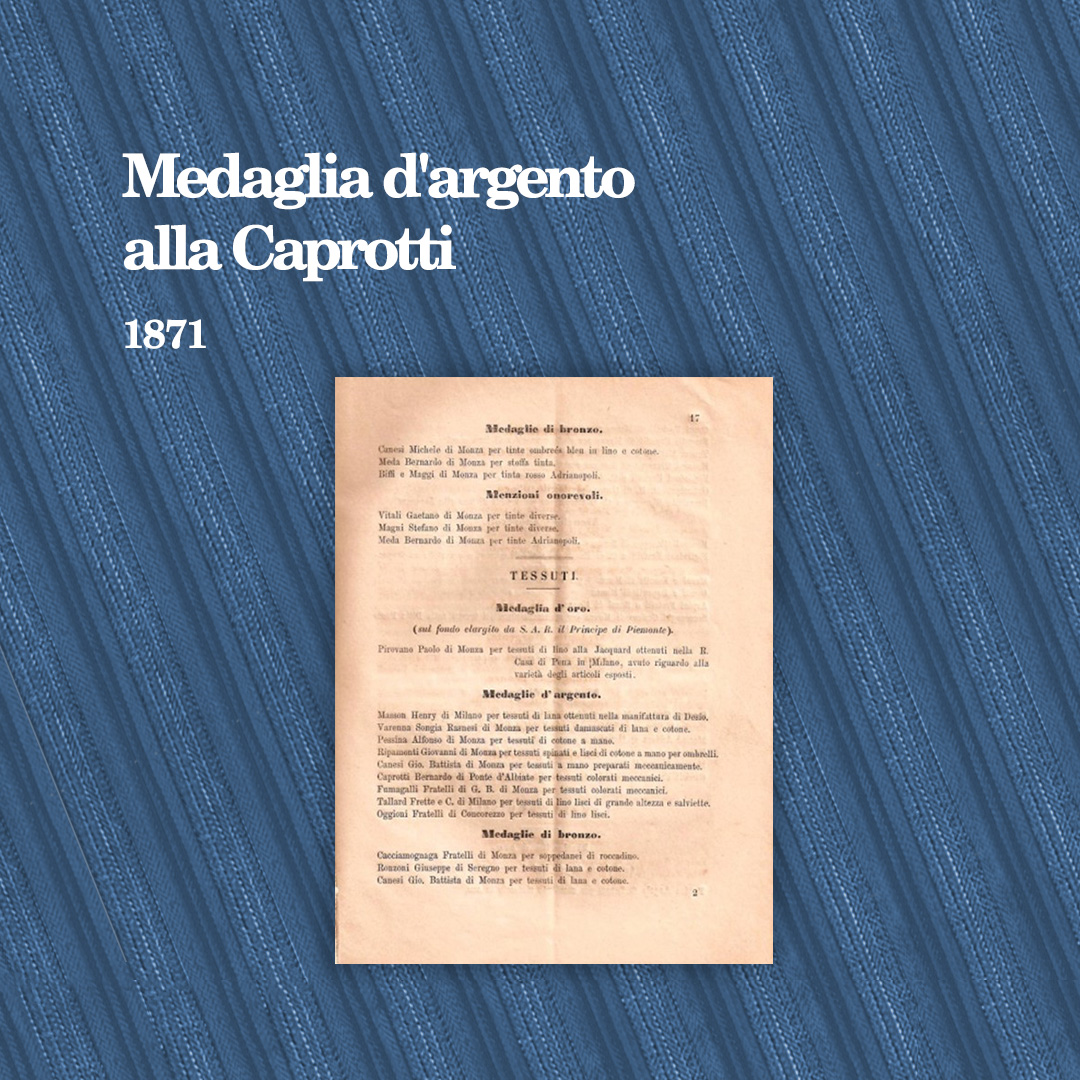
| Monza Provincial Exhibition | Monza | 1871 | Silver medal |
| Agricultural and Industrial Exhibition | Como | 1872 | Gold medal |
| Milan National Exhibition | Milan | 1881 | Silver medal |
| Bordeaux International Exhibition | Bordeaux | 1895 | Silver medal |
| Cotton States and International Exposition | Atlanta, Georgia, USA | 1895 | ? |
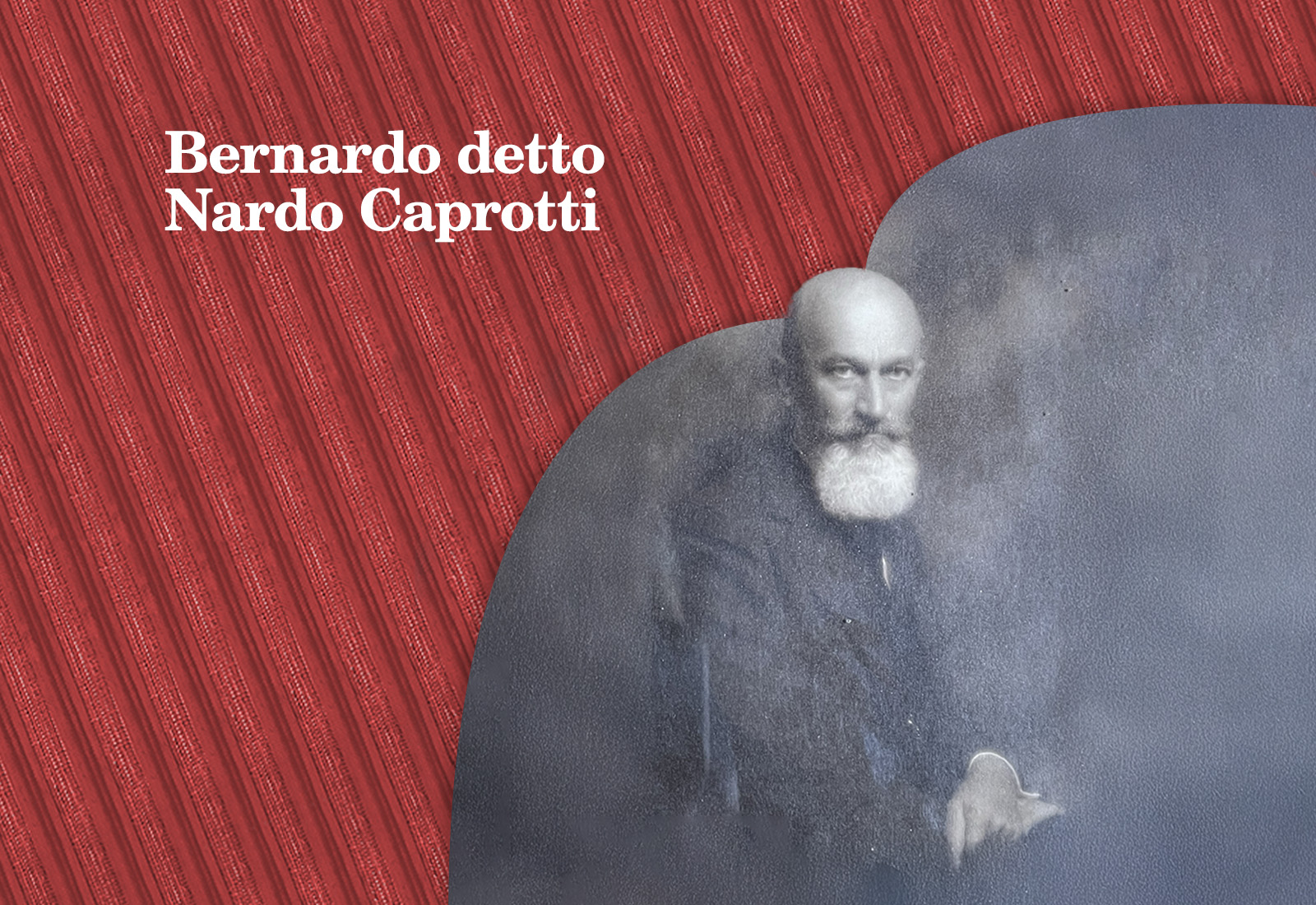
Small presences, then, but valuable. As far as the 1881 Milan Exposition is concerned, the Manifattura Caprotti Archives, kept in Albiate at Villa San Valerio, owned by Giuseppe Caprotti, contain a few letters, few in truth, but enough to understand the extent to which the Manifattura, in the person of Giuseppe and his son Bernardo, my great-great-grandfather, intended to take part in this great kermesse; above all, they give an image not only of what the Manifattura was like at the time, but also of what image it wanted to give of itself in the national and international showcase.
In the first letter, dated 17 April 1881 from Milan, Luigi Pozzi recounts the difficulty of renewing the entrance ticket, which was now expiring, but which could have been done shortly afterwards, except that he presented himself with all the admission papers as an exhibitor, because without these the exhibitors could not be introduced. In the meantime, the shop window has been set up, and is glazed; the rest is up to human fortune. A few days later, on 20 April, Pozzi wrote a short note saying to wait to bring the exhibits to the exhibition, for reasons that would be explained later.
He did not have to wait long, however. About ten days later, on 20 April, a well-packed crate containing 31 pieces and 2 packets of coloured yarn left Albiate by rail for Milan. The company’s best productions are depicted there, described as follows:
| 2 | N. 1 | Blue red cloths | gr. 55 | |
| 2 | N. 4 | “Larian | ” 65 | |
| 1 | N. 5 | “Larissa | ” 65 | |
| 2 | N. 8 | ” Carolina | ” 90 | |
| 1 | N. 9 | Blue-white | ” 90 | |
| 1 | N. 12 | Crossed trellises | ” 70 | Coloured |
| 3 | N. 13 | Crossed trellises | ” 70 | joined |
| 2 | N. 14 | Linen trellises | ” 100 | calendered |
| 2 | N. 19 | Silviagown | ” 70 | Calendered |
| 2 | N. 20 | ” ” | ” 75 | IIa |
| 4 | N. 23 | Fantasy canvases | ” 65 | apprettate |
| 4 | N. 24 | Casaline bleu red | ” 65 | |
| 3 | N. 25 | ” ” ” | ” 90 | |
| 2 | N. 26 | Materazze | ” 90 |
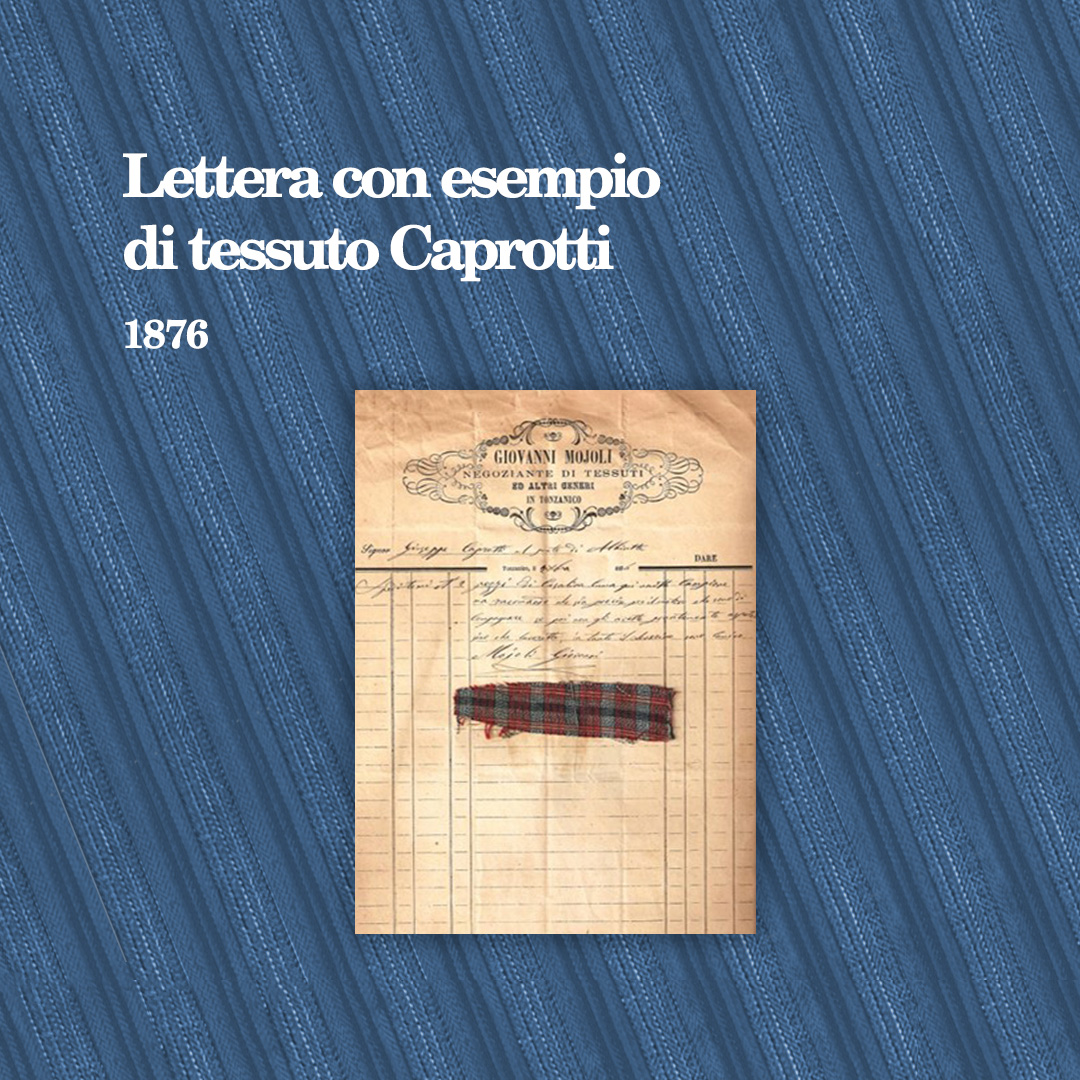
These are, therefore, coarse fabrics of medium-low quality, those brightly coloured cottons with which the countryside is supplied, where the bright chromatic notes in clothes are much appreciated, or fabrics used to make heavy linings, everyday, work products, aimed at production and practicality (as well as poor pockets). Modest fabrics, therefore, despite the catchy and gentle names, especially for women. Many examples remain in the Caprotti archives, scraps of fabrics attached as samples to the requests of the various customers or to their invoices, which bring us back to cottons with a thick weave of stripes, checks and squares, with sometimes almost daring combinations, in the most varied colours, light blue and orange, brown and orange, blue and red, grey and red, in all possible variations.
Most interesting of all is the letter addressed to the Exhibition Jury Commission on 26 September 1881, signed by his great-great-grandfather Bernardo, in which he replied point by point to the questionnaire submitted to him:
I am answering the questions put to me by this Esteemed Commission in its folio 20 andante.
1) The steam engine works comulatively [sic] with the plumber when water is needed.
2) The 350 or so people who work in the factory can be broken down roughly as follows:
men 30 loom workers
“10 on the preparation machines
“30 at the dye works
“20 to miscellaneous work
“15 service staff
“10 administrative staff
80 women loom attendants
“90 tannery, winding and warping women
….” 15 to various jobs
” to tanning and warping for hand weaving.
3) The 400 or so handlooms are scattered throughout the municipalities of Albiate, Carate, Verano, Marciano, Paina and Seveso; and on average we can calculate that they work 8 to 10 months a year. Next winter I will set up a new small weaving factory in the municipality of Cabiate with 80 hand looms with regulators, which will have to work all year round [in essence there was a factory but there were also looms in the farmsteads, scattered around the countryside].
4) In yarns I use organzine no. 16 to 40 in weft no. 12 to 44. I purchase the organzine n. 16 to 24 from Gioacchino Zoppi of Ranica, from Mioerry di C. of Albino, from Antonio and Andrea Ponti of Milan, and in their absence from Swiss spinning mills; and for hand weaving from various domestic spinning mills and especially from Fratelli Fumagalli of G. B. of Monza, from Domenico Helmes of C. of Naples and from Giovanni Schoch of E. of Milan; I purchase wefts Nos. 16 to 32 almost exclusively from Tomville, Aselmeyer & C. and from Antonio and Andrea Ponti; for the fine numbers I depend absolutely on the Swiss spinning mills.
5) I enclose a mirror of the figures taken from my records, specifying the importance or otherwise of my export trade in the different markets. The articles exported for America are identical with those consumed here, serving those Italian colonies. On the contrary, those forAfrica, which are shown in my exhibition, are quite special forEgypt and for the various provinces of the Soudan [sic], whose markets I am told are quite new for Italian cotton fabrics; the little business done in the past in these articles hindered me not a few annoyances and sacrifices; now, however, I believe that I have almost ensured a discreet torrent of business, as is attested by the figure done this year, but which refers only to these last months, and I currently have for the amount of 30 to 60 thousand lire in commission.
In commenting precisely on the figures in this letter, Roberto Romano rightly points out that, given the addressee to whom it was addressed, the volumes and figures expressed could also have been artfully ‘inflated’ to increase the importance of Caprotti’s export of fabrics to America and Africa, as well as to Trieste and Dalmatia, at the time foreign states that were part of the Austro-Hungarian Empire. However, it is true that already from the first years after the Unification of Italy, taking advantage of an extremely favourable economic situation, Caprotti turned its attention to exporting, expanding successfully into Latin America, Argentina above all, where it supplied a large population of emigrants with fabrics and colours similar to those known at home. It is also true that, again from the 1870s, Caprotti also attempted the route to Africa, where it achieved flattering, albeit discontinuous, successes, but without the goat brand achieving American successes.
In conclusion, it can be said that the Manifattura’s participation in the Exposition was convinced and well supported, not wanting to miss such an important event even if the kind of event – the blessed Exposition, as his ancestor Giuseppe wrote – was not entirely in the solid Caprotti’s heart, for whom it evidently bordered on a waste of time and money: when asked by a friend on the jury if he would have liked to win a gold medal, Giuseppe replied at first glance that he was not at all interested, but then, on second thought, he wrote to the jury and pointed out that, yes, this would be the case if he had declared himself out of the competition, but having decided to compete , it was obvious that he aspired to the best reward, should the jury consider him worthy, a reward that he did not intend to give up in order to possibly favour some other competitor.
Gold medals are not awarded, but silver ones are, and as mentioned at the beginning, the Manifattura obtained one thanks to those flattering results that led, a few years later, a Parisian journalist to hold up the Ponte Albiate factory as an example of modern productivity, this, of course, publicity of much greater liking and depth. In any case, great care is taken to ensure that Caprotti appears on the national scene as a small but valiant industry in continuous growth and incessant search for new markets, new trends, new technologies that support its yearning for the future.
Bibliography:
Esposizione nazionale di Milano 1881, edited by G. Lopez, Milan, 1981.
I. P. BARZAGHI, Milano 1881: tanto lusso e tanta folla. Rappresentazione della modernità e modernizzazione popolare, Cinisello Balsamo, 2009.
V. DUMESNIL, L’établissement Bernardo Caprotti di Giuseppe à Ponte Albiate (Prov. de Milan), in L’Encyclopédie Contemporaine illustrée, Paris, 15 septembre 1895.
R. ROMANO, I Caprotti, L’avventura economica e umana di una dinastia industriale della Brianza, Milano, 1980 (reprinted 2008), pp. 171, 197.
ID., I Caprotti: aspetti privati, dal Risorgimento alla Seconda Guerra Mondiale, 08/11/2022.
ID., Le Ossa dei Caprotti. The Caprottis and the Manifattura: the workers with my great-grandfather Bernardo Caprotti, September 1924.
ID., “Le Ossa dei Caprotti”. I Caprotti e le coop : Albiate, Bernardo Caprotti e le cooperative di mutuo soccorso (1907-1920). Cues from the book.
ID., Le Ossa dei Caprotti. La Manifattura Caprotti e la continuità: tessuti dall’Ottocento agli anni Ottanta del Novecento. Ideas from the book.