Drafted on 11 January, updated on 11 September 2025
The Mercosur agreement was signed at the end of 2024, and many have wondered: who might benefit from this agreement?
And, as a starting point, we recommend this article from Le Monde.
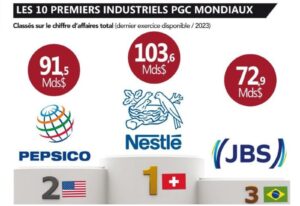
JBS, the Brazilian meat giant set to benefit from the EU-Mercosur treaty
The multinational, the world’s leading producer of animal protein, is expected to capitalise on the EU-Mercosur treaty to expand its presence in Europe, which accounted for 7 per cent of its exports in 2024.
By Anne-Dominique Correa (Rio de Janeiro, correspondent)
Whilst the announcement on 6 December of the conclusion of the agreement between Mercosur and the European Union has caused a stir in the French countryside, in Brazil it is JBS that is popping the champagne corks. The Brazilian multinational, the world’s leading producer of animal protein, is expected to capitalise on the treaty to expand its presence in Europe, which accounted for around 7 per cent of its exports in 2024.
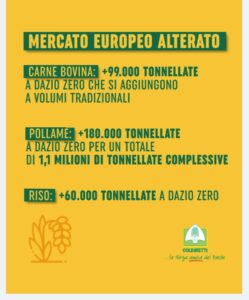
The agreement allows Mercosur countries to export a further 99,000 tonnes of beef, with a tariff reduced to 7.5 per cent. “JBS produces most of Brazil’s premium-quality beef, which is the most sought-after in Europe,” explains Alessandro Francisco Trindade de Oliveira of the Federal Institute of Paraná, who believes that Brazil “could at least double its beef exports to the European Union”. .
Enough to sustain the group’s turnover of 364 billion reais (57.48 billion euros), which has a market capitalisation of 13.3 billion euros. According to a study by the Economic Research Institute Foundation published in August 2023, its activities account for 2.1 per cent of the country’s gross domestic product and generate 2.73 per cent of jobs.
The trade union chaired by Ettore Prandini speaks of “zero tariffs”, whilst *Le Monde* states that the figure is 7.5 per cent.
Massive deforestation
We are a long way from the modest family-run butcher’s shop founded in 1953 by brothers José Batista Sobrinho and Juvencio Batista, two farmers from Nerópolis, in the state of Goiás, in the central-western part of the country. Today, the company is capable of slaughtering 75,000 cattle, 14 million poultry and 147,000 pigs a day. It owns more than 10 fattening units in Brazil, with a capacity of 2 million cattle.
In Brazil, the expansion of the agricultural sector was strongly encouraged during the military dictatorship (1964–1985), which sought to increase the number of livestock farms in the west and north of the country, particularly to ‘occupy’ the Amazon and shield it from the greed of foreign powers, at the cost of massive deforestation. However, it was from the 2000s onwards that JBS, then led by Joesley and Wesley Batista, sons of José Batista Sobrinho, began to expand internationally. The group benefits from the support of the National Bank for Economic and Social Development (BNDES) as part of the industrial policy pursued by the governments of Luiz Inácio Lula da Silva (2003–2011) and Dilma Rousseff (2011–2016), who sought to promote ‘national champions’.
BNDES acquired a stake in the company, injecting 8 billion reais in exchange for a 20 per cent controlling stake. This windfall enabled the group to accelerate its international expansion ahead of an IPO in São Paulo in 2007. The group now accounts for 25 per cent of the global market for beef and offal and operates in 17 countries. And it has no intention of stopping there: on 21 November, the management announced an investment of 2.5 billion dollars (2.38 billion euros) over five years in Nigeria to build six processing plants for poultry, beef and pork.
Various scandals
In Brazil, the company has been the subject of numerous scandals. In 2017, the brothers Joesley and Wesley admitted to having paid 400 million reais in bribes to politicians. Two months earlier, its reputation had already been tarnished by another case: the company had been targeted by a federal police investigation into a corruption scheme that allegedly allowed spoiled meat to be placed on the market, leading the European Union to suspend imports from the companies involved.
Although, in an email addressed to *Le Monde*, JBS defended itself by pointing out that at the time “none of its units were closed”, the affair had left its mark. On Wednesday 20 November, Carrefour decided to suspend the sale of meat from Mercosur countries, citing the risk of “lower environmental and health standards”, before changing its mind.
According to Allan de Campos, a specialist in the agri-food sector’s impact on public health at the State University of São Paulo, Europeans are right to be cautious. In Brazil, livestock “is fed maize and soya containing high levels of pesticides, such as glyphosate, and is subjected to antibiotic treatments”, he points out. Furthermore, he points out that multinationals only monitor livestock when it is on finishing farms – the final stage of rearing before slaughter – thereby ignoring the health conditions on other farms where the animals are born and fattened.
Lack of oversight
This lack of oversight also raises doubts about the multinationals’ ability to curb deforestation. Almost half of Brazil’s cattle, which reached a record 238.6 million head in 2023, are concentrated in the Amazon region, where extensive livestock farming is the main driver of deforestation: between 1985 and 2022, 77 per cent of deforested land was converted into pasture in this way, according to the MapBiomas collective.
According to an email sent to *Le Monde*, the company “prohibits purchases from properties that carry out illegal deforestation” and “assesses thousands of potential livestock transactions every day using a satellite monitoring system”. However, due to a lack of control over its indirect suppliers, JBS remains “one of the main drivers of deforestation” in Brazil, warns Boris Patentreger, the French director of the NGO Mighty Earth, who estimates that the company is responsible for the “deforestation of 118,310 hectares of forest” between February 2022 and July 2024, three-quarters of which is in the Amazon.

This article on Mercosur (EU-Mercosur: what the free trade agreement with South America entails and why farmers are calling for it to be blocked) is very interesting and balanced ; at one point, it states: “The fact is,” explain sources within the EU executive, “that the EU–Mercosur Agreement risks being turned into a scapegoat onto which to vent frustration over problems in the sector that actually have a completely different origin: first and foremost, the low profitability of farming compared with the rest of the economy, which is driving young people away from the sector and penalising agricultural businesses.
Those who have done little or nothing – such as Coldiretti – in recent years to safeguard the profitability of Italian farmersare therefore seeking an external scapegoat on which to base their propaganda.
Coldiretti has taken action against insects, against ‘synthetic meat’, against Chinese tomatoes, or has attempted, with little success, to create a pasta brand. Not to mention the Mattei Plan in Africa.
Now, however, we need to understand the facts – regarding tariffs, but above all regarding farmers’ incomes – and tackle their real problems, which you can read about here: Farmers are back on the streets with their tractors to demand extraordinary measures.
Fortunately, the Italian government seems to have adopted a pragmatic stance on the agreement: French and Polish farmers oppose the Mercosur agreement. [ /vc_column_text]
The European Commission has committed to taking action in the event of negative impacts from imports on certain sectors, such as beef, poultry, sugar and ethanol.
Commission President Ursula von der Leyen stated that she had “listened carefully”to farmers and Member States. “We have put in place even stronger, legally binding safeguards to reassure them,” she said on the social media platform X.
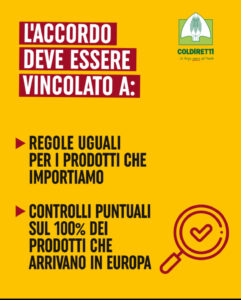
- On the issue of reciprocity – as we have already reported – a sensitive matter concerns health and environmental standards. European farmers accuse their Latin American competitors of failing to comply with EU standards due to a lack of controls.
On these two issues, we must proceed with great caution and ensure concrete guarantees.
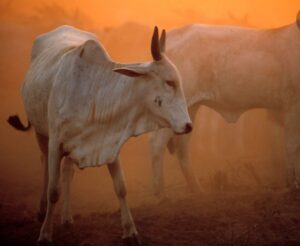
Below: a Brazilian zebu used to make Rigamonti’s bresaola, which is owned by JBS.
See also: Agriculture in Italy and Africa: clarity and transparency are needed