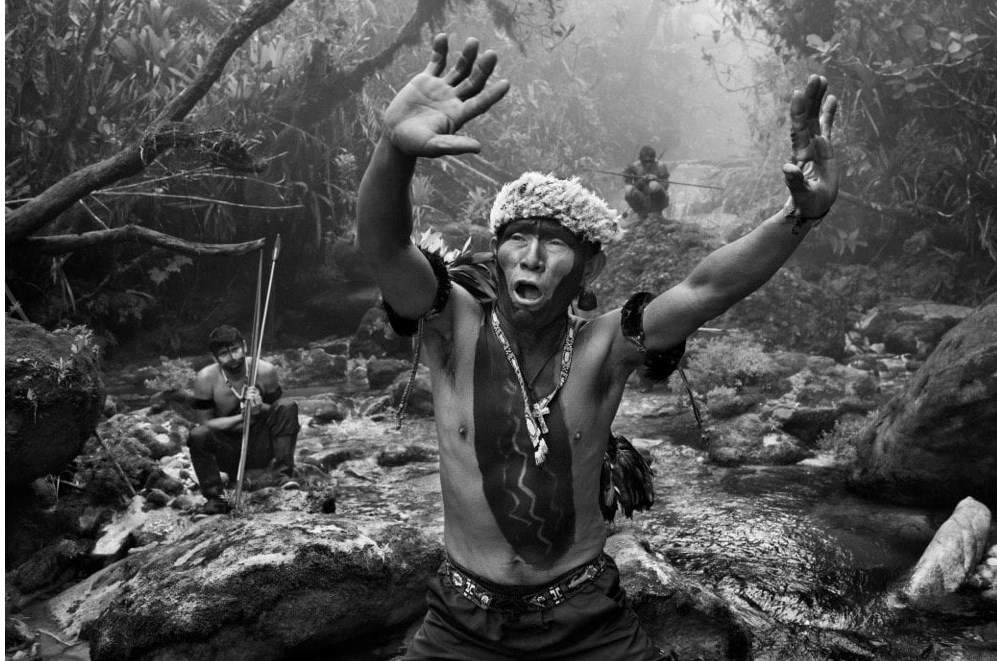
Photo by Sebastiao Salgado : Yanomami shaman . Edited 1 May 2022, updated 3 May 2025
As I often do, I take my cue from several articles to bring you some news with my thoughts. The first article is this one dated 15 March 2022 ( and although it is in French it can be translated on request ) :
New threats to the Brazilian Amazon
“As deforestation reached record levels in February, the government wants to pass a law allowing the exploitation of resources in indigenous territories”.
The second is this I transcribed :
Amazonia, gold mines bringing destruction and violence to indigenous reserves
13 April 2022
In the Brazilian Amazon, the devastation caused by illegal gold mining continues. Not only environmental pollution but violence and abuse on the indigenous populations. A dirty supply chain that also reaches Italy
Despite the dramatic consequences on the ecosystem and local populations, illegal gold mining is increasing in Brazil. In particular, it is the extraction from Brazil‘s largest indigenous reserve that has grown in record numbers. This is stated in a new report by the Hutukara Yanomami Association (Hay), which contains chilling accounts of abuse by miners, including sexual extortion of women and girls.
Disturbing numbers
The area of illegal mining is located in the Yanomami indigenous people’s reserve in the Amazon rainforest, and increased by 46% in 2021 to 3,272 hectares (8,085 acres). This is the largest annual increase since monitoring began in 2018. The report is based on satellite images and interviews with inhabitants.
The explosion of disease and forest consumption
‘In addition to deforesting our lands and destroying our waters,’ the report’s authors write, ‘illegal mining of gold and cassiterite (a primary ingredient in tin, ed.) in Yanomami territory has brought an explosion of malaria and other infectious diseases… and a frightening wave of violence against indigenous people. The fact that gold prices have risen in recent years has caused mining in the Amazon, where 125 square kilometres of green territory have been destroyed in smoke.
Abuse and violence against the population
In the Yanomami reserve, illegal miners with links to organised crime are accused of numerous abuses in indigenous communities, including poisoning rivers with the mercury used to separate gold from sediments and sometimes fatal attacks on residents. Accounts include those of miners administering alcohol and drugs to the Yanomami, then sexually abusing and raping women and girls. The Yanomami said the miners often demanded sex in exchange for food. One miner reportedly demanded an arranged ‘marriage’ with a teenage girl in exchange for ‘goods’ that he never delivered. Hay spoke of ‘a permanent climate of terror and fear’.
Bolsonaro pushes to legalise gold mining in reserves
The report comes as Brazilian President Jair Bolsonaro is pushing legislation to legalise mining in indigenous lands. In general, as we report in the April issue of Salvagente, while much has been written about ‘blood diamonds ‘ over the years, little is known about gold. If we think of the production chain of the world’s most precious metal, romantic images of prospectors scouring a river in the Wild West waiting for a few nuggets will most likely come to mind. Instead, in reality, what leads to wedding rings, rings and other gold artefacts is a process in which violence and abuse, as well as devastating effects on the environment, are unfortunately more frequent than we imagine.
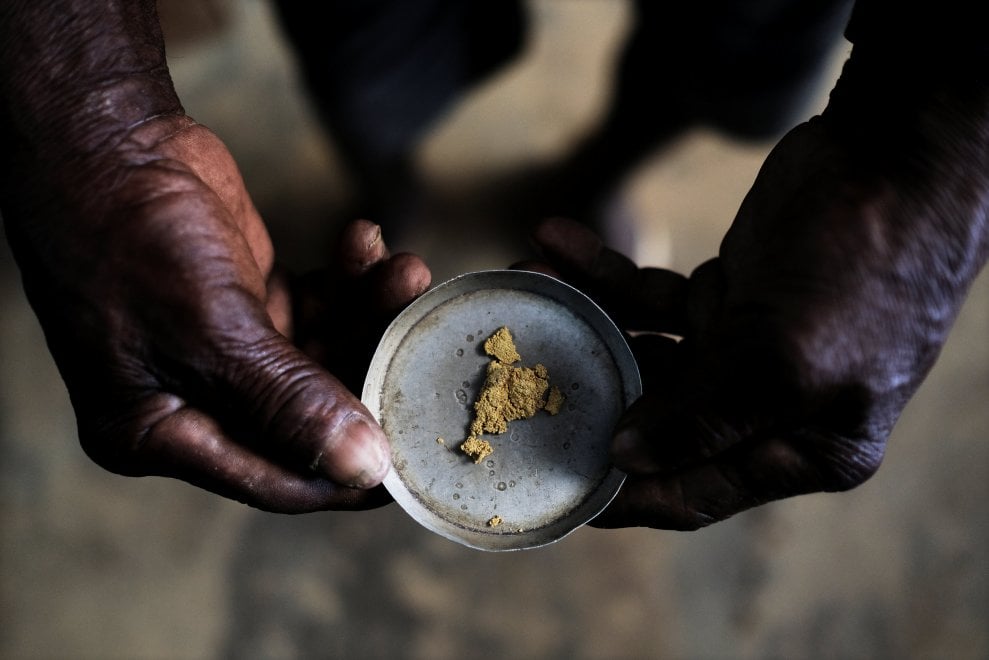
Below: the hands of a gold miner
The second source on this topic is Le Monde, whose article I unfortunately could not find online. The paper version has the title:‘Les indigènes du Brésil font entendre leurs voix‘ ( Le Monde 15 April 2022).
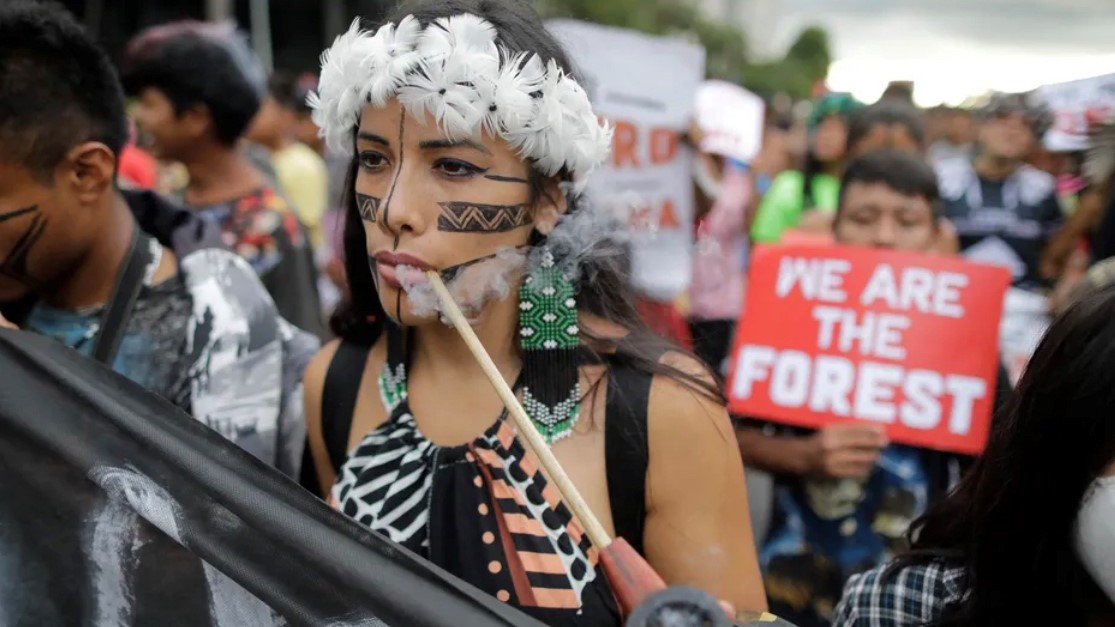
The image at the bottom of the article (AFP) is taken from other French newspaper pieces about the permanent demonstration that Brazil’s indigenous people have been carrying out since 4 April 2022, in Brasilia. This is the 18th edition of the Terra Libera encampment that brings together 8,000 indigenous people from some 200 indigenous peoples united in the Association of Indigenous Peoples of Brazil (APIB).
The APIB came together to oppose Jair Bolsonaro ‘s bills that would favour illegal gold prospecting.
Indigenous peoples represent 1% of the population but hold 13% of Brazil’s territory.
The government would like to make gold panning legal . And the Yanomami people, who oppose it, are seriously concerned first of all because: ‘there are about 20,000 illegal prospectors causing unprecedented malnutrition in our children. It is simple, we have no more protein to give them because themercury pollution, used for gold mining, kills the fauna’.
According to the Yanomans ‘ report mentioned above, ‘we have reported this situation to all possible authorities but they do nothing, even though all the evidence is there’. Indeed, the photos leave little doubt: there are airstrips, gold diggers’ camps, all the holes in the forest, shoals of dead fish and undernourished children.
The pollution suffered by the Munduruku people living in the southern Amazon rainforest has been documented by the Fiocruz medical research centre. On these Indian lands, gold diggers allegedly spilled more than 7 million tonnes of toxic waste into the Tapajos River.
“We know that the gold rush is the reason for this pursuit of gold. And we would like to make the countries that compare gold in Brazil responsible, because it is illegally extracted from our Amazon,’ denounces leader Alessandra Korap Munduruku.
Canada, Switzerland and Great Britain are mentioned as the top importers. …
And record deforestation is increasingly visible.
The Amazon races towards the point of no return
The only hope is that the executive changes following the next elections in January 2023.
The other great threat to the Amazon is agribusiness: soya and meat, as shown by the case of bresaola made in Italy, made with animals from Brazil.
On soya you can read this article.
Brazil’s agriculture feeds 800 million people. To give a yardstick for comparison, Ukraine feeds 400 million.
In 2021, according to the Catholic Church, at least 100 Yanomami Indians were killed in Brazil.
Read also :
- Amazonia : is being destroyed , with Jair Bolsonaro’s blessing, with 1200 illegal airstrips
- Brazil : Lula versus Bolsonaro . The challenge that concerns us
- Amazonia, Indians risk annihilation
- Lula seems to be dealing with it. Read also Lula takes action to end gold mining in Indigenous Yanomami territory
- But deforestation, as of today, is 46% higher than 2022
Below: the story, published in Sette of 1 July 2022, of Bruno Pereira and Dom Philips, two environmentalists (the former was an anthropologist, the latter a journalist) killed by poachers on the Itaquaí river in the Amazon.
Historian and TV presenter Fiona Watson said on the subject: “I hold President Bolsonaro responsible, because of his policies and his incitement to hatred and racism” and also ” indigenous territories have become akin to war zones“.
Final note: despite the change of government, absolutely nothing has changed in Brazil – in 2024:
In Brazil, indigenous peoples’ disappointment with Lula’s policies
The indigenous peoples number 1.7 million, divided into 33 administrative territories, 23 of which are still awaiting ratification (Le Monde 29 April 2024).
The most threatened people remain the Yanomami, 363 deaths in 2023, due to disease and malnutrition.
Below : Indigenous participants in the Terra Libera camp demonstrate in Brasilia on 13 April 2022.