[vc_column_textFirst draft : 15 November 2020 , last updated 1 April 2025
Between 2020 and 2021 I had transcribed this article to which I had added my thoughts at the bottom.The title was “Donald Trump leaves the US isolated on the world stage”. I changed it whenI added this link from 1 April 2025 which shows how history is repeating itself, although much has changed in the White House, where unfortunately Donald Trump no longer has anyone to suggest alternative routes or limit his actions.
Tariff war:Japan, South Korea and China unite against the US offensive
Tariffs are a defensive weapon, a boomerang that will only cause inflation, especially in the US. Anda country that cannot interface with others, except by force, is a weak country.
Below : a post from today, 1 April 2025
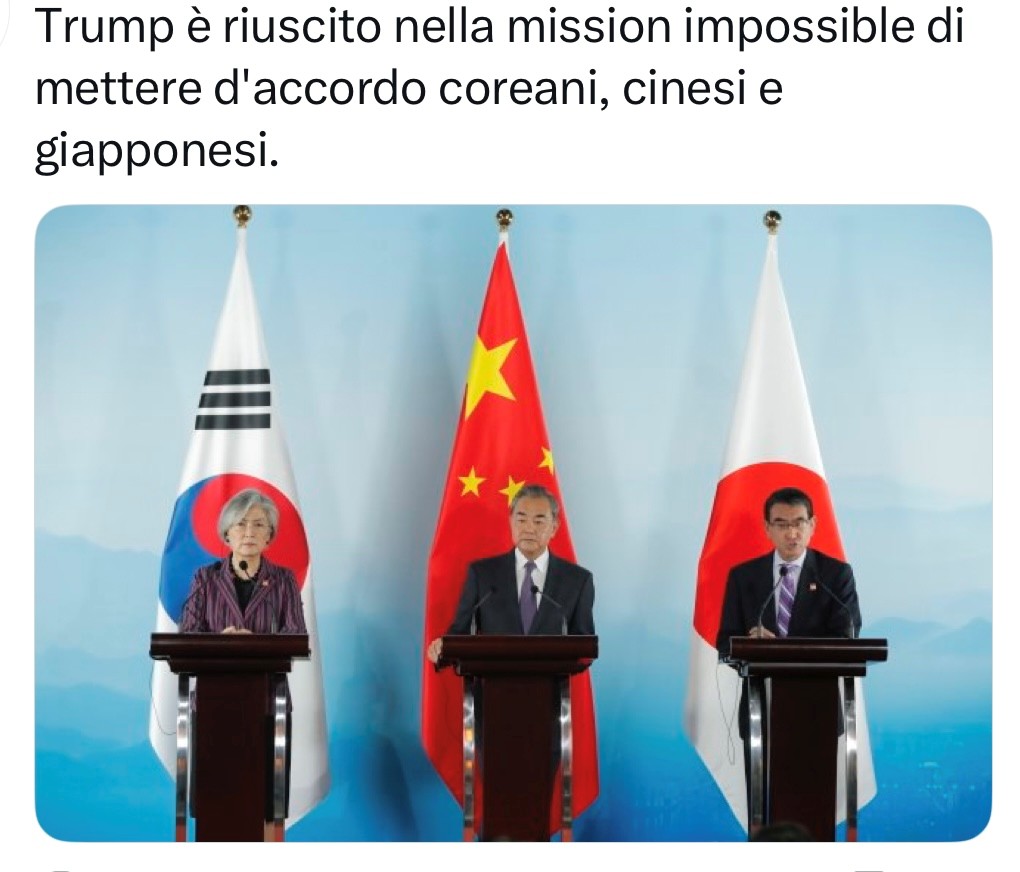
-
“China signs the biggest trade pact on the planet with 14 countries. Korea and Japan are in it’
“It will represent 30 per cent of the global economy and population and reach 2.2 billion consumers.
Fifteen Asia-Pacific economies have formed the world’s largest free trade pact, a China-backed agreement that excludes the US.
The signing of the Regional Comprehensive Economic Partnership (RCEP) at a regional summit in Hanoi, is a further blow to the agreement promoted by former US President Barack Obama, from which his successor Trump exited in 2017.
The RCEP could strengthen China’s position as an economic partner with Southeast Asia, Japan and Korea, putting the world’s second-largest economy in a better position to dictate the region’s trade rules.
The United States is absent from both the RCEP and the successor to the Obama-led Trans-Pacific Partnership (TPP) (*), leaving the world’s largest economy out of two trade arrangements spanning the fastest growing region on earth.
The RCEP could help Beijing reduce its dependence on overseas markets and technology, a shift accelerated by a deepening rift with Washington. RCEP brings together the Association of Southeast Asian Nations (ASEAN), plus China, Japan, South Korea, Australia and New Zealand. It aims to progressively lower tariffs in many areas over the coming years. The agreement was signed on the sidelines of an online ASEAN summit held as Asian leaders addressed tensions in the South China Sea and plans for a post-pandemic economic recovery. India did not sign over fears of an increase in its trade deficit with China, but could join at a later date.
Read also
 Biden, grana and limoncello: what will change for Italian exports to the US
The pact will account for 30% of the global economy and population and reach 2.2 billion consumers. China’s Ministry of Finance said the new bloc’s promises include the elimination of a series of tariffs, some immediately and others over 10 years.There are no details on which products and countries would see an immediate reduction in tariffs. “For the first time, China and Japan have reached a bilateral tariff reduction agreement, achieving a historic breakthrough,” the ministry said.
The agreement includes 20 chapters of rules covering everything from trade in goods, investment and e-commerce to intellectual property and government procurement, with the prospect of entering into force when all signatories have ratified it. It is the second major multilateral trade agreement for Asia, following the Comprehensive and Progressive Agreement for the Trans-Pacific Partnership (Cptpp), the 11-nation version of the TPP without the US: seven countries are also part of the 15-nation Rcep.
This is the first time that the rival East Asian powers – China, Japan, and South Korea – have concluded a free trade agreement.Despite being outside the RCEP and having served as vice-president of the US government that promoted the TPP, it is unlikely that President-elect Joe Biden will join the TPP anytime soon, as his government will have to prioritise dealing with the COVID-19 outbreak.
Il Sole 24 ore 15 November 2020
(*) This paragraph of the article is unclear but Obama had nothing to do with abandoning the TPP, which, indeed, he promoted.
From Wikipedia: “On 23 January 2017, US President Donald Trump signed an executive order to formally withdraw US membership of the treaty. The withdrawal of the TPP was one of the first official acts of the US president who thus wanted to fulfil the promise he had repeatedly announced during the election campaign. Donald Trump declared his intention to initiate a series of bilateral agreements with the various countries in the region. His departure from Washington ushers in the new course of US policy in the Asia-Pacific region’.
The only possible partner left out of the RCEP: India, which feared Chinese leadership and abandoned the negotiations last year.
It should also be noted that in the US, 3500 companies , fed up with the tariff policy unleashed by Donald Trump, have sued the government (including Coca-Cola, Disney and Ford).(source: Financial Times).
The latest chapter in the war against China: US blocks 8 Chinese apps including Alibaba’s Alipay
-
Trump also pitted the US against Europe
european tariffs have just been triggered in response to US tariffs.
And in the OECD, he is the one who, in June, suspended negotiations on the possible taxation of high-tech giants, on which France is proceeding.
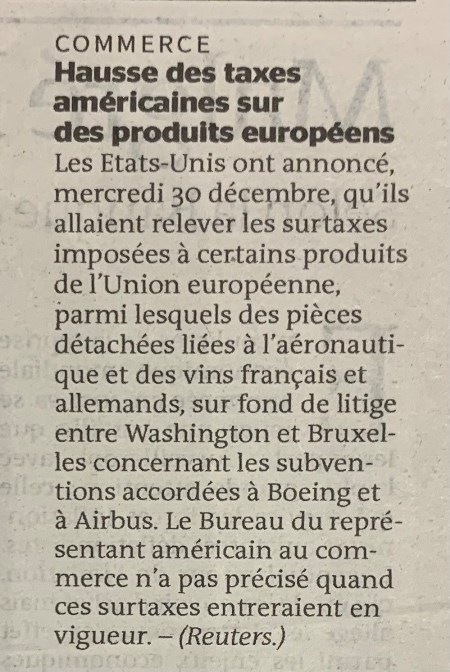
The US risks paying dearly for Trump’s wars and his isolationism , such as the raising (‘hausse’) of US duties against the EU, see below Le Monde of 1 January 2020.
Read also Trump’s latest challenge: he lengthens the list of duties to France and Germany