

Written on 3 April 2025, updated on 10 August 2026
I’ve spoken to you about the divide that has developed over the years between the US and Europe.
All true, at least as far as the past is concerned.
We could be facing a second huge shift, on a par with what happened between the US and Ukraine.
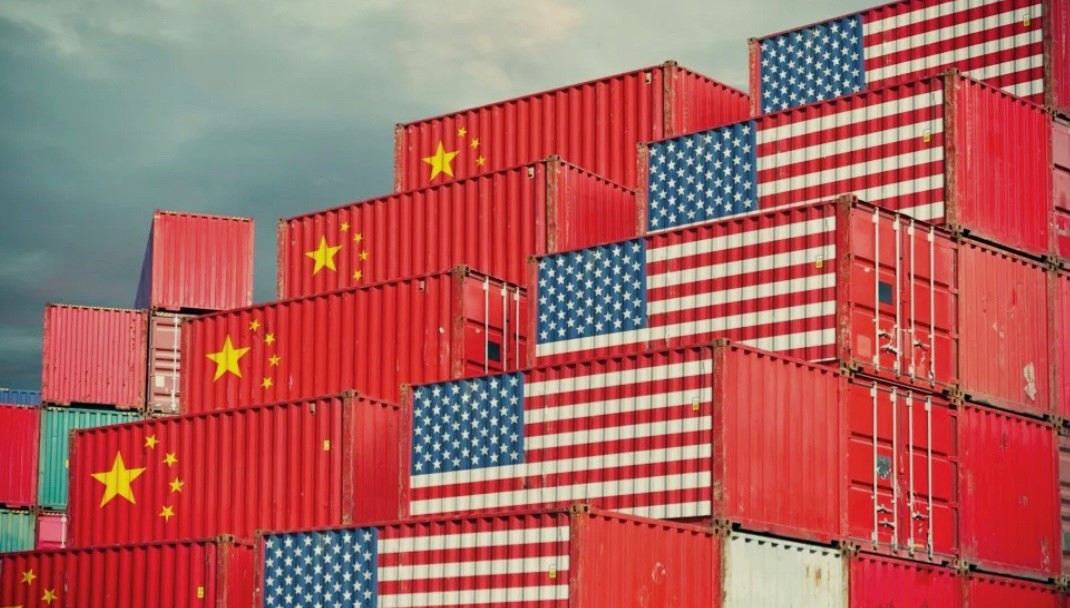
The imposition of 54 per cent (*) tariffs on goods entering China will not only create terrifying tensions and skyrocketing inflation, but also risks emptying the supercentres [hypermarkets, which are much larger than supermarkets]such as Walmart or Costco, which are already struggling greatly to source non-food goods to sell.
A few days ago, *Le Monde* reported that, for example, small electrical appliances – such as toasters, which are found in every American home – are 99 per cent manufactured in China.
Indeed, the Financial Times writes: ‘China sees an opportunity in Trump’s cultural revolution.’
In hindsight, in 2026, it can be said that the tariffs were borne by US consumers: Trump’s tariffs will cost an average American family $1,100 a year,and Trump is paying out the first tariff refunds: $100 billion to importers, whilst consumers remain excluded.
Below are Thomas Friedman’s reflections on technology and tariffs: I found them enlightening.
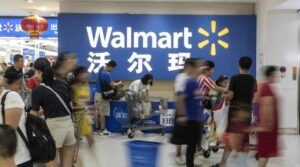
Below: a Walmart store in China; economies are interconnected even if the US administration ‘doesn’t understand this’. The American chain has stated that its sales will slow this year due to the Trump effect.
Excerpt from: Friedman: I’ve Seen the Future, and It Wasn’t in America byThomas L. Friedman
Trump’s wishful thinking – that we simply need to erect protective barriers around our entire economy – doesn’t work
I was in Shanghai recently and found myself wondering which world of tomorrow to visit: the fake one – the ‘Tomorrowland’ designed by the Americans at Shanghai Disneyland – or the real future – the imposing new research centre, roughly the size of 225 football pitches, built bythe Chinese tech giant Huawei? I chose the latter.
It was a fascinating and impressive experience, but ultimately deeply unsettling – a clear confirmation of what an American businessman, who has been workingin Chinafor decades, told me in Beijing: ‘There was a time when people came to America to see the future. Now they come here.”
In Pudong (Shanghai) in the 1990s, when China was ‘the world’s factory’ (I visited China seven times to import non-food goods for Esselunga. Read: From supermarkets to Esselunga superstores (part 2). Development).
I had never seen anything like it. Built in just over three years, theHuaweicampus comprises 104 individually designed buildings, with manicured lawns, linked by a Disneyland-style monorail, and houses laboratories capable of accommodating up to 35,000 scientists, technicians and other staff, with 100 cafés, fitness centres and other facilities aimed at attracting the best Chinese and foreign technologists.
The new research and development centre is Huawei’s response to the US attempt to strangle the company, beginning in 2019, by restricting the export of American technology, including semiconductors, due to national security concerns. The ban has inflicted huge losses on Huawei, but with the help of the Chinese government, the company has sought to circumvent the obstacle by focusing on innovation. As reported last year by the South Korean business daily Maeil Business Newspaper, ‘Huawei astonished the world by unveiling the “Mate 60” series, a smartphone equipped with advanced semiconductors, in defiance of US sanctions’. Huawei has continued along this path with the world’s first triple-folding smartphone and has unveiled its own mobile operating system, Hongmeng (Harmony), designed to compete with those of Apple and Google.
The company has also entered the field of developing AI technology applicable to everything from electric vehicles and self-driving cars to autonomous machinery for the mining industry capable of replacing human labour. Huawei executives have stated that in 2024 alone, the company installed 100,000 fast-charging stations across China for its electric vehicles; by way of comparison, in 2021 the US Congress allocated $7.5 billion for a network of charging stations, but by November this year the network had only 214 active stations across 12 states.
It is certainly alarming to look at all this closely.President Donald Trumpis busy determining which teams transgender athletes can compete for, whilst China is transforming its factories with AI to outperform ours. Trump’s ‘Liberation Day’ strategy consists of doubling tariffs whilst gutting the national scientific institutions and the workforce that drive American innovation. China’s liberation strategy is to open more research centres and focus on AI-driven innovation to become permanently free from Trump’s tariffs.
The message China is sending to the United States is this: we are not afraid of you. You are not who you think you are – and we are not who you think we are. I prefer to express my patriotism by being brutally honest about our weaknesses and strengths, about China’s weaknesses and strengths, and about why I believe the best future for both nations – on the eve of the AI revolution – lies in a strategy called: ‘Made in America by American workers in partnership with Chinese capital and technology’. Let me explain.
Trump’s wishful thinking
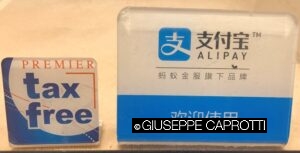
I agreed with Trump regarding the tariffs imposed on China during his first term. China was blocking access to certain US products and services, and we needed to retaliate against Chinese tariffs. For example, China dragged its feet for years before authorising the use of US credit cards on its territory, waiting for its own payment platforms to completely dominate the market and transform the country into a cashless society, where virtually everyone pays for everything via mobile payment apps installed on their phones. When I tried to use my Visa card in a shop at Beijing railway station last week, I was told it had to be linked to one of those apps, such as Alipay [by Alibaba] or WeChat Pay, which together hold over 90 per cent of the market [ and with which the Chinese do ‘everything’, worldwide, under the logo in a shop: the Chinese pay only with those two apps, even in Paris].
I take issue with Trump’s wishful thinking, according to which all we need to do is erect protective barriers around an industrial sector (or our entire economy) and, before long, US factories will flourish and produce in America at the same cost, without any extra burden on US consumers.
Those who think that China has achieved global manufacturing dominance solely through deception are also mistaken. Of course, it has cheated, copied [a classic example: the Guangzhou Fair – formerly Canton – was full of samples copied at lightning speed: one day a product was on one stand, the next day it was on another…] and forced technology transfers. But what makes the Chinese manufacturing giant so powerful today is not just the fact that it offers products at more competitive prices, but that it produces at lower costs, more quickly and in a way that is increasingly integrated with artificial intelligence.
The Chinese ‘fitness club’
How does it manage this? Jörg Wuttke, who was for many years head of the European Union Chamber of Commerce in China, calls it the ‘China fitness club’, and this is how it works. China starts by focusing on STEM education – science, technology, engineering and mathematics. Every year, the country produces around 3.5 million graduates in STEM disciplines – a figure almost equal to the total number of graduates from bachelor’s, master’s and doctoral programmes across all disciplines in the United States.
With such a large number of STEM graduates, you can deploy talent to solve any problem more effectively than anyone else. As Keith Bradsher, head of the New York Times’ Beijing bureau, stated last year: ‘China has 39 universities with programmes designed to train engineers and researchers for the rare-earth industry. Universities in the United States and Europe have, for the most part, offered only sporadic courses.’
Over 550 Chinese cities are linked by high-speed trains that put ours to shame. And thanks to digitalisation and pervasive connectivity, you can enter and leave your hotel room simply by facial recognition. The entire system is designed for speed – even if you challenge the Communist Party’s rule, in which case you will be arrested swiftly and disappear just as quickly.
If we do not build a similar ‘fitness club’ behind any tariff barrier, we will only end up with inflation and stagnation. You cannot achieve prosperity through tariffs alone [it’s like saying that a company only needs to cut costs, without investing in development], especially at the dawn of artificial intelligence…
And I sincerely believe that they – the Chinese – are right. Because they are building culture and innovation, whilst the White House is destroying education and research.
China will have the expertise; America will not.
Confirmation comes, for example, from this news item:
China’s digital RMB (Yuan) will now be fully connected to:all 10 ASEAN countries and 6 nations in the Middle East
This accounts for 38 per cent of global trade volume, which is now set to bypass the US-dominated SWIFT system and flow directly through China’s digital RMB infrastructure…
The US dollar is under direct threat as never before…
- US debt: waging war against those who hold 8.92 per cent of your debt ($759 billion, the world’s second-largest holder after Japan) – whom you’d like to refinance your debt with – doesn’t strike me as a wise move. And indeed, China is divesting more and more: it used to be the largest holder of US Treasuries, but is now the third-largest after Japan and the UK.
Below: China exported $438.9 billion to the US in 2024, whilst China purchased goods from the US for ‘just’ $147.8 billion.
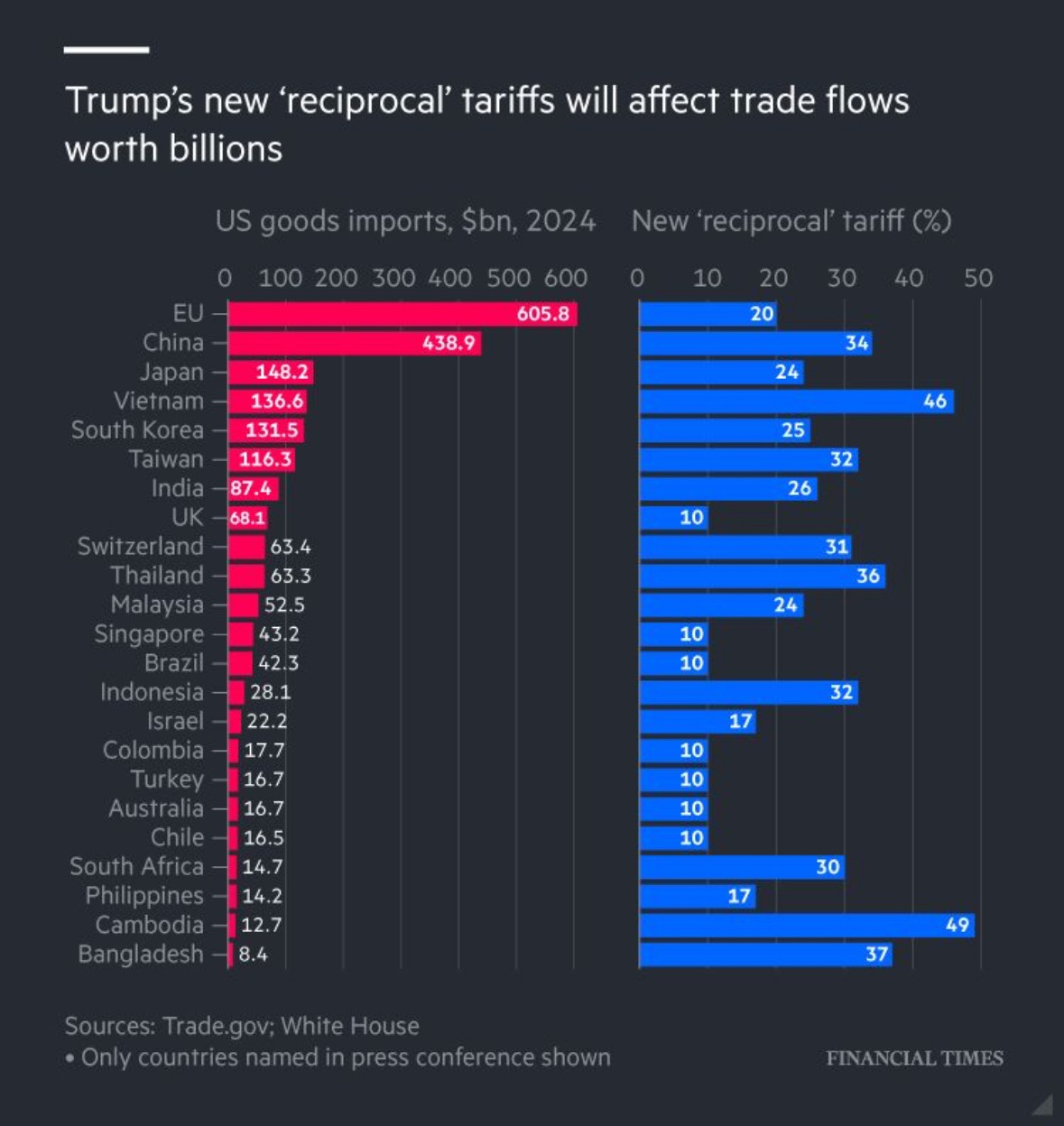
I won’t go into the details of the current escalation, but I would point out that China has been working to supplant the dollar for many years.
- Industry: Trump is probably handing China victory on a plate: the French economist Thomas Piketty, for example, said, “By 2035, China’s GDP will be double that of the United States. The US is losing control of the world’ (print edition only, 13–14 April 2025).
And indeed, its share of the manufacturing market has risen from 6 per cent in 2000 to 13 per cent in 2023 (Le Monde, 18 April 2025).
What is happening: Western companies claim that Beijing is demanding sensitive commercial information to safeguard rare earths as part of the export approval process. This includes details on production, images of products and facilities, and confidential customer lists, according to several companies and official guidelines. “They’re asking for a lot, a great deal,” said an executive whose company imports speaker components from China to Italy.
Why it matters: the extensive requirements have raised concerns about the potential misuse of data and the disclosure of trade secrets, with some companies in sensitive sectors finding it difficult to comply or even to apply for export licences. China wields significant influence as it dominates the sector. China introduced stricter controls in early April, as tensions with the US escalated, but has not stated whether it will abandon them as part of the framework agreement with the US.
Conclusion: when it comes to knowledge, innovation, skills, manufacturing, US debt and rare earths, China certainly holds more ‘cards’ than the United States.
Africa does not have enough universities to educate its own students, but China has organised an effort to recruit them whilst the United States is scaling back its diplomatic, military and humanitarian engagement on the continent.
Below: China and the US locked in a battle over AI (The Wall Street Journal, 13 August 2025, and Fortune, 14 August 2025. On AI: “The US still has the upper hand: it is home to the leading cutting-edge laboratories, has an investment capacity that China is, for now, unable to match, and continues to produce a greater number of high-end models and patents with greater impact. China, however, publishes more scientific research on AI, has overtaken the US in terms of the total number of patents, and installs far more industrial robots”.


