Written on 8 July 2025, updated on 24 June 2026
Europe has fallen behind America, and the gap is widening. From technology to energy, from capital markets to universities, the EU cannot compete with the United States
This will have an impact far beyond relative living standards. Europe’s dependence on the US for technology, energy, capital and military protection is steadily undermining any aspirations the EU might have for ‘strategic autonomy’.
In 2008, the economies of the EU and the US were roughly the same size. But since the global financial crisis, their economic fortunes have diverged dramatically…
In 2008, the EU economy was slightly larger than that of the US: $16.2 trillion compared with $14.7 trillion. By 2022, the US economy had grown to $25 trillion, whilst the EU and the UK combined had reached only $19.8 trillion.
The US economy is now almost a third larger. It is more than 50 per cent larger than the EU excluding the UK. The aggregate figures are shocking. Underlying them is the picture of a Europe that has fallen behind, sector by sector (the only real, very large, fly in the ointment is the rise in the Trump administration’s debt).
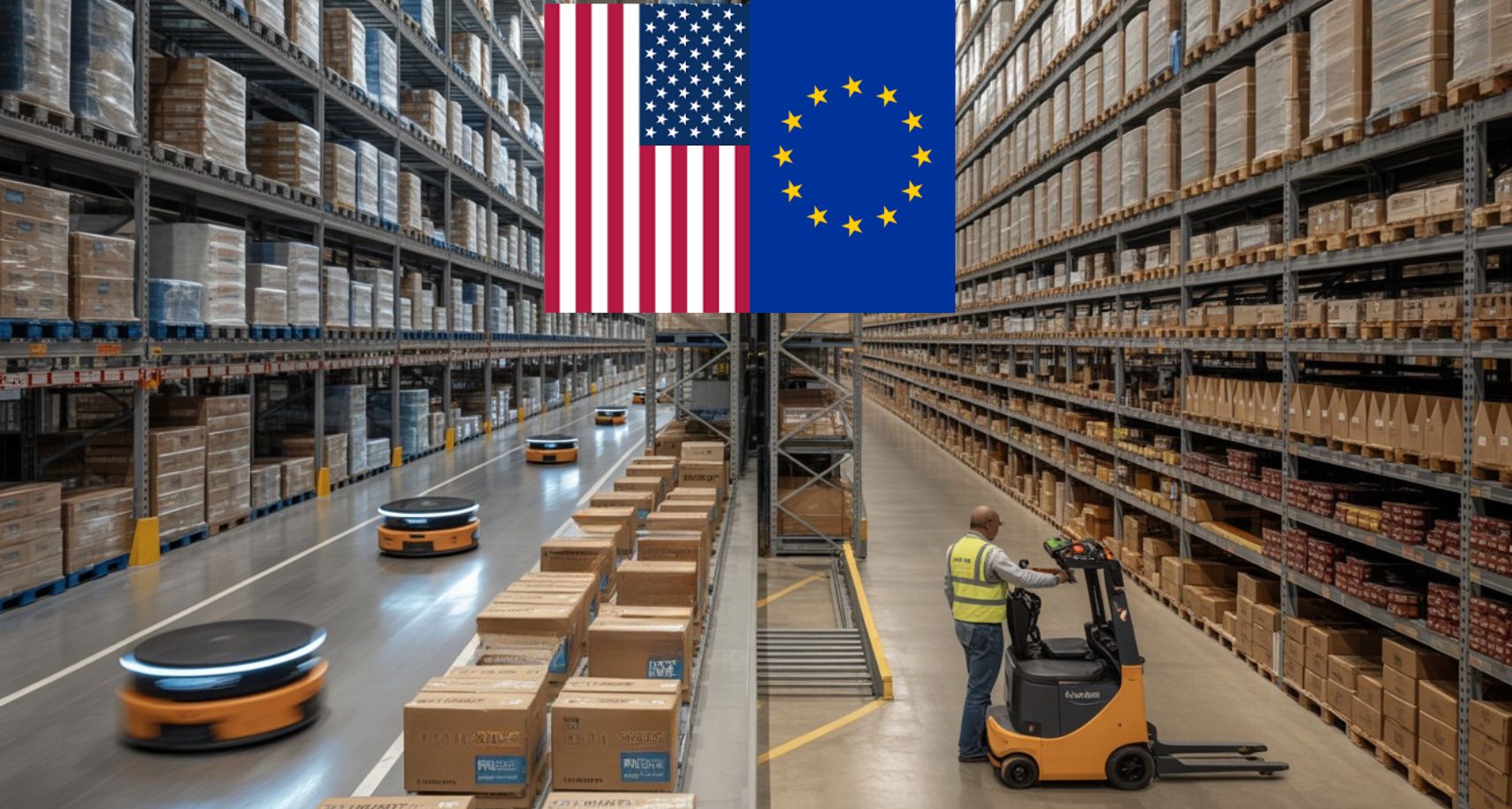
And in terms of distribution, the gap is becoming increasingly evident:in the US, there is:
- high levels of automation
- rising productivity
- unimaginable online turnover
- sky-high advertising revenues
- cloud and data centres, for Amazon
- a range of delivery options
- the choice for retail companies to venture into delivery, competing with platforms that deliver ready-made food from restaurants.
Walmart’s executives aim to grow sales by 4 per cent a year, but do not expect to significantly increase the number of employees. The employment figures raise questions about the future of work in the US retail sector, which employs one in ten American workers and provides ample opportunities for promotion for those without university degrees. Around 1.6 million Walmart employees are based in the US, a figure that has barely changed over the past decade. Walmart’s wage trend contrasts with that of competitors such as Costco, Target and Home Depot.
Wall Street analysts say the company’s expansion without job creation reflects a challenging push into e-commerce and the automation of labour-intensive tasks, from unloading shipping pallets to updating price labels on shelves. Artificial intelligence is set to boost these efforts. Walmart executives say that investment in technology means new roles for workers, not fewer. “Tasks will evolve. Jobs will change. And many years from now, we will still employ a large number of people and will be happy to do so,” said Chief Executive Doug McMillon at an investor event in April.
This week (in June 2025), Walmart will host 13,000 employees and shareholders at its Associates Week event, an annual ritual at its headquarters in north-western Arkansas. But critics say workers are missing out. Walmart’s net sales in the US have risen by 36 per cent over the past five years, whilst average hourly wages in the US have risen by 28 per cent, to $18.25.
“Walmart’s jobless growth is a continuation of a pernicious trend that Walmart itself has promoted: squeezing more output from every hour of work and increasing sales faster than wages”, said John Marshall, director of capital strategies at Local 3000 of the United Food and Commercial Workers, which concluded an unsuccessful effort to unionise the company a decade ago. Walmart’s wage trend stands in contrast to that of its peers.
Over the past five years, major retailers Costco, Target and Home Depot have added tens of thousands of employees. E-commerce giant Amazon has almost doubled its global workforce to 1.6 million.
“The overarching trend is very clear. I think most retailers want to automate many different functions within their operations because labour is a very, very costly part of doing business,” said Neil Saunders, a retail analyst at GlobalData. “We’ve seen Walmart lean heavily into this”. In April, Walmart showcased labour-saving technologies to investors and the media at two new warehouses outside Dallas – one a cold-storage hub for food, the other a distribution centre designed to enable rapid deliveries to e-commerce customers.
Walmart executives say that these technological investments mean new roles for workers, not fewer . Around 600 staff work inside the 730,000-square-foot cold store. This works out at one employee for every 1,200 square feet – roughly the size of a small house (120 square metres). Inside, a multi-level system of lifts, conveyors and sorters handles pallets of eggs, meat, produce and other perishable goods after they arrive from suppliers, storing them on racking up to 80 feet high. Guided by algorithms, the robots then sort the foodstuffs to be grouped and dispatched to cold stores in 175 shops across the region. The centres can dispatch more than double the volume of traditional cold stores, reducing costs by 20 per cent. Rob Montgomery, Walmart’s executive vice-president of supply chain operations, said the technology has spared associates from walking for miles and lifting tens of thousands of pounds a day: “Here, our associates are working alongside automation to get the job done.”
Two miles away, Walmart’s DFW-5 distribution centre is up for sale as the US e-commerce business grew by 21 per cent year-on-year in the last quarter. The 1.5 square metre warehouse can hold up to 2 million individual products, comprising both Walmart’s own goods and those from third-party suppliers using its online marketplace. It employs 650 staff. Inside, a task that once took 12 steps has been condensed to five, helping to reduce costs by an expected 30 per cent by the end of this year.“What used to be a three- or four-hour process to fulfil an order now takes less than 30 minutes in a building like this,”said Kieran Shanahan, chief operating officer of Walmart US. Among the automated tasks is the assembly of cardboard boxes.
…Local authorities in Texas have approved millions of dollars in tax breaks for Walmart to build both the distribution centre and the cold store, which opened in 2023 and 2024 respectively. In exchange for the proposed subsidies, the city of Lancaster and the surrounding Dallas County each required Walmart to employ hundreds of people at the sites. …
Walmart now has 29 dedicated e-commerce distribution centres in the United States, down from 40 in 2020, according to annual reports.
Wall Street analysts say the company’s expansion without job creation reflects a strong push towards e-commerce and the automation of labour-intensive tasks.
Automation “will drastically reduce the number of staff at some of these supply chain sites,” said Steven Shemesh, a retail analyst at RBC Capital Markets. Inside the shops, shipments arriving from robotic warehouses that have already been sorted can go straight to the shop shelves, rather than having to be unpacked by hand in back rooms…
Walmart also divested its Argentine business in 2020 and sold its majority stake in the Japanese retailer Seiyu in 2021. The two operations were less labour-efficient for Walmart and employed 50,000 people. Gildenberg added that high inflation in recent years has boosted sales.
In a labour market tightened by the Covid-19 pandemic, Walmart has sought to retain staff through pay rises and bonuses. Around 92 per cent of US associates are paid by the hour. “Walmart sets the de facto wage benchmark for service sector employment in many parts of the country,” said Nelson Lichtenstein, a professor of history at the University of California, Santa Barbara, and an author and editor of books on society.
Walmart will be taking on more frontline staff as it carries out plans to open 150 US stores and dozens of members-onlySam’s Club warehouses…
But the real crux of the matter lies inthe technological acceleration ofWalmart and Amazon, the undisputed leaders – completely out of reach for the European retail sector, which will continue to suffer from unfair competition from online platforms.
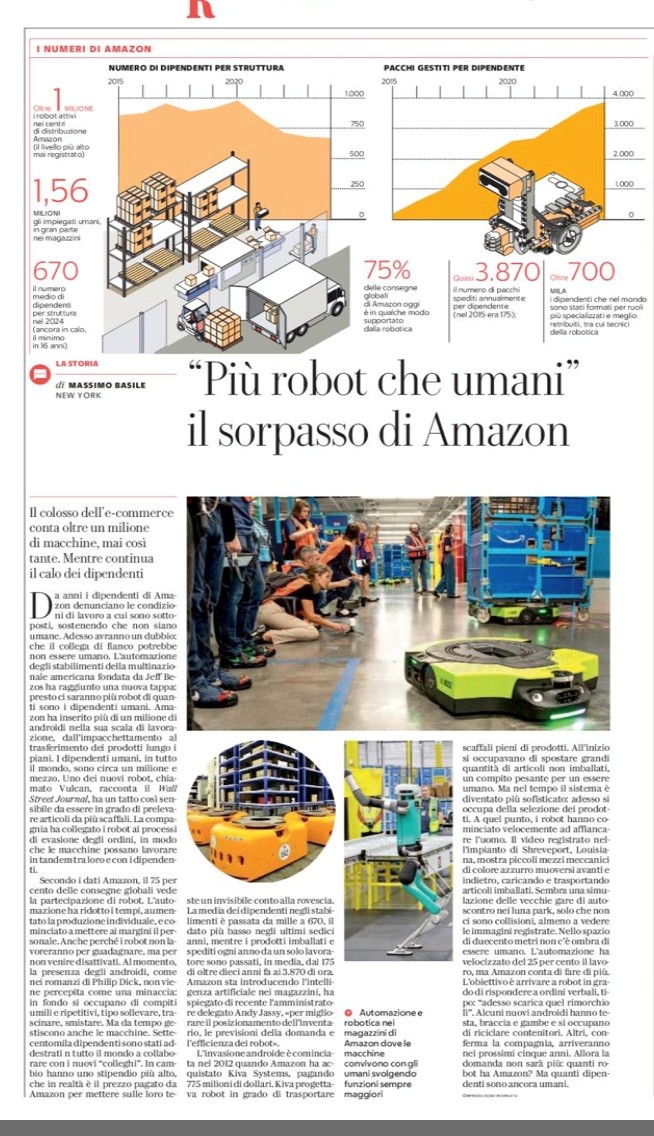
Below: an article on Amazon’s automation.