Written in February 2021, updated on 10 February 2026
This is the follow-up to ‘Ferrero: the hazelnut policy in Italy and Turkey’
Let me start from the beginning: if you say, ‘I love you, Italy’ (the current Nutella campaign), you have to prove it to me – from the field to the shop shelf.
And in any case, a focus solely on Italy is no longer enough, given that Ferrero is a multinational.
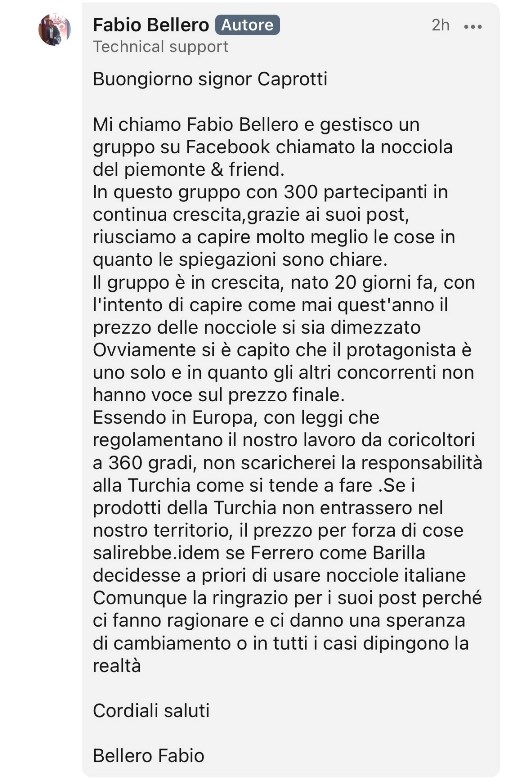
I was told: “Follow what the press is saying.” So I gave a voice to a farmer, the only one who dared to speak out on this subject (though many others have followed suit, even if they don’t mention Ferrero directly…)
Ahmed El Idrissi on LinkedIn:
“…Ferrero isn’t the only company with strong local roots that processes the raw material: hazelnuts.
What I see, based on my very limited experience (growing a few hectares of hazelnuts as a hobby), is a clash of interests between industry (large companies, multinationals) and farmers (small or micro-enterprises).
The question is: why can’t we work together as a system, perhaps by shortening the supply chain?
It would be wonderful if producers of ‘Tonda Piemonte IGP’ hazelnuts were properly remunerated and proud to contribute to the production of a UNIQUE PRODUCT that can be exported all over the world, or at least to the Italian market!
Let’s learn from what the wine sector is doing: over the last 20 years, it has focused on enhancing quality as well as price.
But we cannot accept the current price of hazelnuts being less than 3.00 euros per kg! That’s practically the same price at which Turkish hazelnuts are bought! We cannot expect small farming businesses to survive on state subsidies (for how long?)
The wonderful thing about this sector – hazelnuts – is that producers are paid based on the net weight of the nuts, excluding the shells (it’s a bit like me paying for oranges net of the peel; the other day I was in a well-known supermarket and saw Piedmont hazelnuts at 9.80 euros per kg. I was taken aback – I’d just sold mine at 2.80 per kg, I was tempted to ask the shop assistant if the price was net of the shell, but then I gave up because he wouldn’t have understood) and then, if I grow organically and don’t use insecticides, I’m penalised even further because I’m charged a penalty on all the produce damaged by the stink bug! It’s unbelievable.”
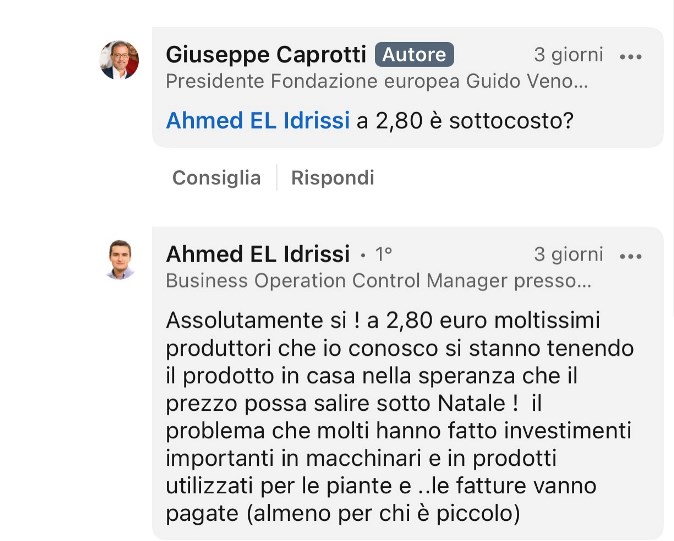
Giuseppe Caprotti:
“Is 2.80 below cost?”
Ahmed El Idrissi:
“Absolutely! At 2.80euros, loads of producers I know are holding onto their produce in the hope that the price might rise in the run-up to Christmas! The problem is that many have made significant investments in machinery and plant care products, and… the bills have to be paid (at least for small-scale growers).”
Ahmed El Idrissi:
“If we want to promote biodiversity, if we want to promote the local area, if we want to promote the product, we cannot simply plant thousands of hectares of hazelnut groves in lowland areas along the ravines where maize used to be grown!!
And then we’d be dousing them with weedkillers, pesticides, chemical fertilisers and so on… and the resulting product would be blander than a potato and taste more like a peanut than a hazelnut.
Let’s promote products from areas in Italy with a long-standing tradition; let’s support those producers who farm organically.
When I go shopping along 20 linear metres of wine shelves, I find boxed wine, but I can also spot the labels that tell me about the region; I might even find a wine from a town that’s particularly dear to me, because my grandfather was a member of that winery, and I even remember the vineyards that produced those grapes. Can we dedicate 5 linear metres to baked goods, creams and the like that tell me where those hazelnuts come from?
… My point is that we need to create a collaborative system between producers, the confectionery industry (meaning both artisan workshops and multinationals), distributors and perhaps even institutions to promote the raw material – namely the ‘Tonda Gentile Trilobata’ hazelnut produced in the Langhe, and in certain municipalities in the Asti and Alessandria areas – through the production and marketing of products with a strong connection to the local area.
All this to create wealth in that region, to promote that region, to preserve that region, and to raise its profile abroad.
But in my view, this is only possible if we break the equation ‘price of Turkish hazelnuts = price of hazelnuts produced in Clavesana’, for example;
We must ensure that the same product does not contain a mixture of foreign hazelnuts and Piedmontese hazelnuts,
the other day, a buyer from a confectionery company boasted that his product contained a good quantity of hazelnuts from the Langhe,
BUT WHAT DOES THAT MEAN?
It’s as if a Barolo producer were to tell me that his bottle also contains a proportion of wine from a carton, ‘but the rest is Barolo’.
Conclusion: why doesn’t Ferrero follow Barilla’s example, which produces pasta made from 100 per cent Italian wheat?
Ferrero could differentiate between Italian and non-Italian products. And the environmental problem, years after this article was first written, remains.
Read also: Small Piedmontese hazelnut growers on hazelnut prices influenced by Ferrero, or see below.