Compiled 14 February, updated 17 February 2026
At the end of November I wrote about its move to Nasdaq on 9 December 2025:
Sales were up 4.5 per cent last quarter, taking market share away from direct competitors such as Target, for example.
The company said food priceinflation in its shops was 1.3%, down 0.2 percentage points from the second quarter and less than half the national inflation rate for groceries purchased at home.
CEO McMillon said Walmart has temporarily reduced prices on about 7,400 items, more than half of which are groceries, and said he welcomed Trump’s decision last week to reduce duties on food ingredients that are poorly grown in the US.
The strong results prompted Walmart to revise its net sales forecast upward for the second time this year. Executives now expect growth of 4.8 to 5.1 per cent for the full year, up from a previous forecast of 3.75 to 4.75 per cent.
The company, which has a market capitalisation of more than $800 billion, up 20 per cent after the announcement of its partnership with ChatGPT, will begin trading on the Nasdaq on 9 December.
The e-commerce division had a 27 per cent growth last quarter…
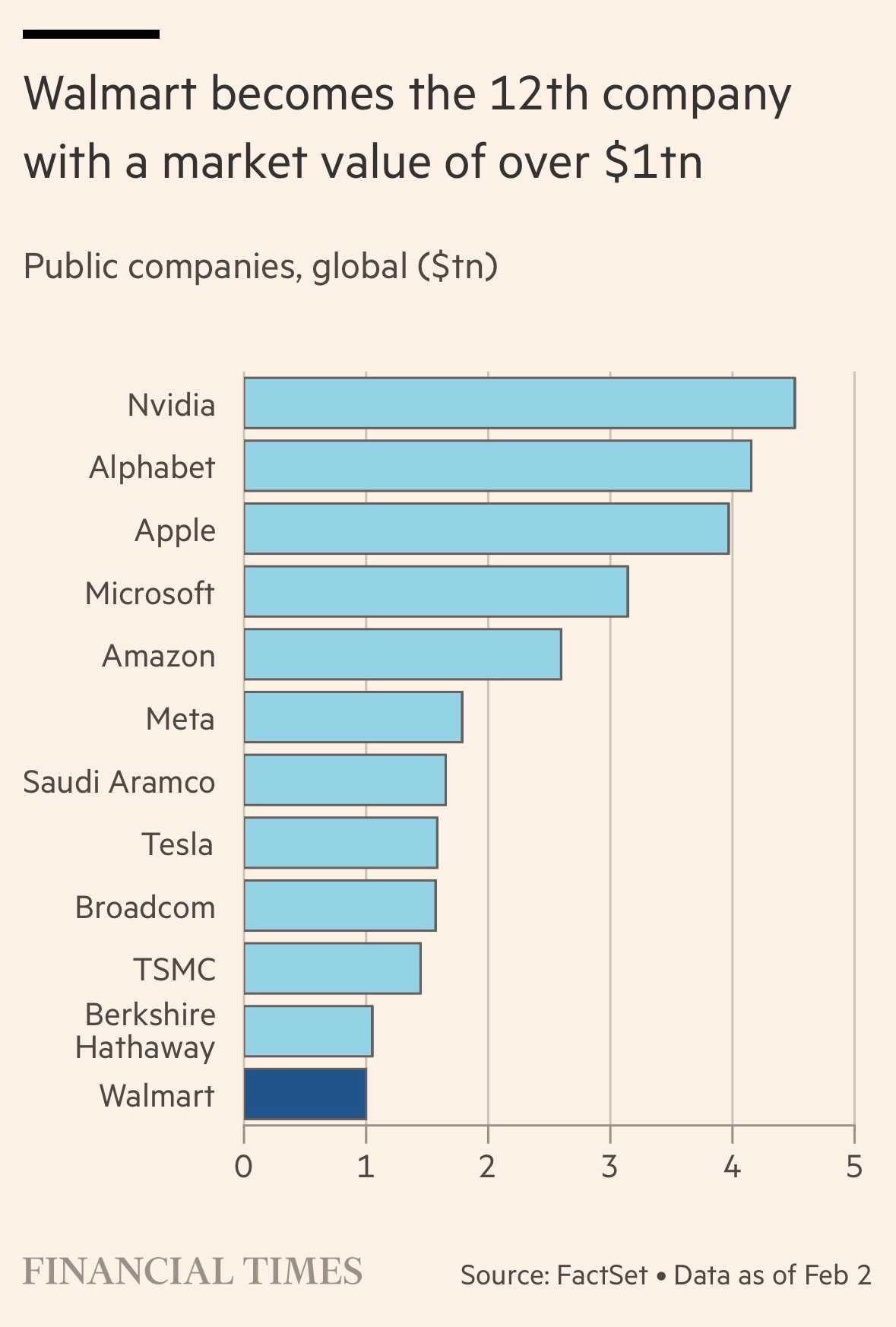
Walmart’s market capitalisation exceeded $1 trillion, putting the largest US retail chain in an exclusive club dominated by technology groups. The Arkansas-based company reached this milestone on Tuesday, capping a rally in which its shares have more than doubled in the past two years, outperforming the blue-chip S&P 500 index.
Walmart has invested tens of billions of dollars to develop an e-commerce business that is now a credible competitor to Amazon. Annual e-commerce sales are expected to reach about $140 billion when it releases its results this month. His online business became profitable last year [as did Ahold Delhaize’s].
Founded by Sam Walton with a single shop in 1962, the retailer has expanded to nearly 11,000 shops worldwide. Analysts predict Walmart’s annual sales will exceed $700 billion [in 2026], although they expect Amazon’s figure to exceed that of the retail chain for the first time, according to Visible Alpha…
What does this all mean?
- the figures give the size of the growing gap between the US and Europe.
- Walmart, as the 12th largest company in the world in terms of capitalisation, has the potential to face eternal rival Amazon on an equal footing.
- the gap in distribution, then, is absolutely unbridgeable. Suffice it to say that Walmart was born five years after Esselunga. In Europe, who would have the conditions to play a similar game with platform, logistics, data and AI without depending entirely on external ecosystems? Apart from the Chinese JD.com, Shein, Alibaba and Temu a European company that could do it would be there, which one do you think?