Compiled 21 March, updated 9 June 2025
The translation of this article completes the picture I have already outlined
How Walmart built the biggest threat Amazon has ever faced
With thousands of shops and an army of drivers, the retail giant can make same-day deliveries in over 90% of the country
By Sarah Nassauer
Walmart delivered five billion items the same day they were ordered last year, twice as many as in 2023. It is now able to deliver most of the 120,000 products in its supercentres, including meat, eggs and milk, to 93% of US households on the same day, sometimes within hours.
Amazon does not release figures that allow an exact comparison of its same-day delivery reach. But Walmart’s sprawling delivery network, which in some areas is faster than Amazon’s, represents a leap that would have been unimaginable just a few years ago.
“I’m very, very grateful that we have about 4,700 shops” that now also serve as fast delivery hubs, John Furner, CEO of Walmart USA, said in an interview. “It’s something that maybe a few years ago people wouldn’t have expected that we would be able to provide on a large scale.”
To make most of these express deliveries, the retailer relies on thousands of freelance drivers using a system called Spark [spark], created by Walmart, which uses an app to coordinate online orders from its fleet of supermarkets.
About 41% of all e-commerce sales in the US go through Amazon, a much larger share than Walmart’s 9%. Amazon could overtake Walmart this year as the country’s largest company by revenue if sales trends persist. Walmart had sales of $681 billion in 2024; Amazon’s was $638 billion.
But over years of trying, testing, and failing, Walmart has carved out a niche for itself that has prompted Amazon to try to catch up: fast delivery of online orders that often include inexpensive groceries and increasingly other items it sells in its shops, such as clothing, decorations, batteries, and prescription drugs.
An Amazon spokesman declined to disclose the share of US households that can now receive same-day shipments. Shoppers in more than 3,500 US cities and towns have access to grocery delivery in some form through Amazon, he said, and the company can deliver millions of items the same day. The company says it delivered more than two billion items it calls ‘everyday essentials’, such as cleaning products and paper towels, on the same or next day in the US last year. These figures do not include fresh groceries, but it is working to quickly add those items to its same-day delivery warehouses, it said.
“I don’t think Walmart will ever reach the size that Amazon has online,” said Blake Droesch, retail analyst for Emarketer, which tracks e-commerce. “But Walmart is one of the few retailers that has had the capital and the strategy to mount a real defence.”
Walmart as a whole is profitable, but its e-commerce operations, which generate 18 per cent of the company’s revenue, are not. Executives have said that e-commerce is approaching profitability, but they have not set a specific timeline for when they expect to reach that goal. They are building other more profitable businesses in addition to traditional retail, such as advertising. In this way they are operating as a technology start-up, just like Amazon, which famously did not record a profitable year until almost a decade after its inception.
Investors have not been spooked. Walmart’s shares have doubled in two years to record levels and its market value is almost $737 billion. Amazon’s market capitalisation is over $2.1 trillion.
If the discounter can provide high-quality products such as Wagyu beef and eye-catching clothing “at a Walmart price point in a very convenient fast delivery service, I think it’s a winning proposition,” Furner said.
Walmart’s spark
Samantha Atkinson became a Spark driver last year to supplement her income by running a small online cosmetics business.
Samantha Atkinson became a Spark driver last year to supplement her income by running a small online cosmetics company. Photo: Ryan Dorgan for WSJ
Over the past decade, Walmart executives realised they needed to use their grocery business to fend off Amazon’s expansion. Walmart gets more than 50 per cent of its US revenue from selling meat, eggs, lettuce and other groceries. It used its scale to lower the prices of those items, which attract shoppers for regular trips.
This setup works when shoppers also buy higher-margin items in the part of the shop that insiders call ‘the other side of the box’: clothing, home décor, or small appliances. Walmart executives hoped that a version of the same system could work online: using groceries to lure online business away from competitors, then making money with larger, more profitable purchases.
“We think we’ve done the hardest part,” said Doug McMillon, soon after becoming CEO in 2014. “We have the shops, the employees and the experience in a physical world that others will have to build.”
When McMillon took the top job, Walmart was running a small test in Denver of a service that allowed shoppers to buy groceries online and pick them up in store parking lots. Dubbed ‘online grocery shopping,’ it started with a handful of stores that offered both pickup and delivery.
Under McMillon, Walmart seized on the idea of using pickup to grow online more profitably. Around 1,000 of its 4,600 U.S. stores offered the pickup service by 2017. Internally, it was rebranded as ‘online grocery pickup’ or OGP, a moniker that many Walmart workers still use today.
Executives knew shoppers loved fast grocery delivery, even if pickups offered better profit margins. By 2016, Walmart was working with driver services such as Uber and Lyft, tacking deliveries on to its parking-lot pickup system. Those relationships proved complex and costly for both parties, and Walmart cycled through several partners.
Five days a week, Atkinson spends about four hours delivering groceries at Walmart.
Delivering, says Atkinson, “allows me to connect with people in a strange and unexpected way”.
This led her to build her own system, called Spark, named after the company’s six-pointed yellow logo. In 2018, Walmart announced a test of its network of independent drivers to expand its grocery delivery reach, which at the time covered about 40 per cent of US households. Today, tens of thousands of Spark drivers, who are not Walmart employees and are paid by delivery, make most of the retailer’s same-day deliveries.
Walmart pays Spark drivers about $10, plus tip, to pick up orders from Walmart workers in shops and sometimes collect items from the shelves. If an order includes many items or requires a longer trip, the payment increases.
The creation of the network has helped to reduce Walmart’s profit margins as wages have risen over the past decade. It created operational problems when Walmart workers picked up products for online orders and roving robots scanned clogged shelves in shop aisles, problems that Walmart mostly managed. Impulse purchases almost disappeared when shoppers skipped the traditional checkout lines. But Walmart’s executives and board of directors decided that the biggest risk was that people would stop shopping at Walmart altogether.
..
Samantha Atkinson became a Spark driver last year to supplement her income by running a small online cosmetics business. Five days a week, she spends about four hours in the morning driving across southeast Idaho delivering groceries from Walmart in her black Nissan Murano.
The 43-year-old mother of three young adult daughters likes to start at dawn to get her pick of the most profitable orders that might have been uploaded to the Spark app overnight, she said. Walmart gradually increases the amount it pays for undelivered orders to entice drivers to take them.
Often these orders have been placed late at night before but not delivered, so include beer or cold medicine. “I often wake them up,” Atkinson said. “And I’m like, ‘Hi. I have your Bud Light!” ”
He typically earns about $100 a day before paying for gas and other expenses, picking up three or four orders at a time from the shop’s car park. His goal is to earn at least $15 for a basic delivery that isn’t too far off, he said, which includes Walmart pay and any tips.
Her cosmetics business includes many hours alone in front of a screen, she said. Making deliveries from Walmart, she said, “allows me to connect with people in a strange and unexpected way.”
Atkinson likes to start early and collect orders from the night before. The Spark app gradually increases payments for orders that remain undelivered.
Range expansion
Walmart’s same-day delivery coverage has increased from about 76% of US households two years ago to 93% today. It now reaches small towns like Elizabethtown, Pennsylvania, (population: 12,000) and Trenton, Texas (population: 815).
To expand the range, Walmart spent years working on technology that could more accurately predict how far the delivery service could go without food spoilage or drivers becoming frustrated, said Parvez Musani, a Walmart technology executive who worked on the project.
For example, a ride may take longer in rush-hour traffic or a dense urban area. “It’s seamless for drivers,” Musani said. The technology designs delivery areas using shopper and census data, driving time and other factors. Walmart started using it fully in late 2024.
The system has allowed Walmart to increase its delivery radius more accurately than the previous postcode-based approach, Musani said.
Managers had to make changes to reduce delivery errors. For example, when Walmart workers load a delivery driver’s car, one order generally goes in the boot, the second in the back seat and the third in the front passenger seat to avoid delivery errors.
The switch to online delivery was difficult and expensive. Walmart paid $3.3 billion in 2016 for Jet.com, an online retailer of groceries and other items, which later closed. It invested heavily to build a personal shopping and fast delivery service for wealthy New Yorkers, only to shut it down two years later. Walmart still uses drivers from other companies such as Roadie and Uber Eats in some areas to meet demand, but over 80% of deliveries come from its Spark network.
More than a third of Walmart’s online shoppers were willing to pay an additional fee on top of normal delivery charges to receive their items within hours, Walmart chief financial officer John David Rainey said during a earnings call last month. If shoppers are not members of Walmart’s subscription programme, the fees average about $10 per delivery, plus tip.
High-end buyers
Walmart generally charges the same price whether people order online or buy in person. This is an extension of its long-standing practice of maintaining the same prices in all its shops, regardless of geographic region.
In addition, faster shipping and more premium products have helped the company in recent quarters make inroads among higher-income shoppers, which it defines as households earning more than $100,000. It has also found its way into some of those households because American Express offers the Walmart programme as a free perk for Platinum cardholders.
Amazon continues to expand rapidly. In addition to more than 1,000 shipping facilities in the US, it owns Whole Foods grocery shops and more than 200 million people worldwide subscribe to its Prime membership. The similar Walmart offers free delivery on orders over $35.
The company is testing the installation of an Amazon grocery shop next to Whole Foods locations, where shoppers can buy Diet Coke, Doritos and other non-specialty brands so they don’t have to go to a competing shop to complete their shopping. And Amazon has added milk, eggs, and 3,000 other frequently purchased fresh groceries to its same-day delivery logistics centres in Phoenix, Orlando, Florida, and Kansas City, Missouri, so they can be purchased at the same time as non-food Amazon orders. By the end of the year, most of its same-day distribution sites will have a similar assortment, the spokeswoman said.
To offer large-scale grocery deliveries, “you have to have a perishable products business and a massive physical presence,” Amazon CEO Andy Jassy told analysts in a conference call last spring.
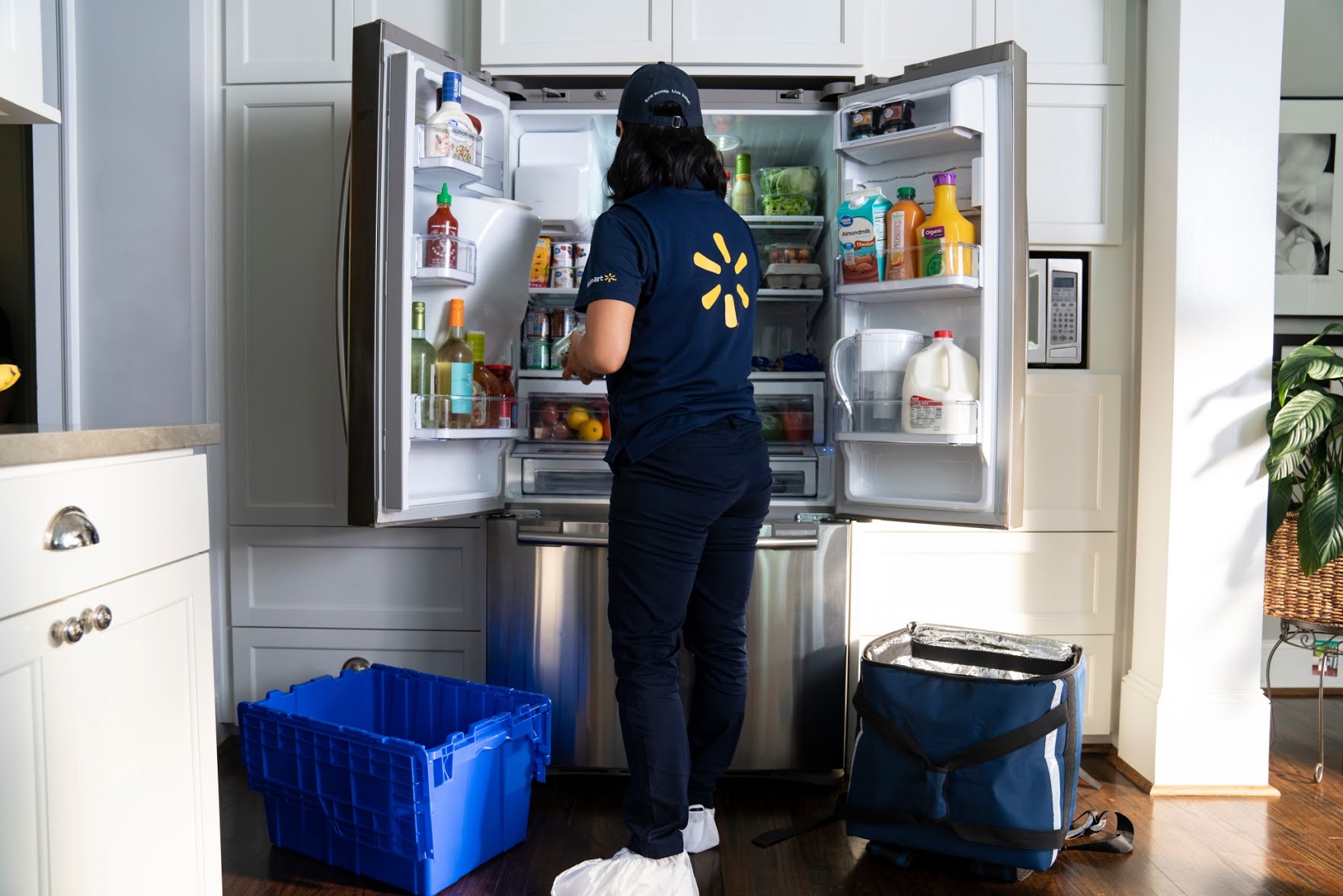
Ramchandra Apte, a software engineer, recently moved from Chicago to a New Jersey flat near New York City. When Walmart offered a Walmart discount and a premium subscription called InHome [ delivery to the home fridge for 45 million Americans ], he signed up, even though there is a Whole Foods closer to him than Walmart.
Whole Foods is “more expensive and I have to carry all the groceries,” said Apte, who does not own a car. “It’s a hassle.”
He still orders non-food items from Amazon, but finds that Walmart’s delivery is a bit faster for groceries. “I make a lot of money,” the 23-year-old said. “I’m just trying to save time and also trying to get good value for the money I spend.”
Walmart can now make same-day deliveries to 93 per cent of US households.
Below: InHome delivery. In addition, Walmart is expanding drone deliveries to five states