Read this article on Donald Trump’s isolationism, which foreshadows what is happening now.
The decline of the American agricultural superpower
The United States is on the verge of losing its status as the world’s leading agricultural exporter.
… The American Farm Bureau Federation predicts that next year the country’s farmers will struggle to produce the staple crops that have made the United States an agricultural powerhouse, with losses of $138 per acre for soya, $167 for maize, $145 for wheat and $406 for cotton. After more than a century, the United States risks losing its position as the world’s leading agricultural exporter.
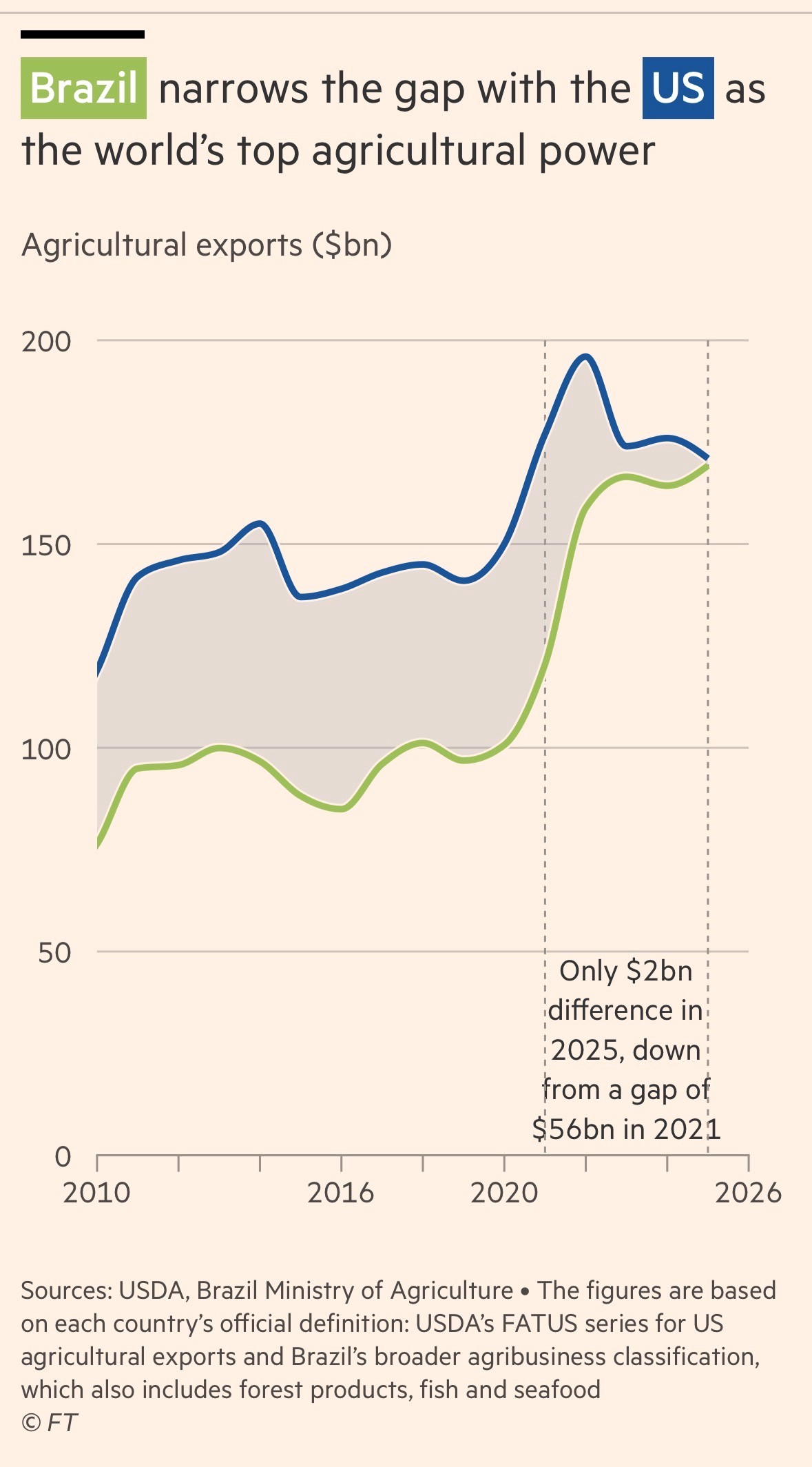
Last year, according to the Department of Agriculture, the United States exported agricultural goods worth $171 billion, just $2 billion more than Brazil’s total declared exports, which many analysts believe benefited from the trade disruptions triggered by President Donald Trump’s tariffs.
With US exports falling and Brazilian exports rising (up 6 per cent in the first half of this year, reaching a new record of $87 billion), 2026 could prove to be the year in which the United States loses its leading position in the agricultural sector.
Brazil is already the world’s largest producer of soya, beef and poultry, and has also overtaken the United States as the leading exporter of cotton, partly due to a shift in Chinese purchases from one commodity to another. This shift in power is not only reshaping the agricultural sector in each country, with altered supply chains and investment models, but also has wider social and political implications…
Brazil is set to overtake the United States as the world’s leading exporter of agricultural products.
Throughout the 20th century, the United States transformed its fertile land, mechanised farms and dense network of silos, railways, barges and ports into a tool for dominating global trade. This system enabled the United States to produce more grain than it could consume and to export the surplus at low cost.
China became the customer that made that system profitable. As its population’s wealth and meat consumption increased, the country’s livestock industry required huge quantities of soya meal.
American farmers planted more soya beans and invested in machinery, warehouses and export terminals, on the assumption that Chinese purchases would continue to rise. That relationship began to fray in 2018, when Trump imposed tariffs on hundreds of billions of dollars’ worth of Chinese goods. Beijing retaliated by targeting products grown in the states that had helped get him elected, and purchases of American soya plummeted.
“Our trade agreements are being changed at will, and all the hard work done to build these relationships, to act in good faith and to try to resolve problems, can be wiped out overnight,” says Aaron Lehman, president of the Iowa Farmers Union.
American farms could not simply stop producing. Land had been leased or financed, payments for machinery were still due, and seeds and fertilisers had already been purchased. In response, the first Trump administration disbursed around $23 billion in subsidies between 2018 and 2019…
When Trump returned to the White House in January last year, Brazil was supplying the bulk of China’s soya imports. The supply chains, processing capacity and trade routes developed in previous years had by then become firmly established. “Five years ago, we lost some of the consumers of our products – our overseas customers,” says Lehman of the Iowa Farmers Union. “They haven’t come back as our customers.”…
The strength of the Brazilian agricultural sector is not merely a consequence of US trade policy. Until the 1970s, this South American country relied on imports to feed its own population, but it has since developed a formidable industry that supplies food to much of the rest of the world.
Today, its global leadership in beef and soya exports complements its traditionally dominant position in the coffee, sugar cane and orange juice sectors.
Raphael Bulascoschi, an analyst at the commodities brokerage firm StoneX, says that the main reason the country is now on track to overtake the United States as the world’s leading agricultural exporter is that much of the land is capable of producing two harvests in the same year.
“This year-round model helps to spread fixed costs and generally improves profit margins for farms,” he adds. In the vast central-western state of Mato Grosso, where the soya industry has experienced exponential growth, more than half of the cultivated land is used for a second crop of maize or cotton. In irrigated areas, it is even possible to achieve three harvests. The state is sometimes called the “Brazilian Texas” because of its immense cattle herds, plantations and frontier spirit.
The availability and affordability of land in Brazil are also key advantages, particularly in frontier regions, leading to massive economies of scale and efficiency…
Naturally, this expansion – which has led to a doubling of Brazil’s production of cereals, pulses and oilseeds over 13 years (346.1 million tonnes in 2025) and to its dominance of the meat market through the JBS group – was bound to cause significant tensions: Trump accused Brazil of deforestation and imposed 25 per cent tariffs, exacerbating tensions between the two countries.
This will not prevent Brazil from becoming the world’s largest agricultural power.