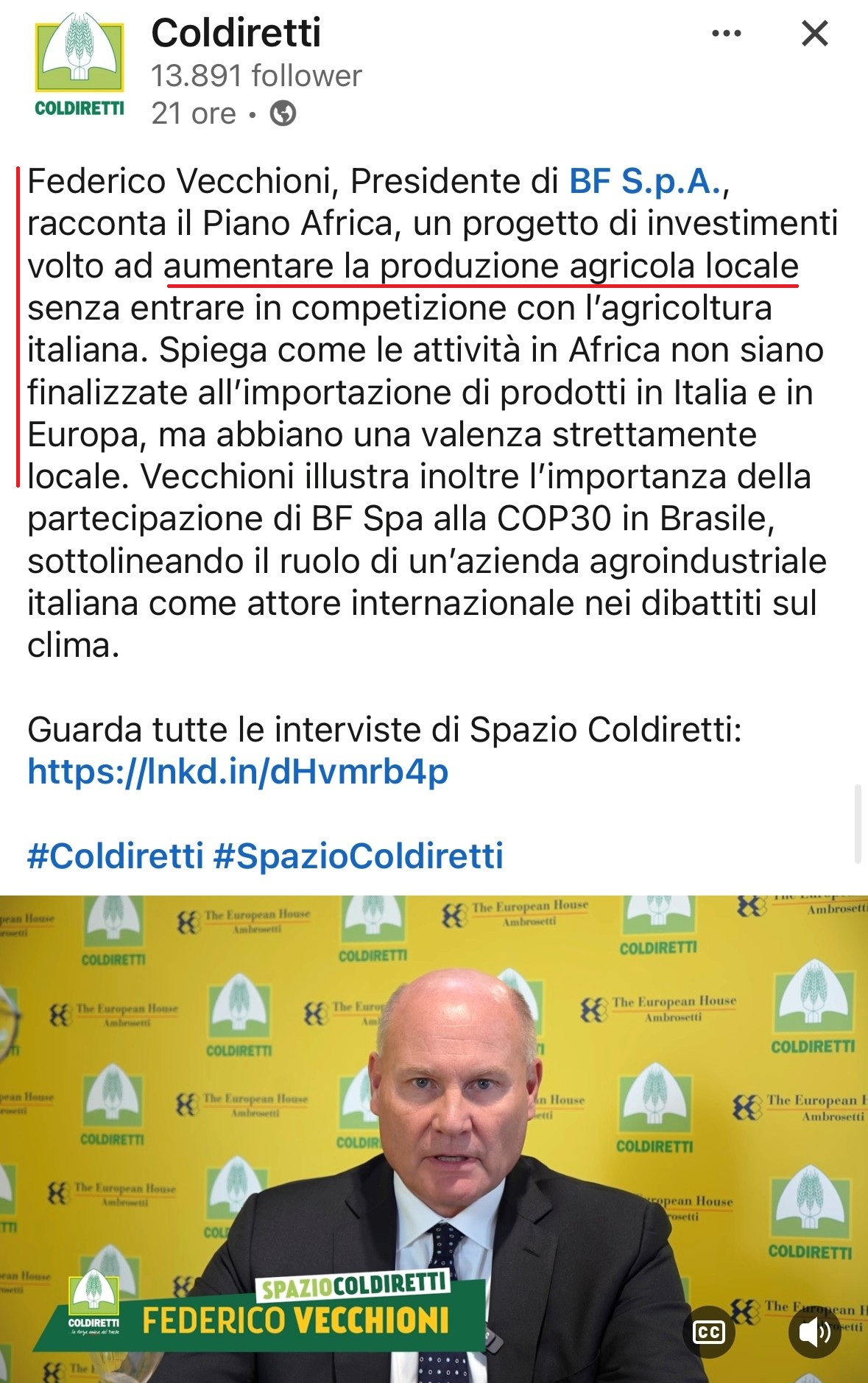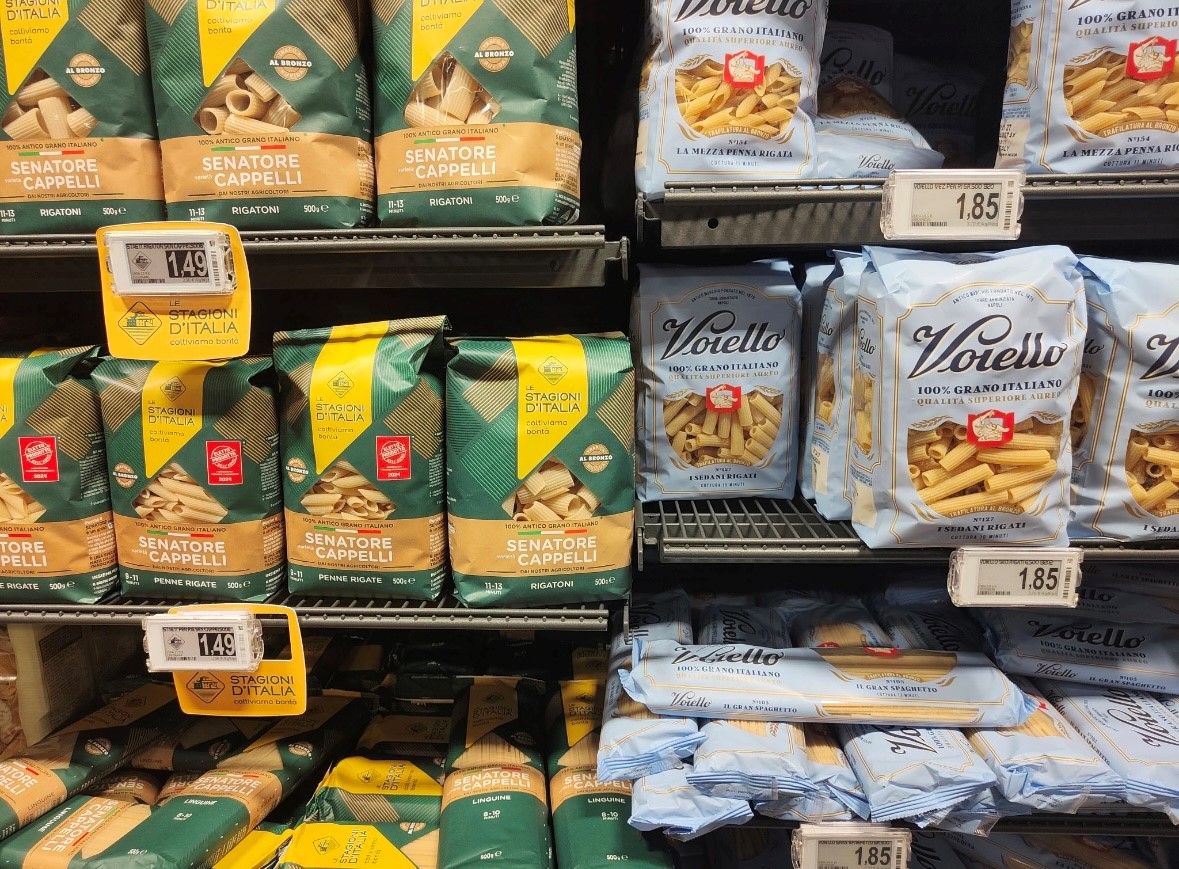
Compiled 11 January 2025, updated 5 January 2026 . Above: BF pasta in promotion next to Voiello pasta (Barilla).
Starting point: Vecchioni (Bonifiche ferraresi): ‘In 10 years we will be the leading agricultural group in the world’.
Jolanda di Savoia (Fe) – In ten years, Federico Vecchioni has transformed a 9 million turnover agricultural company into a 1.3 billion colossus with a capitalisation exceeding one billion. These are the numbers of the Bf holding company, listed on Piazza Affari since 2017.
In 2014 it took over the assets of Bonifiche ferraresi, historically owned by the Bank of Italy, and today the shareholding structure sees Dompè with 24.98%, Federico Vecchioni through club deal Arum with 23.09%, Fondazione Cariplo with 7.29%, Eni with 5.32%,Ismea [the Italian state] with 4.32%, Intesa Sanpaolo with 4.27% and others.
In addition to owning agricultural land, the holding company is involved in seeds, precision agriculture, processing (with various participations in companies), and distribution with NaturaSì.
Interviewed in the latest issue of Capital, Ad Vecchioni, who also owns 25% of the publisher of Panorama and La Verità, says: ‘We have been able for the first time to integrate agriculture, industry and finance, and to have a vision of
far-reaching vision. Then there was also a meeting between myself and Vincenzo Gesmundo, Secretary General of Coldiretti, but that is a long story to tell’.
In 10 years’ time, he continues, Bf will be ‘the world’s first farmer: a great manager of land capital through high technology, an agricultural enterprise capable of moving across different types, different continents and different vocations. […] Today there is no integrated agricultural operator in the world like us, with our size. And the reason, he concludes, is that ‘there has been an underestimation of land as a long-term investment‘.
It should be noted that BF is present in Algeria, Ivory Coast, Senegal, Angola.
For an update read: Algeria: Bonifiche Ferraresi invests in cattle, milk and fodder. On the subject, Enzo di Rosa, on LinkedIN, added: “Italy has allocated as much as 420 million euro toAlgeria, for the production of wheat and legumes, to favour the Bonifiche Ferraresi (BF) group, a company linked to Filiera Italia, the agro-industrial rib of Coldiretti, to cultivate 36,000 hectares of durum wheat desert in Algeria with Italian taxpayers’ money”
And plans to enter Ghana, Egypt, Kenya and other countries.
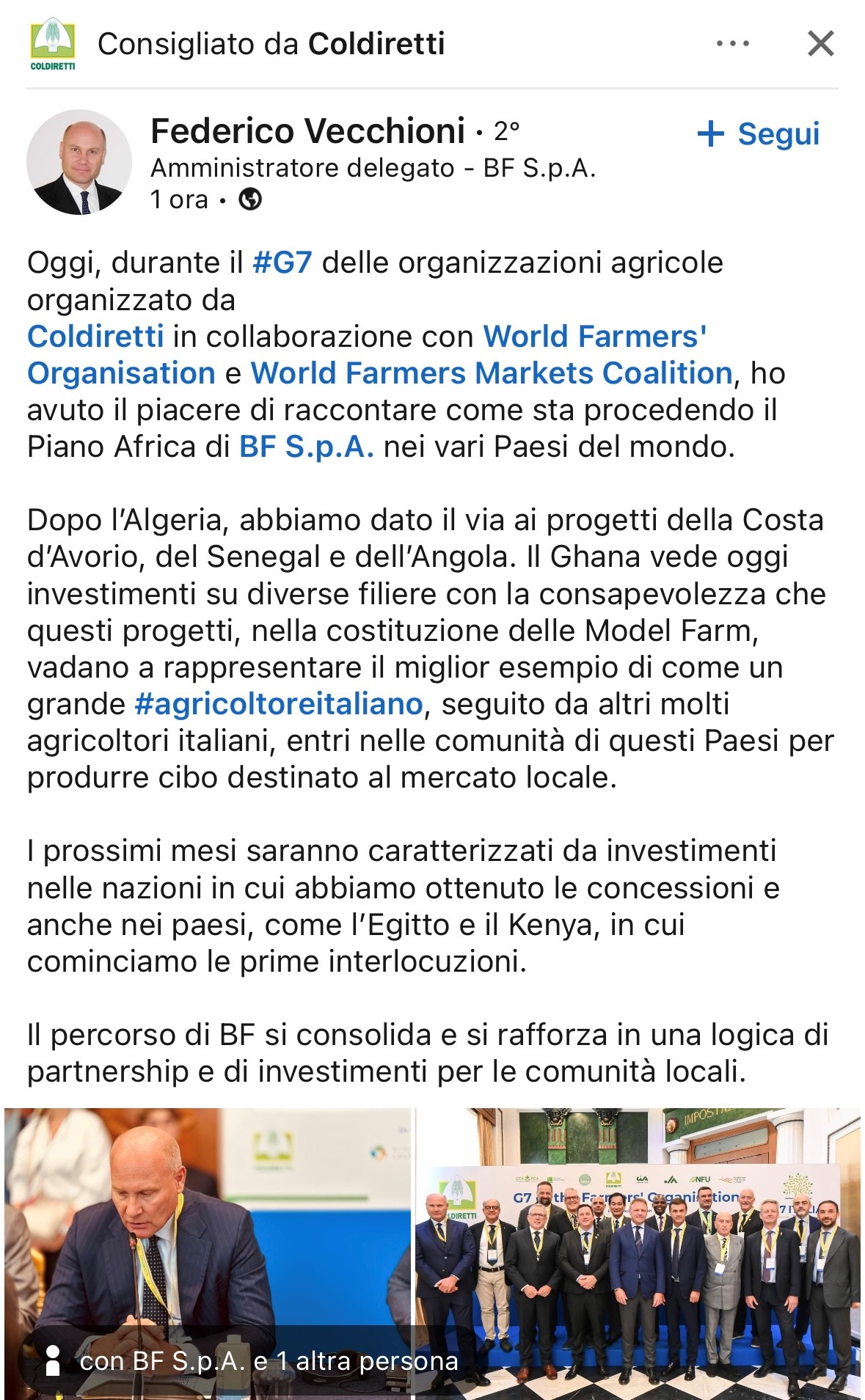
Below: in the photo Federico Vecchioni, Ettore Prandini , president of Coldiretti and Francesco Lollobrigida , minister of agriculture forestry and food sovereignty.
But back to Italy:
In fact, the fact that Bonifiche ferraresi presents itself as the champion of small producers: “from wheat to pasta to increase farmers’ income” is not at all convincing, given the bargain prices practised by BF.
It should be noted – we repeat – that BF also owns Naturasì, whose turnover did not beat inflation and was consequently not doing very well (although, fortunately, 2025 seems to be going against the trend at last)
Perhaps, instead of wanting to be a sort of conglomerate, present in agriculture but also in production and distribution, BF could make a nice ‘political’ contribution to organic food, which no longer seems to be so fashionable: organic food is not doing well even in supermarkets andthe pasta world seems to be saturated .
With that of Naturasì and that of Coldiretti, very close to BF – the types of pasta we are talking about are three. And three new pasta brands were not really needed on the shelves of Italian supermarkets.
All the more so if, as Vecchioni says, ‘Food is not an economic issue, but a geopolitical one’ , it would be a good idea to strengthen Italian agriculture and not scuttle it with very aggressive promotional initiatives.
Then there is the issue of the Mattei Plan on which one wonders: “who are we favouring: the Italians or the Africans?” (the Mattei Plan for Africa will have an initial endowment of around 5 billion 500 million euros between credits, gift operations and guarantees).
. Below is Vecchioni’s answer.
Because if BF is in Algeria, Ivory Coast, Senegal, Angola, Ghana, Egypt, Kenya, Tunisia and Ethiopia,Sicily – for example – is objectively in difficulty, not only because of the water problem.
Then there is the problem of transparency: BF has already started sowing but nobody knows anything about the results. A report was promised in June 2025 but has never been published.