Drafted on 19 July 2012. With some updates dated 8 July 2023
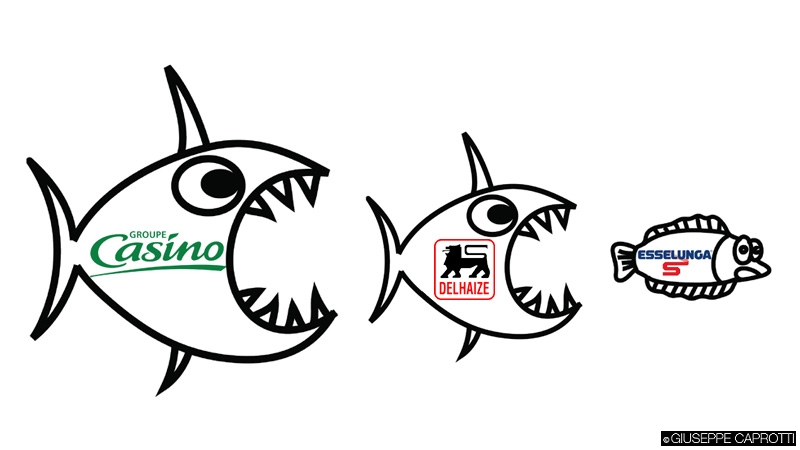
The attempted ‘merger’ between Casino, Delhaize and Esselunga.
Relations between Esselunga and Delhaize began in the late 1980s. Together with the Belgian chain, the European purchasing organisation SEDD was established and managed (the acronym stands for the founding chains Sainsbury’s, Esselunga and Delhaize, later joined by the Docks de France group).
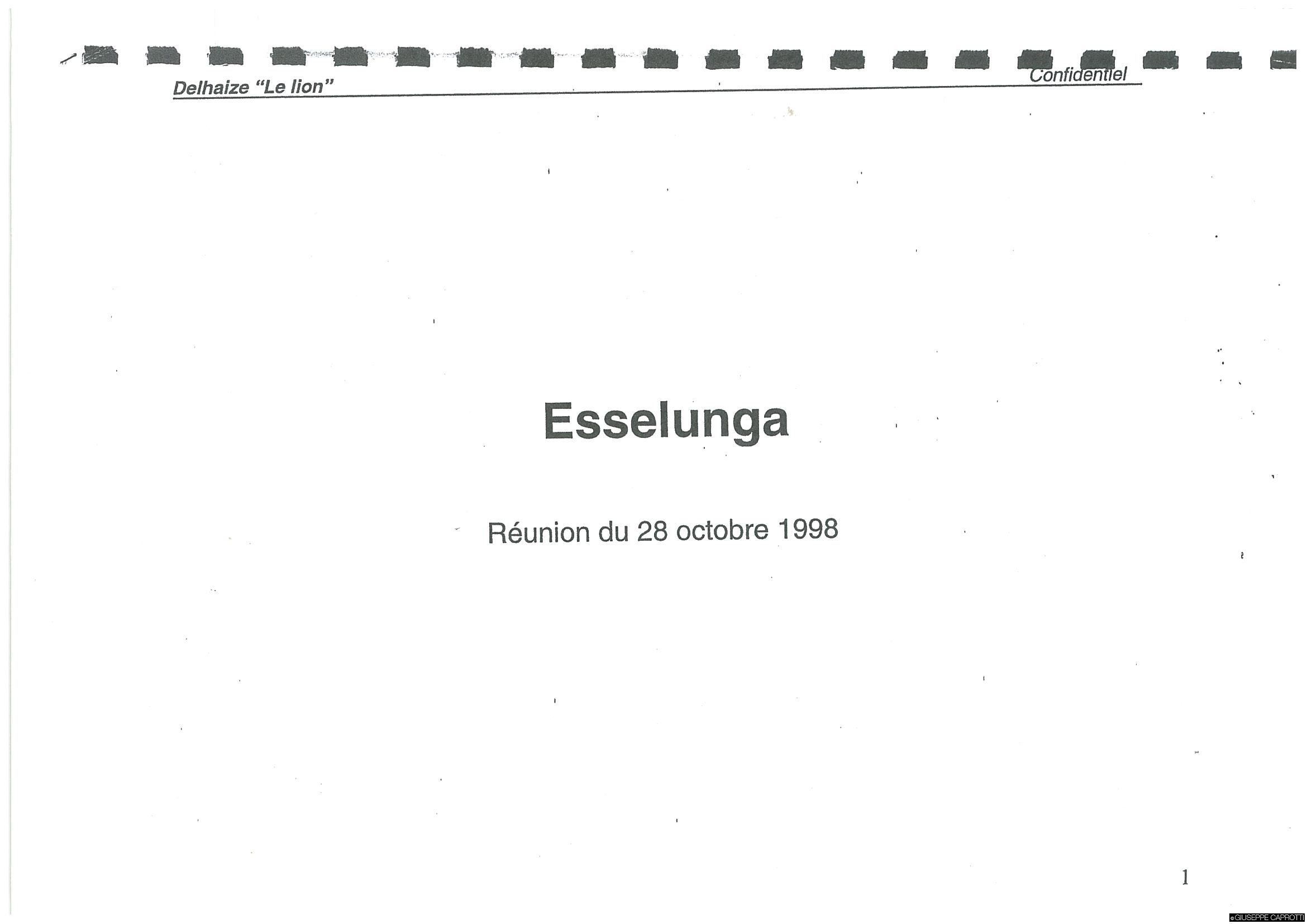
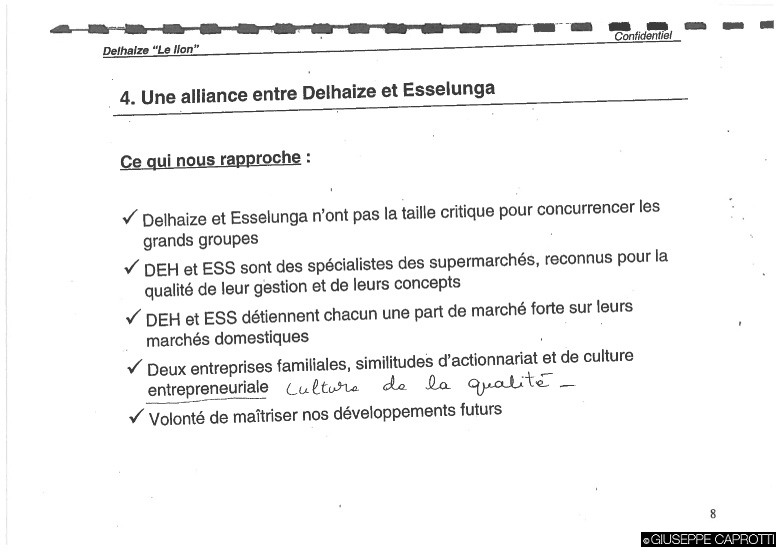
On 28 October 1998, I was invited, along with Esselunga’s then managing director, Dr Carlo Alberto Corte Rappis, to a meeting with our colleagues from Delhaize (Pierre-Olivier Beckers and Gui de Vaucleroy, CEO and Chairman of the company respectively). Delhaize proposed an alliance between their company and Esselunga, with a listed holding company (Delhaize was already listed), with 51 per cent held by the Caprotti and Beckers families and 49 per cent in free float.
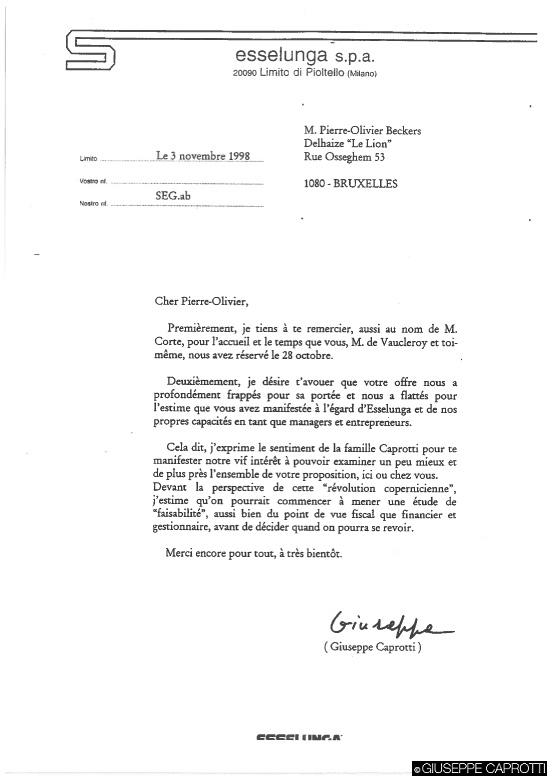
On 3 November, I thanked Beckers for the proposal and asked for the feasibility of this potential alliance to be assessed from a tax, financial and management perspective.
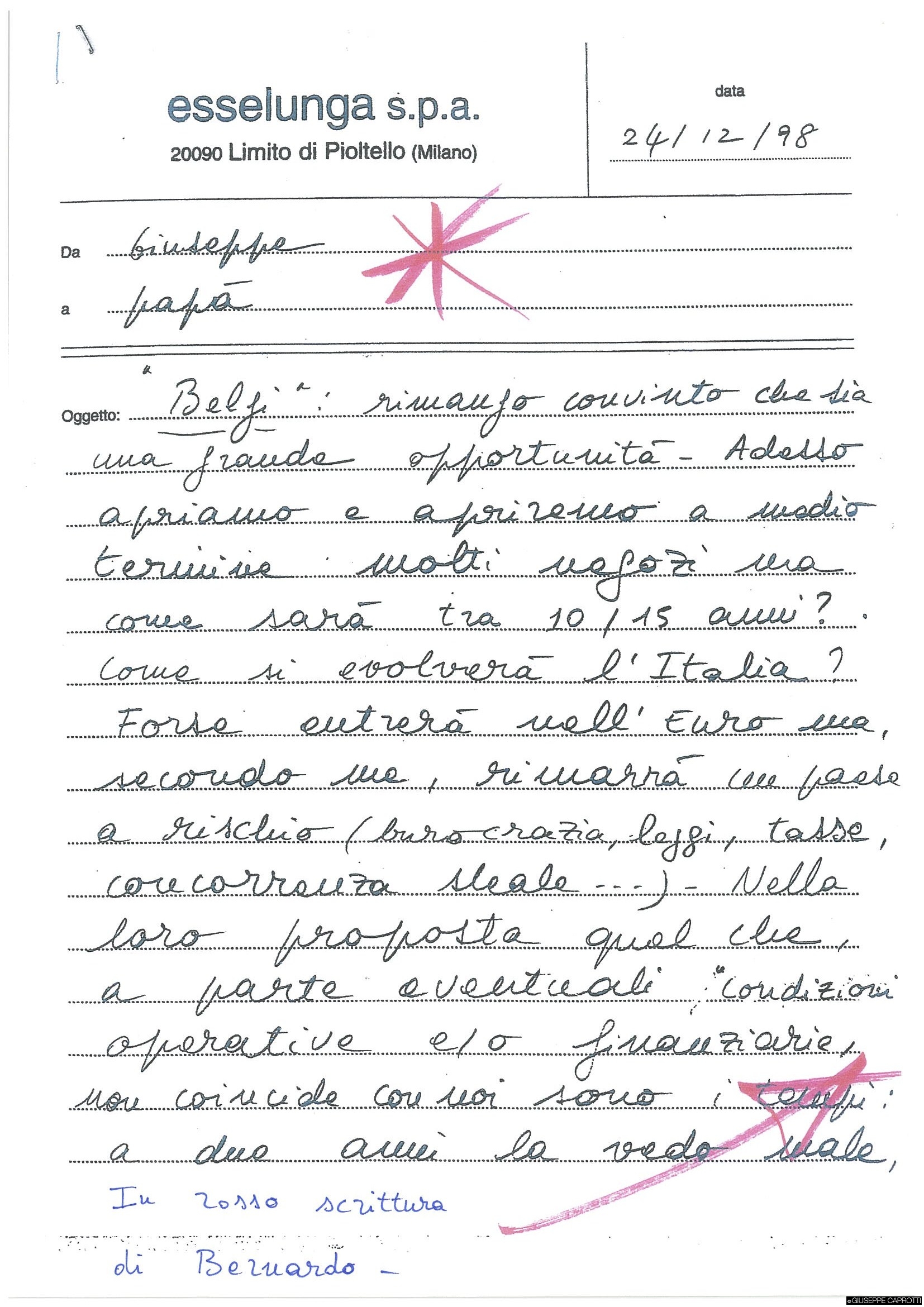
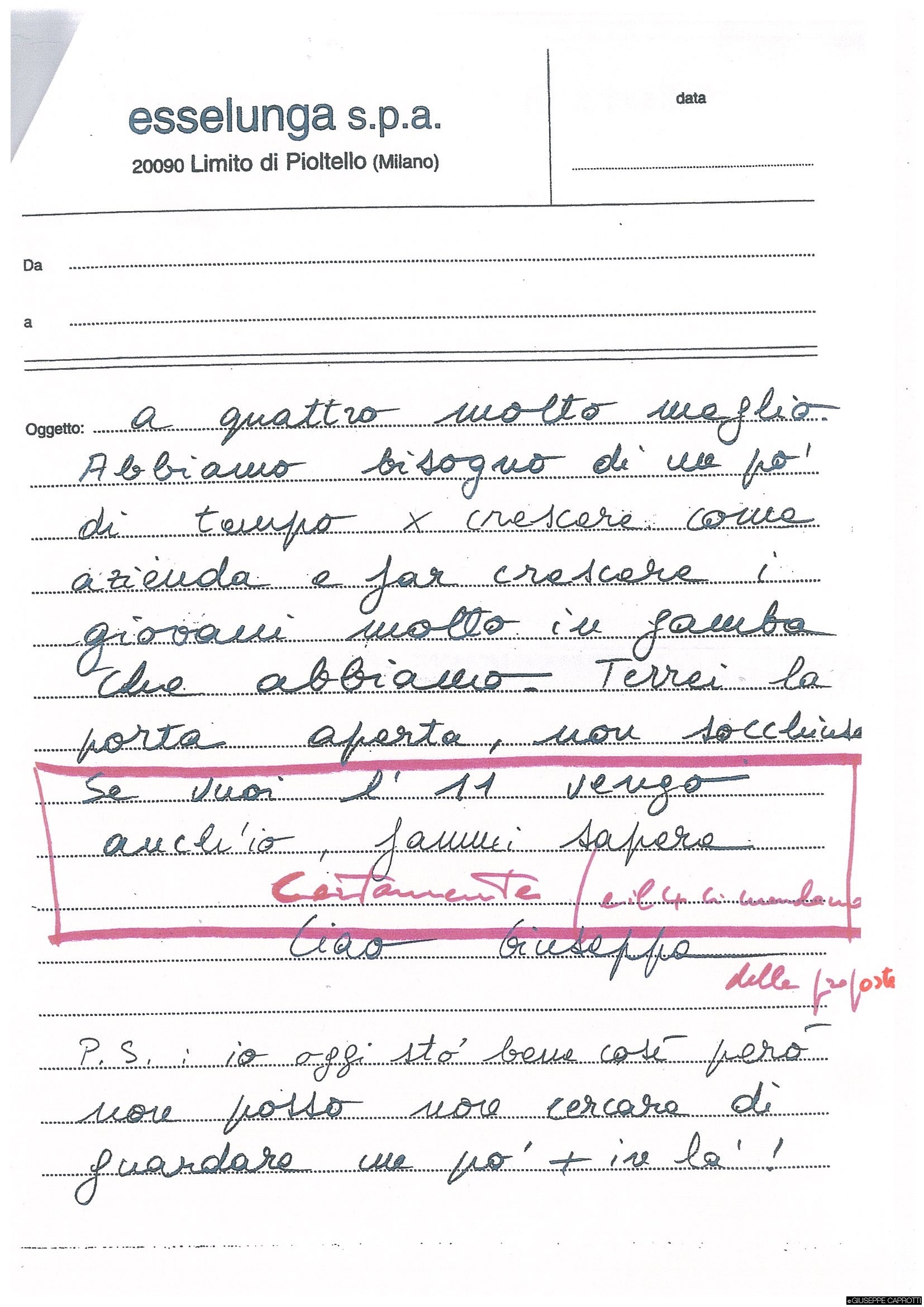
On 24 December, I shared my thoughts with my father (“I remain convinced that this is a great opportunity”and“I would keep the door open, not just ajar”), expressing my willingness to attend a ‘possible meeting’ with the Belgians on 11 January.
On 6 January 1999, contrary to what had previously been suggested, a proposal arrived in Limito di Pioltello that resembled a takeover of Esselunga, which would have been in exchange for shares in the Delhaize Group.
Furthermore, the Belgian group might have entered into negotiations with unspecified third parties (“The parties also confirm as of now their agreement in principle on the implementation… of possible strategic partnerships between Cesar – Delhaize’s code name – and third parties”).
In two letters, between 8 January and 29 January, my father Bernardo cancelled all appointments and declined all offers from Delhaize.
What had happened? And what were Cesar’s (Delhaize’s) true intentions?
The answer can be found, at least in part, in a document sent by Giuseppe to his sister Violetta in January 1999.
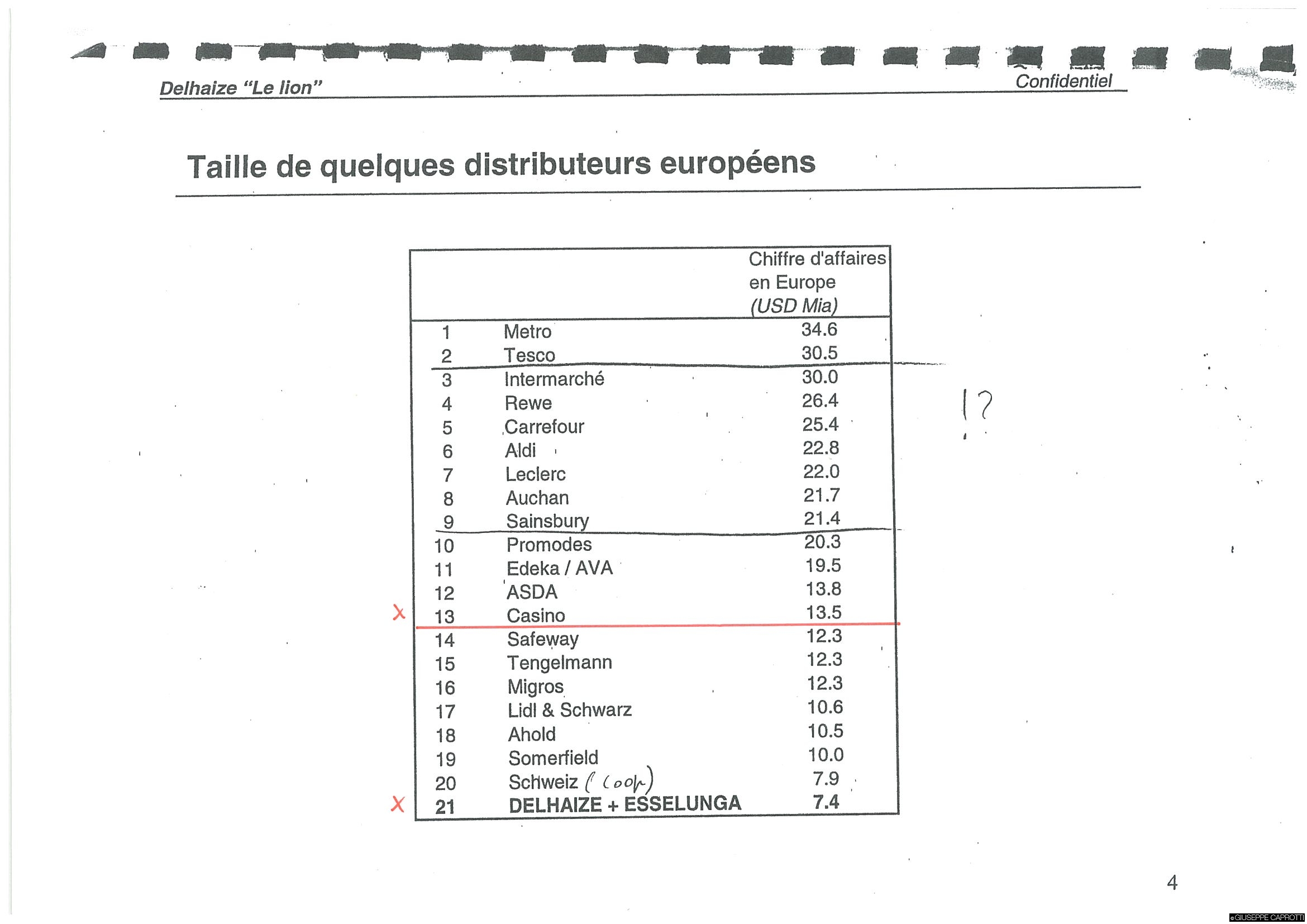
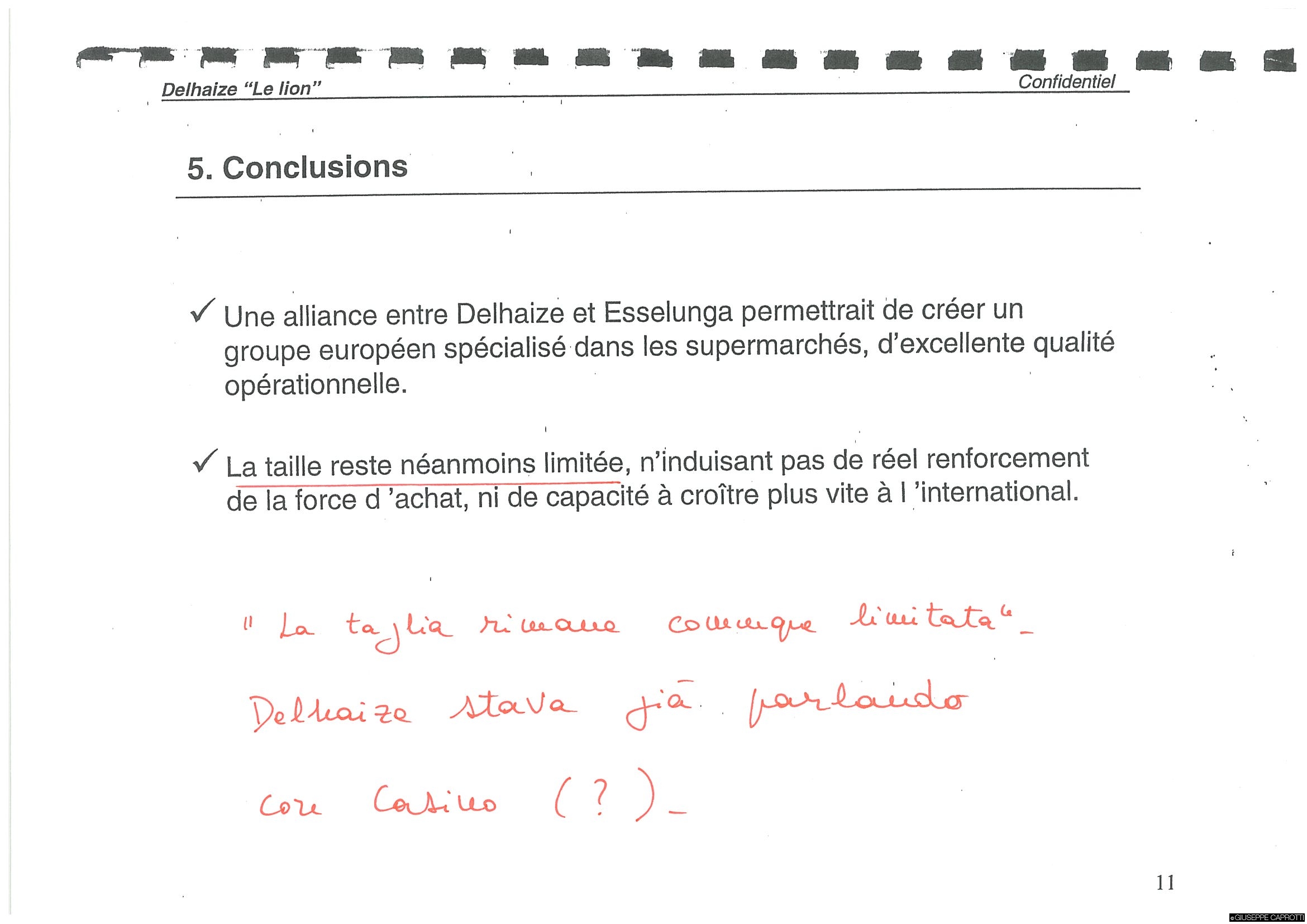
Casino, which at the time was worth around $13.5 billion, compared with the $7.4 billion of a potential Delhaize–Esselunga joint venture, proposed a cross-shareholding arrangement (see summary of documents below) through which Casino would gain a foothold in Italy.

And that’s not all. Through the two planned holding companies (Dexia France and Dexia Belgium) linked by 50 per cent cross-shareholdings, Casino would have held a strong position in France, Belgium and the United States (where Delhaize had 1,157 supermarkets compared with its 111 in Belgium, whilst Casino owned 261 Smart and Final supermarkets there). The mega-group would also have had branches in Poland, the Czech Republic, Greece, Indonesia, Taiwan, Thailand, Argentina and Uruguay.
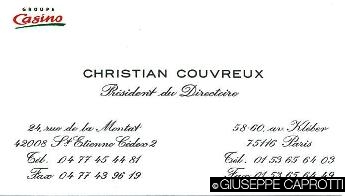
For some time, Mr Christian Couvreux, chairman of Casino’s supervisory board, and Mr Etienne Snollaerts, director of international operations for the group of the same name, had been sounding out the situation in Italy, here with us, to understand the strengths and weaknesses of the family and the group.
They were certainly neither the first nor the last to want to buy us out, but their approach, looking back years later and considering the current context, was undoubtedly one of the most interesting.
To understand the situation, we need to take a small step back: in 1991, Jean-Charles Naouri, a ‘Pied-Noir’ financier (a Frenchman born in Bone when Algeria was still part of France), bought the Breton retail chain Rallye.
In 1992, Rallye and Casino merged, and Naouri became the largest shareholder in Casino (which until then had belonged to the Guichard family of Saint-Étienne).
In 1997, Naouri acquired two family-run French chains, Franprix and Leader Price.
In 1999, Casino acquired a 25.5 per cent stake in the Pao de Acucar chain in Brazil.
This marked a turning point for the group: Casino would buy a stake in it, leading the Diniz family (*), owners of Pao de Acucar, that they would play a role within the Casino group, when in reality it had the very specific intention of taking full control of the family-run Brazilian chain, as it had always done up to that point with all the companies in which it had acquired a minority stake.
It will continue to do so with half of Monoprix (2000 (**)) and other small groups or subsidiaries of large companies around the world.
With Brazil, however, Casino is taking on a global dimension because, by the end of this year, Mr Abilio Diniz, founder of Pao de Acucar, will be forced to sell it to her, in accordance with agreements signed in 2005.
Today, Brazil accounts for 49 per cent of the €46.5 billion in turnover generated by the Casino Group in 2011, and emerging markets (Brazil, Colombia and Thailand) contribute 68 per cent of its operating profit (EBIT).

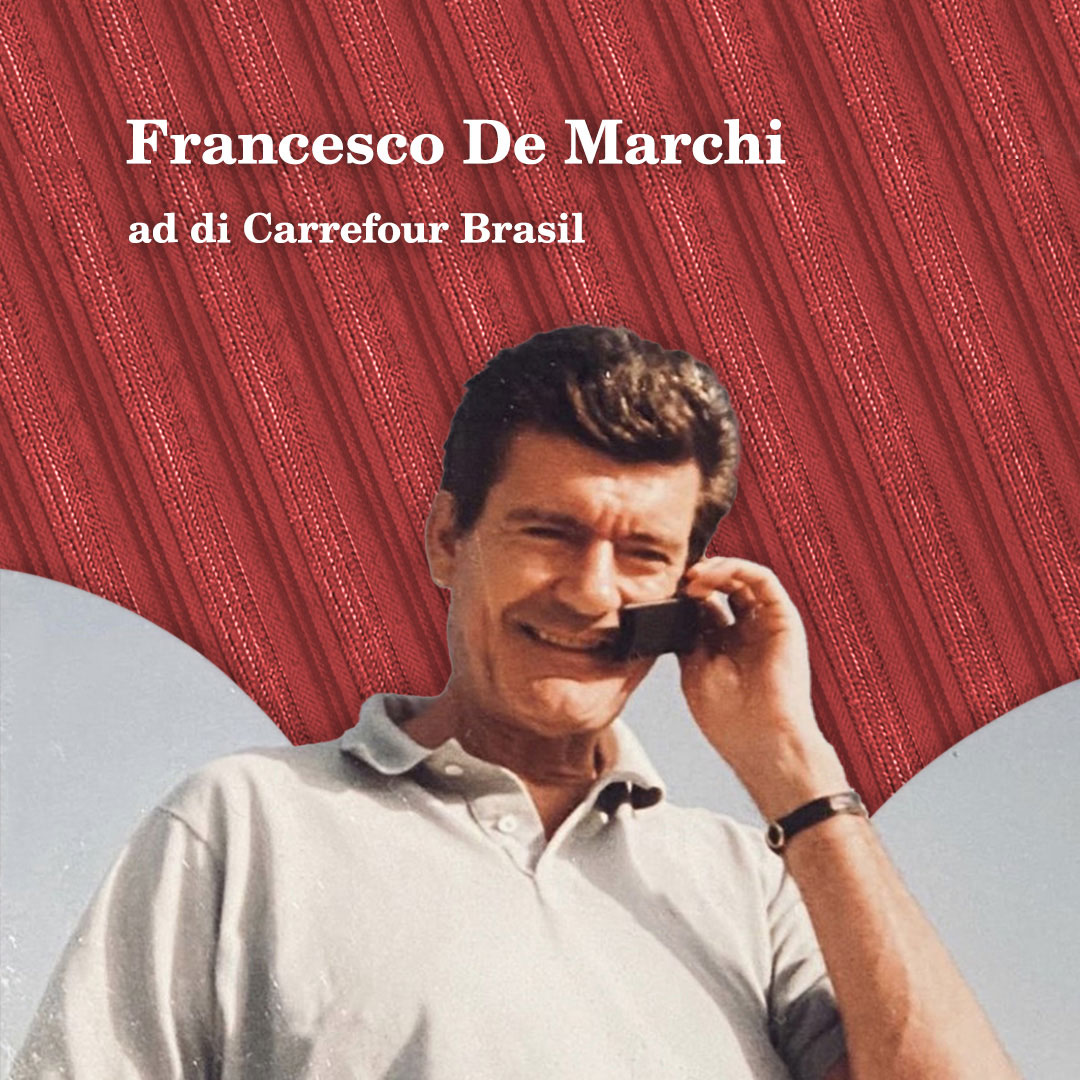
Back in 1979, when I was taken to São Paulo by my friend Francesco De Marchi (photo below) and worked for a few months at Carrefour Brasil, Carrefour was the undisputed leader in the Brazilian retail sector.
Today, Casino – through Pão de Açúcar – has a turnover of €23 billion, whilst Carrefour Brasil has a turnover of just €12.4 billion. Carrefour is facing serious difficulties in France, Italy and globally.
Carrefour’s new CEO, Georges Plassat, has just announced his intention to withdraw from Greece, incurring a net loss of €200 million for the group, and has stated that it will take three years to turn Carrefour around.
Plassat has indicated that one of his possible next moves could be to dismantle the ‘single Carrefour brand’ strategy, which has only just been rolled out in Italy and France. It seems that on this point, Casino – which is performing very well – is not a model to follow, as in France Naouri’s company has its own name on the signs of its mini-markets (Petit Casino), hypermarkets (Géant Casino) and supermarkets (Casino Supermarché).
Returning to the 1999 ‘merger’, if we are aware of Esselunga’s response at the time, we can imagine that Delhaize, too, realised that Casino was proposing – in the long term – the total loss of its independence.
Today, Delhaize is just under half the size of Casino (€21.1 billion compared to Casino’s €46.5 billion) and is perhaps feeling the effects of the crisis more acutely, given that the majority of its turnover comes from Belgium and the US – countries with lower rates of economic growth than Brazil – but Pierre-Olivier Beckers has retained his position as CEO
N.B.: Between 2013 and 2015, Beckers stepped down and Delhaize subsequently merged with Ahold.
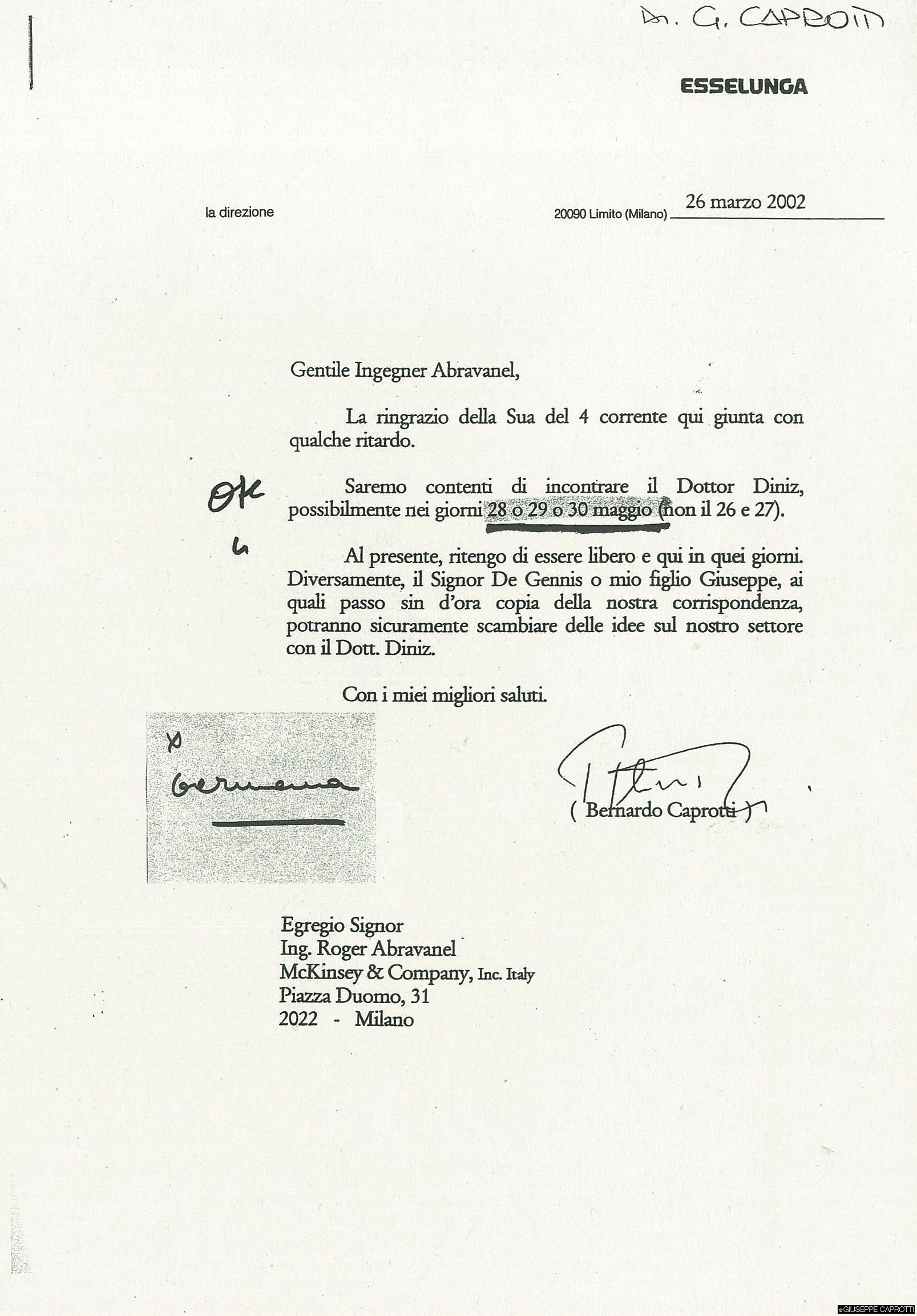
(*) Between late 1998 and 1999 , the Diniz family of Grupo Pão de Açúcar also came to visit us , with the idea of somehow becoming the owners of Esselunga sooner or later.
Mr Diniz returned on a later occasion as well, as can be seen from the letter below
(**) It is expected to take full control shortly.
Documents from Giuseppe Caprotti’s archives:
1) Some charts relating to the proposed alliance
2) Giuseppe’s correspondence with Beckers and Bernardo Caprotti
3) Summary of Beckers’ proposal to Bernardo Caprotti
4) Bernardo’s replies to Beckers
5) Three charts of Casino’s‘idea’
The handwritten notes are by Giuseppe Caprotti
1) Some charts relating to the proposed alliance
2) Giuseppe’s correspondence with Beckers and Bernardo Caprotti
3) Summary of Beckers’ proposal to Bernardo Caprotti
4) Bernardo Caprotti’s replies to Beckers
5) Three charts illustrating Casino’s ‘idea’