

Written on 23 October 2020, updated on 22 September 2026
This article provides context for and supplements the account I gave of the emergence of supermarkets in Italy in my book *Le Ossa dei Caprotti*.
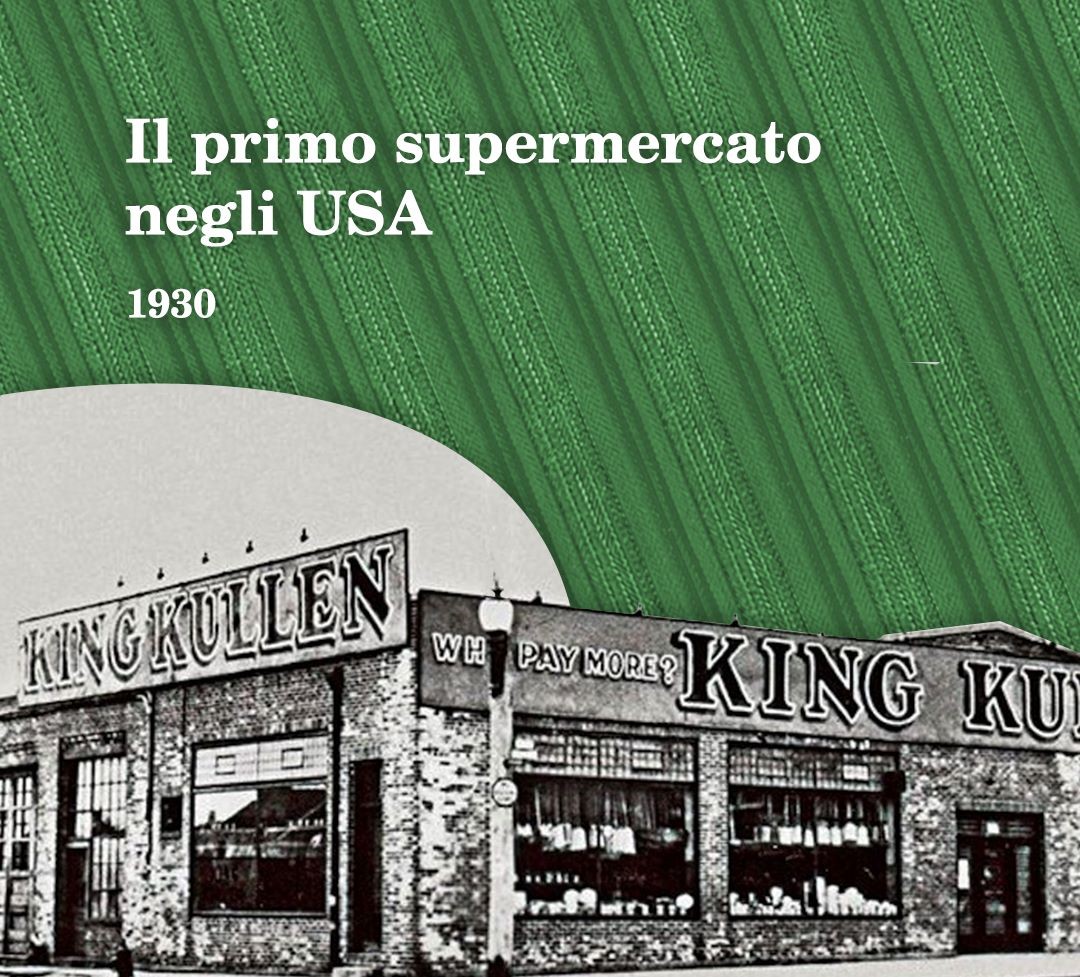
Despite some “false claims” circulating in Italy, the authoritative Food Marketing Institute has determined that the first chain in the US to open a supermarket was called King Kullen.
Founded in 1930 by Michael J. Cullen, a former employee of Kroger – the third-largest US chain – King Kullen remained independent and family-run for almost a century before being acquired by the family-owned food business Giunta’s Meat Farms on 1 August 2026.
King Kullen has just appointed [in June 2026] its first female chairperson. Tracey Cullen is the great-granddaughter of the founder of the world’s first supermarket. “This is a special day for the King Kullen organisation as Tracey takes the helm of the company founded by her great-grandfather 96 years ago, ”said James Cullen, the new chairwoman’s uncle.
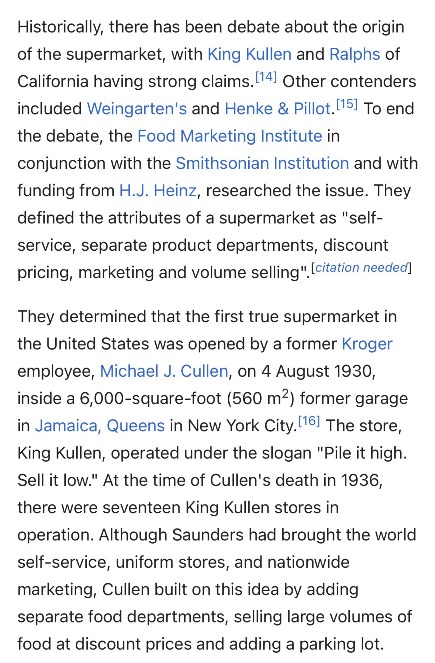
But what interests me in this case, for the moment, is not so much the history as the reasons given by the IMF for defining the establishment as the ‘first supermarket’.
King Kullen had the following characteristics:
- self-service
- departments (separated from one another)
- low prices
- marketing
- high sales volumes
- car park
The first supermarket, converted from a garage, covered 560 square metres. The slogan was ‘Pile it high. Sell itlow’.
Regina Giovanna, the first Esselunga, founded 27 years later in Milan, was just 401 square metres. In the end, we were storing water in the warehouse – illegally – due to a lack of space…
And in Milan, the parking regulations had been disregarded – something I believe is essential in certain areas. But ‘Regina Giovanna’ had excellent turnover figures before it was sold. It all depends on population density and consumer income.
As far as I can recall, even the first Esselunga Sottocasa, in Via Pezzotti, had no car park, and it worked very well.
Below: the report from the Food Marketing Institute.
N.B.: The French retail sector is the product of the teachings of Bernardo Trujillo, whose seminars were attended by 2,347 key figures from the French retail sector after 1957:
“…2,347 French people attended his seminars between 1957 and 1965… Among them were:Bernard Darty(Darty),Bernard Magrez(specialist in Bordeaux grands crus),Marcel FournieralongsideJacquesandDenis Defforey(Carrefour), Gérard Mulliez senior andGérard Mulliezjunior (Auchan),Paul DubruleandGérard Pélisson(Accor),André Essel(Fnac), Pierre andGuy Sordoillet(Conforama)…”
Trujillo was born in 1920, King Kullen in 1930. And some of Trujillo’s principles were clearly inspired by the US:
- Success rests on three pillars: self-service, discount stores and advertising hype. If just one of these is missing, the whole thing collapses; (success is based on three principles: self-service, discount stores and advertising hype)
- No parking, no business; (without parking, there’s no business)
- Stack high, sell low (= stack the productshigh and sell them at a low price. And this is Michael Cullen’s slogan!)
It’s as if to say: ‘We are all children of the US retail industry’. Gérard Mulliez, the founder of Auchan, describes how he was fascinated by Bernardo Trujillo in the biography written by his granddaughter Margaux – see image below – from page 73 onwards.
After all, Trujillo was a manager at NCR (a manufacturer of cash registers) and his courses were held in the US.
The Americans had the capital.
And, above all, the know-how and management skills that the Europeans lacked.
The same is true of the British retail sector. Both J Sainsbury’s and Tesco emulated the American self-service model.

To round off the picture, I recommend:
- watch Our relationship with FOOD has changed a great deal over the last 100 YEARS: how? In Will’s video, it’s very clear how the Americans began trying to increase the amount of food available – by lowering its price – to feed their troops during the Second World War.
They then moved on to the distribution system that Nelson Rockefeller had already set up in Venezuela in the 1940s, with a chain of supermarkets.
- read *Le Ossa dei Caprotti*, published by Feltrinelli ( 2023). Among the many interesting coincidences, we discover thatOSS colonel (the forerunner to the CIA) James Hugh Angleton – one of the book’s central figures – spent much of his life (*) working for NCR (National Cash Register). Just like Bernardo Trujillo, the ‘father’ of global distribution.
Both possessed excellent business acumen.
- Read *La cooperazione di consumo in Italia* (Consumer Co-operatives in Italy), published by Il Mulino (2004). Authors: Vera Zamagni, Patrizia Battilani and Antonio Casali.
In 1957, the Co-ops opened a shop without shop assistants in Bologna. In 1963, the first supermarkets opened in Empoli and Sassuolo (on page 350).
(*) Angleton lived in Milan from 1933 to 1941 – at 47 Corso Venezia – before joining – having already served as an officer in the First World War –the OSS, established by President Truman on 13 June 1942, and consequently returning to his homeland, Washington.
He was then sent back across the Atlantic, first to Algiers and subsequently to Sicily and Caserta.
He subsequently took part in the Anzio landings, lived in Rome and Florence, where he distinguished himself as a ‘liaison officer’, in counter-espionage (intelligence gathering) and as an expert on economic matters, whilst also cultivating personal relationships with Countess Bossi Pucci and Prince [Junio Valerio] Borghese, whose life would later also intersect with that of his son, James Jesus Angleton, head of the CIA’s Rome station and later head of US counter-espionage.
Awarded the Bronze Star Medal, he also received the Commenda dei Santi Maurizio e Lazzaro, probably because in 1944 he had been looking after (“was helping to take care of”) Prince Umberto (“Crown Prince”), son of the King of Italy.
He returned to Milan after the war as head of NCR andthe Italian Chamber of Commerce.
And the American publication *Progressive Grocer* recently reminded me that the Jewel Tea Company was founded in 1899 (Jewel-Osco is celebrating its 125th anniversary in Chicago) – information which you’ll find on page 69 of my book. I mention this to reiterate that the Americans invented the retail trade.
Of course, in the case of both Jewel and Dominick’s [where I worked for two years], they started out as small shops which later evolved: the Di Matteo family’s first supermarket opened in 1950.
Below: a few pages from a letter by Angleton to one of his superiors regarding his dealings with the Italian nobility.


