Compiled 21 October 2024, updated 11 March 2025
Global warming has resulted in one of the world’s northernmost coffee plantations in Sicily
The historic Morettino brand has started an experimental project in Palermo, growing the first native Sicilian bean. The expected harvest for 2024 is over one hundred kilos, it was thirty in 2021. ‘The climatic emergency endangers traditional crops, but also presents unexpected potential,’ says Andrea Morettino
We are in Palermo, 350 metres above sea level, a few kilometres from the city centre. In June it is already close to thirty degrees, in August even over forty. ‘It’s not Rio de Janeiro, but the climate is fantastic’. At least for coffee.
Andrea Morettino, representative of the fourth generation of the historic ‘Morettino’ brand, moves around his finca, among the coffee plants, like a South American fazendeiro. With global warming and rising temperatures, this corner of Sicily now dreams of becoming the Brazil of Italy by launching the first native Sicilian coffee.
The Morettino company has managed to set up one of the world’s northernmost coffee plantations, sprouting the first local, 100 per cent Arabica bean. It was Arturo Morettino, Andrea’s father, who brought the first coffee seeds from Guatemala to the company in the 1980s. From these seeds, the first open-air plants grew experimentally around the roasting plant, which gradually adapted to the Sicilian climate at latitudes far above the so-called ‘CoffeeBelt‘, i.e. the area where coffee is traditionally grown between Latin America, East Africa and South-East Asia. Over the years, the harvested beans have been roasted for tasting or reseeded to give rise to new plants born and bred in Sicily.
‘But it was only four years ago that we started to realise that cultivation could actually become real “thanks” to climate change,’ says Andrea Morettino. In 2021, when the summer reached one degree Celsius more than ten years earlier, Morettino obtained the first thirty-kilo ‘super harvest’. In 2022 it rose to fifty kilos, seventy in 2023. And for 2024, the forecast is to exceed one hundred kilos. In two years, in practice, production has doubled. “Of course it is still a symbolic harvest, but every year the quantity increases,” says Andrea.
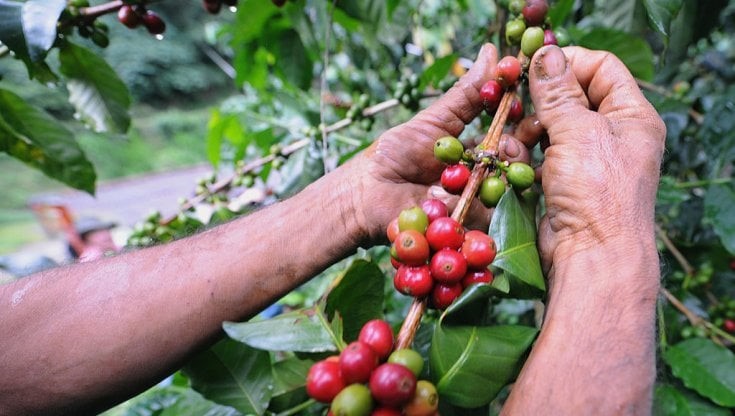
At the finca Morettino, the hand picking of the drupes, the coffee fruits, has just finished. The colour of the drupes ranges from green, through yellow, to deep red, when the time is right for harvesting.
A few berries have been forgotten on the plants. You just have to pry them off with two fingers, then squeeze them out and you see the yellow berries covered in a milky, sugary substance. Usually two are found, the lucky ones find three. But Andrea, on his desk, has kept the first and only drupe containing five kernels on display.
The new white flowers, similar to Sicilian orange blossoms, have already appeared here and there on the finca‘s plants. And young green drupes can already be seen. The cycle from flower to final fruit takes nine to twelve months, but at these latitudes it can be a little longer. “Thanks to the higher and higher temperatures, the plantation is going in a continuous cycle,” Andrea explains. “We alternate flowering and fruiting, we find flowers and drupes all the time. In one year, we can even make seven micro-harvests. And the first harvest, as the heat increases, is always earlier. Last year we did it in May, this year in March’.
This is the picture of agriculture’s adaptation to climate change, which has already led several Sicilian farms to specialise in the cultivation of tropical fruits, tobacco and tea. Next to vineyards, olive groves and traditional citrus orchards, there are now avocado, mango and papaya plantations. And the ancient tradition of sugar cane cultivation has also been revived.
The Department of Agricultural Sciences at the University of Palermo has been monitoring and studying the ‘tropicalisation’ of Sicilian agriculture for years. And in the finca Morettino there are several sensors that record temperature, humidity and pressure, so as to understand under which conditions the plants are suffering.
“The coffee plant must never drop below ten degrees and must never exceed thirty,” explains Nicola Battista, Morettino’s training manager. “Here, during the month of the coldest Sicilian winter, we defended ourselves with plastic sheeting. But the main problem we have today is how to defend ourselves against the heat. In summer in Sicily there are peaks of over forty-eight degrees. In the greenhouses we are trying to encourage ventilation, but this is a work in progress”. Not least because, at the same time, ‘there is the fear of downpours, so that in a week the volume of rain for a season comes down’. Some plants are taller, others shorter. “Sometimes we intervene in the soil with a supplement of natural elements, such as magnesium, potassium and iron. But there is no manual that tells us how we should act, it all depends on the data we collect, observation and our continuous adaptation to climate change”.
Morettino’s coffee cultivation area covers a total of about one hectare. The cultivations are located in Palermo, in the San Lorenzo ai Colli district and the Botanical Garden, and in some areas in eastern Sicily, selected according to soil and climate conditions.
The manual harvesting of the drupes is followed by processing. Depending on the treatment, either by washing or by the natural method of drying, the sugary substance is eliminated or allowed to be absorbed by the beans, which will then have more or less acidity. The final flavour of the blend, the tasters say, has the typical scents of the Sicilian land, with notes of zibibbo grapes and carob.
News of the Sicilian cultivation has gone around the world. And several countries would now like to replicate the experiment. ‘They have also called me from the Canary Islands and Israel,’ says Andrea Morettino.
It was the end of the 19th century when some coffee plants arrived at the Botanical Garden of Palermo from Ethiopia and Somalia and were kept inside the Serra Carolina. In the early 20th century, it was decided to undertake the experiment of growing coffee in open ground, with the aim of freeing Italy from dependence on foreign trade flows and paving the way for a new, all-Italian ‘Coffee Route’. In 1905, experiments began with the first twenty-five seedlings. But they failed to survive the winter temperatures. They tried again in 1911, but even that time a frost wave destroyed the coffee plants. Then, in the 1940s, the seeds were planted in the Carolina Greenhouse and here they managed to adapt perfectly, reaching a height of about three metres over time (these plants can still be seen inside the greenhouse today).
Today, almost one hundred and twenty years after the first experiment in open ground, the Botanical Garden and Morettino are trying again, ‘thanks’ to climate change. In June, Morettino organised the second edition of the ‘Palermo Coffee Festival’ at the Botanical Garden, involving producers of oil and wine, but also those of tropical fruits, tea and tobacco.
“The project has to be seen in perspective, at present it has no commercial purpose but a scientific and experimental one,” explains Andrea Morettino. “Climate change must make us reflect on the present and future of our land, which has shown signs of suffering and risks for traditional crops, but also unexpected potential, as shown by the success of tropical fruit crops in Sicily such as mango, papaya, avocado, kiwi or lychee. The study, carried out by the Tropical Crops Group of the University of Palermo, showed that coffee crops made in Sicily are comparable, in terms of bioactive and nutritional components, to those in the tropical areas of origin’.
The paradox, however, is that coffee plantations require a lot of water and always need moist soil. In hot weather each plant needs one litre of water per day, in winter one litre per week. ‘This, with the drought that Sicily suffers from, could be a problem. It’s climate change, beautiful.
There are three reasons why I became interested in this topic :
1) one is historical: coffee fascinates me more than other products because a distant relative of mine, Giuseppe Caprotti, an explorer – mentioned in ‘Le Ossa dei Caprotti’ on page 24 – did his best to spread ‘arabica’ coffee from Yemen to Italy, via Italian East Africa.
2) the other is environmental : Sicily, desertification is already underway: De Vito (UN consultant) explains the effects of climate change. At one point he says: ‘…I invite every sceptic to look with their own eyes. You don’t need to be a scientist, just have a computer, open Google Earth and see with your own eyes what Italy looks like reproduced thanks to satellite images. If you compare our country today with a map of Italy even just 10 years ago, there is not much more to add. Through satellites, even those who cannot understand the extent of the problem, even the most climate change denier cannot help but change their minds And indeed, just look around, even in Albiate (MB), and you can see – with the naked eye – the devastating effects of climate change.
read also African heat, Caribbean cloudbursts, how the Italian summer is changing.
3) In addition to suffering the damages of change, we must also try to seize opportunities, especially in agriculture (The boom of avocados and other exotic fruits in Apulia is 2020!)
p.s.. : this article makes me think of what is happening in the world of wine, where Italy risks losing most of its vineyards by 2100.