[vc_column_textDrafted 19 March, updated 23 March 2025
I read that ‘there would not be a big difference between US and Italian distribution’. I am sorry to say this, but this is not the case: the gap is very wide and growing:
Stuck in the 1980s: why European retail giants can’t keep up with Walmart’s digital revolution
A decade ago, Walmart’s vast network of physical shops seemed a burden in an era dominated by online shopping. As Amazon quickly rose to prominence with its easy-to-use e-commerce platform and vast inventory, many industry analysts predicted Walmart’s decline. However, Walmart not only withstood the challenge, but also strategically transformed itself into a digital powerhouse, turning its physical shops into valuable assets instead of burdens. Today, Walmart is the world’s largest company in terms of sales, maintaining its dominance and emerging as a strong competitor to Amazon in the e-commerce sector. This transformation reflects a broader evolution in the retail sector, where changing consumer behaviour, the rise of e-commerce and the influence of discounters are reshaping traditional retail models.
One of the key factors in Walmart’s resurgence is the successful implementation of a multi-channel approach. Unlike Amazon, which operates primarily online, Walmart has integrated its vast network of 4,700 US shops into its digital ecosystem. This strategy allows customers to buy products online and choose whether to pick them up in-store or have them delivered directly from local shops. By reusing its physical locations as distribution hubs, Walmart has significantly reduced shipping time and costs. Approximately 90% of Americans live within 10 miles of a Walmart shop, giving the company a logistical advantage over Amazon, which relies on centralised fulfilment centres. This hybrid model not only reduces logistics costs, but also addresses the challenge of last-mile delivery, a sore point for e-commerce companies that operate exclusively online.
Walmart’s strategic focus on cost efficiency is a crucial element of its competitive advantage. This approach allows the company to maintain its reputation for low prices while simultaneously investing in digital transformation. John David Rainey, CFO of Walmart, emphasised the importance of cost leadership saying, “We want customers to think of us as the place to go to get the lowest prices on whatever they want to buy. To do that, we have to have the lowest service cost.”
Walmart has experienced remarkable growth in e-commerce. In the third quarter of 2024, e-commerce sales in the US increased by 22 per cent, mainly due to the popularity of in-store pick-up and delivery services. Currently, 18% of Walmart’s revenue comes from online sales and its marketplace offers over 700 million items from third-party merchants. This rapid digital transformation has consolidated Walmart’s position as a significant player in the e-commerce sector.
To compete directly with Amazon Prime, Walmart introduced Walmart , a subscription service offering free same-day delivery, fuel discounts and exclusive promotions. Walmart has successfully attracted higher income customers: households earning more than $100,000 have accounted for 75 per cent of Walmart’s recent market share gains. By providing valuable benefits and competitive pricing, Walmart has strengthened customer loyalty and increased shopping frequency.
John Furner, CEO of Walmart U.S., says: “We want to be the low-cost provider, but we also want to offer the best convenience. This dual focus on cost leadership and customer convenience has been the driving force behind Walmart’s strategic decisions, and has positioned the company as a formidable competitor to Amazon’s Prime membership model.
A significant part of Walmart’s strategic renaissance is its significant investment in technology and automation. The company has integrated advanced data analytics, artificial intelligence (AI) and robotics into its operations to improve efficiency and customer experience. In regional US distribution centres, robots sort and assemble pallets by department, thus speeding up the storage process in shops. In addition, artificial intelligence tools optimise workforce management, reducing shift planning time from one hour to just five minutes. By leveraging these technologies, Walmart not only increases operational efficiency but also reduces costs, further contributing to its competitive advantage in terms of prices.
This transformation goes beyond simple operational efficiency; it is also about redefining Walmart’s identity within the retail industry. As Nikki Baird, Vice President of Strategy and Product at Aptos, noted, ‘Walmart is rapidly transforming into a technology company similar to Amazon. I believe that these two companies are in a category of their own, while everyone else remains in the retail sector’.
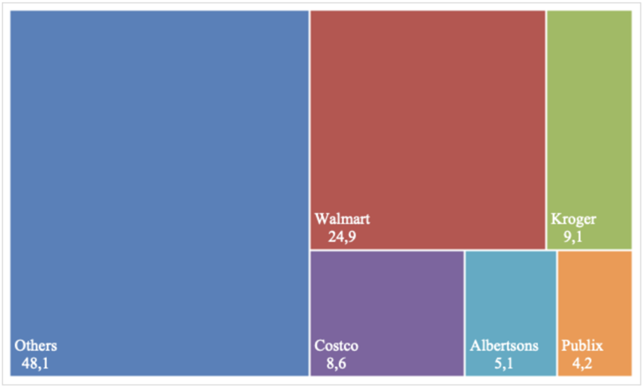
One of the most obvious differences between the retail markets in the US and Europe is the level of market concentration. In the US, Walmart accounts for almost a quarter of all grocery sales, with a market share of 24.9 per cent. Following Walmart are Kroger with 9.1%, Costco with 8.6%, Albertsons with 5.1% and Publix with 4.2%, while the remaining 48.1% is divided among other retailers (see below).
Top five grocery retailers by dollar share, October 2023 – September 2024 (in %).
Source: Financial Times; Walmart includes Walmart US and Sam’s Club shops
This diverse landscape contrasts significantly with European markets, where a few large players dominate. In Switzerland, for example, Migros and Coop control over 70% of the food market, creating a virtual duopoly that limits competition and innovation. The UK has a similar concentration, with a combined market share of Tesco and Sainsbury’s of over 40%. In Italy, Esselunga is the leader along with Coop and Conad, leaving other competitors limited opportunities to challenge their positions (*). Germany is dominated by discounters Aldi and Lidl, which maintain significant control due to their low-cost and highly efficient business models.
(*) It has to be said that for the Italians, more than the level of concentration of shares, which are partly fictitious (Conad, Coop ,but also Selex are consortia), it is very difficult for local companies to break out of their ‘historical’ zones of influence.
This high level of European market concentration creates barriers to entry and decreases competitive pressure, leading to a slowdown in innovation and digital adoption. In contrast, the fragmentation of the US market fosters competition, encouraging retailers like Walmart to constantly innovate to maintain their market leadership. In addition, the lack of concentration allows Walmart to grow without facing the regulatory scrutiny often found in more established European markets.
The retail landscape is undergoing a significant transformation driven by digital disruption. Consumers increasingly prefer the convenience of online shopping, personalised experiences through artificial intelligence and seamless integration between digital and physical channels. Walmart has successfully harnessed these trends with its hybrid fulfilment model and robust digital ecosystem. In contrast, many European retailers have been slower to adapt due to inflexible business models and a heavy reliance on physical shops.
In highly concentrated markets such as Switzerland and Italy, major retailers have little incentive to innovate, which has led to a stagnation in digital adoption. Meanwhile, Tesco and Sainsbury’s have struggled with slow digital growth due to high operating costs and complex supply chains. This strategic inertia has left them vulnerable to discount retailers such as Aldi and Lidl, which continue to expand aggressively through cost-cutting measures and shop efficiencies.
Walmart’s evolution from a traditional retailer to a digital powerhouse demonstrates its adaptability, resilience and foresight. By utilising its vast physical network, investing in advanced technology and diversifying revenue streams, Walmart has maintained its market leadership and set new standards in the retail industry. This strategic shift has allowed Walmart to compete effectively with Amazon and consolidate its position as the world’s largest retailer by revenue. In contrast, European retailers are struggling to keep up, hampered by market concentration and outdated business practices. Reflecting Walmart’s commitment to continuous improvement, John David Rainey acknowledged: “We don’t do everything perfectly here, and there are many lessons we can learn from our competitors.
As the digital revolution continues to reshape the industry, European retailers face a clear choice: adapt or risk becoming irrelevant. Walmart’s journey is an inspiring model for the future of retail, demonstrating how strategic foresight and digital innovation are essential to survive in an ever-changing market. While Europe remains anchored in the past, Walmart is already paving the way for the future.
And indeed: Walmart can now reach 93% of US households with same-day delivery.
In addition, Walmart has become the first to integrate pharmacy, grocery and general merchandise into a single online order
Walmart claims to have 270 million weeklycustomers globally (to give you an idea, the total US population is 340 million ), so when it comes to US retail… Walmart is definitely an indispensable reference point.
(*) Walgreens Boots Alliance operated 14,000 pharmacies (of which 9,000 in the US ), its stock market value had fallen by 90% (and it was sold, accordingly, at 10% of its peak value). Boots, prior to Pessina and the merger with Walgreens, was also a manufacturer of private label products (I had visited some of its factories when I worked for Esselunga).
Read also : How Walmart built the biggest threat Amazon has ever faced
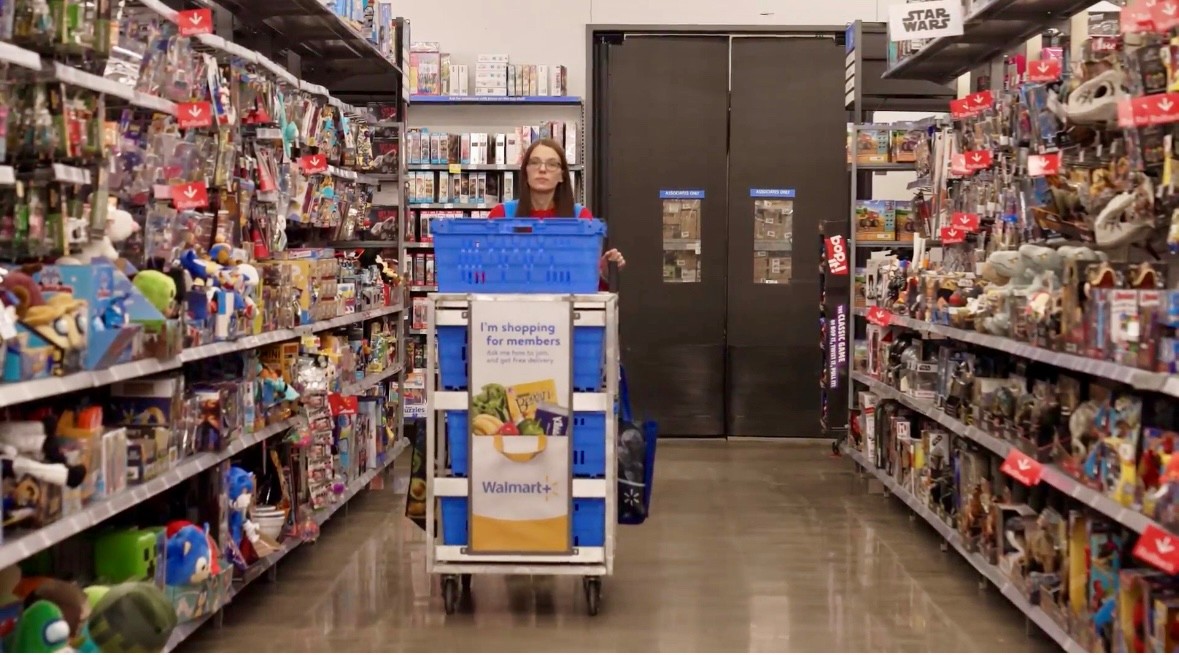
Thanks to Luigi Consiglio of GEA and Alessandro Belgiojoso.Below a delivery picking cart.