Written on 23 November 2025, updated on 15 January 2026
I had written about Svalbard in early 2025, having visited it in person the previous year:
“Gianni Albertini, Enrico’s father, was my great-uncle; the husband of the twin sister of my beloved grandmother Luisa Quintavalle, Aunt Ida Quintavalle (née Albertini).
…
Last summer – in July 2024 – I visited Svalbard with some of my family and, whilst chatting to one of the two guides, I mentioned my great-uncle’s expedition aboard the whaling ship Heimen–Sucai.
One day, much to my surprise, after hearing so many stories on board the boat we were travelling on about the history of the region, the Swedish, British and Norwegian explorers at the two poles, and having enjoyed watching the old film*La tenda rossa* about Umberto Nobile’s expedition, I was told that we were in ‘Albertlinibutka’, or Albertini Bay, situated at the northernmost tip of Svalbard, as shown in the photo below.
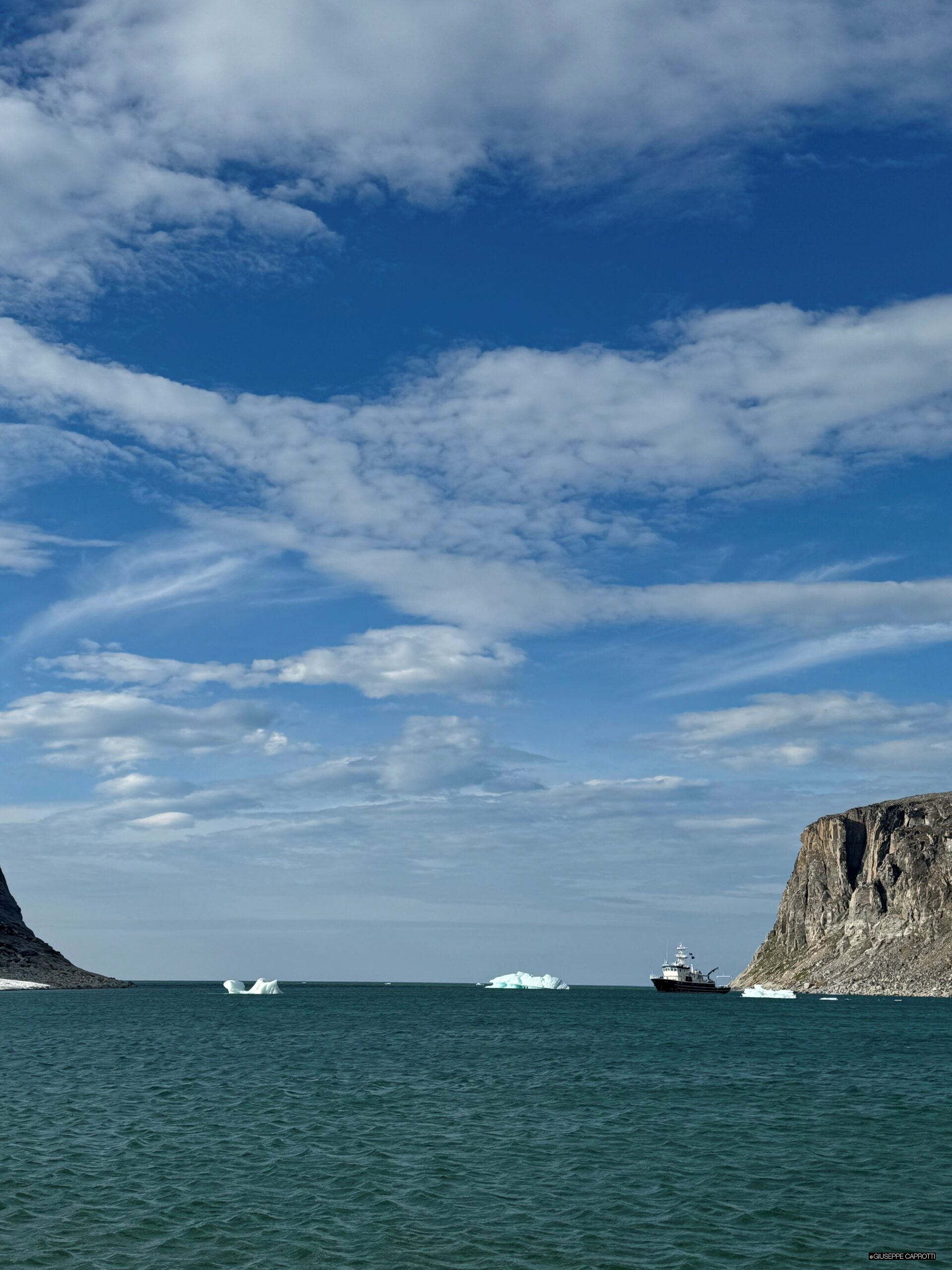
It was a very significant moment for me: following the writing and launch of my book *Le Ossa dei Caprotti*, published by Feltrinelli, I began a process of re-evaluating my family.
In that magical setting … the figure of my great-uncle played a substantial part in bringing this existential journey of reconciliation and forgiveness to a close.
I immediately wrote to Gianni’s son, Enrico …”. telling him of my intention to write about it, butsadly he passed away before I could see him again.
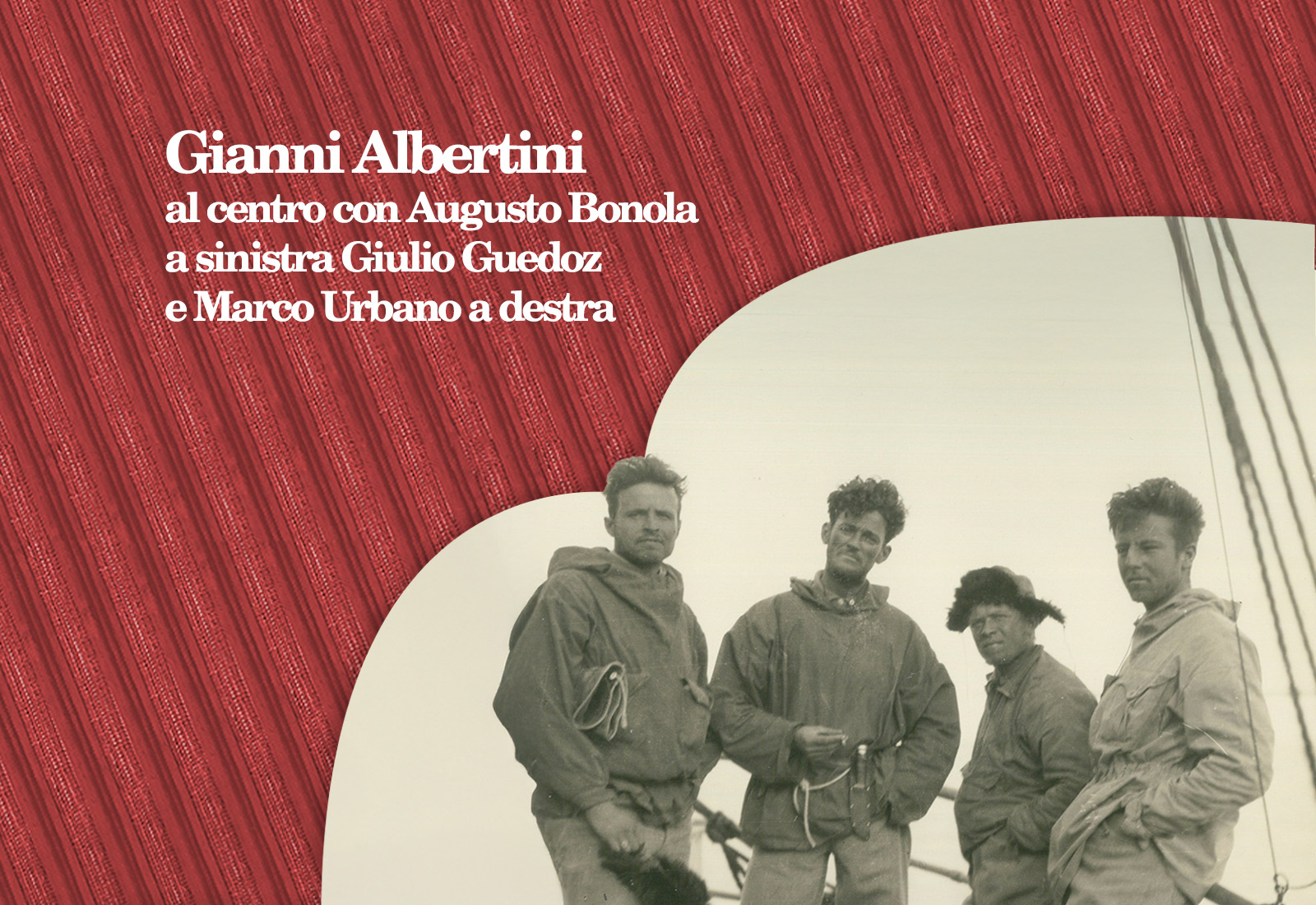
Below: Gianni Albertini with part of his crew, during the expedition aboard the whaler Heimen-Sucai.
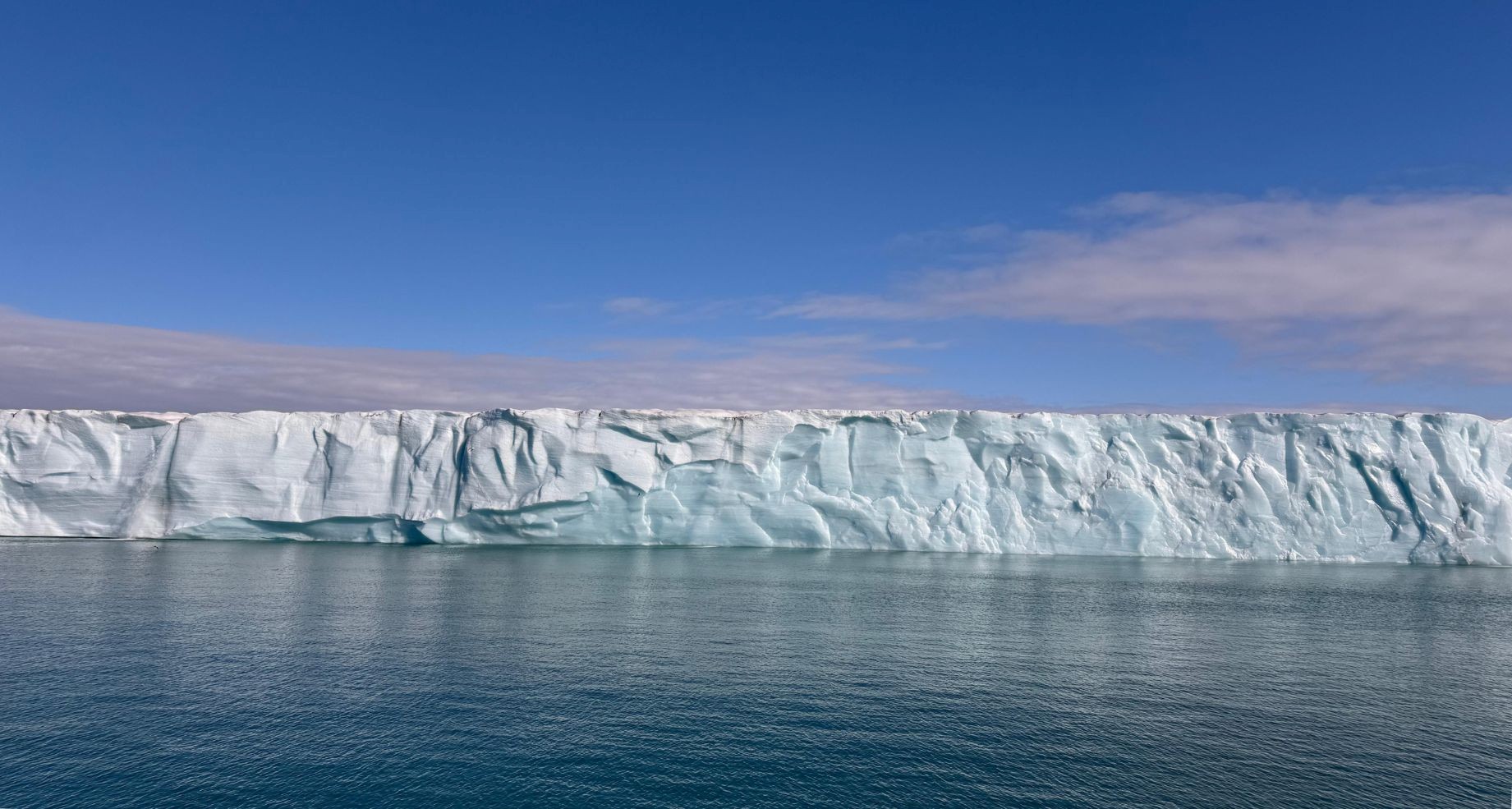
… You have to walk on the Longyearbreen glacier, high above the village, to truly experience the Far North. Léo Decaux[glaciologist] loads his rifle and shows off his flare gun, which is compulsory outside the town in case of an encounter with a polar bear. On the day of the excursion, snow is falling heavily, blanketing the landscape in white. But the powder “won’t last all summer”, warns the glaciologist.
The mass balance of the archipelago’s 2,200 glaciers is negative: they are melting more than they are accumulating.
Le Monde, 13 November 2025: Svalbard has warmed by 4 degrees over the last 30 years
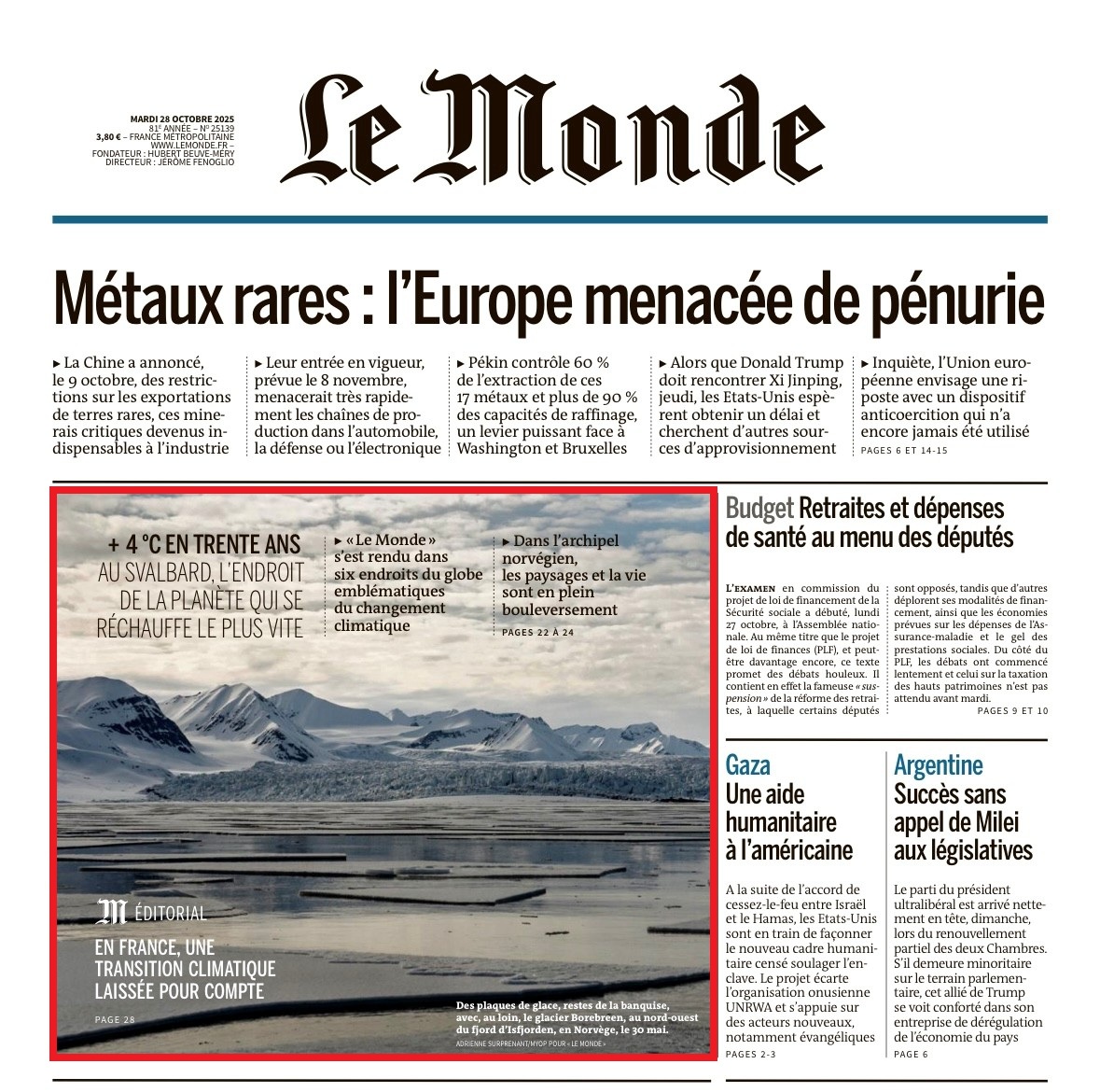
In 2024, they recorded the greatest annual mass loss of any glacial region in the world. Longyearbreen, like others, is ‘in its terminal phase’, says Léo Decaux.
It is hard to imagine the end of these giants at such high latitudes. And yet. Svalbard is now 53 per cent covered in ice, compared with 60 per cent ten years ago. Under the current scenario of a 2.5 °C rise in temperature by the end of the century, it is predicted that between 30% and 50% of their glacial mass will disappear.
This upheaval, 3,300 kilometres from Paris, “affects us too”, warns Léo Decaux. “The Arctic plays a role in regulating the Earth’s temperature and stabilising the climate. Less ice and snow mean more warming and more extreme weather events here.”
In Longyearbyen, the administrative capital of Svalbard, 60 kilometres from Borebreen, the temperature has already risen by around 4 °C over the last thirty years and by almost 10 °C during the winter months.
“Currently, the rate of warming is five to eight times faster here in winter than the global average,” calculates Kim Holmen, the iconic meteorologist at the Norwegian Polar Institute, recognisable by his long grey beard.
2024 broke all records: globally, first and foremost, as it was the warmest year on record and the first to exceed the 1.5 °C warming threshold set out in the Paris Agreement on climate change. And locally: temperatures exceeded 20 °C at Longyearbyen Airport, whilst seasonal averages typically range between 6 °C and 9 °C.
How can we explain these staggering figures? Firstly, there is the Arctic feedback loop, which acts as a vicious circle: the disappearance of ice and snow due to warming limits the reflection of the sun’s rays, thereby increasing the temperature and causing further melting.
But if the 61,000-square-kilometre archipelago is the region of the Arctic that is warming the fastest, it is also because “it is influenced by a current whose waters originate from the Gulf Stream, and these waters are becoming increasingly warmer”, explains Kim Holmen.
“We are at the epicentre of climate change. It’s like being transported into the future of a catastrophic scenario, but here it’s real,” says French glaciologist and guide Léo Decaux, who has been studying Svalbard for eleven years…
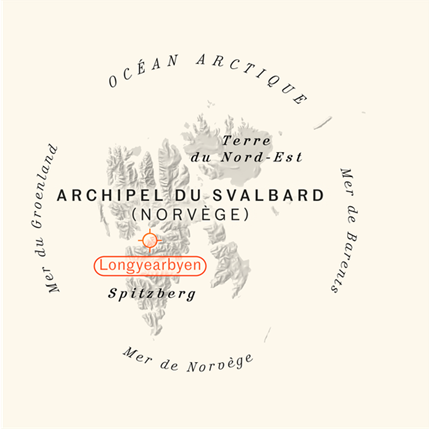
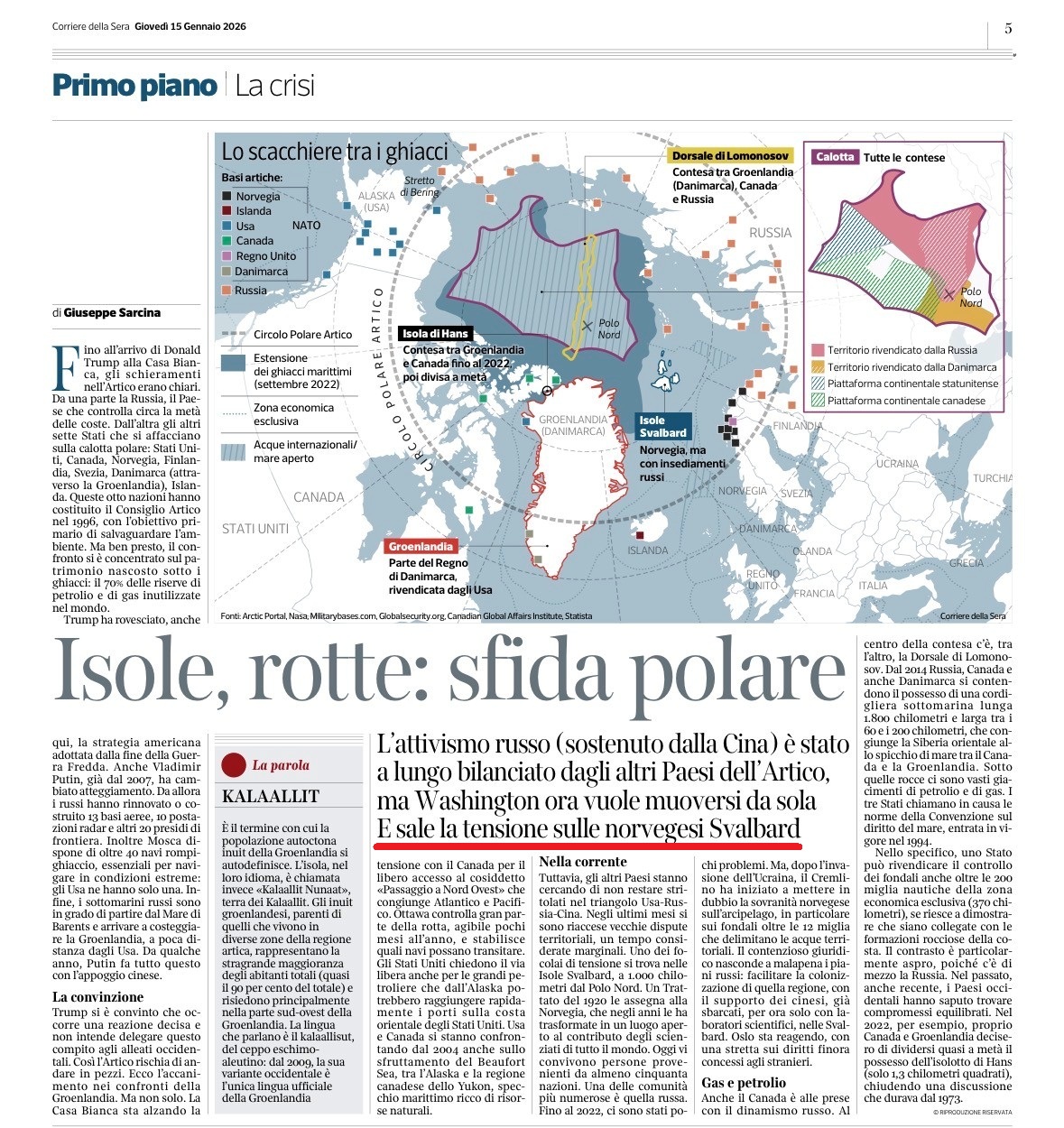
The islandsalso have other distinctive features: they are a territory that, formally, forms part of Norway but which lies outside the Schengen area, having a status of its own derived from the Svalbard Treaty.
At the time, all signatories had the right, on a par with Norway, to colonise Svalbard and develop its economy;
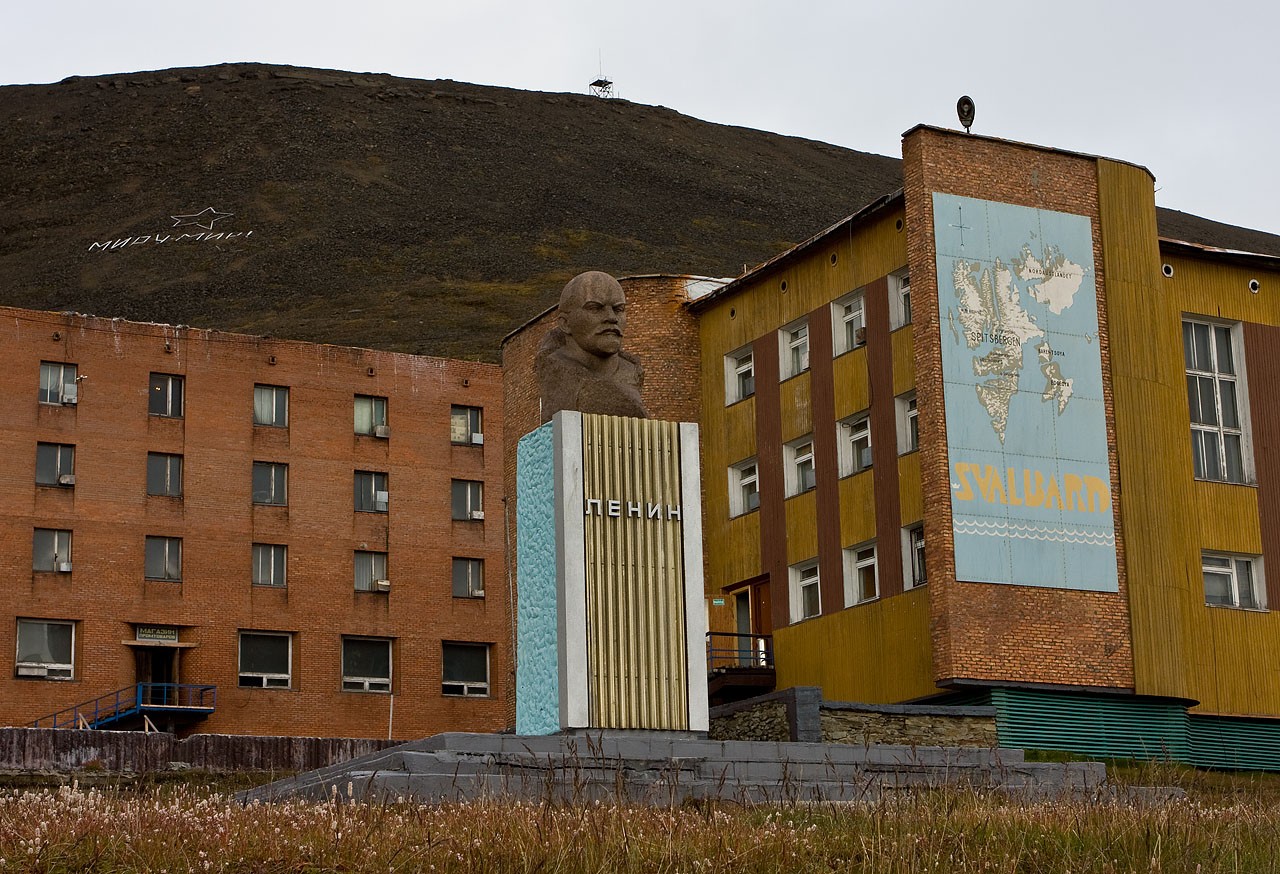
However, the only country to take this possibility seriously was the Soviet Union, whose settlements at Barentsburg and Pyramiden grew to several thousand inhabitants; for a time, the most widely spoken language on Svalbard was Russian. During the Cold War, Soviets made up two-thirds of the islands’ population (the remaining third were Norwegians), which totalled around 4,000 people.
The Russians mined coal in Svalbard.
Following the dissolution of the Soviet Union and the cessation of subsidies, the Russian population fell from around 2,500 to 450 between 1990 and 2010, and Pyramiden was completely abandoned. The two Soviet-era sites are considered Russian and are not open to visitors.
Svalbard is, by treaty, militarily neutral; consequently, there are no military personnel from any state present in the archipelago.
The photograph of the Barentsburg site – below – is taken from https://commons.wikimedia.org/wiki/File:Barentsburg_Lenin.jpg, authored by Svein-Magne Tunli.
The melting of Arctic ice will facilitate northern trade routes, and Russia is in an excellent position to capitalise on the consequences of climate change, as Federico Fubini highlights in *Corriere della Sera*:
The Russian mystery in the Red Sea: is Moscow helping the Houthis against the West?
There is just one pocket of chaos that remains completely unchanged. Neither the naval missions by the United States and European nations, nor the Anglo-American air strikes, nor the Israeli attacks seem to have changed anything. The Houthis, the militias controlling much of Yemen, continue to block transit from the Strait of Bab el-Mandeb, which links the Mediterranean and Suez to the Gulf of Aden, on to the Indian Ocean and from there to East Asia, where almost half of the world’s manufactured goods are produced and the fastest-growing markets are located.
Russia plays a quiet but decisive role in this blockade, which has been ongoing for two years. According to data from the International Monetary Fund, up until the end of 2023, around 80 ships a week – including cargo ships and oil tankers – passed through Bab el-Mandeb: this was the main route from Chinese to Italian ports, two weeks faster and cheaper than circumnavigating Africa to Gibraltar. However, since the Houthis began launching missiles or drones at ships from the headlands of the Arabian Peninsula, transits have plummeted from 80 to 30 per week and have not recovered. The threat posed by the Yemeni guerrillas has withstood billions of dollars invested by Western governments to eliminate it.
According to unconfirmed but persistent rumours, the Houthis are demanding a bribe from shipping companies in exchange for not attacking. How is this possible? Part of the explanation lies with Russia, which is aiding the Houthis. According to Reuters, in late September Moscow, with Iran acting as mediator, discussed sending Yakhont missiles (which are highly effective against ships) to the Yemeni guerrillas. And at the end of October, the Yemeni Vice-President Aidarus Al-Zubaidi was in Moscow, where he was received by the Russian government at the highest level.
What is the Kremlin’s interest in all this? To destabilise and weaken European economies as much as possible, without a doubt (including Italy’s). But also to boost the appeal of the Arctic route, under its control, which is opening up between China and Europe: for Italian ports, this would be a defeat.
It would be a defeat for the whole of Europe: does anyone remember Trump’s (*) remarks on Greenland? The Danish territory borders Svalbard… And indeed, Arctic leaders have sounded the alarm: the threat of a hybrid war – including the sabotage of undersea internet cables by Russia and others – is shifting from the Baltic Sea to the far north. Denmark and Greenland are planning to build a new data cable between them, and the remote Faroe Islands are in talks to have the line run through their archipelago to strengthen their resilience against potential attacks, according to the islands’ prime minister.
The United States, China and Russia are setting their sights on Arctic routes and territories. And Arctic resources feature in Trump’s proposed ‘peace agreement’ with Zelenskyi (Corriere della Sera, 16 November 2025).
(*) The appointment of a US special envoy to Greenland has sparked outrage in Denmark. In a post on X, Louisiana Governor Jeff Landry, appointed by Donald Trump, stated that his aim was to “integrate Greenland into the United States”. In response, the Danish Ministry of Foreign Affairs summoned the US ambassador in Copenhagen.
Below: in January 2026, tensions rise between Norway and Russia in and around Svalbard.