Compiled 5 January , updated 10 January 2026
With the Mercosur-EU treaty we have been ‘in the game’ for more than 25 years
The biggest obstacles to the ratification of the treaty are economic (tariffs) but also environmental, affecting people’s health.
Then there is transparency: the negotiations are not public, few are aware of them, as was the case with the TTIP, an EU-US agreement that was never signed.
To take an easy example, with the TTIP, European consumers would risk having the consumption of US hormone meat imposed on them.
These things have already happened in the recent past.
Note: Brazil is said to have overtaken the United States in beef production to become the world’s largest producer (Reuters), favouring the multinational JBS, the world’s third largest food producer by turnover, which owns the Rigamonti group in Italy (bresaola but also ham).
Let’s focus for a moment on the economic side: to this, which on duties seems to be going in the right direction, is added resentment towards the European Union. Various organisations are in fact protesting against the cuts in the Common Agricultural Policy funds (- EUR 87 billion).
This is the case of Coldiretti, which is demanding €9 billion (the share that Italy would miss if the cuts were fully implemented.)
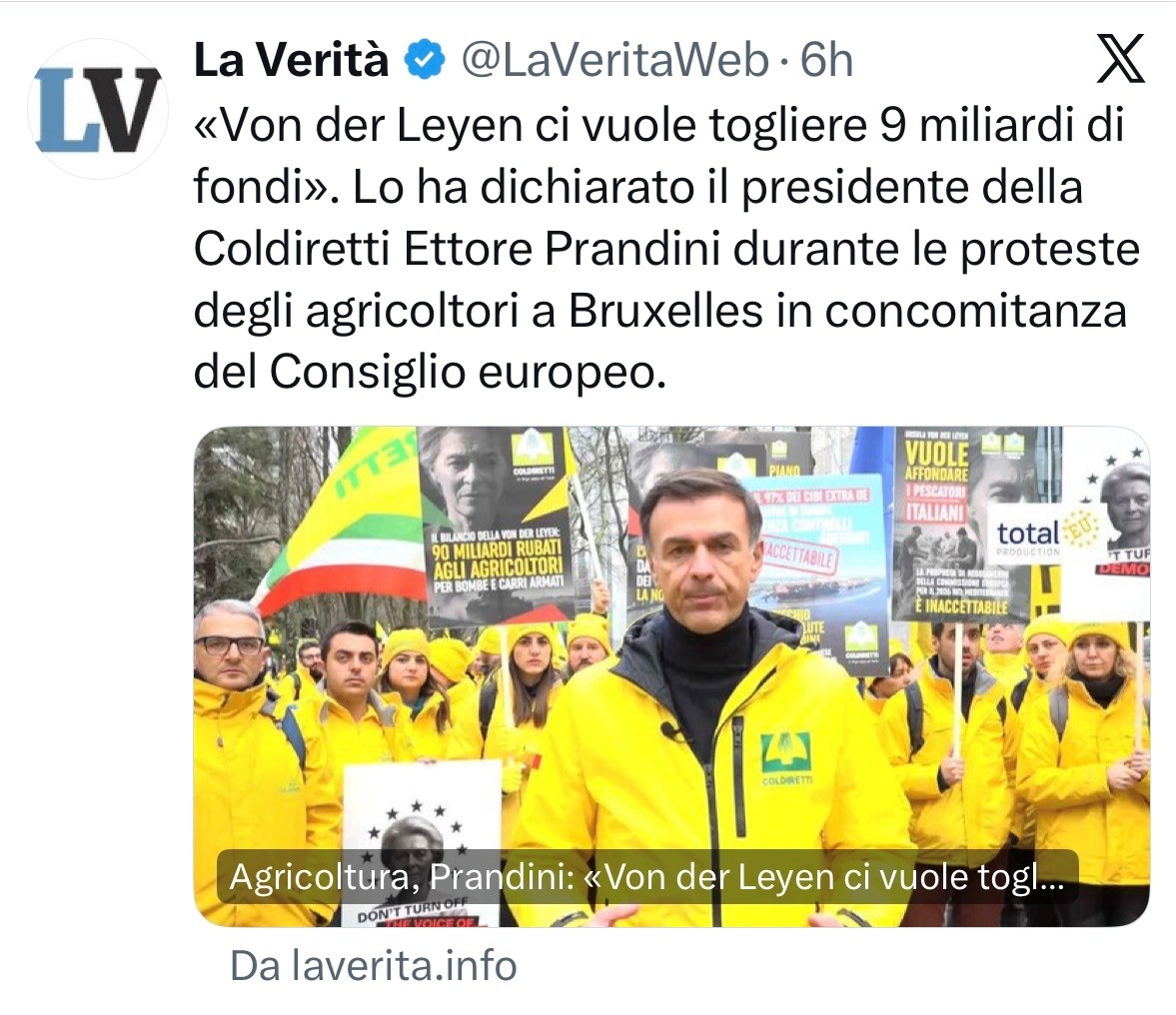
Coldiretti’s position reflects the unease of the sector, in some European countries, well summarised in this Newsletter of the French newspaper l’Express:
29 June 2025 will remain a black date for cattle breeders. On that day, an outbreak of contagious dermatosis nodularis (DNC) was detected in Savoy for the first time in the country. Six months later, outbreaks multiplied throughout the country, while the Minister of Agriculture divided her time between vaccination campaigns and herd culls in an attempt to erect a ‘health wall‘. Anger grows, misinformation spreads, against the backdrop of deep despair in the farming world. Prudent, the Elysée once again tries to stall on the Mercosur dossier, another highly sensitive issue.
Mercosur and DNC: these two tense factors of the moment conceal a third, perhaps even more worrying, because it reveals the fragilities of ‘farm France’. By 2025, the country’s agri-food trade surplus will have completely dissolved. Not only are exports of wine and cognac, cereals or dairy products – which traditionally generated billions in surplus – in trouble, but Spanish fruit and vegetables have never sold so well in France. As for imports of cocoa or coffee, they are becoming more and more expensive.
29 June 2025 will remain a black date for cattle breeders. On that day, an outbreak of contagious dermatosis nodularis (DNC) was detected for the first time in Savoy. Six months later, outbreaks multiplied throughout the country, while the Minister of Agriculture divided her time between vaccination campaigns and herd culls in an attempt to erect a ‘health wall‘. Anger grows, misinformation spreads, against the backdrop of deep despair in the farming world. Prudent, the Elysée once again tries to stall on the Mercosur dossier, another highly sensitive issue.
Mercosur and DNC [contagious nodular dermatosis]: these two tense factors of the moment conceal a third, perhaps even more worrying, because it reveals the fragilities of ‘farm France’. By 2025, the country’s agri-food trade surplus will have completely dissolved. Not only are exports of wine and cognac, cereals or dairy products – which traditionally generated billions in surplus – in trouble, but Spanish fruit and vegetables have never sold so well in France. As for imports of cocoa or coffee, they are becoming more and more expensive.
Consequence: the food balance, which in 2024 had a positive balance of EUR 4 billion, is expected to be around zero this year, if not actually slip into negative territory – a first for half a century. At the time, French governments did not stop encouraging the modernisation of agriculture. The words of Prime Minister Georges Pompidou, in Aurillac in 1967, demonstrate this:
“The economic revolution causes urbanisation to develop, urban populations to grow and modern methods of exploitation to allow much higher yields, hence greatly increased production. Hence the need for farmers to be able to sell ever greater quantities of produce to the cities or to foreign markets proper’.
A message well received: in 2000, France ranked second in Europe with a food surplus of EUR 10 billion, behind the Netherlands ( EUR 15 billion). “But today, the Netherlands has a balance of EUR 45 billion, while France’s is zero: we have lost the game,” notes Vincent Chatellier, a researcher at Inrae. At the root of it all is the erosion of agricultural competitiveness.
But that is not the only reason. First and foremost, ‘farm France’ suffers from its progressive downsizing: the number of farms is shrinking like a shagreen and production is falling. The reason is the lack of prospects. “When you don’t earn enough in the long run, especially in livestock farming, you invest less, robotise less, improve productivity less,” Chatellier points out.
Above all, farmers end up giving up: farming is suffering a silent demise. Herds follow the same trajectory: at the beginning of the year, there were 3.1 million dairy cows in France, a number halved in forty years. Jacques Chirac‘s famous phrase at the 2005 Salon de l’Agriculture comes to mind:
‘They are not cattle, they are masterpieces’.
Masterpieces that today are in danger.
Eric Chiol
Director
The Italian situation is different:
- we are not big cattle breeders
- the food trade balance was positive with an annual surplus of around 433 million at the end of 2024.
- But it is probably industrial processing that has benefited, not agriculture I say this because it has been so for some time. This explains the CAP claims of all the Italian agricultural unions.
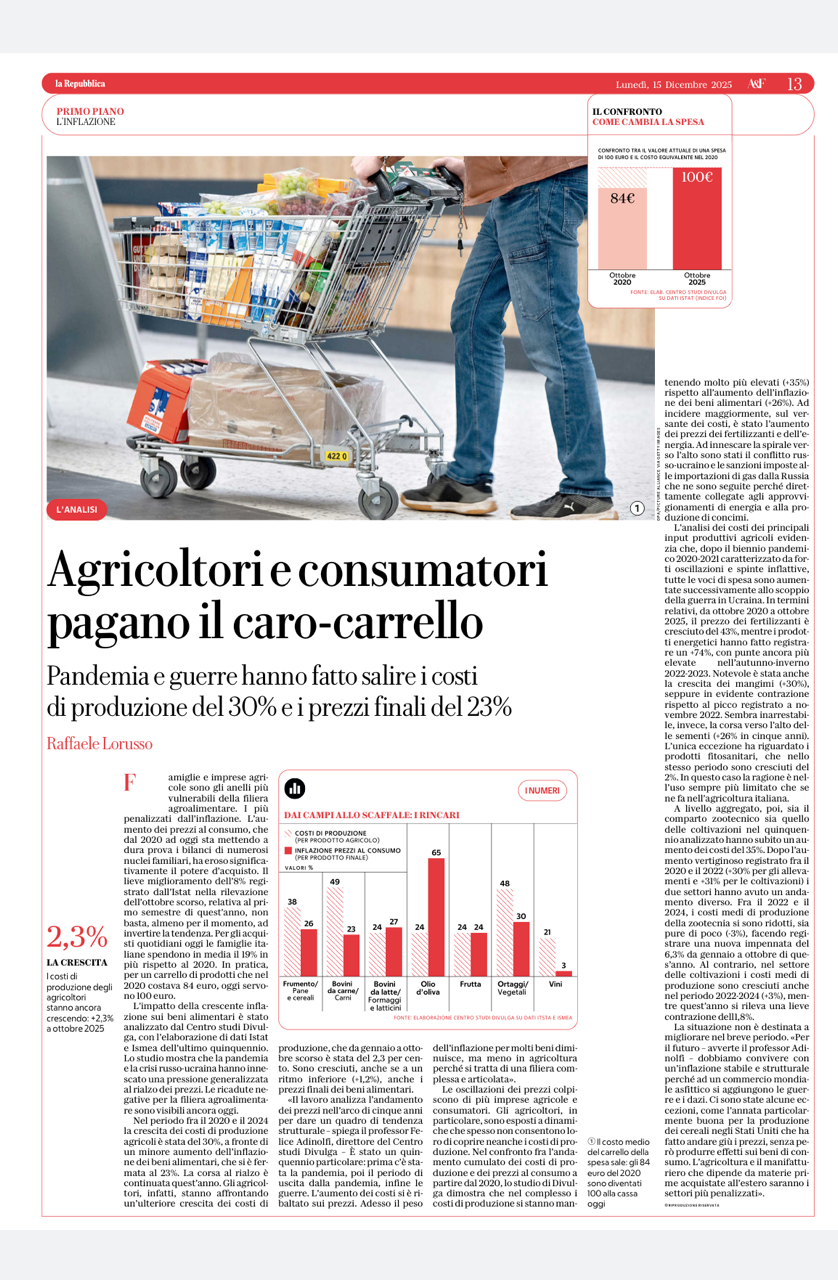
- the recent article in Repubblica AF below seems to prove me right: rising costs and the failure to adjust selling prices have reduced farmers’ margins (you can also read about this here).
And it is on these last two points that the Italian-French alliance has come together to say no, for now, to Mercosur.
The fact remains that European agriculture is, for true diverse factors, struggling (youcan find confirmation on England in the Financial Times here: Food production is no longer profitable for British farms, says a review Nearly a third of farms recorded losses last year as rising costs and unstable weather conditions hit household incomes).
Returning to Mercosur – what we read in French and Italian newspapers – makes it clear that not everything was still clear about the guarantees given in environmental terms (and therefore concerning the health of Europeans) a day before it slipped, with Italy’s support, the agreement (19 December).
Le Monde headlined on 18 December: ‘EU-Mercosur agreement: guarantees still unclear’.
This reflected what weighty MEPs such as Pascal Canfin (below) had to say: ‘We are extending the possibilities of investigations to health and environmental issues’ is not a reassuring sentence considering that it was uttered in December 2025, a few days before the possible ratification of the treaty.
Conclusion :
Giorgia Meloni was certainly right to stall on the ratification of Mercosur, also considering the problems with the CAP. The South American market, so coveted by Confindustria, could turn out to be a double-edged sword.
The problems of agriculture, as we have repeatedly emphasised, cannot be solved with ‘support funds’ alone, but with a vision and answers (support funds for what?) that seem to be lacking and that should take into account many factors, such as, for example :
- combating unfair practices, controlling selling prices and margins,
- combating climate change and improving water supply (dramatic, e.g. in Sicily,
- new management technologies (e.g. AI),
- clear food labelling
So Mercosur yes, but with caution. Taking all these factors into account.
P..S:: then there is a question that the current government should answer: why so much money for Africa? Once the African states have benefited from the Mattei Plan, will they not compete with Italian agriculture, which could be even more weakened by Mercosur?