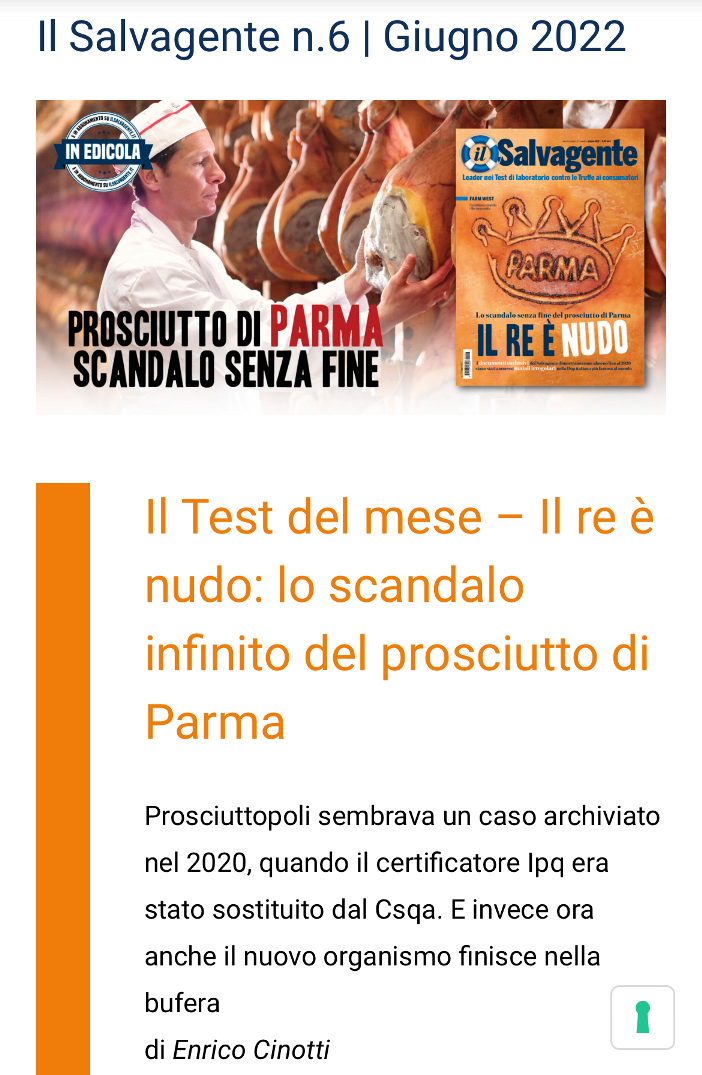
This is the sequel to Prosciuttopoli: the scandal continues, the new control body Csqa suspended
The stark reality: the never-ending Parma ham scandal
By
–
27 May 2022
In 2020, the Repressione frodi (Fraud repression) discovered more than 14,000 batches of overweight pigs regularised to become Parma ham with an ‘unacceptable’ procedure. But endorsed by the certifier Csqa. Over 700 thousand hams involved. Exclusive documents in the new issue of Salvagente
‘Itwasregularised without regularising‘. This was the practice followed in the slaughterhouses where the pig legs destined to become PDO Parma hams were cut up. Pigs out of weight, not allowed by the regulations of the Protection Consortium, which through a mathematical trick were systematically ‘regularised’ as conforming consignments. A situation endorsed by the Csqa, the certificationbody of the Parma supply chain.
The result? Consumers convinced they were bringing prestigious slices to the table could pay between 30 and 50% more for a ham that probably did not have the characteristics to bear the famous mark. In what to all intents and purposes seems to be a new chapter in the Prosciuttopoli scandal, which broke out just five years ago and brought to light the fraudulentuse of fast-growing breeds of pigs not allowed by the specifications, the legs obtained from overweight pigs would have to be unbranded, thus excluded from the PDO circuit and sold at a decidedly lower price.
Buy here the new issue of Salvagente with the complete investigation on Parma Ham
A scandal that, according to Salvagente, which publishes exclusive documents in the new issue on newsstands from today, has continued even in more recent years with animals out of weight – due to genetics or incorrect feeding – that have continued to become Parma Ham without having the required characteristics. According to theIcqrf, theCentral Inspectorate for the Protection of Quality and Fraud Repression of Agri-Food Products of the Ministry of Agricultural Policies, which in February suspended the Csqa for four months for ‘repeated violations of the ControlPlan’, between January and November 2020 ‘for the entire protected chain, 14,596 out-of-weight bat ches were detected out of a total of 58,245 batches delivered, referable to 2,125 farms’, the entirety of the Parma suppliers.
In other words, the Repressione Fradi (Fraud Investigation Department) ascertained that 25% of the pigs entering the PDO supply chain in 2020 did not have the characteristics to receive the prestigious mark.
How many hams are involved? The numbers are enormous: each batch represents a lorry carrying 130 heads from which – net of self-control and health authority rejections – about 200 legs are obtained. On balance, an estimated 730,000 irregular legs are involved.
An enormous number, which, however, risks being only the tip of a much larger iceberg, given that the ‘irregular regularisations’ would continue until December 2021.
Fictitious rendering
At this point, the question must be asked: how did a batch that did not conform to the weight manage to be sent to the slaughterhouse and then entered into the PDO circuit? This is where themathematical contrivance comes into play, branded as ‘unacceptable’ by the Icqrf and which led to the suspension of the Csqa, which seems, write the inspectors in the report presented in October 2021, ‘more oriented towards satisfying the needs of the supply chain (including the ham factories and the Consortium, ed.) than concerned about compliance with the production specifications and the Control Plan’. The ‘ recklessmanagement ‘ of the certification body has favoured ‘operators by avoiding penalties for serious non-conformities’, which turns out to be more interested in ‘economic aspects than in the management of impartiality’.
But what was the mathematical contrivance through which ‘regularisation without regularisation’ was achieved? In a nutshell: the dead weight of the animal was used and not the average live weight as prescribed by the Parma ham specifications. And so, using a numbers game, it was within the acceptable range for a leg to be considered PDO and not downgraded.
Numbers game
Let’s go in order. Pigs that weighed more than the permitted weight when alive – 160 kilos, plus or minus a tolerated deviation of 10%, with a range between 144 and 176 kilos – were regularised when dead by means of a real forcing: the theoretical slaughter yield was applied to make the batch compliant and not the real one envisaged by the specifications.
In the slaughterhouse, the average weight is calculated because in a batch of pigs there can be animals that weigh more than the standard and thus compromise the entire supply. To make it regular, calculations have to be made to assess whether it can aspire to enter the PDO circuit.
Let’s take an example. A consignment that arrives at the slaughterhouse with an average of 182 kg is irregular. In this case, the rules allow the heaviest animal to be excluded and, after slaughter, the average live weight to be reconstructed and regularised by applying the actual yield. The accepted average slaughter yield is 82% and in our example the average carcass weight (eviscerated) is 152 kg. To reconstruct the average live weight of the animal, the actual yield is applied (82% of 152) and the result is 185 kilos: the batch remains non-compliant and should therefore be excluded from the PDO. What happened instead in the slaughterhouses with the endorsement of the Csqa as ascertained by the Icqrf? Not the real yield was applied but a fictitious yield almost always between 84 and 86% (applying this to our example, the final weight turns out to be 176 kilos, therefore in line with the specifications) so as to give the go-ahead to almost all of the more than 14 thousand consignments found to be irregular on arrival at the slaughterhouses in 2020.
The Fraud Repression inspectors write: ‘In the reports examined, the yield used by the slaughterhouses is almost always between 84 and 86% and does not correspond to the actual yield of the relevant slaughtered batch, which, if used, would have revealed that the batches had not been regularised. A mathematical artifice is applied to ‘adjust’ a weight that would have resulted in the exclusion of the animal from the prestigious Parma chain. Theaim is clear: ‘The slaughterhouses used a theoretically high yield to divert as few carcasses as possible‘. A modus operandi that suited many (starting with the same butchers who, with a higher fictitious yield, won the PDO mark on the leg andcashed in 70-80 euros, while they would have received less than half if the leg had been excluded) and about which the CSQA, according to the Icqrf minutes, has never had any objections. “With the regulations in force,’ reads the Icqrf report, ‘regularisation after slaughtering is already a stretch; to allow it according to the interpretation of the control bodies (Csqa, ed.) is unacceptable’.
The ‘flawed’ study
Granted that, as ascertained, it is not regular to apply a theoretical yield instead of the real one, who calculated the fictitious percentage that was used?
The audit by the Fraud Repression reveals a real conflict of interest: the percentage was in fact set by the meat industrialists, the pig breeders and the Consortium itself. The theoretical yield of between 78 and 86% that was applied to regularise non-compliant consignments is taken from a study conducted in December 2019 by Crpa, a research body owned by several trade associations: Anas (the pig breeders), Assica (the meat and charcuterie industrialists) Progeo (feed mills), Aia (breeders) and, dulcis in fundo, the Parma Consortium. ‘It is quite evident,’ writes the Repressione frodi, ‘that a study on the slaughtering yield commissioned and carried out by the said body is lacking in third party status, especially for the purposes connected with the use of the results that directly affect the owners themselves of the Crpa’.
The paradox is that the previous certifying body, the Ipq, suspended in 2019 and replaced by the Csqa, had tried in the past to apply a yield of 86 per cent, but in that case Assica’s industrialists had opposed it. Now instead, together with others, they have paid for a study to legitimise that percentage.
The inconsistencies do not end there. The Ministry’s Inspectorate disputes the formation of the sample taken: the study does not explain why some slaughterhouses were chosen and not others and why different observation periods were considered. Not only that: the slaughter yield data were taken from the portal impresa.gov on which slaughter operations (including weight) are recorded. ‘That data is unreliable‘, accuse the ministry inspectors, because ‘the file with which it is transmitted can be altered by the slaughterhouse before being sent’. It may sound absurd, but it also turned out that ‘some slaughterhouses did not have the weighing and simply entered on impresa.gov the weight indicated by the farmer’. In the light of all these criticisms, one can only wonder how reliable the sample taken by the study and the resulting theoretical yield percentage can be.
Had a more straightforward path been followed, a universally accepted average yield of 82% would have been used to regularise out-of-weight batches.
The Icqrf’s conclusion was blunt: ‘There isno doubt that all this was well understood by the supply chain and the control bodies, who did not intend to use a universally accepted yield value (82% in fact) that would have meant diverting more carcasses from the PDO‘. Which instead became Parma hams. This brings us back to the main problem that has marked one of the jewels of Made in Italy and that is, the Icqrf continues, ‘that the average weight of the pigs is widely higher than that envisaged by the specifications. This is therefore the main problem to be solved to maintain the credibility of the PDO system’.
The Csqa’s reply: ‘Problems solved’. But the dates do not add up
Il Salvagente posed a series of questions to Csqa reviewing the critical issues that emerged from the Icqrf inspection: in the issue on newsstands we report the company’s full position. In its answers, the certifier, by way of introduction, states that ‘Icqrf’s supervision was carried out on the activities carried out by Csqa on the PDO Parma Ham supply chain in a year that saw the concomitance of three factors of great impact: the start of the new control plan without any transition period; the beginning of the pandemic period; theintegration into Csqa of the staff of the previous control body in order not to create negative repercussions in terms of employment and social aspects’.
Have the regularised lots become PDO Parma hams? Have they all been sold? “With regard to the most serious objection,’ Csqa replied, ‘concerning the alleged incorrect application of the regularisation procedure for out-of-weight lots, it is stressed that this finding was not subsequently confirmed by Icqrf, which acknowledged, in the summer of 2021, the correctness of Csqa’s work, specifying that: ‘The interpretation provided by these bodies is consistent with the current formulation of the Control Plan (…)’. The hams were therefore declared fully compliant and no product exclusion from the protected circuit was ordered by the competent authority. Any other consideration or inference is therefore pointless and specious’.
Something about the dates, however, does not make sense to us: Icqrf presented the Final Audit Report on 7 October 2021 with the censures of the work of the Csqa, how can the body claim to have had a previous green light from the same Inspectorate?
The Salvagente also understands that in mid-July 2021 the Directorate General for the Recognition of Control and Certification Bodies and Consumer Protection of the Icqrf confirmed that for the regularisation of out-of-weight consignments the actual and not the theoretical yield was to be applied as ascertained for the whole of 2020. So even in the summer, no green light seemed to have been given.
Finally, the fact remains that if everything had been resolved in the past few months, the Icqrf’s decision to place Csqa under protection in February 2022 would be incomprehensible.
The position of the Parma Ham Consortium: ‘No violation’
The critical issues raised by the Icqrf-Repressions Fraud along the Parma Ham supply chain brings us back to the main problem that the Consortium has been unable to solve for years: the average weight of pigs is much higher than that specified in the specifications. We asked the Parma Ham Consortium why it continued to sell legs that had been regularised with procedures censured by Icqrf and contrary to the control plan and specifications?
This is the Consortium’s position: ‘With regard to hams branded and sold as “Parma Ham”, no violation of the specifications has been committed and to state the contrary is entirely specious. In fact, it is in the interest of the Consortium itself and its producers to offer all consumers a product that conforms to the production standards imposed in the specifications and with all the guarantees proper to a PDO. Csqa has shown that the regularisation procedure had been discussed and shared with Icqrf before being properly implemented and approved in the control plan.
As a Consortium, we appreciate the considerable efforts made by Csqa – both during the pandemic and in recent months – to bring their activities in line with our indications to strengthen the control system and we continue to reiterate our full support for their work, confident that the matter will be brought to a positive conclusion as soon as possible”.