Drafted 3 August 2023, updated 18 July 2025
For an update to July 2025 read : Unfair Practices : The failure of regulation.
And their situation is aggravated by new taxes.
In this situation, it is significant to reread what was discussed a few months ago.
Government and Coldiretti, meanwhile, have preferred to deal with cultivated meat, insects, ‘pasta on the moon’, etc..
It was easier than solving people’s real problems.
‘Interesting’ is this interview – dated 1 August 2023 – by Luigi Scordamaglia who – although he does not state it – is a consultant for Coldiretti.
At Coldiretti I had proposed, in 2020, the establishment of a ‘French-style’ price observatory.
In the meantime, what has happened in this regard to date in Italy?
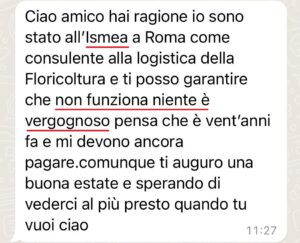
Ismea, mentioned by Scordamaglia, is considered an incompetent and quite useless bandwagon.
What sense it makes to monitor prices only for wheat and milk is only known to Luigi Scordamaglia.
The only interesting and true thing he said was that cows are affected by climate change.
Interview (from 1 August 2023)
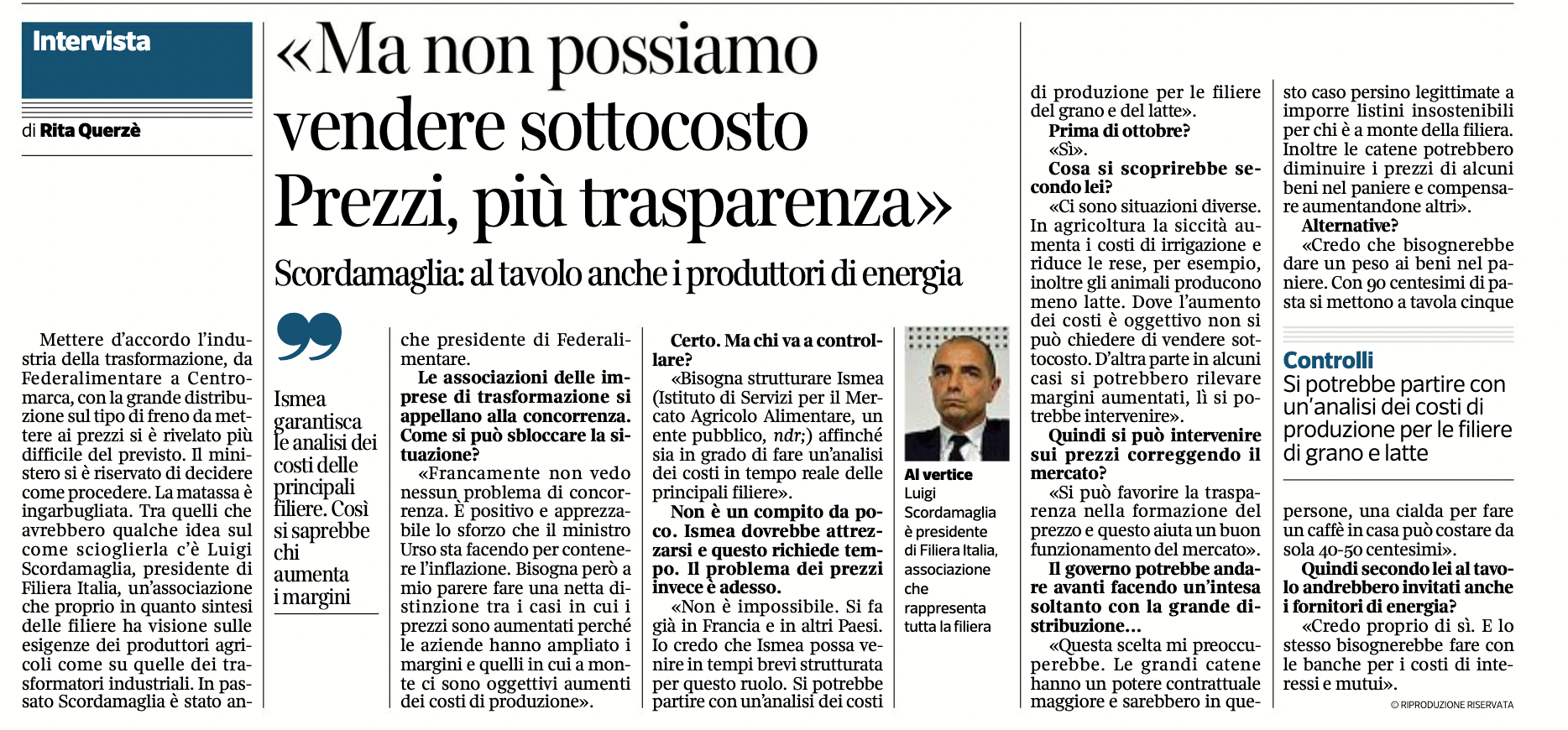
‘But we cannot sell below cost Prices, more transparency’
by Rita Querzè
Scordamaglia: energy producers also at the table
Getting the processing industry, from Federalimentare to Centromarca, to agree with large retailers on what kind of price restraint to put on prices proved more difficult than expected. The ministry has reserved the right to decide how to proceed. The skein is tangled. Among those who would have some ideas on how to untangle it is Luigi Scordamaglia, president of Filiera Italia, an association that precisely as a synthesis of supply chains has a vision of the needs of agricultural producers as well as those of industrial processors. In the past Scordamaglia was also president of Federalimentare.
The associations of processing companies are appealing for competition. How can the situation be unblocked?
‘Frankly, I don’t see any competition problem. The effort that Minister Urso is making to contain inflation is positive and appreciable. However, in my opinion, a clear distinction must be made between cases where prices have risen because companies have increased their margins and those where there are objective increases in production costs upstream’.
Of course. But who goes to check?
‘We need to structure Ismea (Istituto di Servizi per il Mercato Agricolo Alimentare, a public body, ed;) so that it is able to do a real-time cost analysis of the main supply chains’.
This is no small task. Ismea should equip itself and this takes time. The problem of prices instead is now.
“It is not impossible. It is already done in France and other countries. I believe that Ismea can come quickly (!) structured for this role. We could start with an analysis of production costs for the wheat and milk sectors’.
Before October?
‘Yes’.
Checks
One could start with an analysis of production costs for the wheat and milk sectors
What would be discovered in your opinion?
“There are different situations. In agriculture, drought increases irrigation costs and reduces yields, for example, and animals produce less milk. Where the cost increase is objective you cannot ask to sell below cost. On the other hand, in some cases increased margins could be detected, there one could intervene’.
So you can intervene on prices by correcting the market?
“Transparency in price formation can be encouraged and this helps the market to function well.
The government could go ahead by making a deal only with large retailers….
“This choice would worry me. The large chains have greater bargaining power and would in this case even be legitimised to impose unsustainable price lists for those upstream in the chain. Moreover, the chains could decrease the prices of some goods in the basket and compensate by increasing others’.
Alternatives?
“I believe that the goods in the basket should be weighted. With 90 cents of pasta you can put five people at the table, a wafer for making coffee at home can cost 40-50 cents on its own’.
Ismea would guarantee cost analyses of the main supply chains. Then we would know who is increasing margins
So in your opinion the energy suppliers should also be invited to the table?
‘I do believe so. And the same should be done with the banks for interest and mortgage costs.
The more you broaden the discussion tables, the less you decide: ‘the representatives of the producers (including Federalimentare, Centromarca, Assica and Assolatte) claim that it is difficult to intervene in the price dynamics of the members and call for the participation of other players in the chain: producers of raw materials, packaging, logistics and energy companies‘.
All that is missing are the banks mentioned by Scordamaglia and then ‘we are all set’.
So Coldiretti (= the politicians) and Confindustria seem not to want the regulated baskets (*) and possible controls of unfair practices.
Which is in contradiction with these declarations: Made in Italy tomatoes start harvesting, but 50% Chinese imports.Coldiretti and Filiera Italia, stop those who violate human rights, released regarding this terrible affair: Naceur died on the hottest day of the summer while picking watermelons for 1 cent a kilo.
On the other hand, Coldiretti is against cultivated meat but is pro-GMO (an obvious contradiction), so what could one expect from the association run by Prandini at this juncture, if not ‘many fine words’ (contradictory)?
Blah, blah, blah.
(*) ‘The industry has decided to take a step back and not subscribe to the conditions proposed in the Mimit draft’. Read also : Francesco Mutti: “We don’t come from years of extra profits, Urso’s anti-inflation plan does damage.”
[vc_column_textConclusion :
1) unfair practices, deteriorating food quality and exploitation are linked.
A pinch of climate denialism can also be added , passing it off as ‘defending the economy’.
2) And Coop, which would like a basket of capped prices different from the one proposed, then, a few hours later, signed the anti-inflation agreement proposed and signed by Minister Adolfo Urso.
This, however, for the moment, seems very propagandistic and ‘smoky’.
In fact, the minister stated: “With the capped basket we are convinced that we can give a definitive blow to inflation by bringing it back to natural levels,” stressed the Minister for Enterprise and Made in Italy, Adolfo Urso, commenting on the memorandum of understanding on the quarterly spending spree. “According to OECD data,” Urso continued, “inflation in Italy in the last month fell from 7.6% to 6.4%, a drop of 1.2 percentage points, greater than that recorded in the OECD area, where the consumer price index fell by an average of 0.8%. A consolidated trend thanks to the effect of the constant price monitoring carried out by MIMIT’.
As we pointed out at the beginning, price monitoring is not Italy’s forte.
Above all, the food industry and farmers, who are crucial for price management, are missing from the tables ‘where decisions are made’.
The risk is that not only will little or nothing happen but that yet another opportunity to curb unfair practices will be missed, read more Crisis and minimum guaranteed price: fruit grower writes to minister.
P.S.: there are the starting prices (e.g.: the list prices that the large-scale retail trade receives) and then there are those to the public. The minister is probably referring to the latter but in Italy we are not ‘good’ at monitoring even those.
Faced with a well-known situation – in 2020 I wrote: ‘if it goes on like this, agriculture risks dying and with it part of the Italian ‘savoir faire’ in food’- now – in 2024 – while farmers are making their voices heard, it can be said that the only thing done was the anti-inflation cart that allowed many private label products to be sold.
But certainly no one has tried to solve the problems of food, ‘from field to table’. A political but above all an economic problem.
The C.R.A (Comitati Riuniti Agricoltori) interviewed:
… What about trade unions like Coldiretti?
The unions are part of the problem. In words they stand with the farmers but in deeds they receive millions of euro, they are foddered by a political class that has been perverse and parasitic for years.
Why don’t the unions join the protest?
Because they are subservient to the strong powers, there are no longer the trade unions of the past. In these hours they are phoning their members to tell them not to come. They are sabotaging us….
Read also :
- Agriculture: some call for taxing ‘the extra profits of large-scale distribution’
- Tractor protests, because in the crosshairs is the large-scale distribution system: from unfair trade practices to sales below cost.
- “Vegetables plummet and foreign merchandise comes under pressure”.
- EU backtracks on agricultural emissions and pesticides after farmers’ protests.
- Climate : EU plan spares agriculture. We will all pay the consequences: cancer, loss of biodiversity and inflation
- Agriculture : Coldiretti under indictment
- Coldiretti, Lollobrigida and Fratelli d’Italia, deep ties
- Discount stores: 8.2% in value sales in 2023. And fruit and vegetables? It costs more but farmers are underpaid
- Gesmundo’s letter to the directors of Coldiretti: ‘The protests? Thugs who want to erase our identity’
- Farmers demand a guaranteed minimum price (#prezzoequo) and a strict ban on sales below cost
- France: Macron announces ‘guaranteed minimum prices’ in agriculture