


Compiled 15 July, updated 8 August 2025.
Above is a Coop initiative that has caused a lot of discussion, not least because it is not clear whether it is, or is not, an undercost (moreover, I am wary of ‘disproportionate’ discounts). Not very original, it is reminiscent of the previous ones of the discount chain Eurospin.
Foreword:
- Together with Mario Gasbarrino, exactly five (5) years ago, I had made a proposal to Coldiretti to control unfair practices: there had been great enthusiasm at the front, which had not been followed by concrete facts.
- We had done this because we knew how much agricultural producers were suffering from impoverishment.
- Unfortunately, the trend will be exacerbated by the fact that agriculture will be penalised by the European CAP.
- In the decade to 2024, the estimated number of people living in predominantly rural regions of the EU decreased by almost 8 million, or 8.3%, while the urban population increased by more than 10 million, or 6%. Regions, which account for about 40 per cent of the EU’s land area and are home to almost a third of its population, are experiencing a steady decline in resident population. Falling numbers mean that shops and bars are being forced to close, buses run less frequently, doctors are harder to find and classrooms are emptying. This fuels further departures, in what the OECD calls a vicious circle.
Below : Europe’s rural populations are declining and are also the poorest (FT 17 July 2025)
The refund on turnover, which starts at a fixed 10% and can go up to 14% of the turnover, certifies the distortion of the market where caporalato and black market practices are often practised.
It is crucial that the failure of the regulation on business practices be certified .
In 2019, the EU passed a directive against unfair commercial practices. But many of the demands of large-scale retailers fall under the so-called ‘grey list’: they are therefore legal, if formalised in writing. “Today, not only are we forced to accept them, but we also have to sign contracts stating their legitimacy. It is even worse: we are self-certifying the reduction of our profit,’ says another operator.
Although Italy transposed the directive with Law 198/2021, prohibiting, for example, double-digit electronic auctions, the impact remains limited. ‘The European directive and law 198 transposing it are the classic warm nappy given to the dying,’ comments lawyer Gualtiero Roveda, an expert in agri-food law, when questioned by Internazionale. Penalties for unfair practices in 2023-2024 amount to only 665 thousand euro against estimated damages of at least 350 million per year.
Weak bargaining power and unfair competition from abroad
Producers’ bargaining power is also reduced by fragmentation: “There are 7,000 producers selling fruit and vegetables to large-scale distribution. There are 25 distribution signs,’ says the manager of a large fruit and vegetable group. In this context, every negotiation is a battle. “The market makes the price. But in this market, the seller is almost always in a weak position,’ he adds.
Complicating the picture is foreign competition. “It can happen that they call us and tell us that the Spanish product is cheaper. Or that the Greeks are offering a lot at a lower price,’ the manager continues. Either you accept those conditions or you stay off the shelves’. A form of unfair international competition that is perfectly legal but ‘devastating on an economic and social level’.
Below is an explanation by Mario Gasbarrino on the vicious circle of promotional contributions: suppliers, in all sectors, have always had ‘inflated’ starting lists that try to predict and anticipate the demands of the GD.
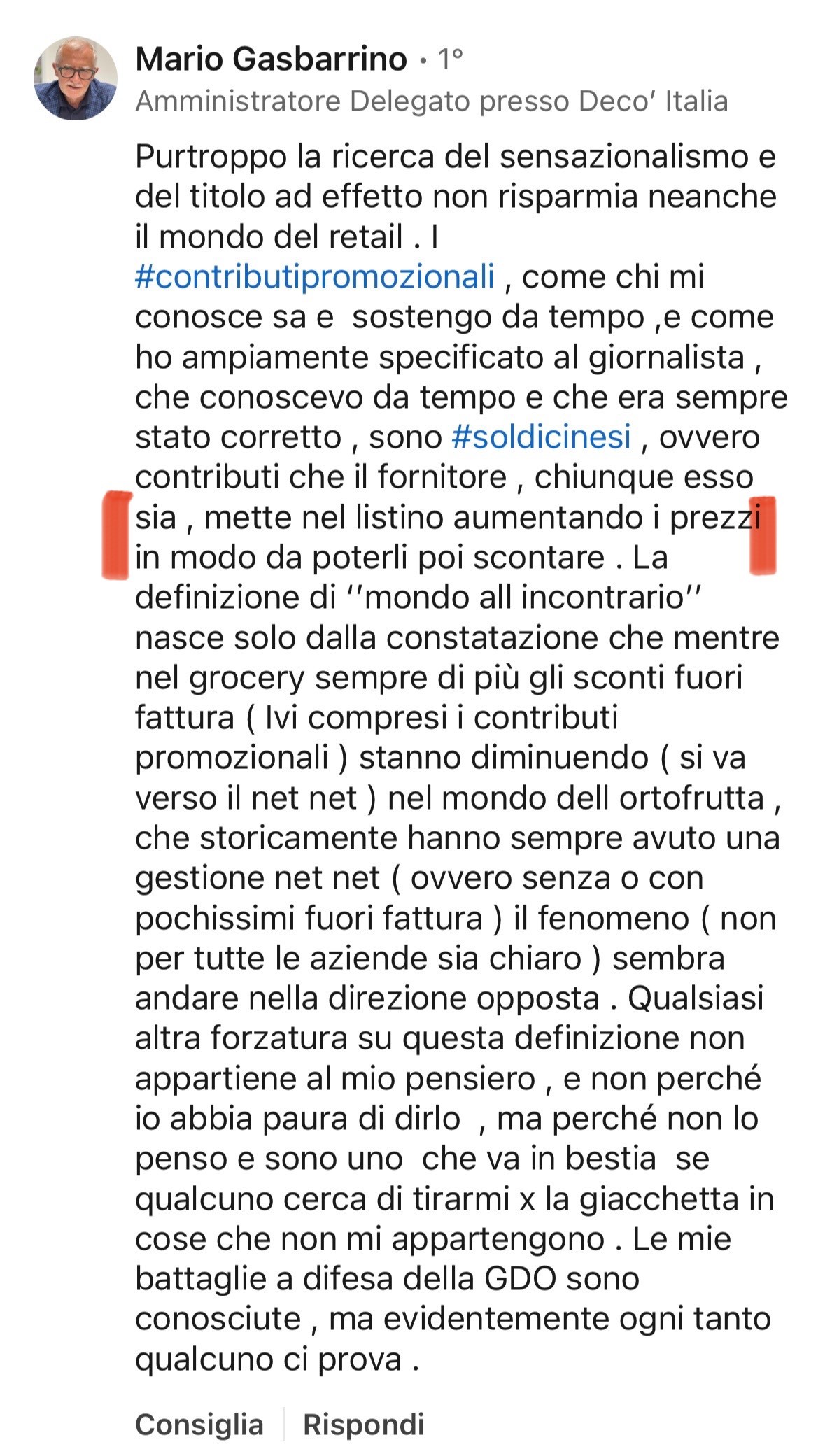
The fruit and vegetable sector is the most exposed to these distorted supply chain dynamics. Mario Gasbarrino, CEO of the Decò group, admits that negotiations are often ‘muscular’.
Fruit and vegetables, says Gasbarrino, ‘is an upside-down world’. “Promotions are planned two months in advance, when you still don’t know if the goods will be there. It is absurd. Fresh produce, by its very nature, should not follow promotional logic’.
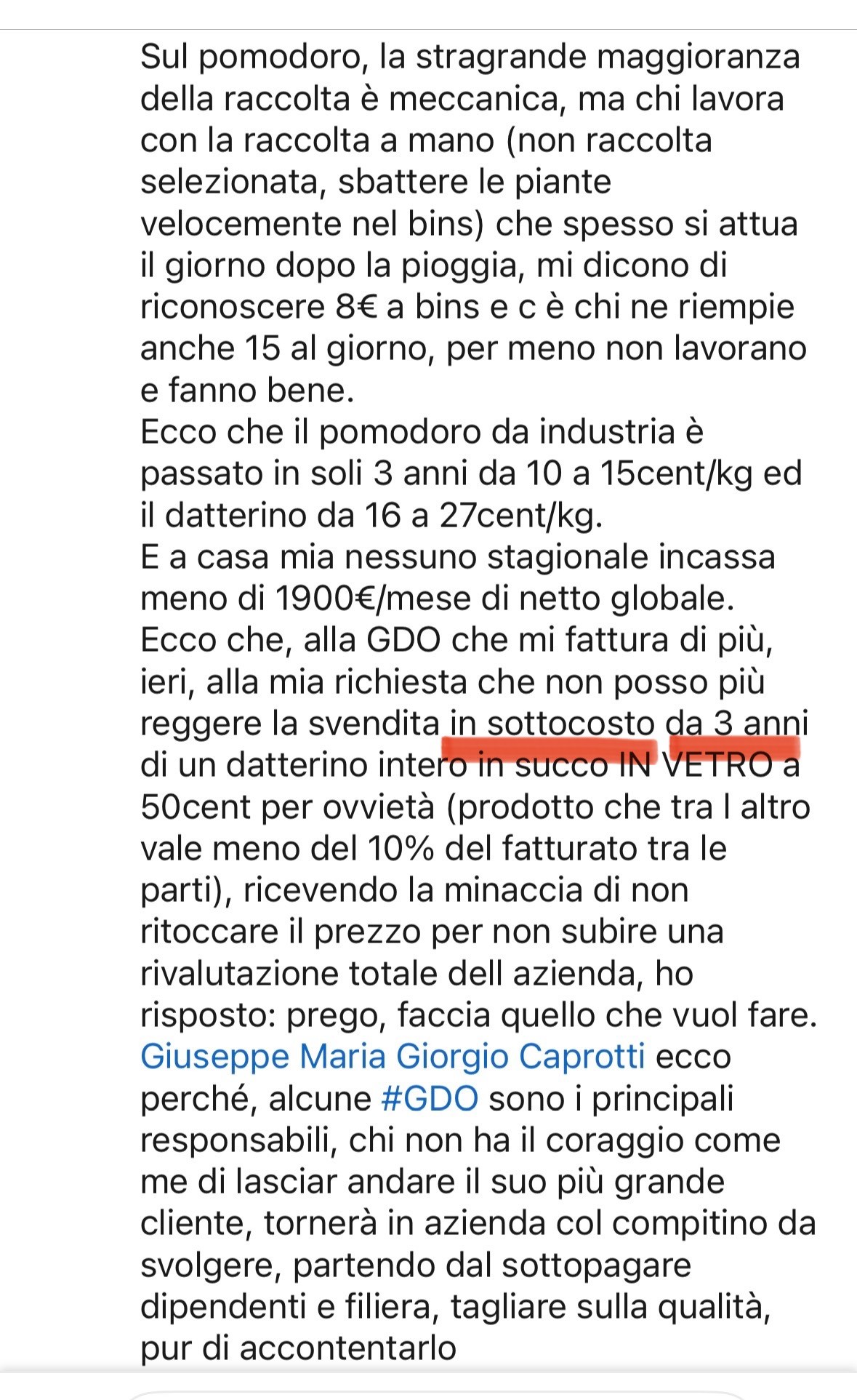
Below is one supplier’s comment on the undercutting practised even on packaged products.
Conclusion :
- those who are not in the industry should know that they pay at least 10% more for fruit and vegetables in supermarkets – very often inedible – than they should
- those who complain – perhaps even justifiably – about the CAP (Coldiretti, Confagricoltura, etc.), which takes funds away from farmers, should concentrate on enforcing rules to limit unfair practices: in the last five (5) years, little or nothing has been done, except in a few sectors that are not strategic for Italian farmers and consumers.
- if you don’t get to the root of the problem – unfair practices – it is perfectly useless to make demagogic anti-inflation carts.
- these practices harm farmers, producers and distributors (whose margins continue to fall, we’ll talk about that again).
- basically, on prices and unfair practices, the ‘dolce far niente’ of Italian politics continues.
Remember this when you see the next tractors in the streets, when you hear about the sad affairs of groups like Auchan, Casino, Carrefour Italia and others , or when you hear about the deterioration of food quality.
Below: the legitimate protest of farmers who forget to talk about unfair practices and the fight against climate change.


