Drafted 27 June, updated 30 June 2025
Is Cuore oil really special? Why do we pay double for it?
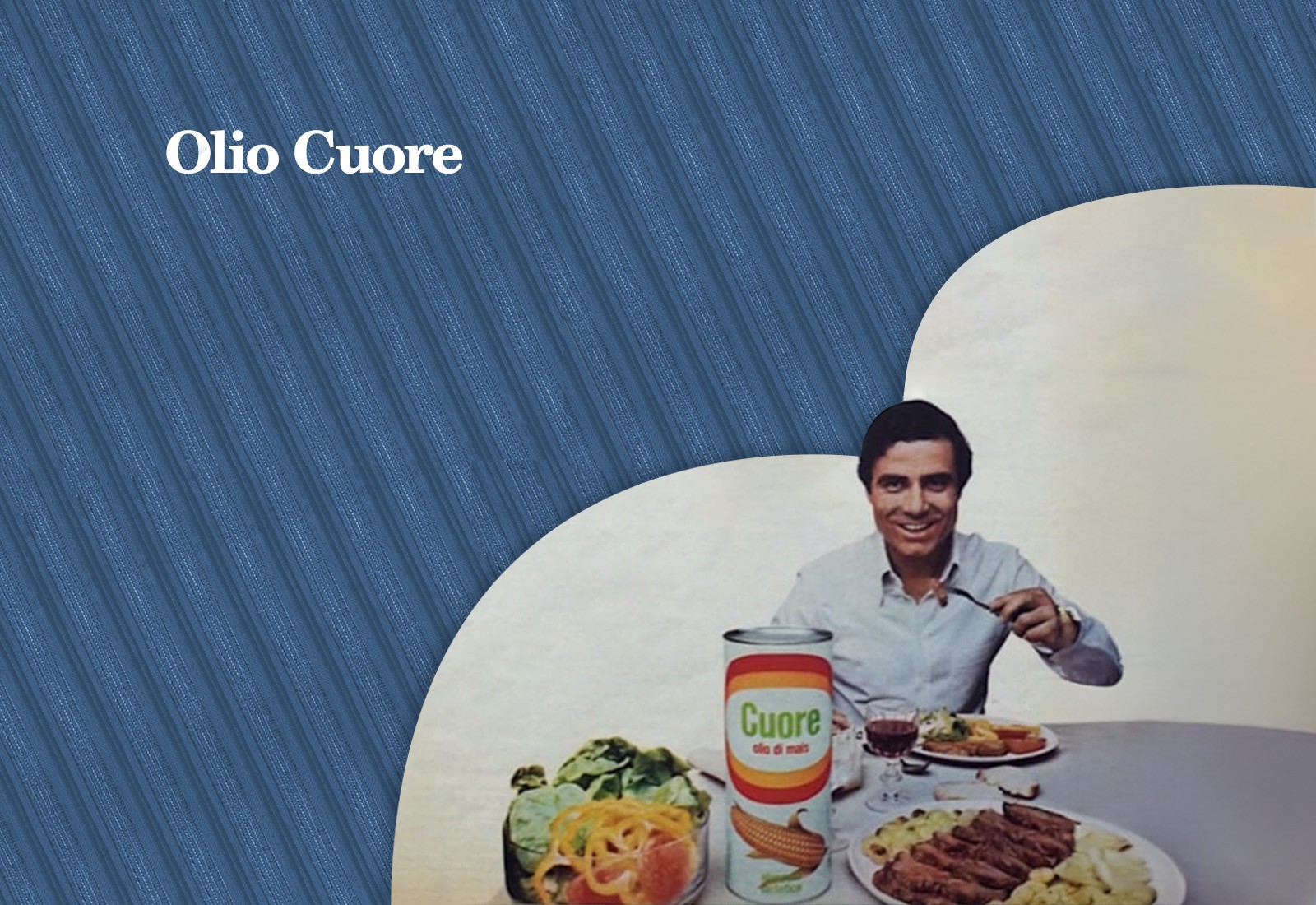
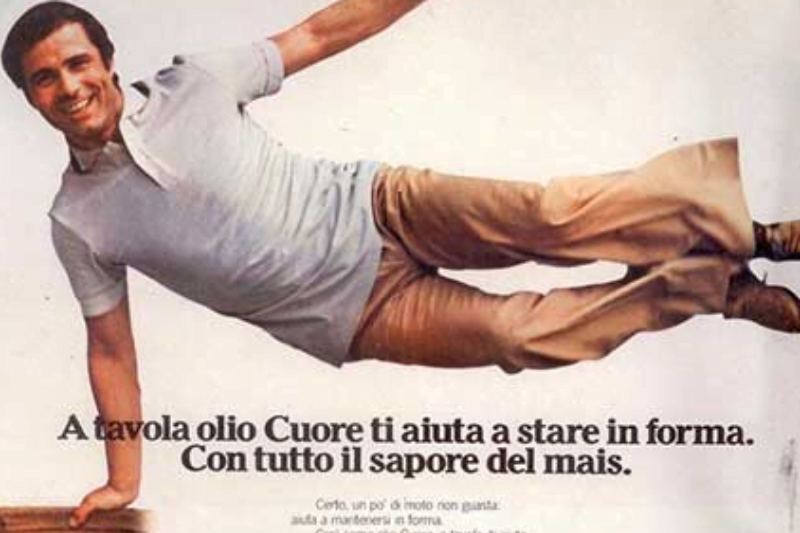
Cuore maize seed oil has for years been touted as a valuable aid against cholesterol and in many respects a ‘friend of the heart’. Just over 25 years ago it was also ‘light’ (so said Nino Castelnuovo as he jumped the fence in the product’s famous TV commercials). All this thanks to the addition of a handful of laughably priced vitamins and an excellent communication strategy. In fact, the can cost 5,000 lire, twice as much as other almost identical corn oils. Then the word ‘light’ disappeared from the commercials thanks to an intervention by me at the Antitrust Authority, which in 1998 recognised as incorrect the word ‘light’ referring to an oil with the same characteristics as the others. The news went almost unnoticed even though it was difficult for Chiari & Forti (then owner of the brand name) to accept the censorship.
Today the Olio Cuore sold in supermarkets is not only not ‘light’, but has 10 mg/100 g less vitamin E, and has reduced the amount of vitamin B6 by almost two thirds (from 2.6 mg/100 g to 1.0 mg). Also jumping the fence was the well-known DJ Linus. What has not changed is the price, which is still twice as high as the others. If at the end of last century it cost 5,000 lire and the others 2,500, now to buy it you have to shell out 5 euros per litre while the other brands cost my half (see table below). But then is it really worth buying it, paying up to twice as much as a normal Coop, Carrefour or Esselunga brand corn oil?
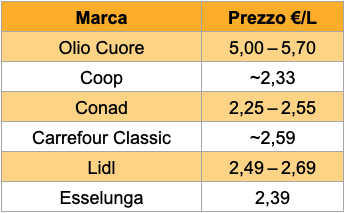
It costs twice as much, but the linoleic acid is the same
The health claim you buy on the label that linoleic acid ‘contributes to the maintenance of normal blood cholesterol levels’ is authorised by the European Union , but could be found on the labels of all other corn oils on the market. Cuore oil contains about 54 g of it per 100 g, but a similar amount is also found in other brands, which however do not carry the claim due to commercial choice or to avoid having to add the mandatory information required by the regulations ‘The beneficial effect is obtained with a daily intake of 10 g of linoleic acid‘. In essence, Cuore has no better effect on cholesterol than normal corn oil.
Vitamin E: useful, but already abundant in the diet
Heart is enriched with vitamin E, up to 80 mg per 100 g. But vitamin E is already widely present in the Italian diet, thanks to the consumption of vegetable oils, nuts, seeds, and green leafy vegetables. According to CREA and EFSA data, there is no widespread vitamin E deficiency in the general population. Enrichment, therefore, does not meet a real need, except in special clinical cases (malabsorption, severe nutritional deficiencies). Heart oil also contains vitamin B6 (1 mg/100 g), an important nutrient for metabolism and the nervous system. However, vitamin B6 deficiencies in Italy are limited to the elderly with a monotonous diet, people with gastrointestinal diseases, and those who consume too much alcohol.
For the rest of the population, B6 intake is sufficient through a normal diet that includes common foods such as meat, fish, whole grains, bananas and potatoes. Again, enrichment has more marketing value than real nutritional benefit. Heart oil is an example of how communication and nutritional enrichment can make a product perceived as ‘special’ that, in fact, is similar to others. Cholesterol is kept under control with the overall diet, not with a well-made label.
(*) The censored advertisement read: ‘Always on the front line against cholesterol’ and showed the packaging with the claim ‘Heart – dietary corn oil – vitaminised’. Underneath the Latin appeared the claim: ‘Because light. Because healthy. Because dietetic’.
Below: Nino Castelnuovo in the advertisement for Cuore oil from 1982
The explanation of why Cuore oil is so expensive can be found in my book, Le Ossa dei Caprotti.
It all starts with marketing, price lists and promotional contributions from suppliers.
On these I offer a summary made with AI. Those who know the logic can skip this piece and go to the conclusion.
Definition and nature of promotional contributions:
Supermarkets have two types of earnings: the ‘first margin’ (the difference between the selling price and the purchase cost) and the ‘second margin’ or ‘adjusted gross margin’, which includes the contributions that producers pay to the supermarket for achieving set targets . These contributions, if well managed, can significantly increase profits (p. 181-182 of Le Ossa dei Caprotti )
They are also called ‘premiums for sales made’ (p. 207)
Developments in the management of promotional contributions:
By the end of the 1980s, the market had changed, and suppliers, at the request of French chains, had started to pay promotional contributions no longer in the form of invoice discounts, but during or at the end of each year (p. 201)
These sums were significant, reaching more than 15 per cent of the turnover of a large retail chain.
Bernardo Caprotti initially preferred the ‘top margin’ with the discount on the invoice, proud of the efficiency of his organisation. This approach, however, meant that money not given to Esselunga was received by competing chains (p. 201).
Giuseppe Caprotti, the author, started ‘collecting money – lots of it – from suppliers, thanks to promotional contributions’. This allowed him to normalise relations with important suppliers such as Barilla, with whom there had been years of dispute (p. 201 and 203).
Impact on Esselunga’s profitability:
Promotional contributions were one of the fastest growing revenue items for Esselunga (p. 207 and p. 225).
In 1994, Esselunga had collected the equivalent of EUR 46 million in marketing contributions.
In 1997, Giuseppe’s first year as commercial director, the figure had more than doubled to EUR 96 million (p. 207).
In 2002, when Giuseppe became managing director, the income from promotional contributions reached 313 million euro (page 207).
In 2003, Giuseppe’s last year in the company, it was close to 380 million (p. 207)
After his departure, in 2008, promotional revenues reached EUR 611 million (over 10% of total sales). In 2017, the figure reached EUR 1.25 billion (16% of sales) (p.207)
This increase in promotional contributions allowed Esselunga to increase its overall profits, turning it into a ‘gold-covered’ company (p.207 and p.228).
Obviously, as we will see below, it is not always easy to obtain them, especially if the ‘big brand’ such as Cuore oil, in the 1980s and 1990s, has strong bargaining power vis-à-vis the large-scale retail trade.
Below: Nino Castelnuovo, Pippo Baudo and Raffaella Carrà on the covers of Esselunga magazines.
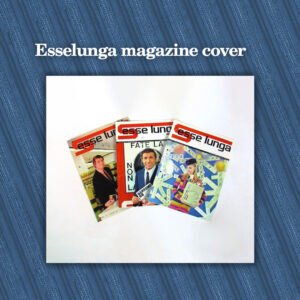
“Olio Cuore” is mentioned in sources in connection with Chiari & Forti, a company owned by Giulio Malgara.
Towards the end of the 1990s, Malgara’s company, Chiari & Forti, had launched Pasta Cuore with an exceptional testimonial, the actress Maria Grazia Cucinotta, for a commercial . The advertising investment had been considerable, and in order to sell the pasta it was necessary to renegotiate contracts with large-scale distributors .
Esselunga, however, had always lost money by selling Cuore oil because, if the shelf price was high, promotional contributions were very low and the product was sold below cost by the entire distribution.
But at a certain point Giulio needed to expand the range and I seized the opportunity:
“With our father even in the company there were good times, when we both showed we were having fun. Giulio Malgara himself had been the unwilling protagonist of one of these. At the end of the 1990s, his company, Chiari & Forti, had hired an exceptional testimonial in the form of the actress Maria Grazia Cucinotta for the Cuore pasta launch ad, with which he attempted to extend a brand that was very strong in oil at the time to other products .
He had made a huge advertising investment but, in order to sell his pasta, he then needed to renegotiate contracts with large-scale distributors to include it among brands that were much better known for that type of product.
At Esselunga, however, we had always lost money with Cuore oil, selling it below cost. In the contract renewal with Chiari & Forti I managed to exploit our strong position and snatched a one billion lira insertion premium from them. With my father, we laughed at the good Giulio for a long time.
In my book, Le Ossa dei Caprotti this piece can be found on pages 192 and 193.
P.S.: that the logic of the ‘big brands’, in the infernal circle of marketing, has not changed in 30 years?
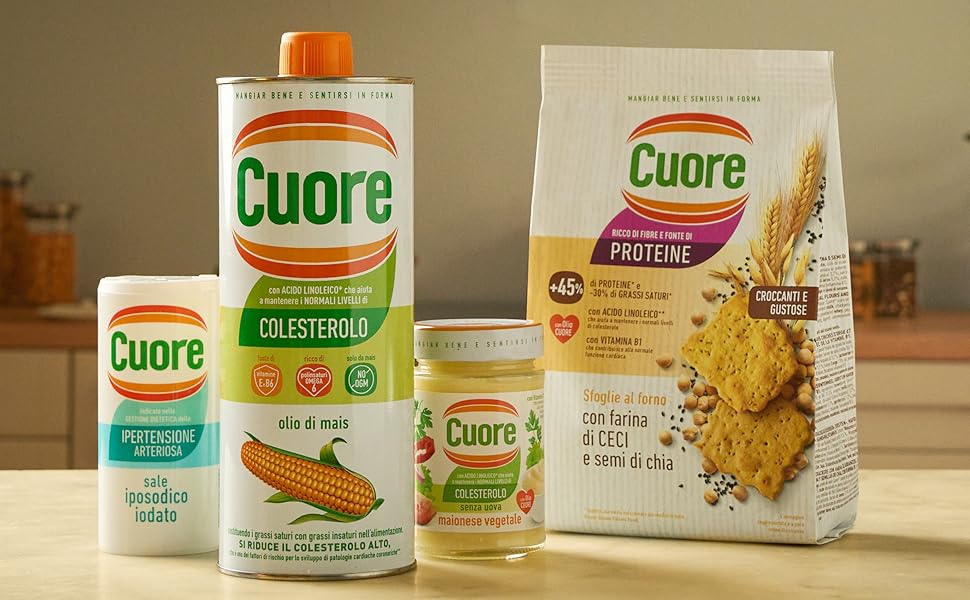
Below: the widening of the range of Cuore products sold by the new ownership (Montenegro).