

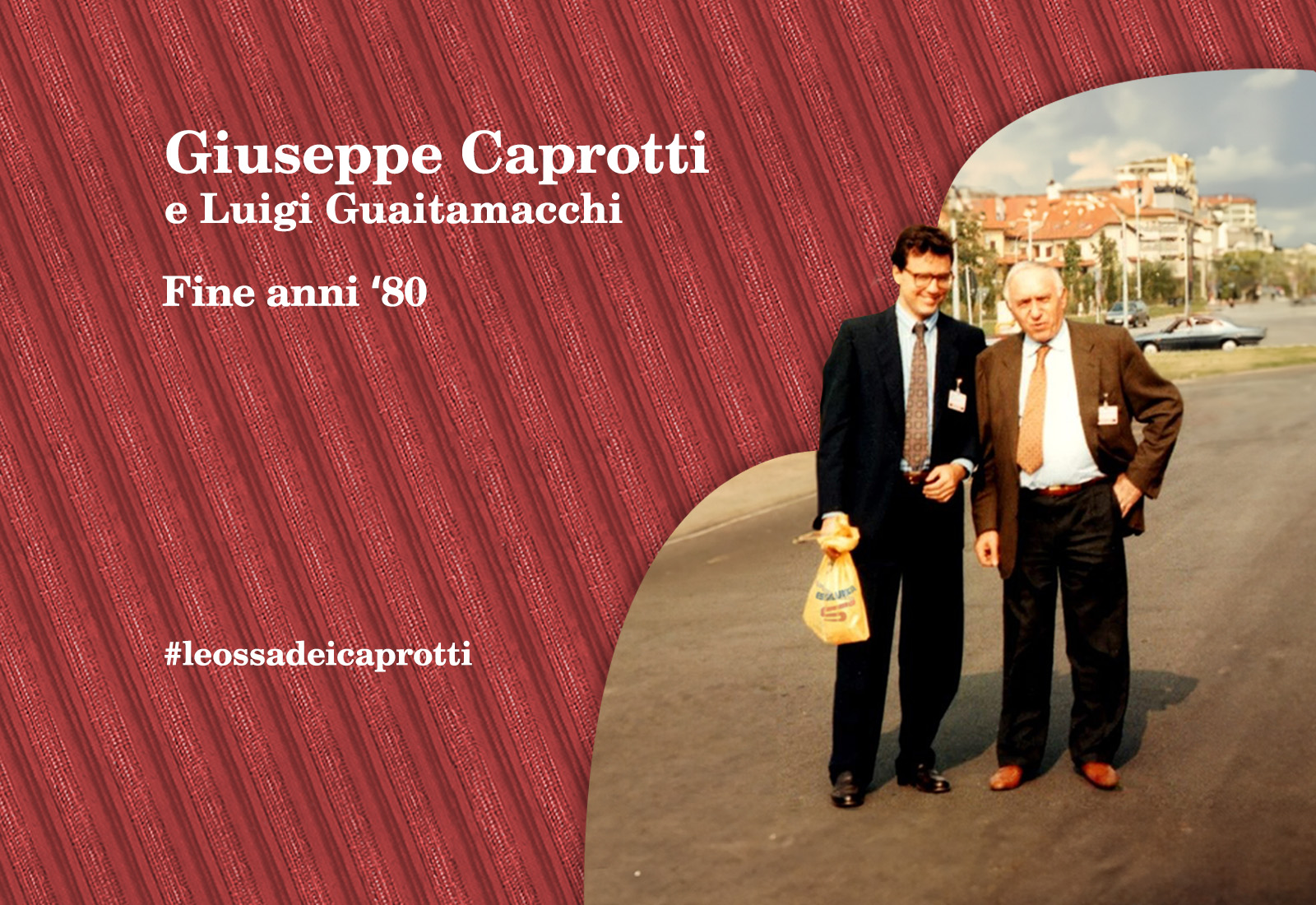
The photo on the cover was taken near the Esselunga in Piazza Ovidio, which was the chicken market area – where we used to go together in the mornings – and was close to ‘Mr Luigi’s’ [Guaitamacchi] flat.
“When I entered Esselunga, in 1986, I found a reality that had gone through an extraordinary phase of development. The foundations remained those left by the Americans, which my father from 1965 onwards never questioned, diligently following their directives but implementing them with great skill.
Five essential points can be identified.
Firstly, supermarkets must be supported by a warehouse to serve them: ‘There can be no supermarket network without a warehouse, and vice versa’ is the first commandment that is always repeated. Without a nearby warehouse, in fact, in food products there is a risk that the costs of replenishment will become too high and also that you will run out of goods: in fresh products this is a particularly serious problem because products have to be replenished on the shelves several times a day.
Then, second commandment, quality and convenience: what is not there you import or produce.
Own brands, with fancy names, are the third pillar: like the big brands, they too must have low prices, accessible to all.
The fourth strong point is the technical and management approach: employees must observe a Marines-like discipline and personnel costs must be low.
The last commandment is the law of [Richard] Boogaart [the Kansas manager to whom we owe, along with other American managers, the basis of Esselunga‘s success, ed.] (…): never open a supermarket in Rome. With my father, the southernmost shop would be in Arezzo.
I remember endless discussions, as long as I was in the company, because to me it seemed normal to expand southwards. In his last years, he would be persuaded by my sister Marina’s husband to open one in Aprilia and two in Rome, the latter opened when he was no longer there. The execution will not be by him: they will be the first without a warehouse in the area that can serve them (…)’ (CAPROTTI, The Bones, pp. 132 – 137).
Luigi Guaitamacchi, an executive who was in the company before Bernardo and had worked with the Americans [by whom he had been hired], told me that, in those days, if one day there wasn’t enough work, you stayed at home (…)’ (CAPROTTI, Le Ossa dei Caprotti, pp. 63-64 and p. 132).
“My career [at Esselunga] began in the technical, construction and maintenance department (…). I was tutored by Luigi Guaitamacchi, head of meat, dairy and charcuterie purchasing. Coming up from the ranks, he speaks a little dialect and a little Italian. He is a serious professional, who every day goes to the general market in Via Lombroso at six o’clock in the morning to make purchases from selected suppliers and to keep an eye on how the market is moving. And I with him (…)’. (Ibid., p. 137).
Certainly, Luigi Guaitamacchi was a man of strong character, he would not otherwise have succeeded in remaining in the ‘inner circle’ of my father’s loyalists, even taking advantage of the undoubted advantage of having been one of the first people hired in that new, incredible reality that was the ‘American supermarket’ in the 1950s.
For me, however, he remained one of the men who taught me the trade [of distributor], and for this I am and will always be grateful to him.
A final curiosity: among the photos below is one of two customers in front of the meat counter at Regina Giovanna’s first supermarket. It is taken from the volume The International Basic Corporation. Thirteenth Case Study in an NPA Series on United States Business Performance Abroad 1968, National Planning Association, Washington D.C. 2009 by Wayne G. Broehl, vice-president of IBEC. It is cited on page 49 of my book.
An American consultant, Duane Horney, had been given a contract to manage the meat department “as manager and trainer of the butcher’s shop” and“the self-service meat was initially a flop. It was only after many months of effort that IBEC managed to persuade the Italian housewife to adapt to do-it-yourself in this area as well’…”. (ibid. p.65 and p. 51)


