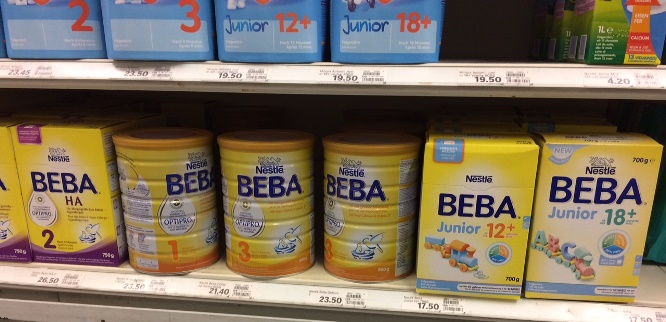
After the mineral water scandal and the frozen pizza scandal, in which two people died, Nestlé was overwhelmed by the baby milk affair :
According to ‘Le Monde’, the manufacturer waited for a ‘health risk analysis’ before informing Dutch and then European authorities of the presence of cereulide in milk produced in the Netherlands...
Bacillus cereus. ‘Cereulide can cause sudden nausea, vomiting and stomach pains,’ EFSA states.
“In younger children it can alter the body’s electrolyte balance and lead to complications such as dehydration,” the Authority adds, adding that the risk, “low to moderate”, increases in infants under 6 months.
For Ingrid Kragl, information director of the Foodwatch association, the lack of a standard on cereulide does not prevent “European regulations from being very clear about banning the marketing of products that highlight children’s health“.
Nestlé stated that: ‘Initially, in late November 2025, our self-checks revealed the presence of cereulide in some of our products at one of our factories in the Netherlands. Results received in early December confirmed the presence of a minimal amount of cereulide in products still under our control’.
The Dutch authorities, who have jurisdiction over this Nestlé factory, were only informed of these anomalies by the food group on 9 December, while the European authorities and other importing countries (including France) were informed of the anomalies on 10 December. On this date, the first series of milk recalls was initiated in several countries, some of which had been on the market for several months.
In addition to the timing of these first recalls, other questions arise about the weeks that passed before the recalls were extended, from 5 January to milk from other Nestlé factories, then in the second half of January to other producers(Lactalis, Danone, Vitagermine, Hochdorf in Switzerland, Granarolo in Italy, etc.)
On 2 January, Nestlé reportedly ‘started to inform the authorities of the various countries involved’. In France, the Ministry of Agriculture was alerted on 5 January by the Swiss group of the contamination of a batch of oil, but it specified that ‘the contamination of other batches of raw materials from the same supplier is only known afterwards’, which would explain the disarray of subsequent recalls.
Since this toxin is particularly resistant and very difficult to eliminate, consumer and parent associations wonder why the precautionary principle was not applied to recall all milk containing this enriched oil. Since the mad cow scandal at the turn of the century, producers have been obliged to trace it back immediately.
Questioned on 28 January in the National Assembly and the Senate, the Minister of Agriculture, Annie Genevard, considered the ‘accusations levelled at producers and the State’ to be ‘extremely serious’ and assured that recall procedures had been initiated ‘farm by farm, as soon as the presence of this toxin was detected’ and that the State’s supervision had been carried out ‘very seriously’.
With its complaint against X involving eight offences, including endangering and harming the physical integrity of infants and aggravated deception, Foodwatch hopes that a judicial investigation will shed light on those responsible. Two criminal investigations were opened in Bordeaux and Angers after the death of two infants: they had consumed the recalled milk and investigations are ongoing to determine the causes of death.
The contaminated ingredient is an arachidonic acid-rich oil produced in China, a notification sent to the RASFF on 9 January from Switzerland (notification 2026.0177) revealed.
Infant formulas often contain arachidonic acid (ARA), which is involved in the development of the nervous system along with docosahexaenoic acid (DHA). While European legislation obliges manufacturers to add only DHA, the presence of ARA is still optional, but many companies add it to their products.
As Fallto Alimentare says: ‘What is scandalous, apart from the scale of the alert, are the delays’. And we add: the water scandal – and the pizza scandal – should have taught Nestlé something, but the tendency – as with the Bervini meat and AIA ham scandals – is always to sweep ‘the dust under the carpet’.