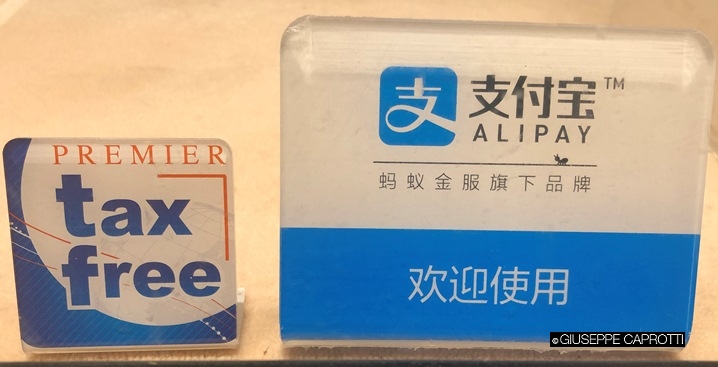
By 2025, Alipay handled $20.1 trillion in transactions. This is not a marginal figure. It is double the entire European e-commerce. Nor is Alipay alone: WeChat Pay processes comparable volumes. Together they control 90 per cent of the Chinese digital payments market.
These numbers tell something much deeper than commercial superiority. They tell of a completely different architecture of digital commerce, where payment, loyalty, advertising and logistics are not separate functions, they are one. A collective intelligence that connects companies, customers and platforms in an ecosystem that Europe cannot even imagine.
While Italy debates how to integrate a loyalty card into a payment app, China has already solved the problem twice and is looking beyond.
The mechanism: how it really works
Let’s start at the beginning. Alipay is not a ‘fintech company’ in the sense we understand it in Europe. It is an extension of Alibaba’s trading body. When Alipay processes a payment, it doesn’t just collect the transaction data. It collects the behaviour. The preference. The intention. And this data does not remain isolated-it spreads instantaneously through the Alibaba ecosystem like sap.
Think of 88VIP, the world’s largest loyalty programme: 50 million members, 98% retention rate. It is not a loyalty programme in the traditional sense-that is, a catalogue of discounts. It is a membership that integrates Taobao (the Chinese eBay), Tmall (Chinese Amazon), Ele.me (Chinese Deliveroo), Youku (Chinese YouTube), Fliggy (Chinese Booking). When an 88VIP customer buys something on Taobao, Alipay sees the data, Ele.me’s algorithm knows that customer has a propensity for food delivery, Alibaba’s advertising platform prepares targeting for Youku’s next message.
It is a vertical integration of human behaviour.
WeChat Pay works slightly differently, but with the same underlying architecture. Mini-programs (lightweight applications within WeChat) allow companies to build shopping experiences directly within the chat. Starbucks has its own mini-program in WeChat. When you order a coffee, that data stays inside WeChat. Loyalty is native. It is not a back integration, it is the very structure of the transaction.
The global loyalty market in China will be worth $32.66 billion in 2029, with an annual growth rate of 13.6 per cent. This is not a projection. It is the speed at which the system is transforming in real time.
What is happening in Italy: the limit of fragmentation
Fidaty is Esselunga’s loyalty programme. It has 95% of the Esselunga customer base-about5.6 million people. For Italy that is an impressive number. If it were a company in its own right, Fidaty would be the fifth largest Italian retailer by customer base.
But look at the structure. Fidaty is a catalogue of discounts. Customers accumulate points when they shop at Esselunga. He uses them to get a discount on things he probably wouldn’t have bought. There is a partnership with Doc24 (parapharmacy) and Infinity (IPTV). But these are superficial alliances. Fidaty does not know the customer’s behaviour on Doc24 in real time. It does not integrate logistics. It does not have access to payment data.
Worse still: in May 2025, Esselunga halved the points customers accumulate for each purchase. Fidaty has become less convenient just when it should have become more sophisticated. The signal is clear: the traditional loyalty model has reached its limits.
And Italy knows it. In 2024, Fidaty users had collected a total of €350 million in shopping vouchers since 2020. It means that the programme works on the level of transparency, the customer sees the value. But it remains a transfer of value from the retailer to the customer. It is not an integration. It does not create cross-category behaviour. It does not invent new services.
What is happening in Europe: the regulatory trap
Apple Pay has 65.6 million users in the US (49% of total penetration). Google Pay has 35 million (30%). In Europe, the numbers are lower and more fragmented. Why? Because GDPR prevents it.
The General Data Protection Regulation (GDPR) solved a genuine problem: protecting European citizens from data harvesting without consent. But it has also crystallised the divide. A super-app like Alipay or WeChat could not exist in Europe in its current form because sharing behavioural data across platforms (e-commerce, social, payments, delivery) would require layered consents, constant audits, widespread legal liability.
Google is trying to integrate loyalty into Google Pay. But it is a slow, limited, cautious integration. It is not native like in China.
European banks? They still use offline loyalty systems integrated into physical cards. The technology is there. The commercial will is perhaps insufficient. But the regulatory structure actively discourages it.
The result is that the European model remains stratified: payment here, loyalty there, advertising somewhere else. Three different things pretending to coordinate.
The JD.com case: when loyalty becomes competitive
JD Plus (the loyalty programme of JD.com, China’s second largest ecommerce giant after Alibaba) has 30 million active members. The retention rate is 96.7%.
What JD Plus has realised is that loyalty is not a lever of discounts – it is a lever of anticipatory behaviour. JD Plus offers faster delivery, priority access to limited edition products, automatic spending credits after certain purchase volumes. Best of all: JD Plus data flows directly into JD.com’s recommendation algorithm. If you are a member, you see different products. The same categories are shown to you in a different order. The experience itself is customised.
Fidaty shows products the same way to everyone. Customisation is secondary.
The heart of the problem: what it means for Italy and Europe
Let us return to the principle. The fact is not that Alipay is technically superior. It is that Alipay solves a problem that Europe does not even know it has: fragmentation.
In China, digital commerce is concentrated. Taobao and Tmall account for 70% of Chinese ecommerce. JD.com 20%. Pinduoduo the rest. This means that when a platform builds an ecosystem, almost all competitors are within the same ecosystem. Competition happens inside the collective intelligence, not outside.
In Europe, digital commerce is dispersed. Amazon has a dominant share, but getting Amazon, eBay, independent shops, marketplaces, social commerce, physical shops and services to share loyalty data in real time is legally complicated, technically possible, strategically not convenient for anyone.
Italy specifically? Esselunga at home is dominant. But Fidaty remains an island. Why? Because integrating Fidaty with digital payments, with advertising, with logistics, would mean that Esselunga would have to take on the role of Alipay, that is, it would have to become a payment and data infrastructure. It is a leap in mentality that no European retailer has yet made.
Amazon? It could do it. But it is necessary to make a distinction that is often forgotten: in the United States, Amazon has over time built an ecosystem that is very close to the Chinese model (proprietary capillary logistics, Amazon Pay, Amazon Advertising as the third revenue pillar, AWS as the underlying infrastructure). An integrated ecosystem, with ‘closing the loop’ ambitions similar to those of Alibaba.
In Europe, however, Amazon operates in a radically different context. It does not have the logistics monopoly that Alibaba exercises in China through Cainiao (its logistics platform that orchestrates millions of shipments per day by coordinating couriers, warehouses and hubs throughout China). It does not control payments as pervasively as Alipay, which is, in fact, state infrastructure in China. It does not have an integrated advertising platform with the same depth. And above all, it operates under the regulatory pressure of the Digital Markets Act, which simply does not exist in China.
The result is that Amazon in Europe is a powerful giant, but not a full service ecosystem like Alipay or WeChat.
The implications are profound. The market structure is not neutral, it determines who can win and how.
The economic value: who really gains
What Alipay has understood is, seemingly, simple: the value of loyalty is not in the points you give the customer. It is in the data the customer gives you every time they use the system.
The customer pays 88 yuan per year (about €11.50) to sign up for 88VIP. That sounds like nothing. But every transaction within the 88VIP ecosystem feeds Alibaba’s recommendation, dynamic pricing, and advertising targeting algorithms. Alibaba does not publish the exact value it generates per user from behavioural data, but it is clear that the economic value of membership for Alibaba is a multiple of the fee the customer pays, otherwise the programme would not make the economic sense it does.
In Europe? Fidaty does not generate direct revenues from loyalty. It generates loyalty to the shop. It generates increased receipts. But it does not generate third-party revenues.
Here’s the gap: in China, loyalty is a revenue-generating infrastructure. In Europe, it is a margin-eroding cost.
The final provocation
Let me ask you a simple question. If in 2025 Alipay processes $20 trillion in transactions and integrates loyalty, advertising, logistics and behavioural data into a single experience, and if Europe continues to treat payments, loyalty, advertising and logistics as separate functions that pretend to talk to each other through fragile APIs and complicated legal consents, who do you think will design the future of ecommerce?
This is not a rhetorical question. It is a question that investors are asking themselves right now. Because European venture capitalists know that if you want to invest in a logistics and loyalty super-app in Europe, you have to fight simultaneously:
- GDPR regulation (which makes data sharing legally complicated)
- The fragmentation of the market (which makes it difficult to reach a competitive size)
- The mentality of European retailers (who still see logistics, payments and loyalty as costs, not revenue-generating infrastructure)
Conclusion:
In China, all three of these things are already solved. Either they do not exist. Or they have been overtaken by the speed of the market.
Europe has the technical talent. It has regulation (even if it hinders innovation, it serves to protect). It has the companies. What it does not have is timing. The right time for a European super-app was five years ago. Today, it is late.
And as we write, 98% of 88VIP customers in China are already deciding where to spend their next money. WeChat knows where and when. Alipay knows the optimal pricing. The advertising system knows which message is most effective for that person, at that time, on that category.
Europe is still debating whether GDPR allows data sharing.
P.S.: E-commerce has fragile barriers, it is gaining more and more geopolitical weight and it is easy to see that China will dominate the world, overtaking the US : ‘China is building the future. America, unfortunately, seems to be merely discussing it’, Jensen Huang, CEO of Nvidia.
Sources
WeChat Pay Market Dominance: Tencent Q4 2024 Earnings Report, https://www.tencent.com/en/investor-relations
88VIP Membership Data: Alibaba Group Investor Relations, https://www.alibabagroup.com/en/ir/home
Global Loyalty Market Projection: Grand View Research, “Loyalty Programme Market Size Report, 2024-2030”, https://www.grandviewresearch.com
JD Plus Programme Statistics: JD.com Investor Relations, https://ir.jd.com
Fidaty User Base: Esselunga Corporate Data, February 2025 https://www.esselunga.it/it-it/investor-relations/financial-information.html
Apple Pay / Google Pay Market Share US: eMarketer, “Mobile Payments in the US, 2024”, https://www.emarketer.com/content/mobile-payments-account-more-than-1-trillion-pos-transactions-2027
GDPR Impact on Data Sharing: European Commission Official Documentation, https://ec.europa.eu/info/law/law-topic/data-protection_en
Ecommerce Market Size China vs Europe: McKinsey Global Institute, “The Digital Era in Asia-Pacific”, 2024, https://www.mckinsey.com