Compiled 21 June 2024, updated 14 March 2026
This article is not only in the Environment section, but also in the “Geopolitics and History” section of this site because energy independence is a fundamental issue for Italian sovereignty (to use a term dear to Giorgia Meloni).
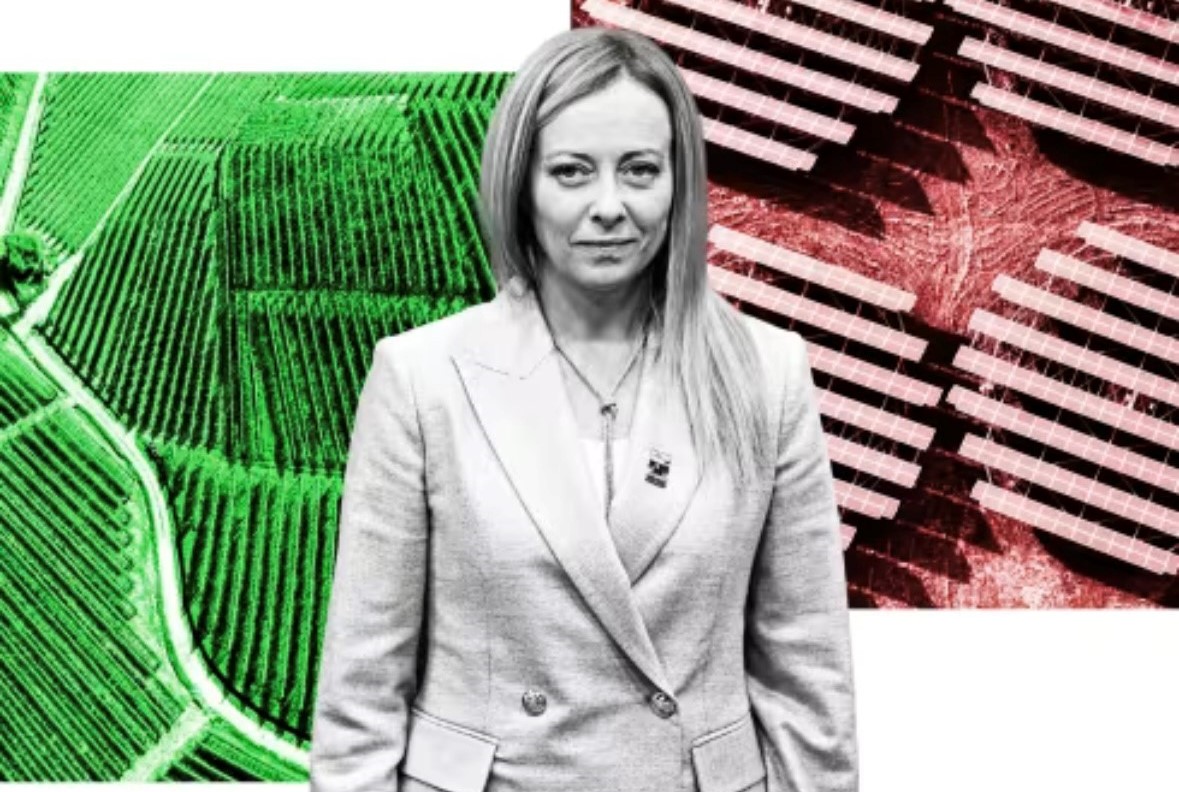
Giorgia Meloni [and Coldiretti] restrain the development of solar energy in Italy
The prime minister says photovoltaics threatens the nation’s ‘food security’, but farmers disagree
Italian Prime Minister Giorgia Meloni has always insisted that she is not a climate change denier and that her right-wing government is committed to greener energy sources. But her coalition is putting the brakes on the deployment of solar panels on farmland, which Meloni has described as a ‘threat to our food sovereignty ‘ – a claim refuted by some farmers and solar energy experts.
Last month, the government issued an emergency decree banning ground-mounted solar panels from land zoned for agriculture. Instead, Rome will require more expensive installations of at least 2.1 metres above ground, to allow cultivation underneath [a bill to suspend the construction of installations for 18 months will arrive in the parliament next Wednesday, 26 June]. Meloni described the decree as a ‘pragmatic measure that corrects … the ideological eco-foolishness of which Italy and its farmers have been victims’. But green energy advocates say the restrictions, which have yet to be approved by parliament, raise serious doubts about Rome’s ability to fulfil its international commitment to reach 80 GW of solar capacity by 2030. “It is a paradox: the cheapest source of energy right now is solar,” said Paolo Rocco Viscontini, president of Italia Solare, an industry group. “Rather than being happy to say ‘hey, we have the solution. Let’s work together to spread this energy source over the country’, new problems are created.”
Critics say the new brakes threaten Rome’s ability to meet its international green energy commitments.
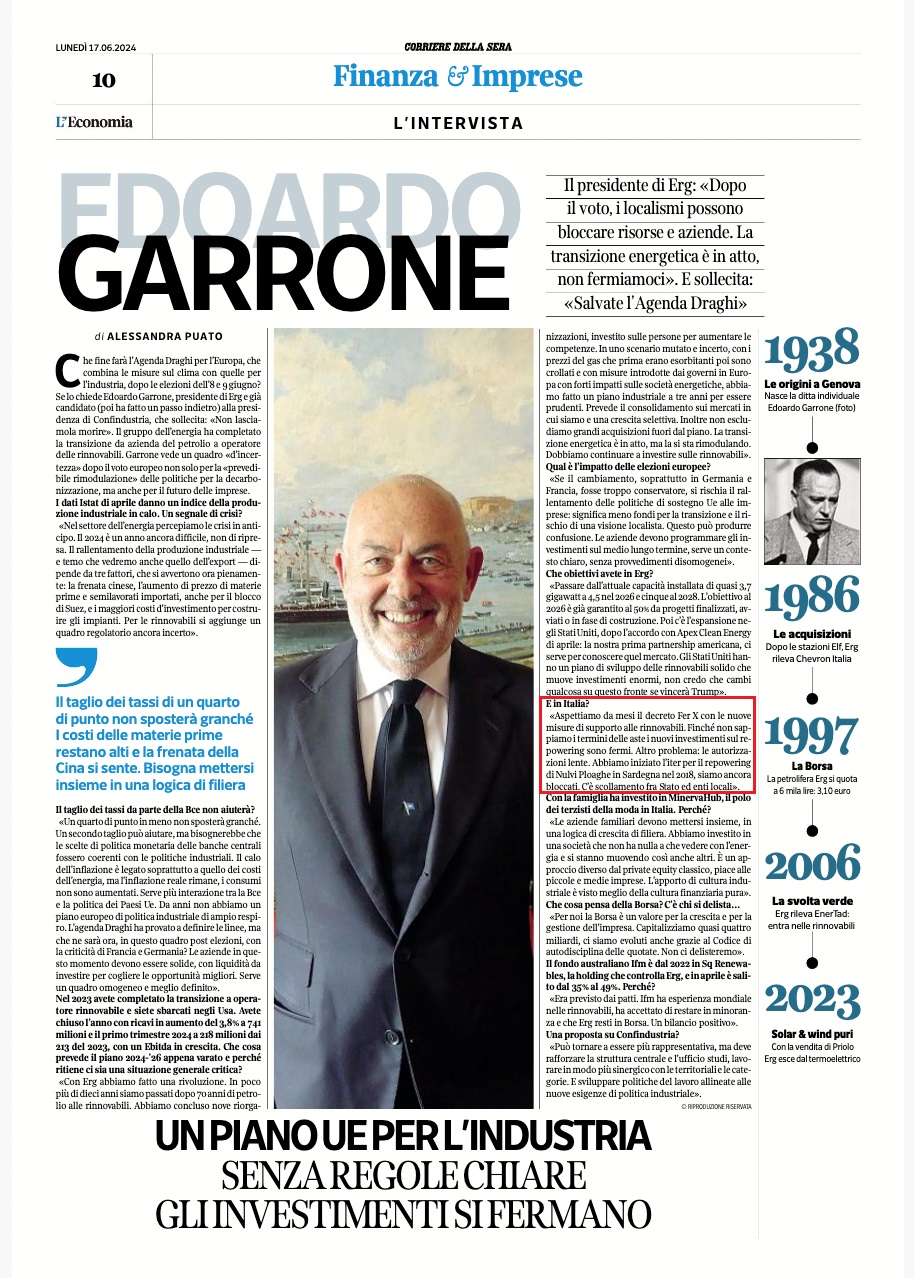
Industrialists in the sector, such as Edoardo Garrone, and investment funds operating in the sector also disagree with the government.
Renewable energy experts point out that high ‘agri-voltaic’ panels will be 20 to 40 per cent more expensive to install than conventional ones, undermining the competitiveness of the sector. The decree also prevents farmers from leasing their land to solar energy developers and instead requires them to invest directly in renewable energy projects on their property. Patrizio Donati, co-founder and CEO of Rome-based solar energy start-up Terrawatt, said: ‘If we create these conditions that make investment unattractive, we will not be able to make this energy transition in time. The latest initiative was supported by Agriculture Minister Francesco Lollobrigida, Meloni’s brother-in-law, over objections from the Italian Energy Minister. It follows a national frenzy raised by right-wing TV commentators who claim that iconic Italian products – from Prosecco to speciality tomatoes – are being threatened by rapacious photovoltaic companies.
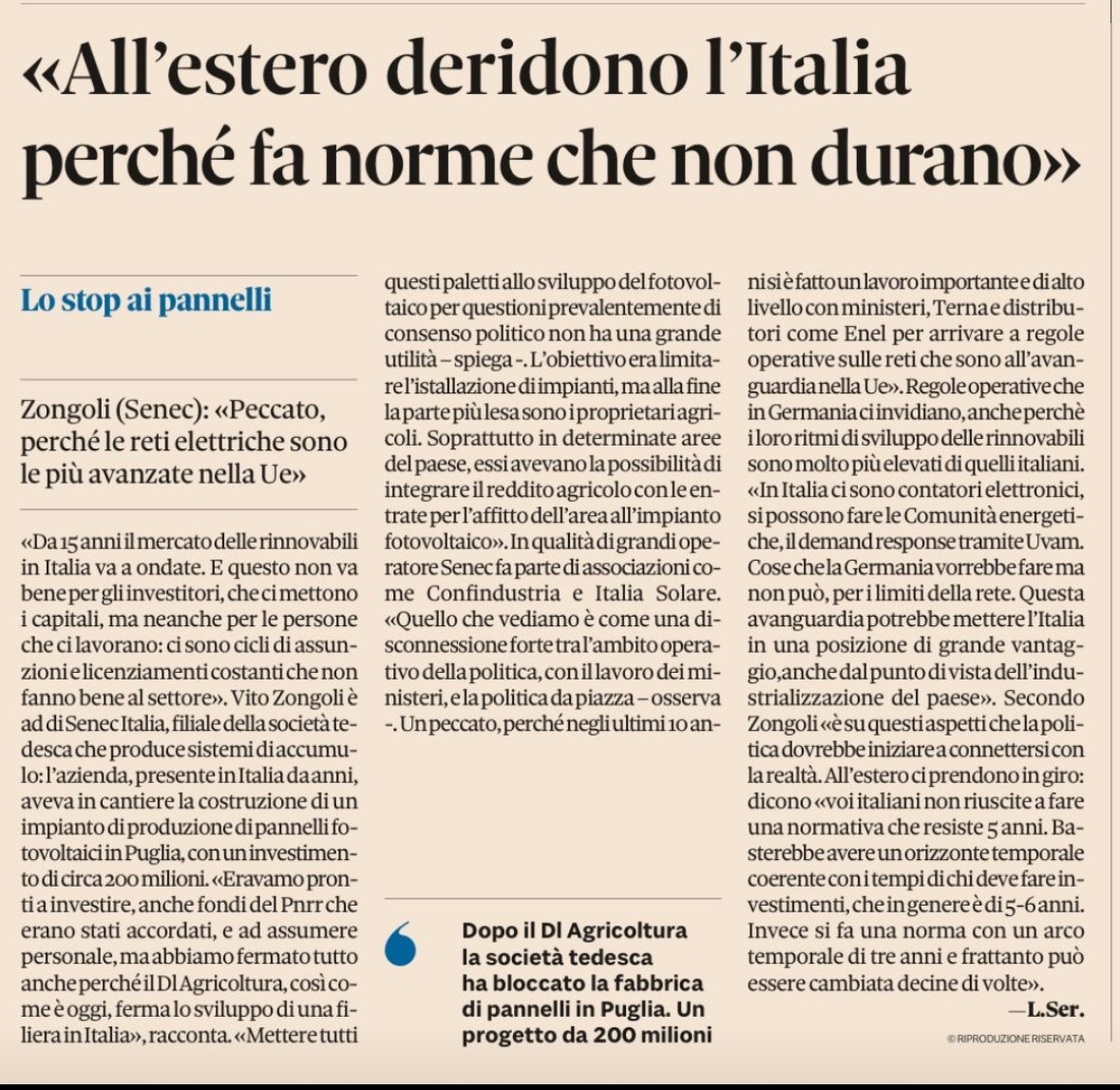
Many farmers scoff at such claims, pointing out that not all farmland is viable for crops, particularly in places where there is no irrigation. In the southern region of Basilicata, 61-year-old Emanuele Bocchicchio said that he has currently left about half of his land uncultivated due to increasingly hot weather, drought and rising cultivation costs. Last year, Bocchicchio agreed to lease 44 hectares of his unused land to Terrawatt, which plans to build two 10 MW solar power plants for which he would receive an annual rental income of €3,000 per hectare once the project is approved. “Photovoltaics is a salvation for us – a gift from heaven,” Bocchicchio said. “We should ask Lollobrigida why he has this hatred for solar panels. What dark mechanism is behind this? It is inexplicable.”
Farmer Emanuele Bocchicchio said that much of his land in Basilicata was unsuitable for cultivation due to drought and rising temperatures. He also said farmers should be given more leeway to figure out how to use unused land. “No one is forced to give their land for solar panels – it is a free choice,” he said. “In marginal areas like this it is vital. But here there is no freedom. Although Italy has 16 million hectares of designated agricultural land, almost a quarter is uncultivated due to poor quality soils, lack of irrigation, fragmented land ownership, labour shortages, or lack of interest on the part of urban landowners in investing in agriculture.
“This government needs to look at the reality of farmers: every year the weather is a little worse,” said Camillo Rossi, a lawyer who leased about half of the 200 hectares of non-irrigated farmland from a company that now generates 50 MW of solar power on the site. A usually hot, dry spring destroyed most of his early crops this year, he said. Renting out his land for solar panels was helping to offset these losses. “This land is beautiful to look at, but it is poor and, unfortunately, we do not have the potential to irrigate,” he said.
“This is what determined the choice of solar panels.” Italia Solare estimates that the country needs only one per cent of uncultivated farmland to meet its solar commitments for 2030, but warns that the new rules will prevent implementation. “We have such a nice solar energy potential, but the political class has never been able to manage it,” said Viscontini. Italy’s influential agribusiness lobby Coldiretti celebrated the ban and says the government must invest in irrigation rather than allow private developers to use marginal dry land for solar farms. “We cannot accept the photovoltaic shortcut,” said Luigi Scordamaglia, Coldiretti’s international policy director. “We do not want to accept the inertia of an administration that has decided not to invest and improve irrigation. We want to realise the full production potential of that land again’.
But
- Luigi Scordamaglia ‘forgets’ that the ‘administration’ he is referring to is represented by the right-wing, which goes hand in hand with Coldiretti, and that absolutely nothing has been known about the water plan for at least three years: 4.38 billion eurowere earmarked for water and land protection. This included the many still critical aspects of the system: infrastructures, reduction of network losses, and investments on the irrigation agrosystem to save crops with the Reservoir Plan. All this is happening in this context: Sicily without water. Tourists on the run
- It is difficult for Italian entrepreneurs to return to a declining agriculture, in wheat but also, in fruit and vegetables, if the balance of power along the agriculture-production-distribution axis is not changed. To date, the profitability of the fields, which has caused the latest protests by farmers, is low.
- Italy, with its aversion to photovoltaics, runs the risk of continuing to play the figure of the country of uncertain rules: Garrone rightly points out that ‘the United States has a solid renewables development plan that moves huge investments’. And he doesn’t think that will change if Trump wins. I don’t think so either, because the USA is pragmatic and the economy, in the United States, plays a much more important role than in Italy, where everything instead moves according to the ideology of the moment.
- the Italian government, on energy, finds itself in an enormous conflict of interest, as Federico Fubini explains very well (Caro bollette, the Italian industry in crisis accuses the (prosperous) energy suppliers: “We pay twice as much as the Germans” ). Snam, Italgas and Terna beat Microsoft, Alphabet (Google) and Meta (Facebook). Italy’s publicly controlled companies that transport or distribute gas and electricity to citizens and businesses are more profitable than some of the world’s largest, most technologically advanced and important companies in the business of the future: cloud, data centres and artificial intelligence. In short, Big Energy beats Big Tech.
More profitable than big tech: What do I mean?I am talking about profitability, meaning the operating profit of companies before paying taxes and interest on debts. In corporate reporting jargon, this is called EBIT (‘Earnings before interests and taxes’).In the first six months of 2025, that of the electricity carrier on the high-voltage grid, Terna (at 48% of revenue), the gas transporter along the country’s major pipelines, Snam (51% of revenue), and the gas distributor along the grid to consumers, Italgas (49% of revenue), beat the world champions in terms of added value, profitability, and frankly also oligopolistic power: microsoft’s EBIT in 2024 remains pinned at 44.6 per cent, Meta’s at 42.2 per cent and Alphabet travels on a paltry 32.3 per cent. As for Enel, in electricity distribution (EBIT at 34.3% of revenues in Italy in the first quarter of 2025) it outperforms Alphabet and the world champion of a high-margin sector like luxury (LVMH in 2024 has EBIT at 23.1% of revenues).
Better to do a bit of demagogy instead of trying to solve the problems, the real ones . On the front of controlling unfair practices, for example, absolutely nothing has happened in the last four years, not least because, in a period of high inflation, keeping prices low, borne by small businesses or the large-scale retail trade, is very convenient.
Read also :
Wind and solar blocked ‘by bureaucracy’ (or by lobbies?). Confindustria has recently tried to unblock blocked authorisations but has said nothing about its conflicts of interest and has achieved nothing.
Legambiente: ‘Checkmate for renewables, Italy continues to put the brakes on the development of clean energies’: The data: as of January 2026, out of 1,781 renewable energy projects currently in the Via Pnrr-Pniec assessment phase, as many as 1234, or 69.3% of the total, are waiting for the conclusion of the Via Pnrr-Pniec technical inquiry, with 17 projects waiting for answers before 2021. Also stalled are 160 projects still waiting for a determination from the council presidency, 45 more than last year
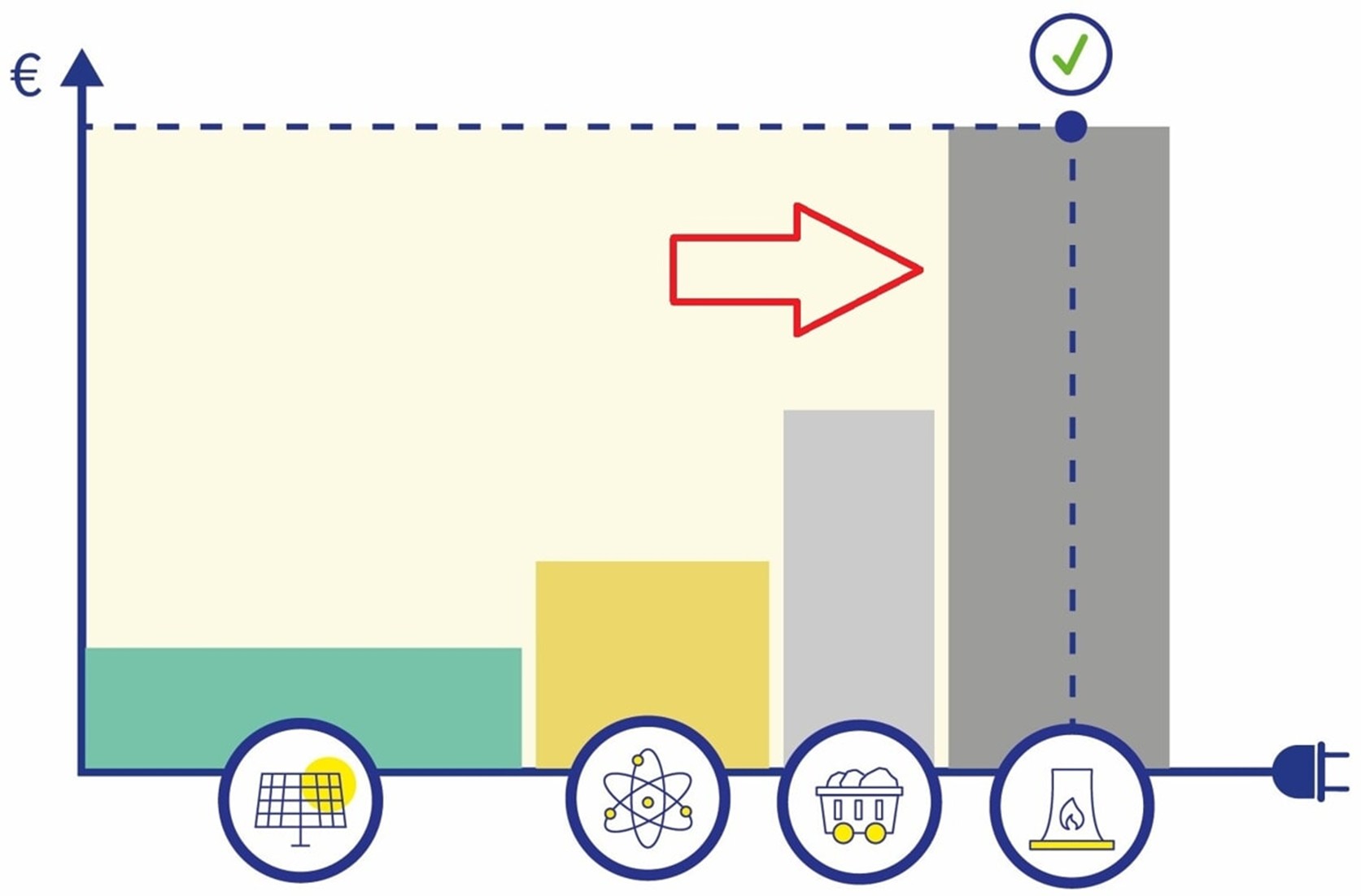
P.S.: Despite the increase in production in recent years, renewables are still unable to lower prices. The reason is the way the energy markets work: this happens because it is traded like a commodity and each power plant offers energy at the price it needs to cover its production costs. What is produced at a lower price is sold first and usually comes from renewables. But if production fails to meet demand – which renewables still cannot – other power plants such as coal, gas or nuclear come into play.
Thus, the final price will be that offered by the most expensive source: in Italy, it is still gas that generates almost half of what is needed. Renewables are only able to make the price, at most, 4% of the time. That is why the cost of electricity bills also depends on the cost of gas and not on renewables.
AI Overview
In Italy, many renewable energy plant projects are stalled due to delays in authorisation, with 1,376 large plant projects blocked by red tape. This problem is particularly evident for wind and photovoltaic projects, with waiting times of up to 43 months for the former and 22 months for the latter. Factors contributing to these delays include the complexity of regulations, coordination difficulties between authorities, and opposition from citizens and associations.
Here are some details:
- Number of blocked projects:
Approximately 1,376 large renewable energy plant projects are blocked in Italy.
- Causes of delays:
Delays in authorisations are due to several factors, including the complexity of the legislation, difficulties in coordination between public bodies and opposition from citizens and associations.
- Examples of delays:
The average time to obtain authorisation for a wind power plant is 43 months, while for a photovoltaic plant it is 22 months.
- Impact on projects:
Only 8 per cent of the wind and 16 per cent of the photovoltaic projects submitted obtain authorisation.
- Regions involved:
Regions such as Campania and Calabria have taken steps to unblock projects, such as the Campania Region amending Regional Law No. 37 of 2018.
- Impact on the market:
Delayed authorisations block the photovoltaic and renewable energy market.
- Appeals to the government:
Appeals have been made to the government to respect the Parliament’s enabling act and not block renewables.
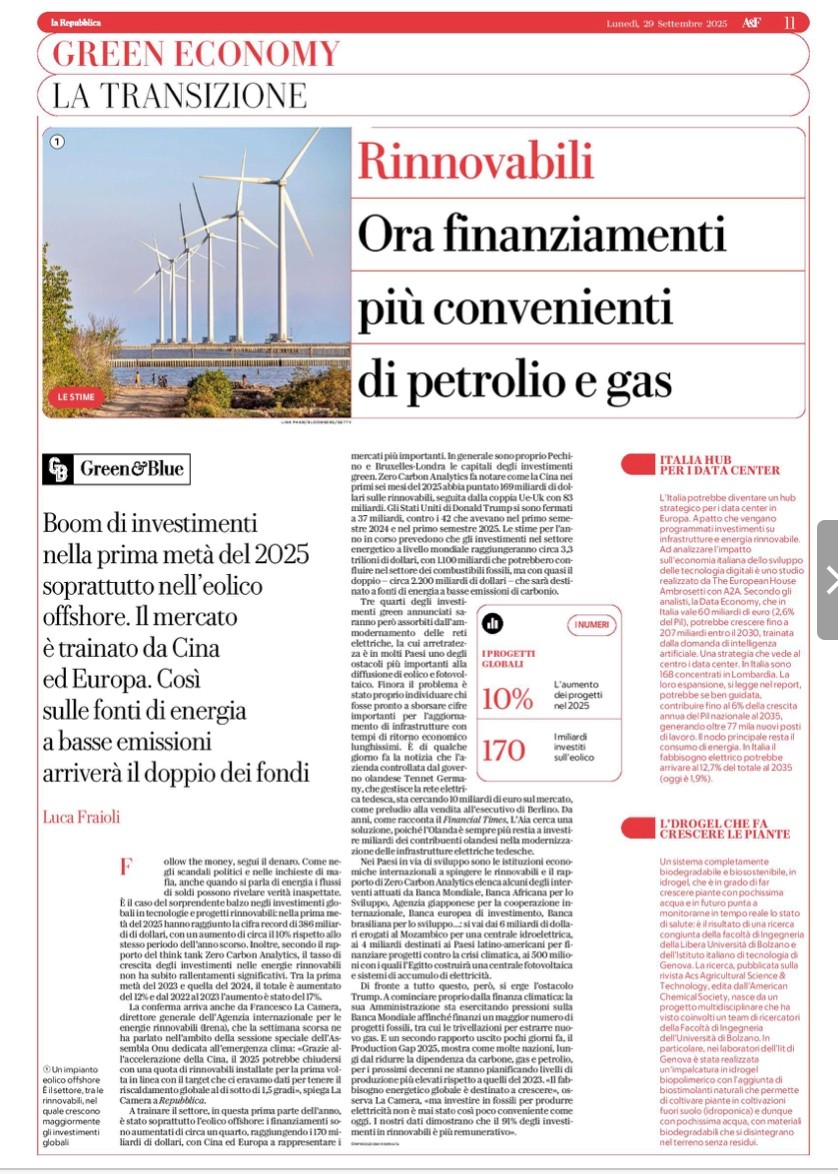
Also interesting is the ‘non-debate’ between Orsini and Meloni at the last Confindustria Assembly where ‘Confindustria asks for money but does not go so far as to say explicitly that it would like it to reduce the cost of energy, because it knows that this would be impractical‘. Below: Donald Trump, for now, has not yet succeeded in reversing the course of renewables, whose investments – worldwide – are booming (AF 29 September 2025). Read also Renewables in Italy, the price of “not doing”: €137 billion