

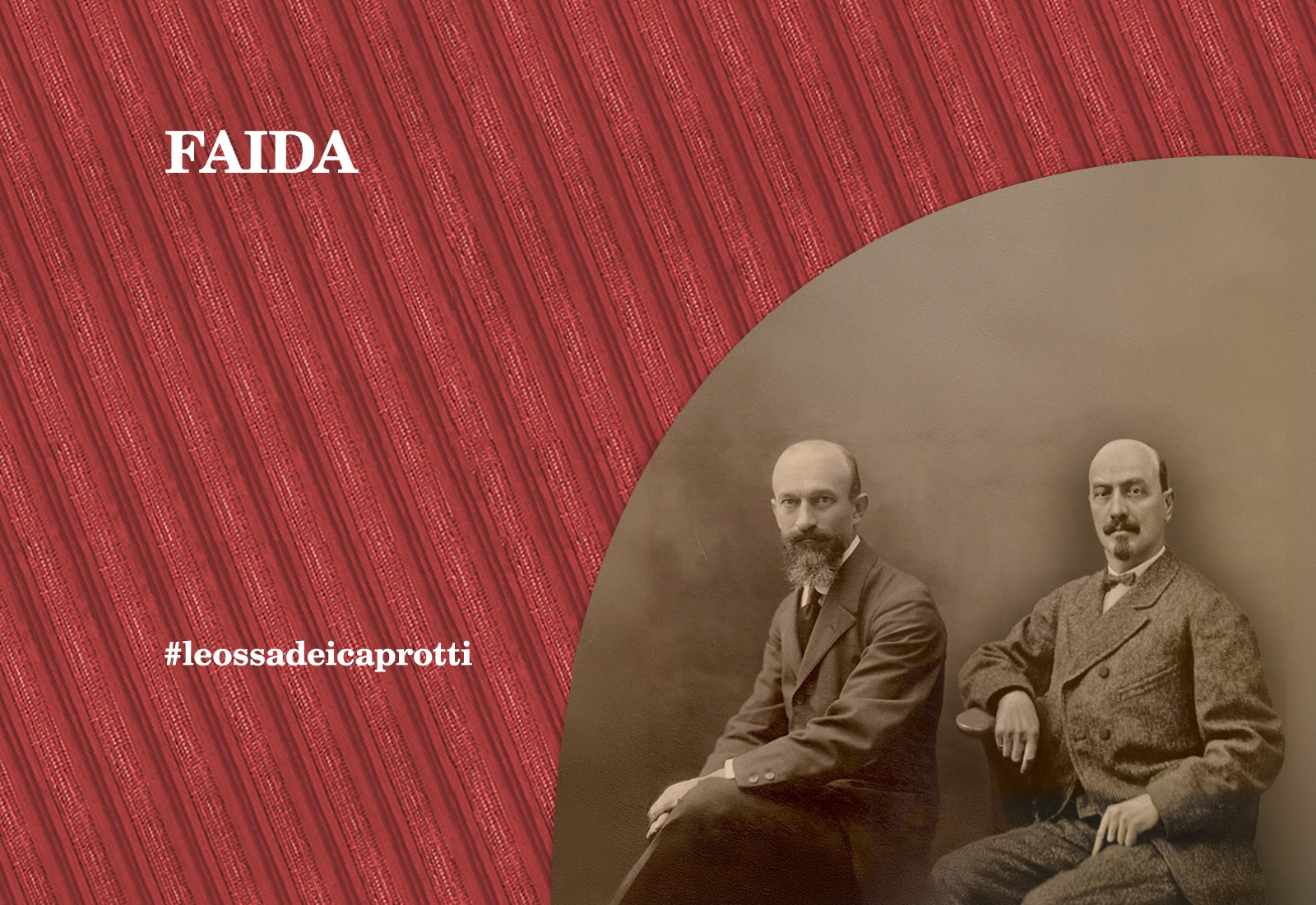
[vc_column_textOn 20 July 1903, Virginia Caprotti died in Ponte Albiate. The obituary, published in almost all the local and main newspapers of the time, summarises, amidst the swirls of language of the time, what her life was really like:
Fervid prayers [sic] /For the pious, generous, upright soul / of /Virginia Caprotti /Who, at twenty years of age, devoted herself to the world / To her Heavenly Spouse, / Lived in purity and love, / Zealous of the faith of divine worship / Of Christian and civil teaching, /Model of ancestral virtues, /To her beloved nieces and nephews, to the people, /Who always loved her and benefited so much, /Who bitterly mourn her passing away/A 64 years old.
Virginia is the second child of my ancestor Bernardo and Carolina Candiani, born after my future great-great-grandfather Giuseppe (1837) and before another series of siblings, Giulia (1841), Leopolda (Leopoldina, 1842), Carlo (1845), Luigia and Maria (Marietta). The children – and especially the girls – grew up in the incense-filled and prayerful environment of their pious mother, so much so that in 1859 Virginia, at the age of 20, solemnly pronounced her vow of virginity, Leopolda and Maria, one after the other, became nuns among the Fatebensorelle, and Giulia became a work teacher at the Institute for the Blind and Deaf-mute in Legnano; of Luigia she was the only one to marry, probably to the general astonishment.
Zelatrice, her obituary calls her. And indeed an indestructible, indefatigable, implacable zeal animated this convinced spinster by choice, inspector of the municipal schools for more than thirty years, who felt she was a daughter of the Lord and his instrument not in a convent but in the century, where there was so much need.
In fact, as was the custom at the time for women from good families, she was not only a member of whatever charitable organisation or foundation existed in the area, even the smallest, starting of course with the ‘Opera pia Candiani-Caprotti‘, which her mother had wanted for the care of the old and infirm, but she was also very attentive to the daily miseries around her: if an old man had nowhere to rest his aching bones, she would find him an armchair that he, being too poor, could never have obtained. A small example, perhaps, but multiplied by a hundred makes her a decidedly intrusive person – she asks, urges, visits until she gets her way, whether it be a rosary recited for the sanctity of the soul or a remedy for stomach ache -, but undoubtedly capable, resourceful and sincerely interested in her neighbour, even if perhaps, in her tower of purity and convinced of her educating mission, which did not allow for any yielding, a little lacking in empathy.
Below: in the Virginia family tree, of which we unfortunately have no photo, she is in the second box
Virginia is the glue of the family. She is constantly shuttling back and forth between the houses where the sisters who have not remained in Albiate have settled, if necessary acting as a “hub” for every passing carriage, parcel and supply, sorting relatives and ironed shirts with precision; she spurs and admonishes, as in the case of the Christmas greetings for 1898 sent to her grandchildren, small masterpieces of minimal feminine art enriched with recommendations of controlled affection; she presides over births and deaths, she also communicates them, with long and moderately affectionate letters that take us back to a time when the events of life were perennially overtaken by death. Thus, for example, on 10 September 1877 he wrote to his brother Giuseppe after the death on the 8th of Maria, a daughter of his only two months old, born with a congenital malformation:
“(…) Even for you, my dear Peppino, it must be painful for you to receive such an announcement, but perhaps it is easier for you to mitigate your grief at the loss of this little daughter of yours because now she counted little time of life, and therefore the affection and love for her was from the beginning; that if instead she succumbed after a few years of life, oh! then the pain must have been more vivid and more felt, because also the love and affection for her must have been greatly increased on your part for her. (…)”.
These seem harsh words, but at the time, with very few children making it past one year of age and then struggling to become adults anyway, one was slow to become attached, one waited: it would have been a useless waste of energy. Virginia then felt sorry for the little girl’s mother, her sister-in-law Giuseppina, who was always frail and anxious, so much so that, in agreement with the doctor, she sent her to her father’s house because she would only burst into tears every time she looked at the dead child. The organiser, the woman who knows what to do in every case, immediately took matters into her own hands: ‘Today I wrote [to Giuseppina] informing her of the funeral yesterday at 4 o’clock. This time, too, I took on the sad task of preparing the girls and the flowers and the wreaths (…)’. And he concludes with the usual spur, my brother, ‘I believe that you will have resigned yourself to your misfortune‘ (after barely two days since the death of a daughter!), after all, misfortunes are inevitable, one has to expect them so one is always ready ‘and does not feel the full weight‘. Fortunately, the small tombstone of the unfortunate Maria, walled up on a wall of the current Caprotti chapel in the Albiate cemetery, speaks of much greater affection and sorrow.
Quick, prompt and intolerant, Aunt Virginia, especially when it came to family quarrels and feuds. She did not allow them, and therefore did everything to settle them. Two of her nephews, my great-grandfather Bernardo and his brother Emilio, quarrelled all their lives, managing to be real bunglers in business – to say the least – who bankrupted three companies, including their own. But Virginia was used to hearing no reason and never allowed her two nephews, her favourite Bernardo and the tempestuous Emilio, to reach a final break-up. For example, she commanded them to come to her house for breakfast together with their wives, and even if the two tried to evade the invitation with every excuse imaginable, the aunt could let it go once, making fun of the excuses given (‘do you have a fever too?‘), twice not. An example is this note dated 17 June 1900, addressed to Bernardo:
‘Would you do me the favour, if you can, of coming to my place for breakfast on Tuesday at 11 o’clock? Emilio and Maria will also be here: I recommend that you don’t go goose. / Goodbye, your very affectionate aunt Virginia Caprotti sends you her best wishes.“.
The good work of keeping at bay two men who managed to tear each other apart at work, whether they were competitors or partners, had to be successfully continued by spouses and nephews, as the two, in their elder years, used to spend Christmas together and with their relatives.
As mentioned at the beginning, Virginia died on 20 July 1903, after having reunited the living and deceased family (she strongly wanted the remains of the two sisters who died young and ‘out of the house’, Leopolda and Giulia, to be moved from their original location to the Albiatese cemetery, where they were buried together under the tombstone that Virginia herself wanted for them, which has also been preserved).
In her holographic will of 23 May 1903, she left everything to her nephew Bernardo, apart from 100 lire for each of her great-grandchildren Lina, Silvia, Peppino, Giulia and Sandro and other minor bequests, as well as the life usufruct of her house and its contents to her lady Matilde Cesana, after her grandchildren had taken paintings, furniture or anything else that pleased them. Everything that remains must remain in the house and nothing must be sold, so that everything may be for the benefit of the Sisters who will come afterwards. The last survivor of you three brothers will nominate the Sisters of Charity to the possession of the said house and united land, which I intend to possess afterwards. Virginia too, more than twenty years later, found final rest in the family chapel, thus concluding her intense story.
Probably if we had had a mediator like Aunt Virginia in our relations (father-son) my story in and with Esselunga and my family would have ended differently.
Sources:
Albiate, Villa San Valerio, San Valerio Archives, Caprotti Family Archives.
Follow Le Ossa dei Caprotti
on Instagram
on Facebook
on YouTube
on LinkedIn
on X


