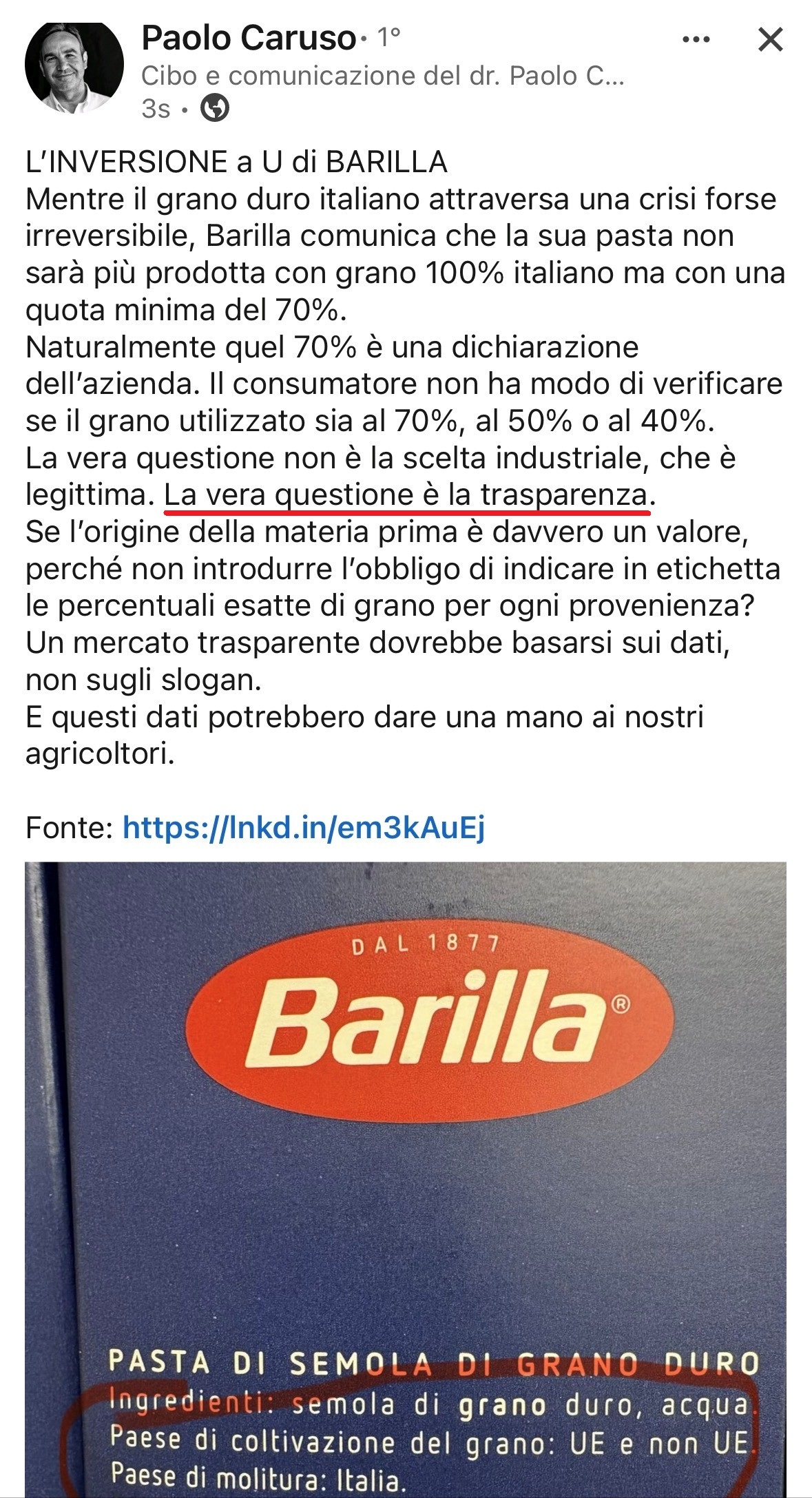
Barilla backtracks on its 100% Italian wheat for pasta.
This news gives us an opportunity to take stock of a sore point: food labelling in Italy.
In 2020, Barilla had committed to using 100% Italian wheat. Now, the market leader for the iconic ‘blue’ range is returning to a blend of ‘EU and non-EU’ wheat, with at least 70% sourced from Italy. A decision that will affect the pasta market. Voiello and Barilla al Bronzo are sticking with 100% Italian wheat.
This change will affect Italian farmers and create a problem of clarity in pasta labelling: why, for honey, for example, can you find out the country of origin – see honey, where it is now compulsory to indicate the country of origin and the percentage – yet this is not possible for pasta?
Below: the clear labelling on Swiss Coop’s chocolate, where you can see where the various ingredients come from and the proportion of some (e.g. 22% Turkish hazelnuts).

Below: the origin of the wheat used by Rummo, Carrefour Terre d’Italia and Pezzullo (on sale at Carrefour).
The latter does NOT provide any indication of origin, confirming that food labelling continues to resemble the ‘Wild West’, and the first to suffer the consequences are Italians, who lack clarity and transparency regarding what they are buying.
Below is a post by Paolo Caruso, whose views I share.
It is pointless, if not ridiculous, to ask – as a minister recently did – to ‘buy Italian food’ if the labelling of that food is completely misleading.
Otherwise, it becomes propaganda and, ultimately, a boomerang for those who preach it.